


UGC vs. Affiliate Marketing: What's the Difference and How They Work Together
Learn the difference between UGC and affiliate marketing, how they can work together, and how brands can combine them into one strategy.
Table of Contents
Brands looking to work with creators usually run into user-generated content (UGC) and affiliate marketing early on, and the two get lumped together more often than they should. Both lean on feeling more authentic than a traditional ad and being cheaper entry points than a large sponsored-post retainer, but there are a handful of differences between UGC and affiliate.
UGC and affiliate marketing pay creators differently, ask different things from them, and solve different problems for a brand. UGC is about acquiring content: A creator makes a video or takes a photo, hands over the usage rights, and the brand runs it wherever it performs best (on the brand's own channels, in paid ads, or on a product page).
Affiliate marketing is about acquiring sales: A creator promotes a product through their own following, using a trackable link or code, and gets paid a percentage of whatever it sells. Once you understand where each model fits, and where they overlap, it's easier to build a marketing strategy that isn't relying on a single type of creator partnership to do every job.
What Is UGC Marketing?
UGC marketing is the practice of paying creators to produce content for a brand to use, rather than paying them to post to their own audience. A UGC creator might not have a large following. They're often nano- or micro-creators, since their focus isn't reach, but producing native-feeling content: a product demo, an unboxing, a talking-to-camera review, or a day-in-the-life clip that features the product naturally.
Once the content is delivered, the brand owns the usage rights (per the agreed contract) and can run it as a paid ad, post it to its own social channels, or use it on a product or landing page. The creator's own follower count barely matters here since the content isn't necessarily going out to their audience at all.
This is why UGC is priced and evaluated differently than a typical sponsored post. Brands are paying for production quality and storytelling, and how well the content will perform once placed somewhere the brand controls, not for access to an audience the creator already has.
What Is Affiliate Marketing?
Affiliate marketing is a performance-based partnership in which a creator earns a commission for sales driven through a unique link or discount code. Unlike UGC, the creator's own audience is often the whole point: They post the content on their own channels, to their own followers, and get paid based on how many of those followers actually convert.
Commission structures vary. Some brands pay a flat percentage of each sale, others use tiered rates that increase with volume, and many pair a small flat fee with commission to make the deal worthwhile for a creator before any sales land. Affiliate programs can run directly with individual creators, through in-platform tools like Instagram's affiliate program, or through dedicated affiliate networks.
Because payment is tied to performance, affiliate marketing shifts more risk onto the creator and less onto the brand. A brand only pays when content actually drives a sale, which is part of why the model appeals to brands with tighter budgets or less certainty about which creators will convert.
Want to put this into practice?
SideShift connects you with vetted UGC creators who actually deliver. Start your free trial and post your first job in under 10 minutes.
Differences Between UGC and Affiliate Marketing
Once you look past the surface similarity of "brand works with creator," the two models diverge on almost every practical detail, from what's being paid for to who's taking on the risk.
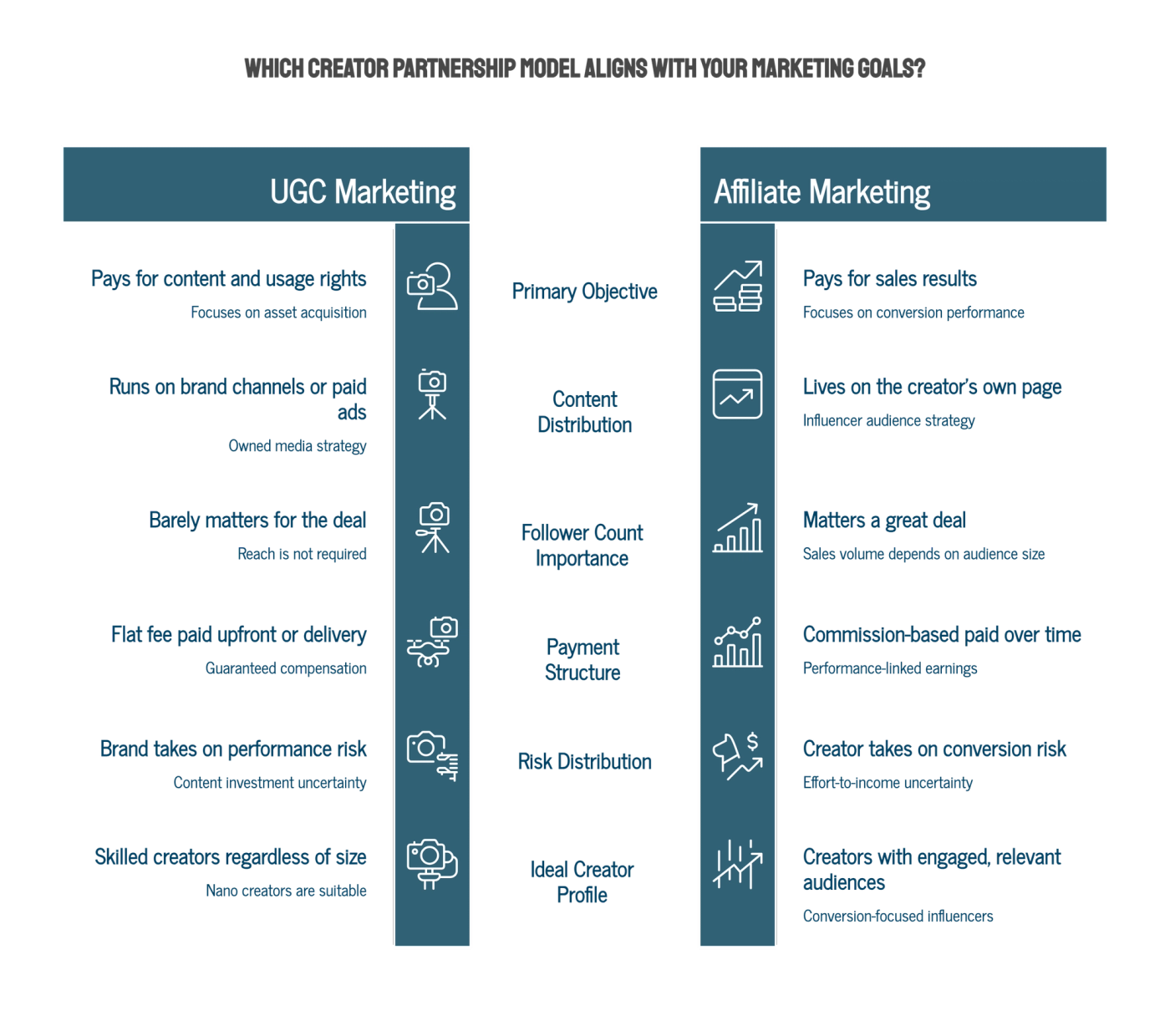
Here's how UGC and affiliate marketing differ:
- What's being paid for: UGC pays for content and the rights to use it. Affiliate marketing pays for results, specifically sales attributed to a creator's unique link or code.
- Where the content lives: UGC content typically runs on the brand's own channels or paid ads. Affiliate content usually lives on the creator's own page, where their existing audience sees it (though the two can blur, since some affiliate content also gets run as paid ads through whitelisting or partnership-ad arrangements)
- Follower count: Follower count barely matters for UGC, since reach isn't part of the deal. It matters a great deal for affiliate marketing, since sales volume is capped by how many people actually see the creator's post.
- Payment structure: UGC is typically a flat fee paid upfront or on delivery. Affiliate marketing is commission-based, sometimes with a small initial flat fee added, and paid out over time as sales come in.
- Risk distribution: With UGC, the brand takes on the risk that the content might not perform once placed. With affiliate marketing, the creator takes on more of the risk, since a post that doesn't convert earns little or nothing.
- Best-fit creator type: UGC favors skilled creators regardless of audience size, including nano creators with almost no following. Affiliate marketing favors creators with an engaged, relevant audience, since conversions depend on that audience actually buying.
None of these differences make one model better than the other. They just answer different questions: UGC answers "what content do we need," while affiliate marketing answers "who can actually sell this."
How UGC and Affiliate Marketing Work Together
The two models aren't competing for the same budget line. They're solving different problems, which is exactly why they pair well.
UGC Fuels Paid Ads, Affiliate Content Fuels Organic Reach
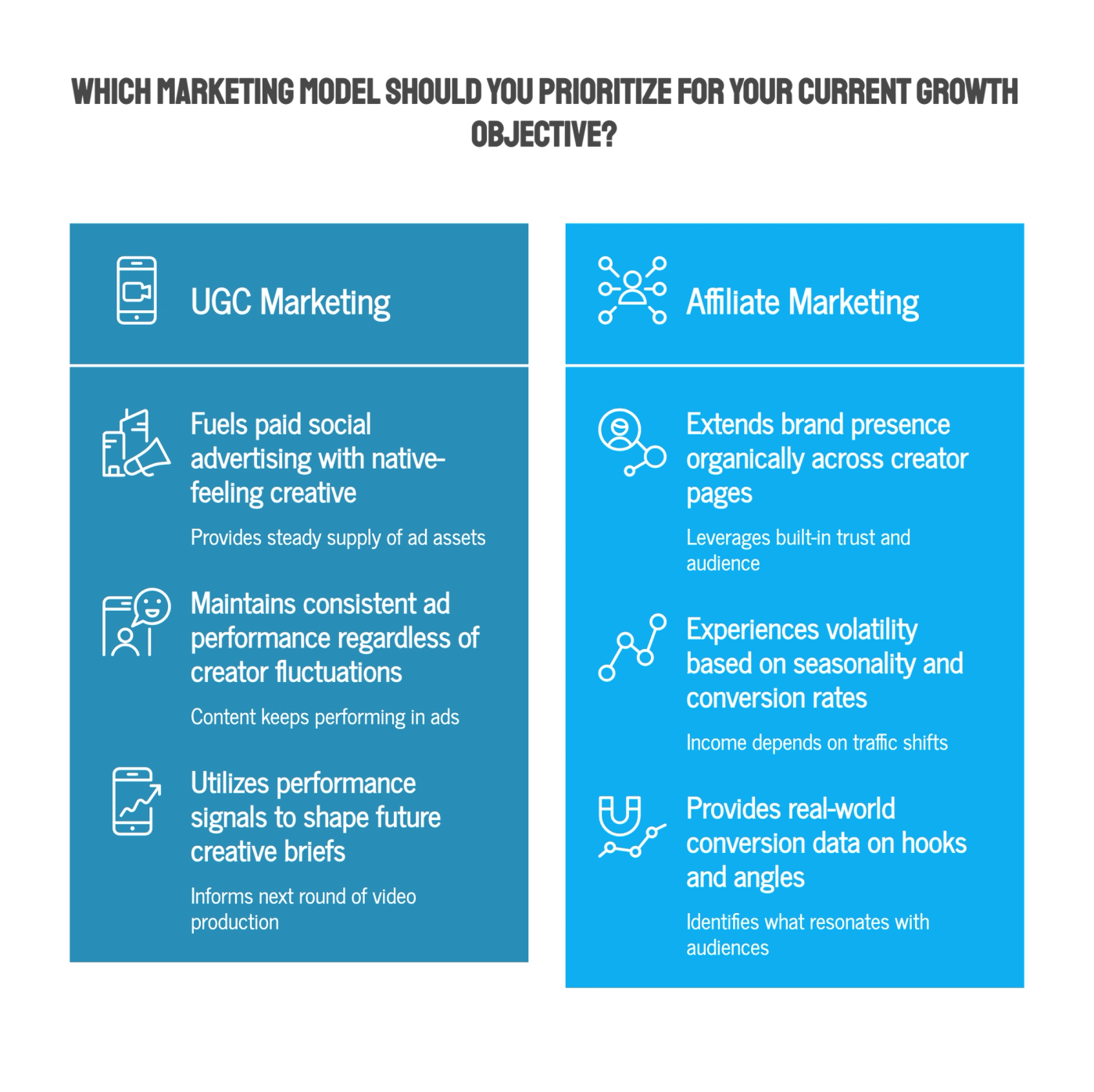
A brand running paid social needs a steady supply of native-feeling creative to test in ads, which is what UGC is built for. An affiliate program, meanwhile, extends the brand's presence organically across dozens of creators' own pages, each with built-in trust and audience. Running both means a brand isn't relying on one channel to carry the whole strategy.
Layering Both Reduces Dependence on Any Single Model
Affiliate programs can be volatile month to month, since commission-based income depends on traffic and conversion rates that shift with seasonality and competition. UGC content, once produced, keeps performing in ads regardless of any single creator's performance.
Affiliate Marketing Performance Data Can Guide UGC Briefs
Watching which affiliate creators, hooks, or product angles convert gives a brand real signal about what resonates, a signal that can directly shape the next round of UGC briefs. If a specific product benefit keeps showing up in an affiliate creator's best-performing post, that's a strong hint for what the next UGC video should lead with.
Want to put this into practice?
SideShift connects you with vetted UGC creators who actually deliver. Start your free trial and post your first job in under 10 minutes.
UGC Creators Can Become Affiliates (and Vice Versa)
A creator who delivers strong UGC content is often a good candidate for an affiliate arrangement once the relationship is established, especially if they turn out to have a relevant, engaged following of their own. The reverse works too: A high-performing affiliate creator can be commissioned separately for UGC, since the brand already knows their content converts. If the relationship evolves, they could even become brand ambassadors.
How Do You Combine UGC and Affiliate Marketing Into One Strategy?
The ideal way to combine UGC and affiliate marketing is sequencing them so one strengthens the other.
- Start with the goal, not the model. Decide what the campaign actually needs first: Fresh ad creative points toward UGC, while driving trackable sales through creator audiences points toward affiliate. Most brands need both eventually, but starting with the main goal first helps build a steady strategy.
- Build a layered creator roster. Sort your roster by what each creator is best suited for: production-focused creators for UGC, audience-focused creators for affiliate marketing, and a smaller group who can realistically do both. This makes briefing faster since you're not guessing which type of deal fits which creator.
- Track both programs with the same metrics where possible. Watch time, saves, and comment quality apply to UGC used in ads just as much as they apply to organic affiliate posts, so tracking both against comparable benchmarks makes it easier to spot which creators and angles are working across the whole program, not just within one model.
- Reinvest based on what's converting. Once a UGC piece is clearly outperforming in paid ads, or an affiliate creator is consistently driving sales, put more budget behind that specific creator or angle rather than spreading spend evenly across the roster. Both models respond well to concentrated investment once a winner is identified.
Find Creators for Your UGC and Affiliate Strategy with SideShift
Whether you're running a UGC campaign, an affiliate marketing campaign, or both at the same time, you'll need one thing: a reliable supply of creators to produce content.
SideShift connects you with a pool of 1M+ vetted creators across niches. You'll be able to test multiple formats, hooks, and angles and invest in what works best for your brand. You also don't have to worry about briefs, contracts, and payments management because it's all handled inside the platform.
FAQs
1. Is UGC or affiliate marketing better for a small budget?
UGC is usually the lower-commitment starting point; a flat, predictable cost that doesn't depend on the creator having a large following. Affiliates can be even cheaper upfront if fully commission-based, but the return is less predictable.
2. UGC creator vs affiliate marketing: can the same creator do both?
Want to put this into practice?
SideShift connects you with vetted UGC creators who actually deliver. Start your free trial and post your first job in under 10 minutes.
Yes, and it's common once a relationship is established. A creator might be paid a flat fee to produce UGC for a brand's ads while separately running an affiliate link on their own page, since the two deals pay for different things.
3. How is affiliate marketing tracked?
Affiliate sales are tracked through unique links, discount codes, or in-platform tagging tools like Instagram's affiliate program, all of which attribute a sale back to the creator who drove it. This allows commission payouts to be calculated automatically.
4. Should a brand run UGC and affiliate marketing at the same time?
Yes, in most cases. The two models serve different purposes, fueling paid ad creative versus driving organic, trackable sales, so running them together covers more ground than relying on either one alone.