
Influencer Marketing vs Brand Ambassadors: Which Model Scales Better?
Influencer marketing vs brand ambassador programs: compare scalability, ROI, and long-term growth to find the right model for your brand.
Table of Contents
Brands today have more options than ever for leveraging creators to drive growth. Two popular strategies are influencer marketing and long-term brand ambassador programs. The two offer distinct benefits, but they differ in scalability, ROI, and audience impact. Understanding these differences is key to deciding which model fits your growth goals. Influencer marketing often delivers fast awareness, viral reach, and content at scale, while brand ambassador programs cultivate sustained, trust-driven relationships that combine content creation, advocacy, and sometimes performance-based incentives like affiliate links.
What Is Influencer Marketing?
Influencer marketing focuses on creators with established social followings who promote products or services through content that aligns with their personal brand. Campaigns are usually short-term, tied to specific launches, product promotions, or seasonal initiatives. The primary goal is rapid awareness, engagement, or conversions. Influencer marketing is ideal for brands that want flexible campaigns, creative storytelling, and access to diverse audiences. It often prioritizes reach and engagement over long-term loyalty, making it highly effective for new product launches or time-sensitive promotions.
What Is a Brand Ambassador?
Brand ambassadors are creators or customers who enter into longer-term partnerships with a brand, often becoming an ongoing representative for the company. Unlike one-off influencer campaigns, ambassadors are committed to supporting the brand across multiple campaigns, social channels, or touchpoints. Many brand ambassador programs include affiliate perks, such as discount links or commission structures, but the relationship is broader than affiliate marketing alone - it combines advocacy, consistent messaging, and authentic storytelling. Ambassadors are trusted voices who can deliver sustained engagement, reinforce brand credibility, and provide a pipeline of content and promotion over time.
Cost Comparison: Influencers vs Brand Ambassadors
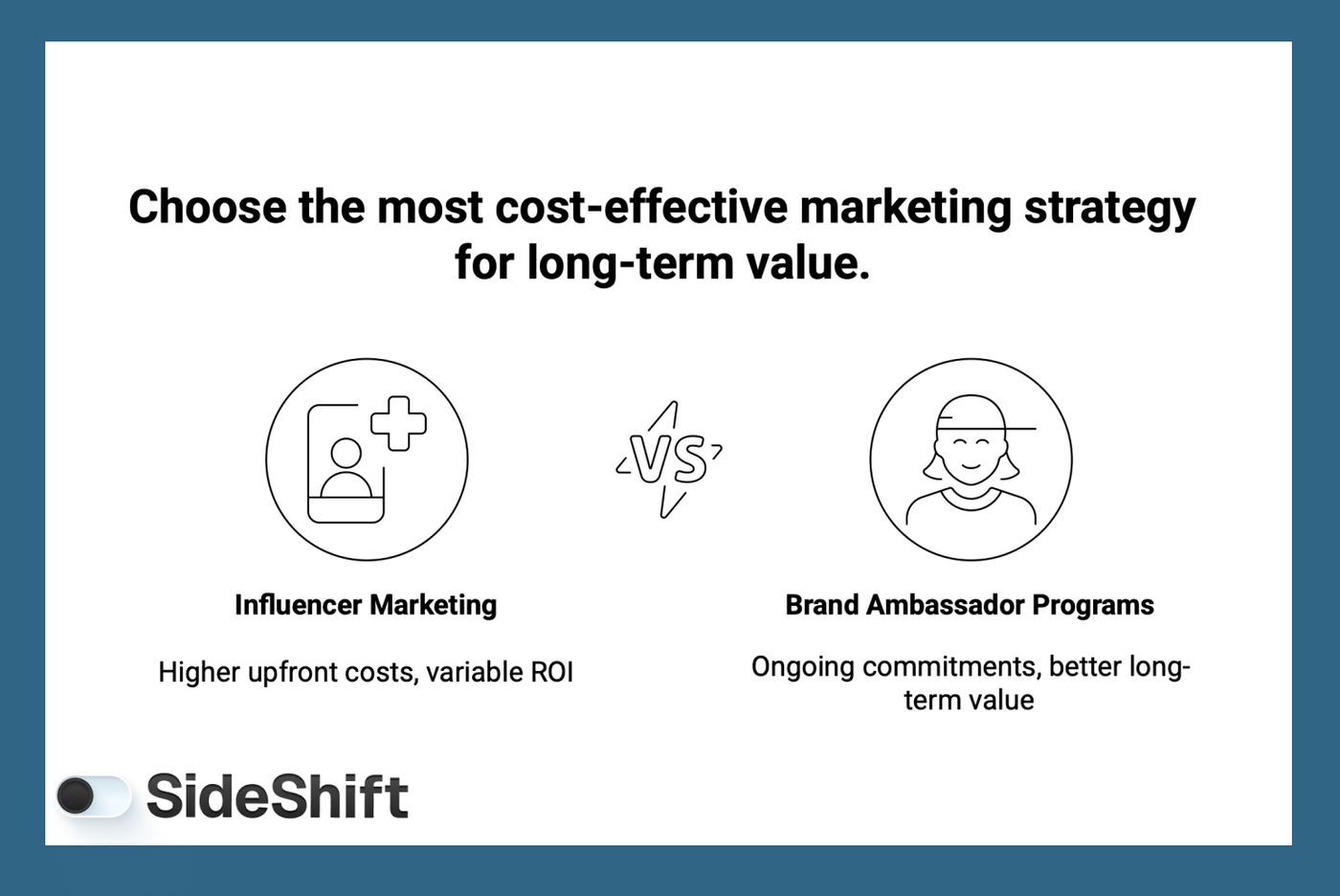
Influencer marketing typically involves higher upfront costs per campaign since brands pay for content creation, placement, and sometimes performance bonuses. Costs vary widely depending on creator tier, campaign length, and deliverables. Brand ambassador programs, in contrast, involve ongoing commitments sometimes structured as monthly retainers or hybrid pay models that include affiliate commissions. While the initial investment may seem higher, ambassador programs often generate better long-term value because the content is cumulative, consistent, and builds stronger audience trust. Unlike pure affiliate marketing, ambassadors combine the benefits of content creation, audience advocacy, and sales incentives, which creates a more holistic ROI.
Performance Comparison: Influencers vs Brand Ambassadors
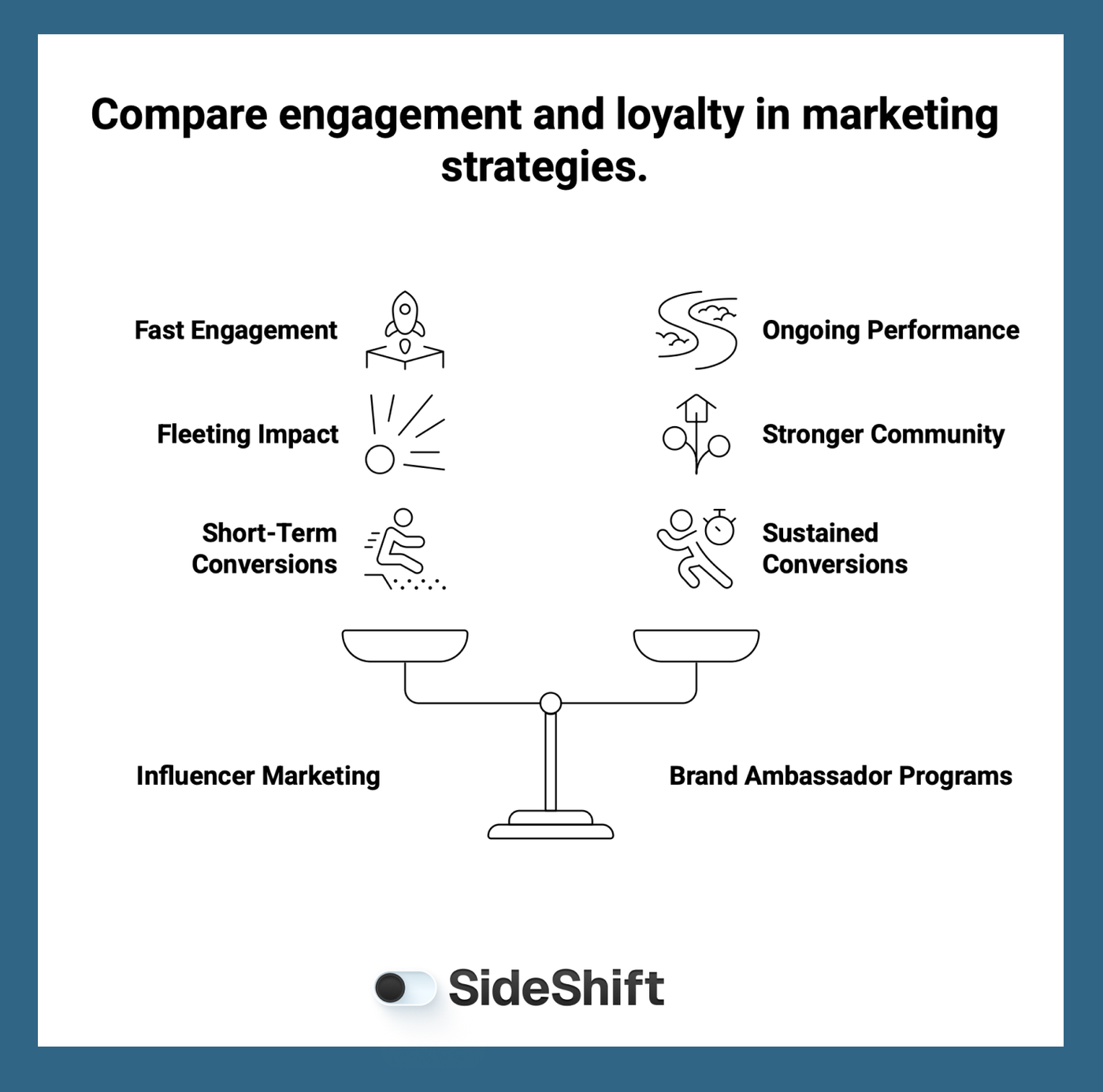
Influencers excel at generating fast engagement, social proof, and viral reach, but their impact may be fleeting if campaigns are not sustained. Metrics often focus on impressions, engagement rate, and short-term conversions. Brand ambassadors, on the other hand, deliver ongoing performance and brand loyalty. Since ambassadors are continuously creating content and advocating for the brand, they achieve higher cumulative engagement, stronger community-building, and sustained conversions. The integration of affiliate-style incentives ensures ambassadors are still accountable for performance, but the relationship is anchored in authenticity and long-term commitment rather than transactional promotion.
Scalability Comparison: Influencers vs Brand Ambassadors
Scaling influencer campaigns is relatively straightforward, brands can hire dozens or hundreds of creators for short-term content pushes. Platforms like SideShift make it possible to execute high-volume campaigns efficiently, producing diverse content at scale. However, brand ambassador programs scale differently. While the individual program may involve fewer creators than a large influencer push, each ambassador contributes continuously over time, multiplying the effect of their content and deepening audience trust. High-volume UGC from ambassador networks can complement influencer campaigns, blending short-term reach with sustained advocacy. Some brands even maintain ambassador applications on their websites, allowing long-term enthusiasts to join and support the brand, further expanding reach while nurturing authentic, ongoing connections.
Want to put this into practice?
SideShift connects you with vetted UGC creators who actually deliver. Start your free trial and post your first job in under 10 minutes.
When to Use Influencer Marketing vs Brand Ambassador Programs
Influencer campaigns in this context would be best for launching new products, driving seasonal promotions, or generating viral content quickly. Brand ambassador programs are ideal when the goal is to nurture long-term relationships, build community trust within a specific niche, or create a consistent pipeline of authentic content that converts over time. Many successful brands run both in tandem: influencers provide spikes in awareness, while ambassadors maintain steady engagement, advocacy, and conversion.
Compare and Contrast Influencer Marketing and Brand Ambassador Programs
While both strategies leverage creators, the difference lies in relationship duration and scope of responsibility. Influencer marketing is short-term and campaign-focused, primarily targeting reach and engagement. Brand ambassadors engage in long-term relationships, combining content creation, advocacy, and performance-based rewards like affiliate commissions. Unlike affiliate marketing, which is transactional and purely performance-driven, brand ambassadors build trust and brand loyalty while still delivering measurable results in addition to qualitative data. The best campaigns often blend the two: fast-moving influencer pushes complemented by ambassadors who provide ongoing advocacy and conversions.
How to Measure and Optimize ROI for Influencer and Ambassador Campaigns
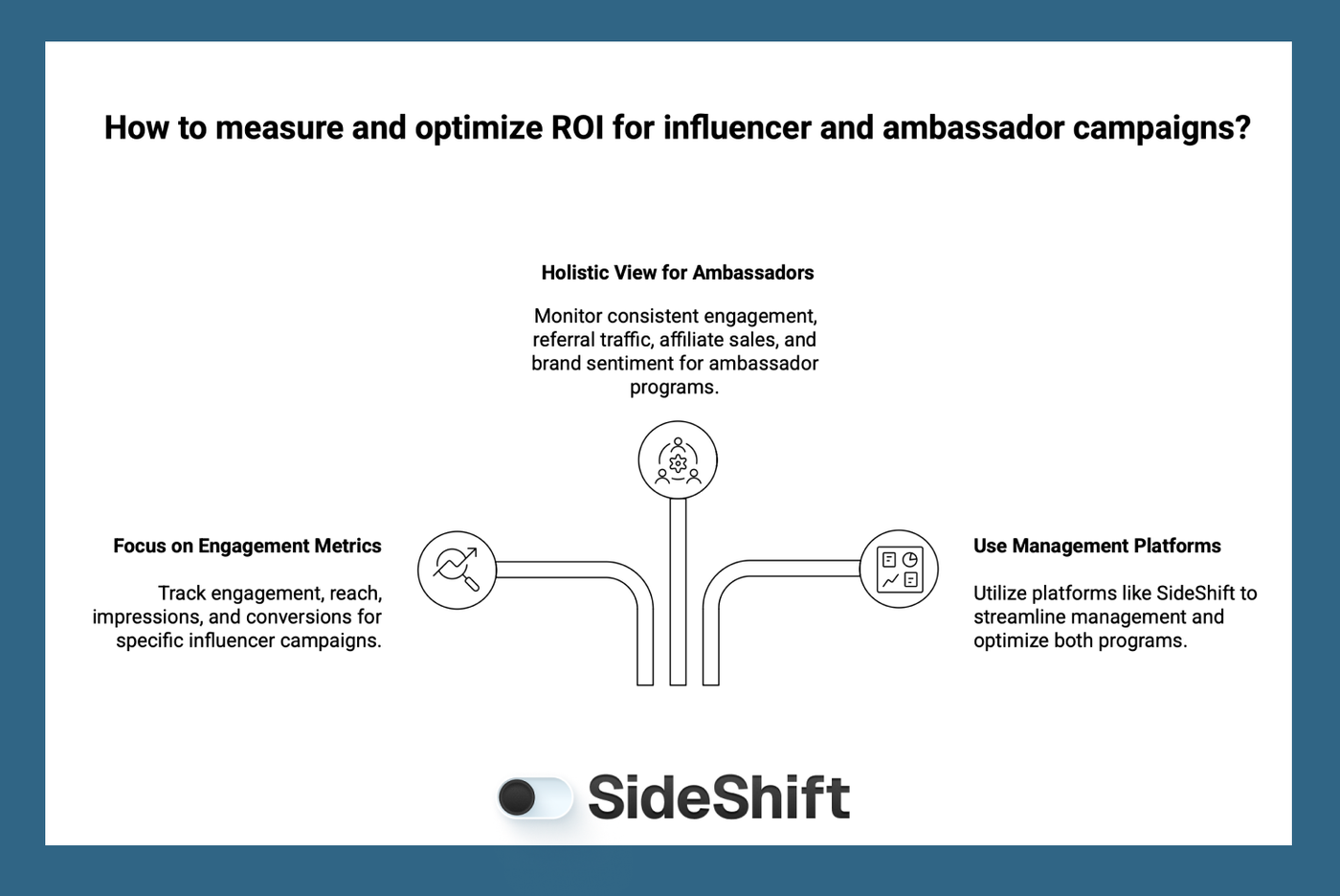
For influencer campaigns, focus on engagement metrics, reach, impressions, and conversions tied to specific campaigns. Ambassador programs require a more holistic view: track consistent engagement, referral traffic, affiliate sales, user-generated content volume, and long-term brand sentiment. Platforms like SideShift simplify management by combining creator recruitment, contracts, payouts, and analytics in one dashboard. This allows brands to optimize both influencer and ambassador programs simultaneously, ensuring measurable performance while scaling creative output efficiently.
Key Takeaways
Influencer marketing and brand ambassador programs each serve distinct purposes. Influencers offer flexible, short-term campaigns with fast reach and engagement, while brand ambassadors create sustained, trust-driven relationships that combine content creation, advocacy, and often affiliate-style performance incentives. Brands that strategically combine both approaches can maximize reach, ROI, and audience loyalty. SideShift enables this integration at scale, allowing brands to manage high-volume influencer campaigns alongside ambassador programs, track performance, and continuously optimize content for both conversions and long-term growth.
Scale your campaigns effortlessly with SideShift. Manage influencers and brand ambassadors in one place, track performance, and grow your brand faster. Start today and see measurable results while building a content army that converts.
FAQs
1.How do influencer campaigns differ from brand ambassador programs?
Influencer campaigns are short-term and campaign-focused, aiming for rapid awareness and engagement. Brand ambassador programs are long-term, combining consistent advocacy, content creation, and sometimes affiliate perks to drive ongoing engagement and sales.
Want to put this into practice?
SideShift connects you with vetted UGC creators who actually deliver. Start your free trial and post your first job in under 10 minutes.
2. Which model provides better long-term ROI?
Brand ambassador programs typically offer stronger long-term ROI due to cumulative content, consistent advocacy, and stronger audience trust. Influencers excel at quick engagement spikes but may have limited longevity without repeated campaigns.
3. Can a brand run influencer and ambassador programs simultaneously?
Yes. Combining influencers for fast reach and ambassadors for sustained advocacy allows brands to maximize both short-term engagement and long-term conversion.
4. How do you measure success in ambassador programs vs influencer campaigns?
Influencer success is measured by engagement, reach, impressions, and campaign-specific conversions. Ambassador programs track cumulative engagement, referral traffic, affiliate-linked sales, and long-term audience loyalty.
5. What are best practices for scaling each model effectively?
Use platforms like SideShift to manage creator recruitment, contracts, and analytics. Scale influencer campaigns for reach and virality, while building ambassador networks for ongoing advocacy and content production. Hybrid strategies maximize both efficiency and ROI.