
What Is a Nano Influencer? Guide for Brands & Creators
Nano influencers have small followings but outsized engagement. Here's what brands and creators should know about how they work.
Table of Contents
The word “influencer” still conjures images of large followings, brand trips, and six-figure partnership deals for most people. But some of the most effective creator partnerships happening right now involve nano-influencer accounts with fewer than 10,000 followers—people who would never describe themselves as influencers but whose audiences listen to them with a level of trust that most macro creators can't match.
Nano influencers occupy a specific and genuinely valuable position in the creator economy, yet both brands and creators often underestimate what that position is actually worth.
Whether you're a brand figuring out where to put your budget or a creator trying to understand your own value, this guide breaks down what nano influencer marketing actually is, why engagement rates at this scale outperform larger accounts, what fair compensation looks like, and how partnerships work when they're done strategically. If you're a creator building your following in the travel space specifically, our guide on how to become a travel influencer walks through that path in detail.
What Is a Nano Influencer?
A nano influencer is a social media creator with a following typically between 1,000 and 10,000 people. They're the smallest recognized tier in the influencer hierarchy, sitting below micro influencers (10,000-100,000), mid-tier creators (100,000-500,000), macro influencers (500,000-1,000,000), and mega or celebrity accounts (1,000,000+).
What defines a nano influencer isn't just the size of their audience. It's the nature of the relationship they have with it. At this follower range, creators often know a meaningful portion of their audience personally or have built a genuine community around a very specific interest or identity.
A nano influencer in the home baking niche, the vintage watch collecting space, or the sustainable fashion community isn't broadcasting to a passive audience. They're having a conversation with people who follow them because they care about the exact thing that the creator posts about.
That specificity and intimacy is what gives nano influencers their primary advantage, and it's the quality that makes them worth understanding rather than dismissing because of their size.
Nano Influencer Engagement Rates vs. Larger Tiers
The data on this is consistent across platforms and studies: on average, engagement rate decreases as follower count increases.
When an account has 500,000 followers, the vast majority are passive consumers who followed after a single viral moment or algorithmic recommendation. The creator can't maintain a personal connection with an audience that large, so the relationship becomes one-directional. Content gets consumed but not engaged with at the same rate.
At the nano level, the audience is smaller but far more intentional. Every follower made an active choice to keep up with that specific person. Comments are genuine conversations. Recommendations carry weight because they come from someone the audience views as a peer, not a celebrity. That peer-to-peer dynamic is exactly what brands are trying to manufacture with large influencer campaigns, and nano influencers have it organically.
Benefits of Working With Nano Influencers
For brands thinking strategically rather than chasing vanity metrics, nano influencer marketing offers a set of advantages that larger partnerships don't.
Want to put this into practice?
SideShift connects you with vetted UGC creators who actually deliver. Start your free trial and post your first job in under 10 minutes.
Here are a few benefits of nano influencers:
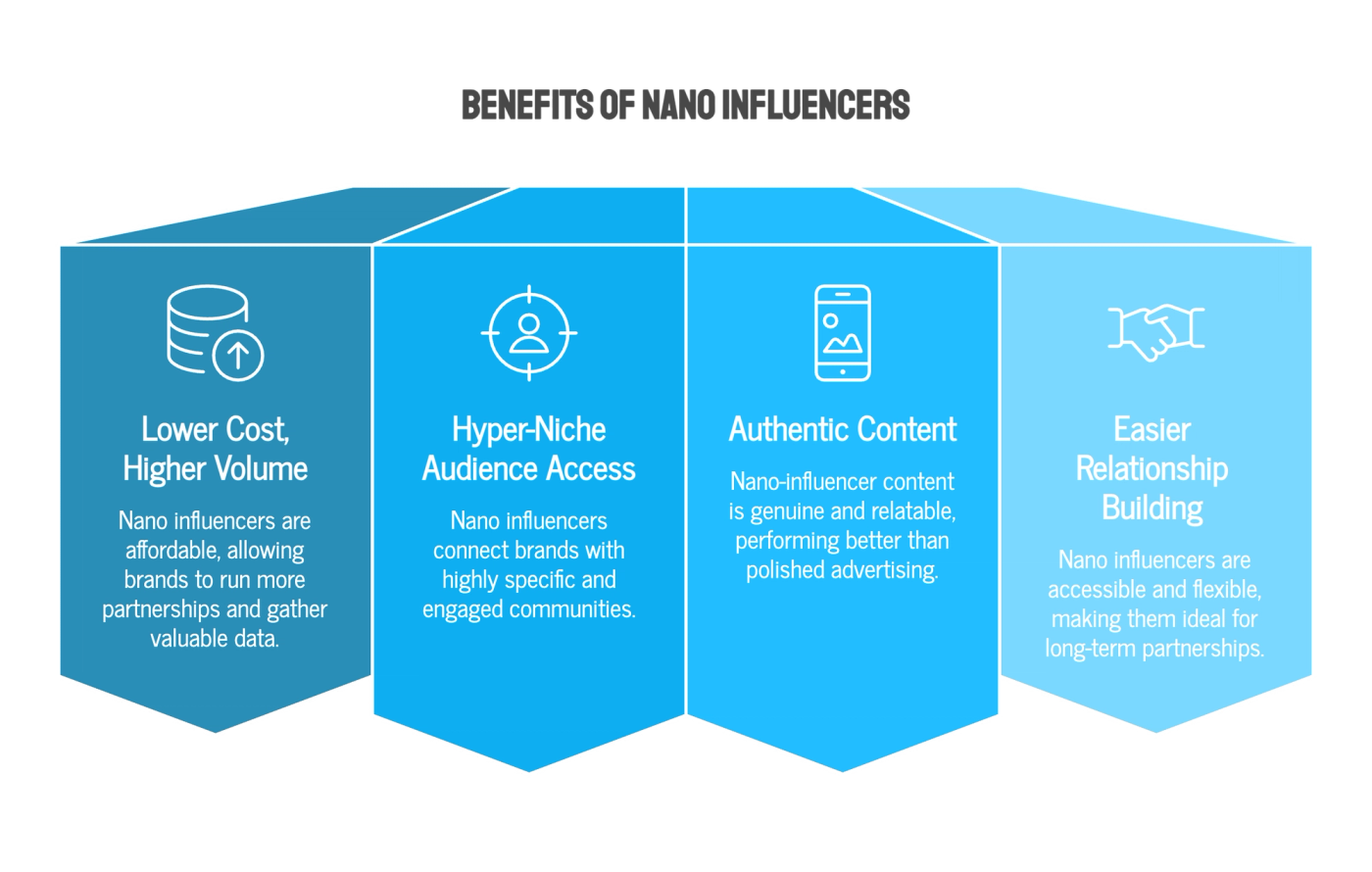
Lower Cost, Higher Volume
Nano influencers typically charge between $10 and $150 per post, with many early in their creator journey willing to work for free product plus a small fee. This pricing structure means a brand with a $5,000 monthly creator budget can run 30 to 50 nano influencer partnerships simultaneously instead of one mid-tier deal.
The content volume alone has value, but the strategic value is in the data: 30 pieces of content gives you enough performance variation to identify what's working and iterate meaningfully.
Hyper-Niche Audience Access
Nano influencers are often the deepest subject matter voices in very specific communities that larger creators don't bother serving. A macro fitness influencer covers general workout content because it reaches the widest audience. A nano influencer, on the other hand, might post exclusively about powerlifting programming for women over 40—a community that's small in absolute terms but extremely valuable to a brand selling products in that category. The niche specificity translates directly to purchase intent.
Authentic Content That Doesn't Look Like Advertising
Nano-influencer content tends to be less polished and more genuine than content from larger creators who have professionalized their production. For many brands, particularly in the direct-to-consumer space, that authenticity is an asset. Content that looks organic often performs better in feeds and as paid social creative than content that looks like it was produced by a marketing department.
UGC is the natural extension of this. Social-native content that looks like it came from a real customer (because it did) is what's succeeding in organic and paid social channels right now. Nano influencers sit right at the intersection of credible and experienced enough to post, but relatable enough to convert.
Easier Relationship Building
Working with nano influencers means working with people who are generally more accessible, more responsive to feedback, and more flexible on creative direction than established influencers with management teams and rigid rate cards. For brands that want ongoing creative partnerships rather than one-off transactions, nano influencers often make more collaborative long-term partners.
The Honest Limitations of Nano Influencers
A complete guide has to cover what nano influencers don't deliver as well as what they do, because overestimating their capabilities leads to misaligned campaigns.
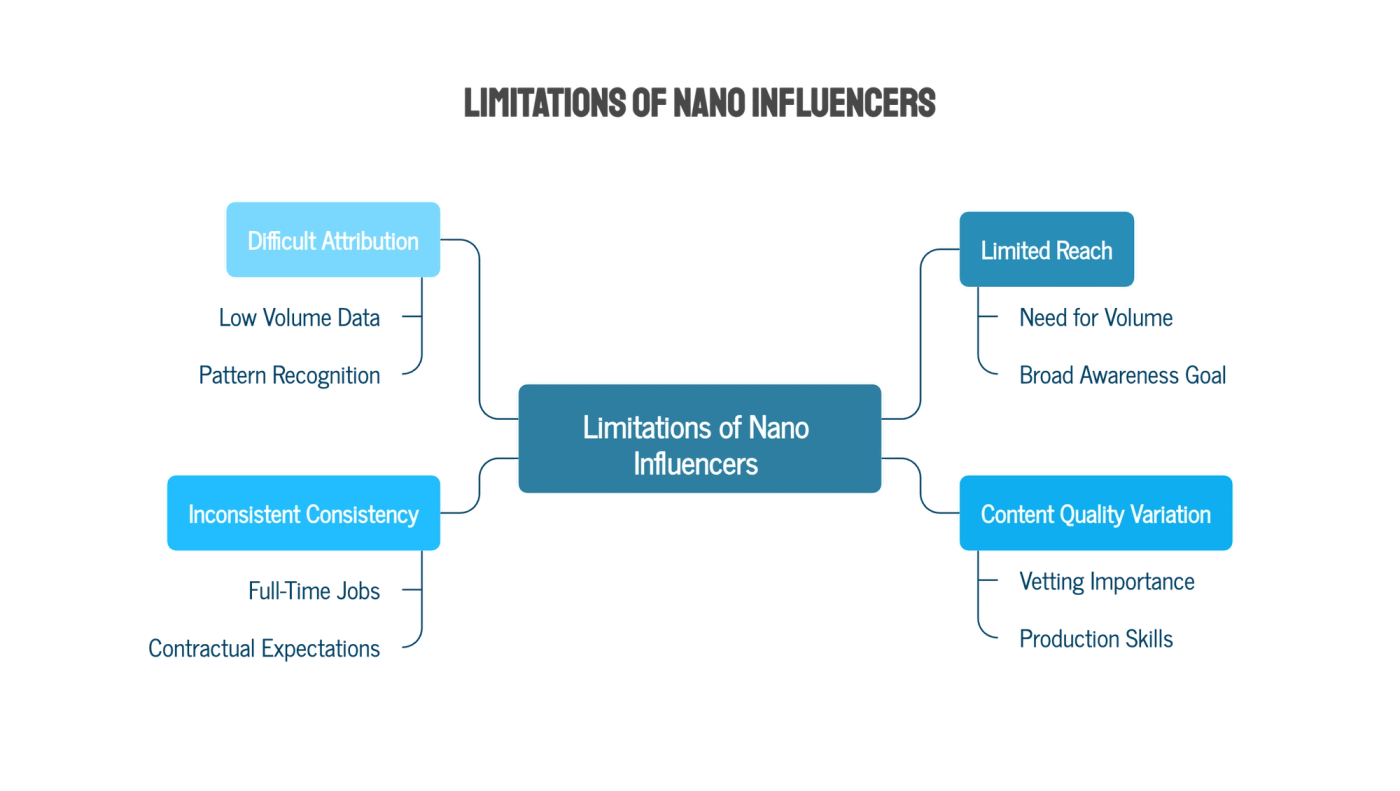
- Reach is limited by definition. A single nano-influencer post reaches a small audience. If your campaign goal is broad awareness at scale, a nano-influencer program requires significant volume, with many creators posting simultaneously to generate meaningful reach. One or two nano partnerships will not move aggregate brand awareness metrics.
- Content quality varies widely. The nano influencer tier includes both creators who produce genuinely excellent content and those who are still early in their development with production skills to match. Vetting is more important at this tier than at higher levels, where there's an established track record to evaluate.
- Consistency isn't guaranteed. Nano influencers are often managing their content creation alongside full-time jobs, school, or other commitments. Without clear contractual expectations, posting frequency and content quality can be inconsistent. Professional program management matters more here than at higher tiers where creators are running their platforms as a primary income source.
Want to put this into practice?
SideShift connects you with vetted UGC creators who actually deliver. Start your free trial and post your first job in under 10 minutes.
- Attribution is harder at low volume. A single nano influencer driving 200 clicks makes it difficult to draw meaningful conclusions about content performance. The nano influencer model only generates useful data when you're running enough creators simultaneously to see patterns across the program.
How to Build a Nano-Influencer Program That Actually Works
The brands seeing strong results from nano influencer marketing programs share a consistent set of practices. Here's what separates the ones that compound from those that fizzle.
Lead With Content Brief Quality
Nano influencers need more structured creative direction than experienced creators because they're often newer to brand partnerships. A strong brief includes the key product benefit to highlight, the tone and format that fits the brand, any compliance requirements, and specific calls to action. The brief doesn't restrict creativity but gives the creator a clear framework to work within.
Run Volume From the Start
Commit to at least 15 to 20 nano influencers for an initial program rather than testing with two or three. The data from a small cohort is statistically meaningless. Volume is what gives you enough signal to identify which creator profiles, content formats, and messaging angles are actually driving engagement and conversion.
Use Hybrid Compensation Structures
For ongoing nano-influencer relationships, SideShift recommends combining a base retainer with performance bonuses. A monthly retainer in the $100 to $300 range for consistent nano creators, plus view-based or conversion-based bonuses, attracts creators who are serious about their output while keeping base costs manageable. This structure filters out low-commitment creators faster than product-only compensation.
Track Creator-Level Performance
Every nano influencer in your program should have a unique tracking link or promo code. Aggregate engagement metrics across the program are useful, but individual creator performance data is what lets you identify which creators to renew, which to increase output from, and which to replace. Without creator-level attribution, you're flying blind on optimization.
Treat Top Performers as Long-Term Assets
The nano influencers who consistently deliver strong engagement and quality content are worth investing in as they grow. A creator with 5,000 followers today who produces reliably excellent content could have 30,000 followers in a year, and a brand that has built a genuine relationship with that creator gets continuity and loyalty that no cold outreach can replicate.
What Nano Influencers Need to Know About Brand Partnerships
For creators at or approaching the nano tier, brand partnerships are one of the most accessible forms of monetization available, but the landscape is uneven enough that going in without context is a mistake.
Here's what's worth knowing before you start pitching or applying.
What Nano Influencers Actually Earn
Compensation at this tier ranges more than most guides admit. A single sponsored post typically falls between $25 and $200, with product gifting common at the lower end, especially for newer creators or highly saturated niches. Instagram and TikTok tend to command higher rates than YouTube Shorts or Pinterest at equivalent follower counts, largely because of engagement expectations and production effort.
Want to put this into practice?
SideShift connects you with vetted UGC creators who actually deliver. Start your free trial and post your first job in under 10 minutes.
The structure of the deal matters as much as the headline number. One-off posts are the most common entry point, but ongoing retainer arrangements (where a brand pays monthly for a set number of posts or pieces of content) offer more financial stability and are worth prioritizing as relationships develop.
UGC licensing deals, where a brand pays to use your content in their own paid ads independent of your posting, are also increasingly common and can meaningfully add to what a single campaign is worth.
What Brands Are Actually Looking For
Follower count is the least interesting thing most brands are evaluating at this tier. What matters more is:
- Niche clarity: A creator with 3,000 followers and a tightly defined audience in home organization, trail running, or plant-based cooking is often more useful to the right brand than a lifestyle creator with 9,000 followers and no clear throughline. The more specifically you can describe your audience, the easier you are to say yes to.
- Engagement quality: Brands running serious programs look beyond the engagement rate number and focus on what the engagement actually says. Comments that indicate purchase intent, personal identification with the content, or genuine community (“I bought this because of your last post”) carry more weight than emoji replies. Curate your best examples.
- Content that already looks like brand content: Brands want to see that you can integrate a product or message without it feeling like an interruption. If your existing content has clear composition, consistent voice, and a point of view, that's the pitch. You don't need a media kit that leads with your follower count, you need a portfolio that leads with your work.
- Reliability signals: At the nano tier, brands are often taking a chance on creators they have limited data on. Anything that signals professionalism, such as response time, clarity of communication, or having a rate sheet, reduces the perceived risk of working with you and increases the likelihood of a longer relationship.
How to Find Brand Deals and Apply Effectively
Cold outreach with a small following and no existing relationship is a low-yield approach, though it can work when targeted. A more efficient path is applying through platforms where brands are actively posting campaigns and looking for creator talent at exactly this tier—where the barrier to entry is content quality and niche fit, not follower count.
When you do apply or pitch, lead with relevance rather than reach. Explain why your specific audience is a match for this specific brand, reference content you've made that demonstrates the fit, and be clear about what you're offering: post-only collaborations, post plus UGC rights, or multi-month arrangements. Vague pitches get vague responses.
A few things worth having ready before you start:
- A simple rate card covering your base post rate, UGC-only rate, and what usage licensing adds
Want to put this into practice?
SideShift connects you with vetted UGC creators who actually deliver. Start your free trial and post your first job in under 10 minutes.
- Three to five examples of your strongest brand-adjacent content in a creator portfolio
- A short audience description you can drop into any application (who they are, what they care about, why they follow you)
Connect with Nano Influencers and Brands on SideShift
For brands, building a nano-influencer program manually means sourcing creators one by one, negotiating terms individually, managing contracts through email, and handling payments through disconnected tools. At a small scale, this is manageable. As programs grow to dozens or even hundreds of creators, it quickly becomes an operational bottleneck that slows down execution and limits consistency.
For creators, finding brand partnerships at this tier often means cold outreach, inconsistent rates, and no clear infrastructure for contracts or payment, which makes it harder to treat it as a real business.
SideShift is built for both sides of the equation. Brands can post campaign briefs, receive applications from relevant creators, and manage contracts, payouts, and performance tracking in one place, with access to over 800,000 Gen Z UGC creators. At the same time, talent get a direct line to brand campaigns that are actually looking for people at their scale, with clear terms and reliable payments built in.
Whether you're running a creator program or building one as a creator, SideShift gives you the infrastructure to do it properly.
FAQs
1. What is the difference between a nano influencer and a micro influencer?
Nano influencers have between 1,000 and 10,000 followers. Micro influencers have between 10,000 and 100,000. The distinction matters beyond the number because nano influencers tend to have even higher engagement rates and tighter community connections than micro influencers, though their absolute reach per post is smaller. For brands prioritizing content authenticity and niche audience access over raw reach, nano influencers can outperform micro influencers on a cost-per-engagement basis.
2. Can nano influencers make money?
Yes, though income at this tier is modest compared to larger creator tiers. Nano influencers typically earn between $25 and $200 per sponsored post, with ongoing retainer arrangements offering more consistent income. The financial reality at this stage is that brand partnerships are more valuable as portfolio-building and skill-development opportunities than as primary income sources, though creators who build consistent brand relationships early often transition into meaningfully higher-earning partnerships as their following grows.
3. How many nano influencers does your brand need for a campaign?
Enough to generate statistically meaningful performance data, which means a minimum of 15 to 20 for an initial program. Running fewer than 10 makes it nearly impossible to distinguish creator-specific performance from random variation, and it limits your content volume too much to drive real reach. Brands that commit to volume from the start get actionable data faster and build stronger programs than those who test cautiously with two or three creators.
4. Are nano influencers good for small businesses?
Nano-influencer programs are particularly well-suited to small businesses because the cost structure is accessible and the niche specificity often aligns better with a focused product offering than broad macro influencer reach would. A small business selling handmade candles gets more value from ten nano influencers in the home decor and lifestyle space than from one mid-tier generalist. The key for small businesses is managing the volume and operational overhead, which is where platforms like SideShift make the model practical.
Want to put this into practice?
SideShift connects you with vetted UGC creators who actually deliver. Start your free trial and post your first job in under 10 minutes.
5. How do you find nano influencers for your brand?
Hashtag research in your product niche, searching tagged posts from existing customers, and community mining on platforms like TikTok and Instagram are the main organic discovery methods. For brands that need volume and operational efficiency, creator marketplaces like SideShift allow you to post opportunities and receive applications from qualified creators rather than spending time on individual outreach. The marketplace approach is significantly more scalable than manual discovery, especially when you need 15 or more creators for a properly structured program.