


Affiliate Marketing vs Influencer Marketing: Key Differences, Costs, and ROI
Compare affiliate marketing vs influencer marketing: performance, costs, what success looks like in each strategy and which one is the best for your brand.
Table of Contents
Picking the wrong model between affiliate marketing and influencer marketing means budget spent chasing the wrong outcome.
A brand that pours into influencer awareness content when it actually needs bottom-funnel conversions can end up with plenty of impressions and no sales to show for it. Flip it around, and a brand that leans entirely on affiliates for a product nobody’s heard of yet may find there’s no warm audience for affiliates to convert in the first place.
Understanding how each model works, their costs, and potential return on investment (ROI) is critical for brands looking to invest strategically in creator partnerships.
What Is Affiliate Marketing?
Affiliate marketing is a performance-driven model where creators or marketers promote products and earn a commission on resulting sales. The model incentivizes measurable results: the more a creator drives conversions, the higher their earnings.
Affiliates can range from small-scale bloggers to large content networks. The partnerships often prioritize trackable metrics such as clicks, leads, and purchases. Brands mostly use UTM links and discount codes to run affiliate programs.
Say a skincare brand launches a referral program offering a 20% commission on sales. A beauty creator makes a “best serums for dry skin” post on her Instagram and includes her unique link to the brand’s product. Every reader who clicks through and buys generates a tracked commission for her, and the brand only pays out when a sale actually happens. No upfront fee, no guesswork, the arrangement is entirely tied to results.
What Is Influencer Marketing?
Influencer marketing centers on brand alignment and audience trust. Influencers, often social media creators with established followings, produce content that integrates products into their lifestyle in an authentic way.
Influencer marketing is most effective when campaigns are strategically aligned with audience demographics, psychographics, and interests. Brands can leverage multiple formats including giveaways, unboxings, challenges, and experiential campaigns, all designed to increase visibility and drive meaningful interactions.
Think about that same skincare brand. It’s launching a new product and wants to build buzz before it’s even available for purchase. It pays a mid-tier skincare creator a flat fee to film a “get ready with me” video featuring the product in her everyday routine. The video isn’t optimized for immediate clicks, it’s designed to get her audience talking, tagging friends, and associating the brand with a trusted face in the skincare space. The payoff shows up over weeks, not hours.
Differences Between Affiliate Marketing and Influencer Marketing
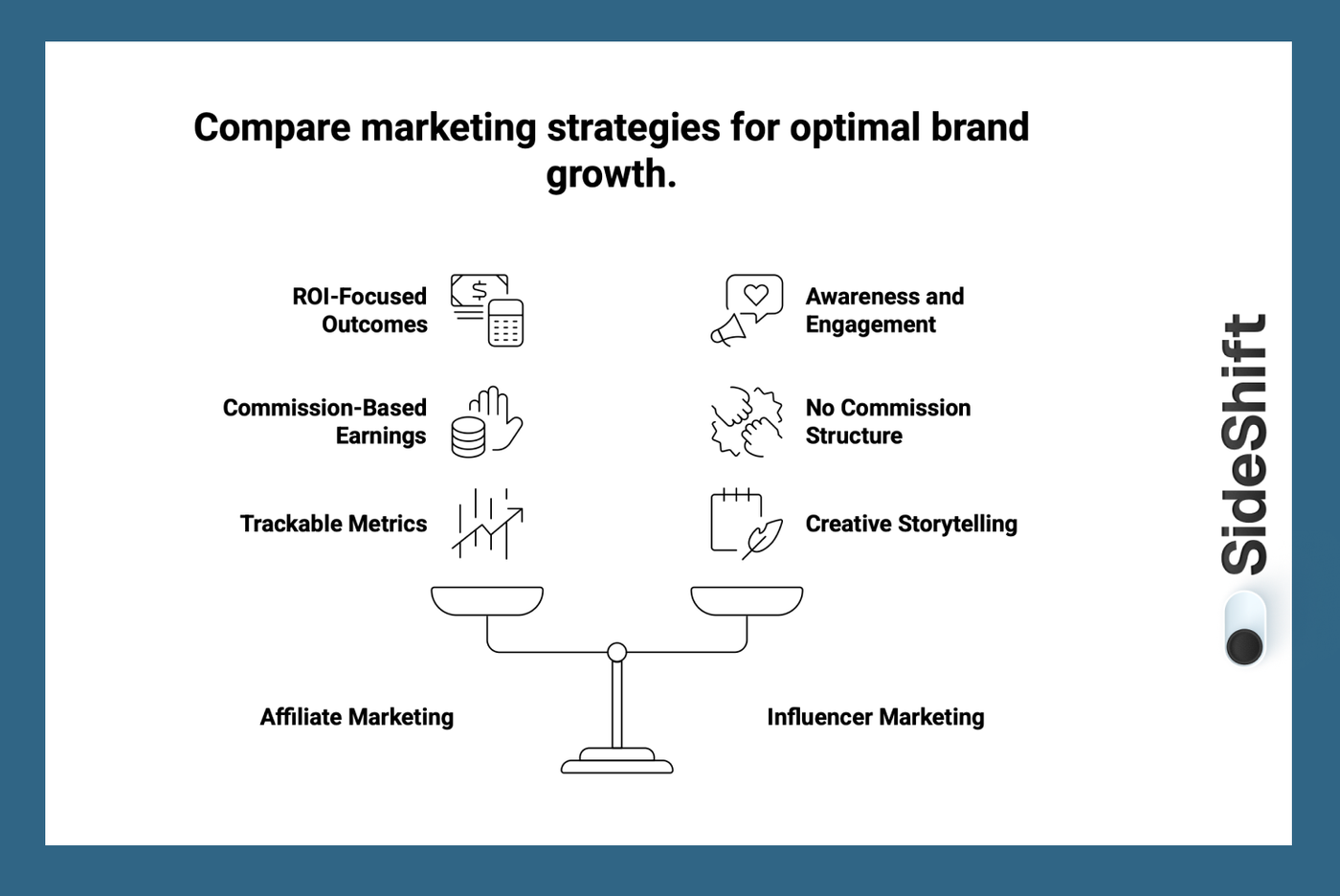
In essence, affiliate marketing is transactional and ROI-focused, while influencer marketing is relational and engagement-focused.
Affiliate Marketing
- Primary goal: Drive direct, trackable sales
- How it works: Relies on incentivized performance; payment is commission-based and tied to tracking links or codes
- Key advantage: Highly measurable ROI with minimal upfront financial risk
- Trade-off: Less brand storytelling, depends on an audience that’s already warm enough to convert
- Best for: Smaller brands with smaller budgets or those seeking predictable revenue streams
Influencer Marketing
- Primary goal: Scale brand visibility and build trust
- How it works: Relies on authenticity, creativity, and creator-audience trust; payment is an upfront fee (or paid after the work is delivered)
Want to put this into practice?
SideShift connects you with vetted UGC creators who actually deliver. Start your free trial and post your first job in under 10 minutes.
- Key advantage: Builds brand equity and engagement that outlasts a single post
- Trade-off: Harder to attribute directly to revenue, requires higher upfront spend before results materialize
- Best for: Brands who want to create awareness for their business, specific product, or initiative
Cost Comparison: Affiliate vs Influencer Marketing
The financial dynamics and incentive structures of these two approaches differ considerably.
Cost of Affiliate Marketing
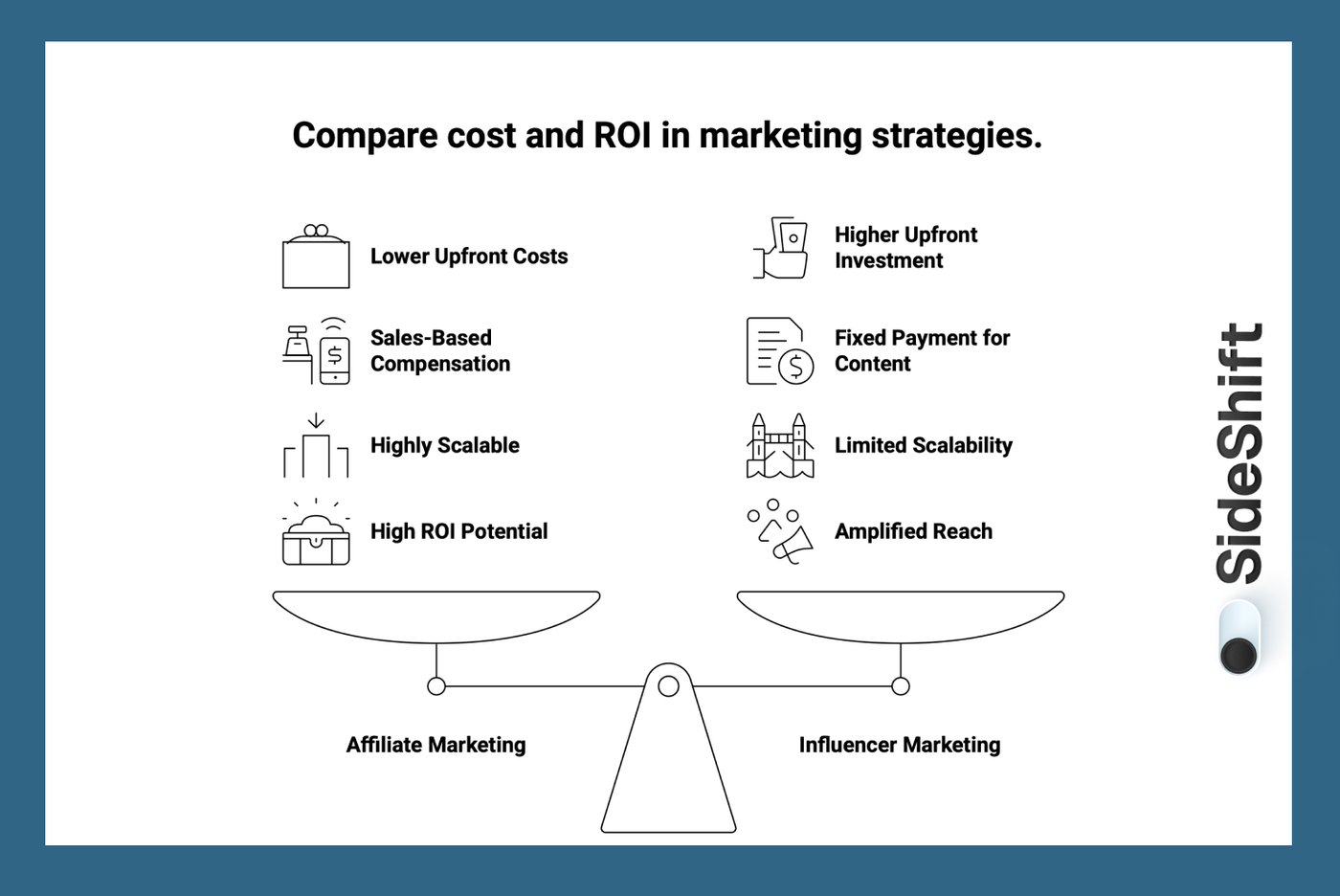
Affiliate marketing often has lower upfront costs since compensation is tied directly to sales performance. As for the commissions, brands typically offer commissions ranging from 5% to 50% of each qualifying sale, depending on the industry, margins, and affiliate program.
This makes it highly scalable, particularly for smaller brands or startups seeking a high ROI without a large marketing budget. According to Forbes, over 15% of affiliate marketers are bringing in over $50,000 annually in affiliate income.
Cost of Influencer Marketing
Influencer marketing usually involves higher upfront investment on the brand’s side to engage an influencer. Brands pay for content creation or partnered content for access to creators’ audiences.
UGC creators often charge anywhere from $50 to several hundred dollars per video, depending on experience, deliverables, and usage rights. Costs vary widely. The investment can pay off with amplified reach, viral potential, and brand trust that lasts beyond a single post.
Performance Comparison: Influencer vs Affiliate Marketing
While both affiliate and influencer marketing strategies drive results, their performance metrics differ.
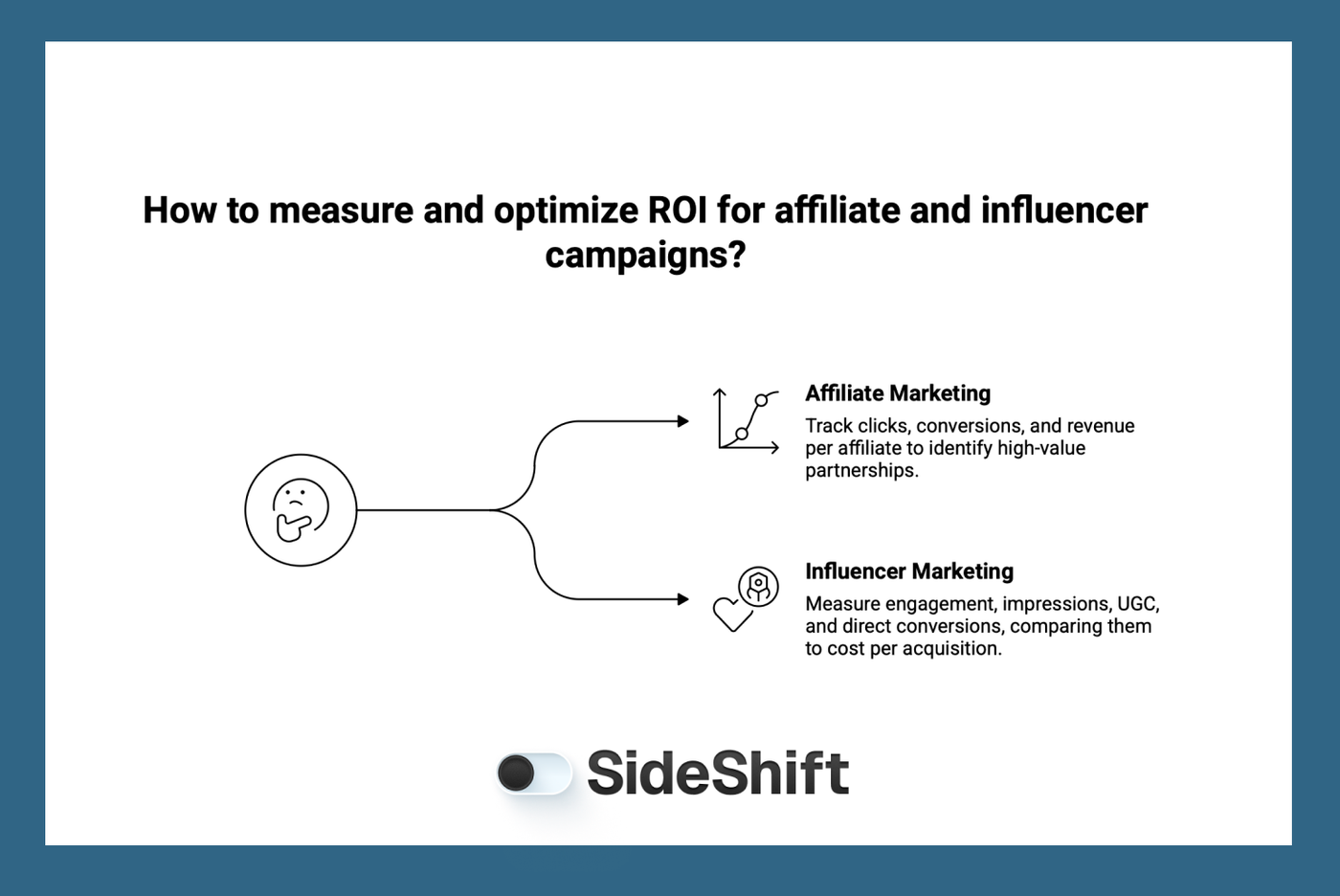
- Affiliate campaigns excel at direct, measurable conversions. Brands can track click-through rates, revenue per click, average order value, and overall ROI precisely, making it easier to optimize campaigns.
- Influencer marketing delivers a mix of quantitative and qualitative results. Beyond immediate sales, metrics include engagement rate, cost per acquisition (CPA), reach, sentiment, and user-generated content volume.
The most effective marketing strategies recognize that these approaches are complementary: one drives measurable conversions, the other builds trust, credibility, and long-term audience loyalty.
When to Use Influencer Marketing vs Affiliate Marketing
Affiliate marketers are a strong fit when brands want performance-driven campaigns with clear ROI tracking. They are especially effective for e-commerce, subscription models, or any product where conversions can be measured directly.
Influencers are better suited for brand awareness campaigns, product launches, or creative storytelling initiatives where engagement, social proof, and content resonance matter most. They can be effective for any business model, as long as there’s a real alignment between the brand and the influencer.
Many modern campaigns combine both approaches: influencers generate awareness and engagement, while affiliates capture the purchase-ready audience, creating a seamless conversion funnel.
Is Influencer Marketing Worth It for a Business with a Small Budget?
When you look at a mega influencer, it’s easy to assume influencer marketing is out of reach until the budget grows. But in practice, the opposite tends to be true. Small businesses get the best results by skipping macro and mega influencers entirely and working with micro or nano creators instead.
These smaller creators charge significantly less per post, sometimes a fraction of what a bigger name would, and they often have audiences that are more tightly knit and engaged around a specific interest or community.
Want to put this into practice?
SideShift connects you with vetted UGC creators who actually deliver. Start your free trial and post your first job in under 10 minutes.
For a small brand, a handful of well-matched nano influencers can generate more meaningful engagement per dollar than a single expensive placement with a creator whose audience is broad but disconnected from the brand’s niche.
How to Integrate Affiliate and Influencer Marketing Strategies
Strong marketing strategies often run affiliate marketing and influencer campaigns in parallel, using each to cover the other’s weak spot. Affiliates are precise but rarely spark discovery; influencers spark discovery but are harder to attribute directly to revenue.
Here’s how to combine them in practice:
1. Distribute resources by phases of the funnel. Use influencers at the top of the funnel to build awareness and trust with a new audience, then route that same audience to affiliates to close the sale. For example, a launch campaign might open with 5 to 10 mid-tier influencers introducing the product, followed by an affiliate cohort promoting a limited-time discount code to the audience that engaged but didn’t buy.
2. Turn influencers into affiliates. Brands often pay influencers a flat fee for content plus a commission on sales driven by their unique link or code. This hybrid structure rewards reach and conversion at once, and it’s often the single easiest way to combine both models without running two separate programs.
3. Build shared creative assets. With a usage rights contract, content produced by influencers (unboxings, demos, testimonials) can be repurposed as affiliate marketing collateral, such as banner ads, email creative, or landing page proof, so affiliates aren’t promoting with generic brand assets alone.
4. Set different KPIs for each role in the same campaign. Track influencers on engagement, reach, and assisted conversions and track affiliates on direct clicks, conversion rate, and revenue per partner. Reviewing both dashboards side by side each month shows where the funnel is actually breaking down.
Build Your Marketing Strategy with SideShift
Whether you’re a small business looking to boost your sales with affiliate marketing or a brand wanting to build awareness for a new product with influencer marketing, you’ll need the right creator to drive the results you’re seeking. Without the right face behind it, any campaign will crumble, regardless of the strategy you pick.
With a pool of 800,000+ pre-vetted creators, SideShift helps you find the ideal creator to represent your brand on social media. You can browse by social media platform or by industry, from wellness and gaming to travel and tech.
SideShift allows brands to manage affiliates, influencers, high-volume UGC, providing analytics, contracts, payments, and content performance tracking all in one platform. By centralizing these workflows, brands can scale both affiliate and influencer strategies while maintaining visibility and control over ROI.
Start your 7-day free trial on SideShift today.
FAQs
1. What’s the difference between affiliate marketing and influencer marketing?
Affiliate marketing is performance-based: creators earn commissions on sales they generate. Influencer marketing focuses on awareness, engagement, and storytelling, leveraging trusted voices to promote a brand.
Want to put this into practice?
SideShift connects you with vetted UGC creators who actually deliver. Start your free trial and post your first job in under 10 minutes.
2. Affiliate or influencer marketing: which model is more cost-effective for small brands?
Affiliate marketing is generally more cost-effective for small brands due to its pay-for-performance model. Influencer marketing can be costlier upfront but delivers long-term brand equity and audience engagement.
3. How do you measure ROI for affiliate vs influencer campaigns?
Affiliate ROI is tracked via clicks, conversions, and revenue per affiliate. Influencer ROI combines engagement metrics, impressions, user-generated content, and sales performance. Both benefit from centralized tracking and analytics platforms like SideShift.
4. Can affiliate and influencer marketing work together?
Yes. Combining both strategies allows influencers to build awareness and trust while affiliates capture purchase-ready customers, creating a seamless conversion funnel.
5. What are the best performance-based models for creators and affiliates?
Hybrid pay structures like retainers plus bonuses or CPM-based incentives can balance consistency with performance, attracting higher-quality creators and driving better outcomes, which SideShift supports natively.
6. Is affiliate marketing the same as influencer marketing?
No. Affiliate marketing focuses on direct sales, while influencer marketing focuses on engagement and brand awareness. However, influencers can work with affiliate links and an affiliate marketer can become an influencer. Brands can also combine both models in their marketing strategy.