
A Complete Ad Angles Framework for UGC & Paid Social (2026)
Ad angles change everything. Get the 7-angle framework top DTC brands use to test creative on Meta and TikTok - plus 30+ real examples.
Table of Contents
An ad angle is the persuasive lens an ad uses to sell a product: the pain point it opens on, the outcome it promises, or the doubt it dismantles. Two ads can feature the same product, the same creator, and the same offer, yet perform completely differently because the ad angles behind them speak to different buyers. Angles sit one level above hooks and scripts. Change the hook and you get a new first three seconds. Change the angle and you get a new audience.
This guide gives you the 7-angle framework we see working across UGC ads and paid social in 2026, with 35 example hooks you can adapt today.
Why Do Ad Angles Matter More Than Creative Volume?
Volume without variety is just repetition, and repetition is expensive. When users see the same creative repeatedly, conversion rates decline and cost per action climbs. We call this ad fatigue.
The recommended fix is adding new and diverse creative, and Meta's current ranking systems reinforce this by matching distinct creative concepts to distinct audience pockets. Five near-identical videos get treated as one concept. Five different angles give the algorithm five chances to find demand.
Your customers are also finding you at all stages of your sales funnel. Some know they have a problem but haven't heard of you. Some know you but doubt you. Some are comparing you against a competitor in another tab right now. Each of those buyers needs a different argument, and no single ad can make all of them.
Ad angles are how you cover the funnel from end to end with the message and creative to reach each unique buyer profile. With 87% of brands increasing influencer budgets in 2026, outspending competitors matters less than out-testing them. The advantage goes to brands whose creative addresses the most distinct buying triggers per dollar.
What Are The 7 Core Ad Angles?
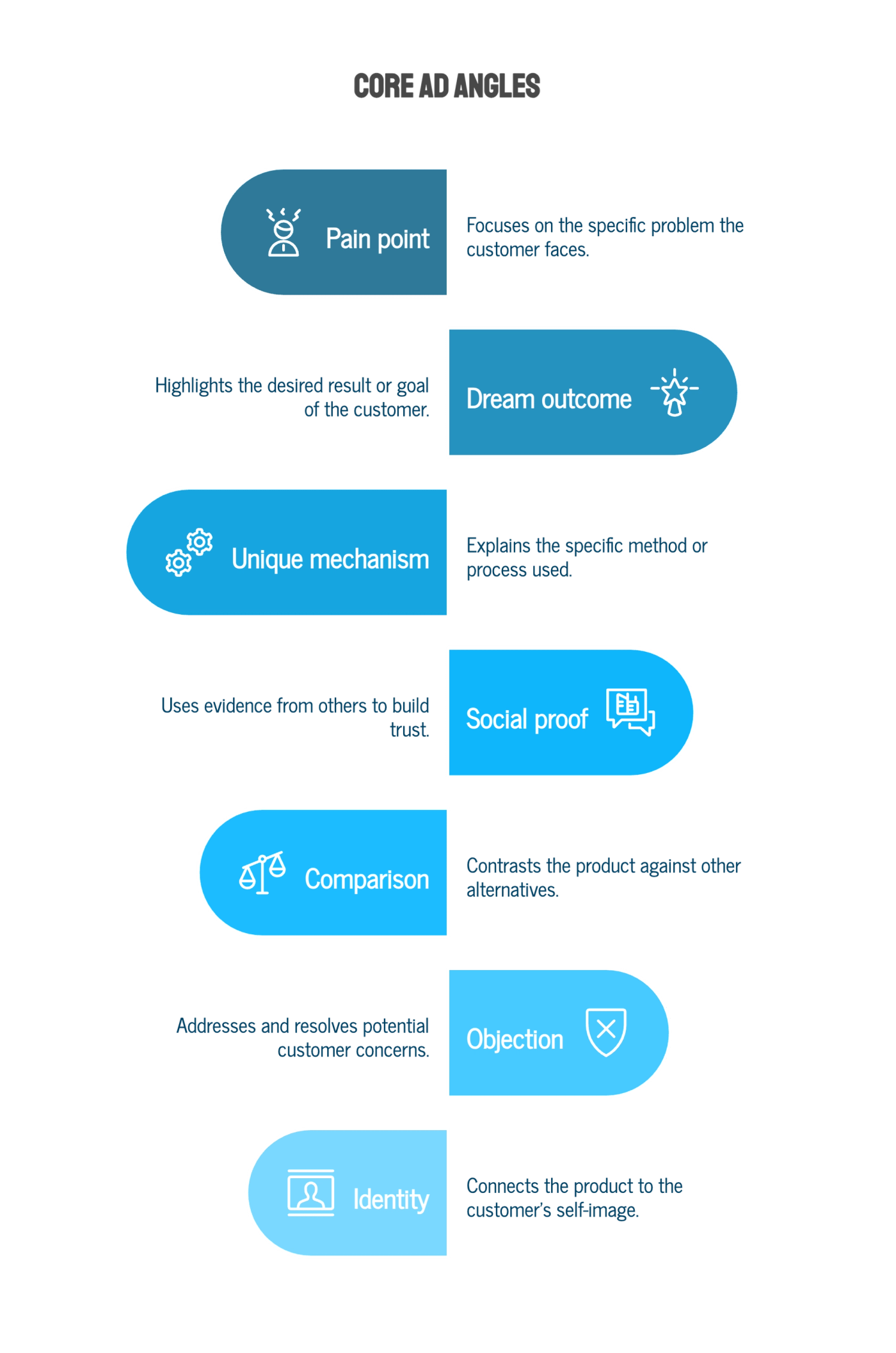
Here's the framework at a glance:
- Pain point
- Dream outcome
- Unique mechanism
- Social proof
- Comparison
- Objection
- Identity
Each breakdown below explains when to use the angle and includes five example hooks.
1. Pain Point
Lead with the problem, in the customer's own words. This is the highest-volume angle for cold audiences because pain is what people recognize fastest.
Awareness level: Problem unaware
Funnel stage: Cold
Primary KPI: Hook rate, CPM
Example hooks:
- "I own four planners and I still missed my kid's dentist appointment."
- "My electric bill doubled and I couldn't figure out what changed."
- "I've thrown away more sunscreen than I've ever finished."
- "We hired three freelancers in a row and every handoff was a disaster."
- "My back hurt so much I was googling standing desks at 2 a.m."
Focus on highlighting a specific frustration your target audience already experiences but might not recognize as an upfront problem with a clear solution.
2. Dream Outcome
Skip the problem and show the after. Best for products where the result is visual or emotionally loaded.
Awareness level: Problem aware
Funnel stage: Cold
Primary KPI: Hook rate, CTR
Want to put this into practice?
SideShift connects you with vetted UGC creators who actually deliver. Start your free trial and post your first job in under 10 minutes.
Example hooks:
- "I haven't set an alarm in six months and I still wake up at 6."
- "My whole skincare routine is two products now."
- "We closed the laptop at 4 on a Friday and nothing broke."
- "I wore the same boots all winter and my feet were never wet once."
- "This is month three of not thinking about dinner until dinner."
Show the transformation or end result customers want rather than the product itself.
3. Unique Mechanism
Explain why this product works when others failed. The angle for skeptical buyers who've been burned by the category before.
Awareness level: Solution aware
Funnel stage: Warm
Primary KPI: CTR, cost per click
Example hooks:
- "Turns out my protein powder wasn't the problem, the timing was."
- "Everyone measures the coffee. Nobody weighs the water."
- "The filter isn't in the bottle, it's in the cap, and that changes everything about how you clean it."
- "My old vitamins were passing straight through me. These dissolve in your mouth."
- "It doesn't cancel the noise, it plays the opposite frequency, which is why planes feel different with these."
Explain what makes your approach or product different from other solutions.
4. Social Proof
Let the crowd make the argument. Reviews, user counts, sold-out restocks, and creator consensus all fit here, and the underlying behavior is well documented: 86% of consumers make at least one influencer-inspired purchase per year.
Awareness level: Product aware
Funnel stage: Warm
Primary KPI: CTR, add-to-cart rate
Example hooks:
- "My mom asked for the link. My mom has never asked for a link."
- "Three people at my office own this and none of us knew."
- "The restock waitlist was 12,000 people. I checked."
- "My physical therapist recommended it, and she hates gadgets."
- "I got mine because my sister wouldn't stop bringing it up at dinner."
Use customer testimonials, creator reviews, or user-generated content to build trust.
5. Comparison
Position against the alternative, whether that's a named competitor, the old way of doing things, or doing nothing. Strongest at the bottom of the funnel.
Awareness level: Product aware
Funnel stage: Hot
Primary KPI: Conversion rate, CPA
Example hooks:
- "I paid for both subscriptions for a month so you don't have to."
- "The $28 one lasted longer than the $90 one. I'm annoyed too."
- "I did one load with each detergent and smelled both shirts."
- "My old routine took 40 minutes. Watch how long this takes."
- "I put the store brand and this one in matching jars and made my husband guess."
Compare your product directly against competitors or common alternatives to help buyers make a decision.
6. Objection
Name the doubt before the viewer does, then dismantle it. This angle is built for retargeting audiences who watched a demo and didn't buy.
Awareness level: Most aware
Funnel stage: Hot
Primary KPI: Conversion rate, CPA
Example hooks:
- "I waited eight months to buy this because of one review. That reviewer was wrong."
- "Everyone asks if it's itchy. I've slept in it. It's not."
- "I assumed the sizing would be off since it's online only. I ordered two sizes and I'm returning the backup."
Want to put this into practice?
SideShift connects you with vetted UGC creators who actually deliver. Start your free trial and post your first job in under 10 minutes.
- "The shipping took three weeks and I'm still telling you it was worth it."
- "I know what it costs. I did the per-use math and it beats my $6 coffee habit."
Address common concerns such as price, quality, shipping, or ease of use to remove purchase friction.
7. Identity
Sell belonging instead of features. The product signals who the buyer is or wants to be. Slower to convert, but it builds the kind of demand that survives creative fatigue.
Awareness level: All levels
Funnel stage: Brand
Primary KPI: Engagement, repeat views
Example hooks:
- "If your camera roll is 80% your dog, keep watching."
- "The people who pack snacks for a two-hour drive already understand."
- "Every youngest sibling is about to feel seen."
- "If you've ever alphabetized your spice rack, we made this for people like us."
- "My fellow cold-plunge-at-6 a.m. weirdos, gather round."
Create content that helps customers see themselves as part of your brand or community, strengthening long-term affinity.
How Do You Test Ad Angles Without Burning Through a Budget?
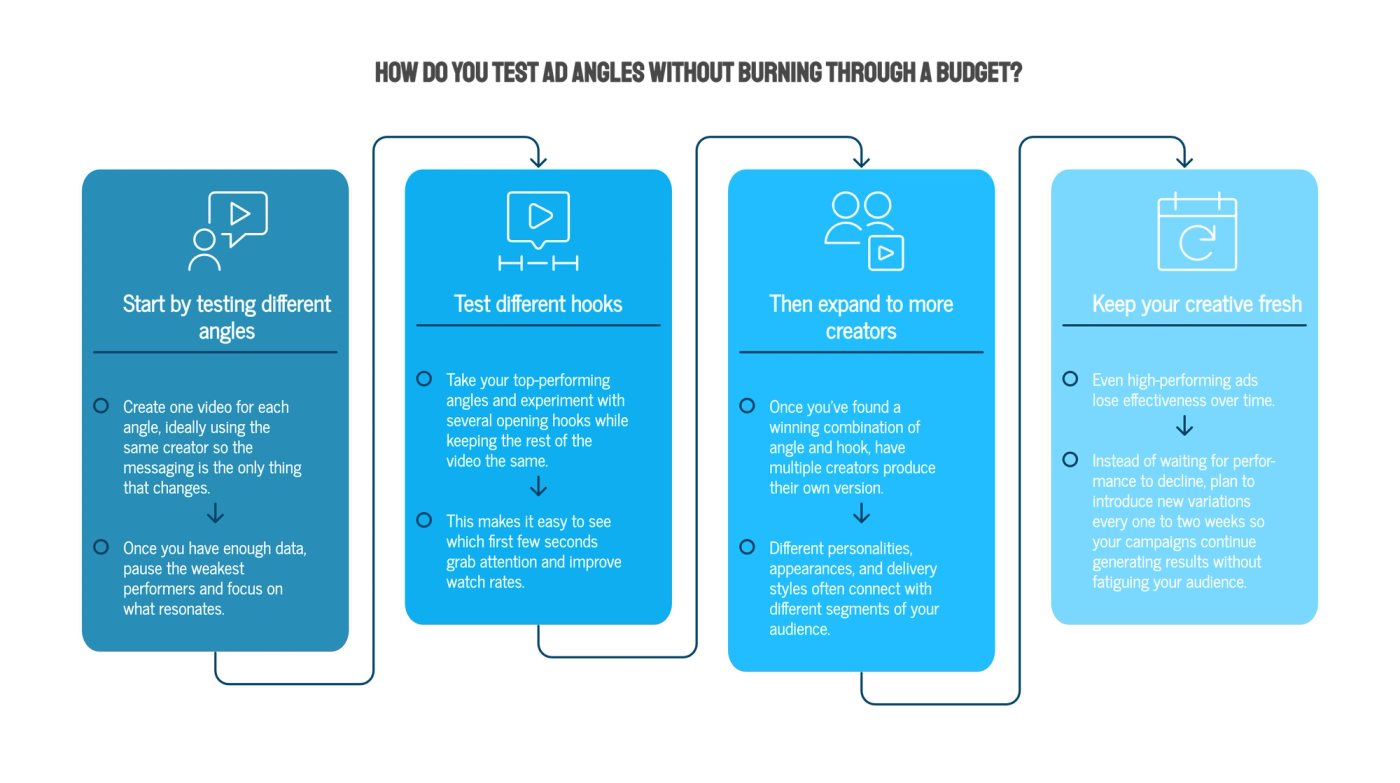
The testing order matters more than the testing budget. Angles are the biggest variable in your creative, so test them first, then drill down:
1. Start by testing different angles. Create one video for each angle, ideally using the same creator so the messaging is the only thing that changes. Once you have enough data, pause the weakest performers and focus on what resonates.
1. Test different hooks. Take your top-performing angles and experiment with several opening hooks while keeping the rest of the video the same. This makes it easy to see which first few seconds grab attention and improve watch rates.
1. Then expand to more creators. Once you've found a winning combination of angle and hook, have multiple creators produce their own version. Different personalities, appearances, and delivery styles often connect with different segments of your audience.
1. Keep your creative fresh. Even high-performing ads lose effectiveness over time. Instead of waiting for performance to decline, plan to introduce new variations every one to two weeks so your campaigns continue generating results without fatiguing your audience.
The bottleneck in this process is usually production capacity, not the ideas themselves. Testing seven angles with three hooks across three creators is 63 videos, and that's exactly the workload that stalls in-house teams.
This is where high-volume creator platforms like SideShift really shine.
On SideShift, GPTZero shipped 600+ TikToks in under five weeks with enough volume to test angles properly and build a repeatable engine from the winners.
If you're still assembling your roster, start with our guide on how to find influencers for your product. Once you have identified proven creators for your campaigns, our influencer relationship management guide covers how to build long-term partnerships and keep them producing month after month.
Test Hundreds of Ad Angles in a Single Campaign with SideShift
Finding the right ad angle usually requires testing multiple versions of the same message. A pain point that resonates with one audience segment may not connect with another, and the fastest way to identify what works is by putting different creative approaches in front of real viewers.
Want to put this into practice?
SideShift connects you with vetted UGC creators who actually deliver. Start your free trial and post your first job in under 10 minutes.
SideShift helps brands run those tests at scale. Post a creative brief with your angle and script framework, get matched with vetted UGC creators in as little as 24 hours, and manage sourcing, briefs, approvals, contracts, and payouts from a single dashboard.
With a network of more than 800,000 creators, you can test different angles, hooks, and creator styles within the same campaign instead of waiting weeks between creative iterations.
FAQs
1. What's the difference between an ad angle and a hook?
The angle is the persuasive argument (pain point, comparison, social proof). The hook is the first three seconds that opens it. One angle can generate dozens of hook variations, which is why you test angles first and hooks second.
1. How many ad angles should you test at once?
Three to four is the practical range for most budgets. Testing all seven simultaneously splits spend too thin for the algorithm to learn. Start with pain point, dream outcome, and social proof, then expand based on what your funnel data shows.
1. Where do you find new ad angle ideas?
Your customers hand them to you. Mine product reviews, support tickets, ad comments, and Reddit threads in your category. The exact phrases buyers use to describe their problems are your pain point hooks, and their stated doubts are your objection angle.
1. Do ad angles work differently on Meta vs. TikTok ads?
The angles are the same; the packaging changes. TikTok ads reward native, creator-led delivery and faster pacing, while Meta ad creative tolerates slightly longer setups and benefits from static versions of winning video angles. Test the angle once, then adapt the format per platform.
1. How often should you refresh ad angles to avoid creative fatigue?
Watch your own baseline rather than the calendar. When cost per result climbs above your historical average or frequency creeps past two to three impressions per user per week, rotate in fresh hooks first, and introduce a new angle when a whole concept stops responding.