
18 UGC Hook Formulas That Stop the Scroll (2026 Examples)
The first 1.5 seconds of a UGC video make or break performance. Get 18 proven hook formulas with real examples for TikTok, Reels, and Shorts.
Table of Contents
You can have the perfect product, a great concept, strong editing, and a generous ad budget and still fail because of the first sentence.
Most users decide whether to keep watching within seconds. If your opening doesn't create curiosity, tension, surprise, or relevance, nothing that comes after matters.
At SideShift, we've seen creators produce winning content with nothing more than a phone camera and a strong hook. We've also seen beautifully edited videos flop because the first three seconds felt predictable.
Good UGC hooks often matter more than production quality.
This guide breaks down 18 UGC hook examples and formulas creators and brands can use across TikTok, Instagram Reels, YouTube Shorts, and paid social campaigns.
Why UGC Hooks Matter More Than Ever
Attention is scarce on social media. You have about three seconds to make a lasting impression. Gen Z users spend an average of just 6.5 seconds focused on a piece of content, while the typical online adult spends more than 18 hours each week scrolling social and video feeds. That creates intense competition for every view.
Most videos never get the chance to deliver their message because viewers decide almost immediately whether to keep watching or keep scrolling. If the opening feels generic, slow, or predictable, they're gone before the real value appears.
That's why strong UGC video hooks have become one of the biggest factors in short-form content performance. A hook is the moment that convinces someone to stop scrolling and invest a few more seconds of attention.
The best creators understand that people don't engage with content because it's well edited. They engage because the opening promises something they care about. That could be a solution to a problem, a surprising result, a mistake to avoid, or a story they want to hear.
Hooks aren't limited to words, either. They can be visual too. A dramatic before-and-after transformation, an unexpected product result, a creator holding up a damaged item, a surprising statistic displayed on screen, or a fast-moving scene that looks different from everything else in the feed can stop a scroll before a single word is spoken. In many of the highest-performing UGC videos, the visual hook and verbal hook work together. The viewer sees something interesting, hears a compelling promise, and immediately wants to know what happens next.
For brands running creator campaigns, testing different hooks often has a bigger impact than changing creators, products, or editing styles.
What Makes a Hook Effective?
Most high-performing hooks do not rely on clever wording. They work because they connect with something the viewer already cares about.
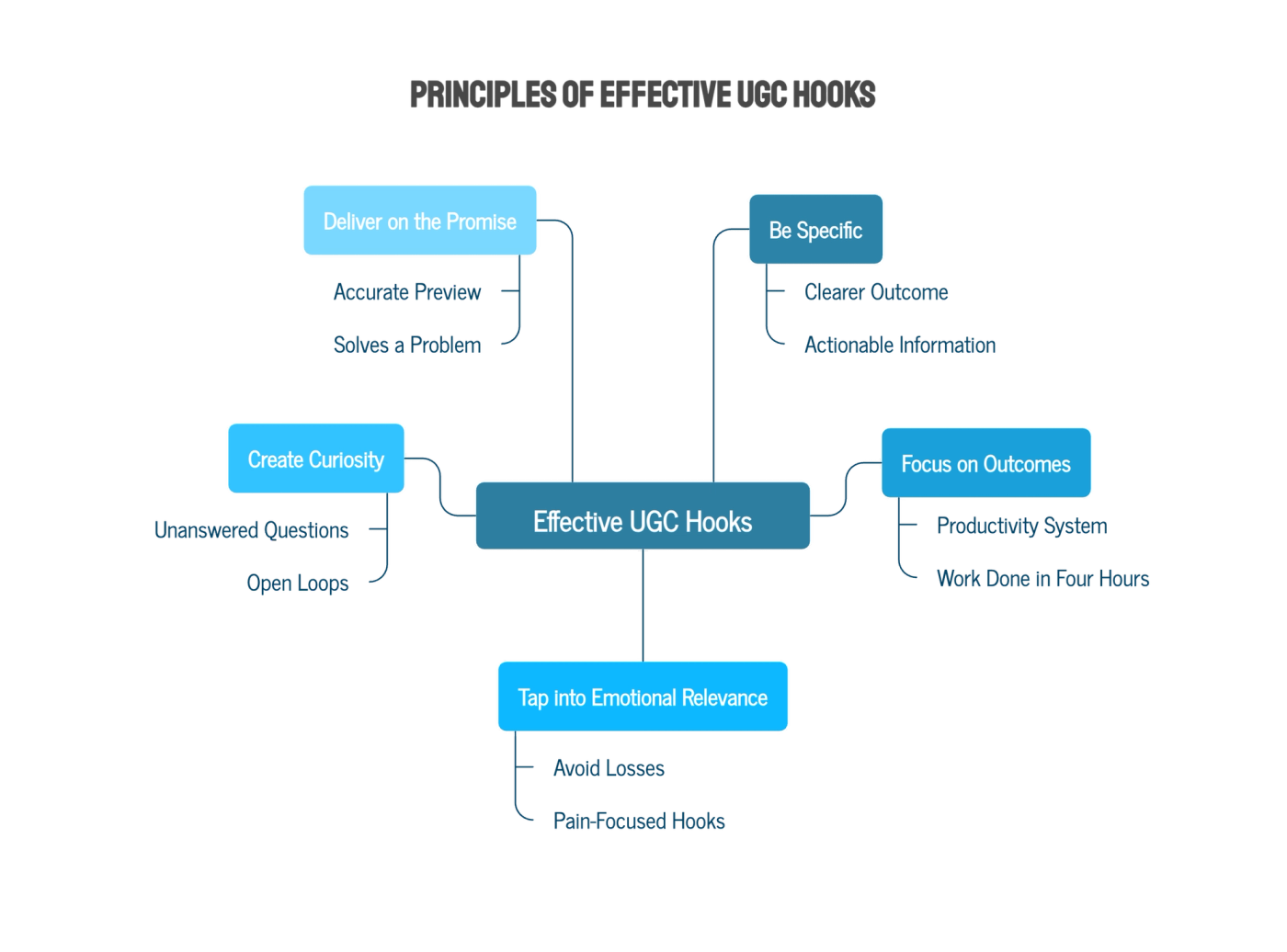
While there's no single formula for capturing attention, there are a few principles that consistently make openings more effective:
- Be specific. Compare “How to get more views” with “How to hit 100,000 views in seven days.” The second example creates a clearer outcome and gives viewers a reason to believe the content contains actionable information.
- Focus on outcomes rather than features. People rarely want the process itself. They want what the process delivers. Instead of talking about a productivity system, a creator might lead with “This is how I got my work done in four hours instead of eight.
Want to put this into practice?
SideShift connects you with vetted UGC creators who actually deliver. Start your free trial and post your first job in under 10 minutes.
- Tap into emotional relevance. Behavioral economics research has consistently shown that people are more motivated to avoid losses than achieve equivalent gains. In content marketing, that often means pain-focused hooks attract attention faster than benefit-focused ones. A creator saying, “Tired of spending hours editing videos?” will often generate more interest than, “Here's a faster way to edit videos.” Both communicate a similar message, but one immediately acknowledges a frustration the viewer already feels.
- Create curiosity. People naturally want answers to unanswered questions. Open loops such as “What nobody tells you about running TikTok ads” or “I tested five viral hook formats and one completely failed” encourage viewers to stay long enough to find out what happens next.
- Deliver on the promise. Effective hooks align with the rest of the video. A strong opening can increase watch time initially, but if the content fails to deliver on the promise, viewers leave quickly. The goal is not to trick viewers with clickbait, but to accurately preview something worth their attention that solves a problem they’re actually having.
18 UGC Hook Formulas That Stop the Scroll
Now that you understand what makes a strong hook effective, let's look at the specific formulas creators use to capture attention and keep viewers watching.
1. How-To Hooks
How-to hooks work because they promise a clear outcome. Viewers immediately understand what they'll learn and can quickly decide whether the result is relevant to them.
Examples:
- “How to get glowy skin in under five minutes.”
- “How to meal prep for the whole week on $50.”
- “How to start investing with $100.”
Formula: How to [achieve specific result] in [timeframe or constraint].
2. Desire-Based Hooks
Desire hooks focus on the outcome people want rather than the process required to get there. They tap into aspirations such as making more money, saving time, looking better, or growing an audience.
Examples:
- “The skincare routine that finally cleared my skin.”
- “How I ate out five times this week and still hit my macros.”
- “The budgeting method that helped me save $10K in a year.”
Formula: The [method/routine/strategy] that helped me [desired outcome].
3. Pain-Point Hooks
Pain-point hooks highlight a frustration the audience already experiences. People are often more motivated to solve a problem than pursue a benefit.
Examples:
- “Tired of spending a fortune on products that don't work?”
- “Stop ordering takeout just because you don't know what to cook.”
- “Still living paycheck to paycheck no matter how much you make?”
Formula: [Relatable frustration] even though you [effort already being made]?
4. Curiosity Hooks
Curiosity hooks create an information gap that makes viewers want to know more. The goal is to make the audience feel like they're missing a piece of the story.
Examples:
- “What nobody tells you about building a skincare routine.”
- “I tried every viral pasta recipe. One was actually worth it.”
Want to put this into practice?
SideShift connects you with vetted UGC creators who actually deliver. Start your free trial and post your first job in under 10 minutes.
- “The weird reason most people never build real savings.”
Formula: What nobody tells you about [topic your audience cares about].
5. Shock Hooks
Shock hooks challenge assumptions or introduce something unexpected. They work best when the surprise feels genuine rather than exaggerated.
Examples:
- “I was washing my face completely wrong for three years.”
- “This $8 grocery haul fed my family for four days.”
- “I stopped budgeting and saved more money.”
Formula: I was doing [common habit] completely wrong, here's what changed.
6. FOMO Hooks
FOMO hooks make viewers feel they might miss an opportunity, trend, or advantage. They create urgency without requiring aggressive sales language.
Examples:
- “Every girl with clear skin is doing this before bed.”
- “This ingredient is taking over the beauty aisle right now.”
- “Financially aware people are quietly doing this with their savings.”
Formula: [Your target audience] are already doing this, are you?
7. Hot-Take Hooks
Hot takes introduce an opinion that challenges common beliefs. Even when viewers disagree, these hooks often generate engagement and discussion.
Examples:
- “Expensive skincare is one of the biggest scams in beauty.”
- “Meal prepping is overrated, here's what actually saves time.”
- “A high salary won't make you wealthy.”
Formula: [Widely accepted belief] is actually [contrarian take], here's why.
8. Story Hooks
Story hooks immediately place viewers inside a narrative. They work best when the rest of the video genuinely delivers a story with a beginning, middle, and end.
Examples:
- “Six months ago my skin was the worst it had ever been.”
- “I had $200 left in my account and a fridge full of random ingredients.”
- “I almost took out a loan before I found this.”
Formula: [Time period] ago, I was dealing with [relatable struggle].
9. Data-Backed Hooks
Data hooks establish credibility by leading with evidence, research, or testing results. They perform particularly well in marketing, business, and educational content.
Examples:
- “I tested 12 moisturizers. Only two actually hydrated my skin.”
- “I tracked every meal for 30 days. Here's what surprised me.”
- “I analyzed my spending for 90 days and found one pattern.”
Formula: I tested [number] [products/methods/strategies]. Here's what actually worked.
10. Challenge Hooks
Challenge hooks invite viewers to follow a journey or experiment. They encourage repeat viewing because people want to see the final outcome.
Examples:
- “I'm only using drugstore makeup for 30 days.”
- “Can I cook every meal at home for a full month?”
- “I'm saving 40% of my income for 60 days.”
Formula: I'm [specific challenge] for [timeframe], here's what happened.
11. Question Hooks
Question hooks directly involve the viewer by prompting them to think about their own situation. The best questions feel personal and immediately relevant.
Examples:
- “Are you storing your skincare products wrong?”
- “Why does your food always taste just a little off?”
- “Would you know if you were being overcharged by your bank?”
Formula: Are you making this mistake with your [topic]?
12. Comparison Hooks
Comparison hooks help viewers evaluate two options side by side. They work especially well for products, tools, strategies, and workflows.
Want to put this into practice?
SideShift connects you with vetted UGC creators who actually deliver. Start your free trial and post your first job in under 10 minutes.
Examples:
- “Drugstore SPF vs. luxury SPF, is the price difference worth it?”
- “Cooking at home vs. meal kits, I tried both for a month.”
- “Index funds vs. high-yield savings, where should your money go first?”
Formula: [Option A] vs. [Option B], which one actually wins?
13. Exclusivity Hooks
Exclusivity hooks target a specific audience segment. Narrowing the audience often makes the right viewers pay closer attention. The more specific, the better.
Examples:
- “If you have sensitive skin, you need to hear this.”
- “This is for anyone who stress-eats and wants to stop.”
- “If you're in your 20s and haven't started investing, watch this.”
Formula: If you're [specific audience], this is for you.
14. Pattern Interrupt Hooks
Pattern interrupts break the viewer's expectations. They can be visual, verbal, or editing-based, as long as they stand out from the surrounding content.
Examples:
- Opening with a close-up of a skin transformation before saying a word
- Starting mid-bite before cutting to the recipe
- Showing a bank balance on screen before explaining how it got there
Formula: Open with the result, visual proof, or an unexpected moment, then explain.
15. Cliffhanger Hooks
Cliffhanger hooks preview the payoff without revealing everything upfront. They create anticipation and encourage viewers to stay until the end.
Examples:
- “Wait until you see what this serum did to my skin in two weeks.”
- “The last ingredient completely changed this recipe.”
- “The third account I opened is the one that made the difference.”
Formula: Wait until you see what happened when I [action].
16. Before-and-After Hooks
Before-and-after hooks showcase transformation. They work because people naturally want to understand how change occurred.
Examples:
- “My skin before and after cutting out one product.”
- “What my meals looked like before and after learning to actually cook.”
- “My finances before and after doing a no-spend month.”
Formula: My [area of life] before and after [specific change].
17. Mistake Callout Hooks
Mistake callout hooks identify a common error and make viewers wonder if they're making it too. They create immediate relevance and self-reflection.
Examples:
- “Stop applying your SPF like this, you're wasting it.”
- “Most people season their food at the wrong time.”
- “You're probably saving money in the wrong account.”
Formula: Stop [common habit], here's what to do instead.
18. Authority Hooks
Authority hooks establish expertise, experience, or proven results. They work best when the authority is real and directly related to the topic.
Examples:
- “After trying over 200 foundations, I finally found my formula.”
- “I've cooked professionally for eight years, this is the mistake home cooks make most.”
- “After tracking my net worth for five years, here's what actually moved the needle.”
Formula: After [experience/timeframe/volume], here's what I know for sure.
The strongest UGC campaigns rarely come from a single perfect hook, but instead come from volume, iteration, and continuous testing across different hook styles to see what actually captures attention. Once brands start combining these hook frameworks with structured creator testing, performance becomes far more predictable, and scaling content stops feeling like guesswork.
Want to put this into practice?
SideShift connects you with vetted UGC creators who actually deliver. Start your free trial and post your first job in under 10 minutes.
Build Better UGC Campaigns with SideShift
Great UGC content starts with great creators, but strong performance usually starts with strong hooks.
The brands generating the highest-performing creator content aren't relying on a single script. They're enlisting an army of creators to distribute hundreds of pieces of content simultaneously, testing multiple hook angles, reviewing performance data, and scaling what works.
The creators behind those campaigns are the ones landing repeat partnerships, because they consistently deliver. SideShift is where both sides connect: brands source vetted creators, manage campaigns, and produce content at scale, while creators get discovered by the right brands and stay organized across multiple deals.
FAQs
1. What are UGC hooks?
UGC hooks are the opening lines, visuals, or statements used to capture attention during the first few seconds of a video and encourage viewers to keep watching.
2. How long should a UGC hook be?
Most effective hooks are delivered within the first one to three seconds of a video.
3. What are the best TikTok hook ideas?
The best TikTok hook ideas create curiosity, highlight a problem, challenge assumptions, or promise a specific result.
4. Do Instagram Reels hooks differ from TikTok hooks?
The fundamentals are similar, but Instagram Reels hooks often perform better when paired with visually engaging content and educational value.
5. Why are hooks important for UGC ads?
Hooks directly impact watch time, engagement, click-through rates, and conversion performance. A stronger opening typically leads to better overall campaign results.