


UGC Creator Rates: What Brands Should Expect to Pay in 2026
UGC creator rates vary by platform and content type. See average pricing for TikTok, Instagram Reels, YouTube Shorts, and Stories - plus what to budget per campaign.
Table of Contents
You found a creator whose content looks exactly right for your brand. You reach out, ask for a rate card, and get back a number that's either way over budget or suspiciously low. You're not sure if you're about to overpay, lowball someone, or just agree to terms you'll regret once the content comes in.
The honest answer is that there's no universal rate card. Creator pricing varies based on platform, audience size, content quality, usage rights, niche, and campaign goals. A TikTok creator filming a simple product review will charge differently than a creator producing polished UGC for paid advertising.
What you can do is come into the conversation informed. This guide breaks down average influencer pricing by platform, explains the factors that move rates up or down, and gives you a realistic picture of what brands should expect to pay in 2026.
What Influences Video Pricing?
Before you can evaluate whether a quote is fair, you need to understand what goes into it. Creator rates are not arbitrary. They reflect a combination of factors that affect the value of the content to your brand and the effort required to produce it.
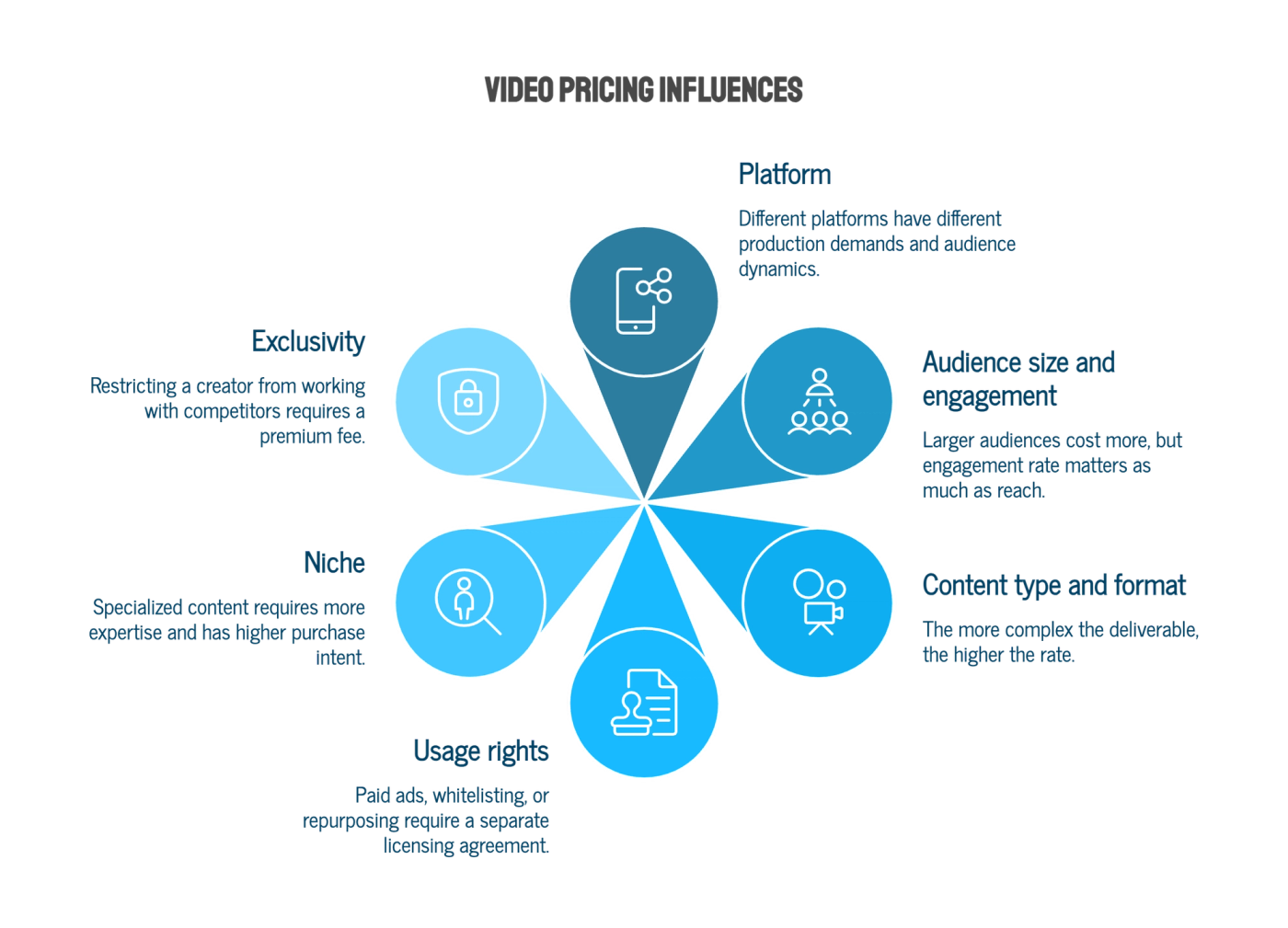
- Platform: Different platforms have different production demands and audience dynamics. A TikTok video shot on an iPhone and posted the same day has a different cost structure than a YouTube integration that requires scripting, filming, and editing over several days.
- Audience size and engagement: Larger audiences cost more to access. But follower count alone is a poor proxy for value. A creator with 40,000 highly engaged followers in a specific niche will often outperform one with 200,000 passive ones. Engagement rate matters as much as reach when evaluating whether a rate is justified.
- Content type and format: A simple talking-head review is easier to produce than a demonstration video, a day-in-the-life integration, or a scripted narrative format. The more complex the deliverable, the higher the rate.
- Usage rights: This is where a lot of brands get caught off guard. The base creation fee covers content production and organic posting. If you want to run the content as a paid ad, whitelist the post, or repurpose it on your own channels, that requires a separate licensing agreement and a higher fee. More on this below.
- Niche: Finance, technology, and legal content creators typically charge more than lifestyle or general consumer creators because their audiences have higher purchase intent and their content requires more expertise to produce credibly.
- Exclusivity: If you want a creator to avoid working with competitors during or after a campaign, expect to pay a premium. Exclusivity clauses vary widely in scope and duration, and both factors affect the price.
Average UGC Creator Rates by Platform
Platform matters more than most brands expect when budgeting a creator campaign. Production norms, audience behavior, and content formats differ significantly across TikTok, Instagram, and YouTube, and so do the rates.
The ranges below are directional benchmarks compiled from industry insight. Actual rates vary significantly based on niche, content quality, and campaign scope. Use these as a starting point for negotiations, not fixed expectations.
Want to put this into practice?
SideShift connects you with vetted UGC creators who actually deliver. Start your free trial and post your first job in under 10 minutes.
TikTok UGC Creator Rates
TikTok is the most accessible platform for high-volume UGC, and rates reflect that. The format favors short, native-feeling content over polished production, which keeps the cost per asset lower than other platforms. Most TikTok creator videos fall in the following ranges:
- Nano influencers (1,000 to 10,000 followers): $50 to $150 per video
- Micro influencers (10,000 to 100,000 followers): $100 to $500 per video
- Macro influencers (100,000 to 1 million followers): $500 to $5,000 per video
- Mega and celebrity creators (1 million+ followers): $5,000 and up
For pure UGC content where posting is not required and the brand receives raw files for use in paid ads, rates typically sit toward the lower end of these ranges regardless of audience size, since you're paying for production only.
Instagram Reels Creator Rates
Instagram Reels rates tend to run slightly higher than TikTok for equivalent audience sizes, largely because the platform's audience skews older than TikTok's and has higher average purchasing power in most categories. Aesthetic standards on Instagram are also higher, which often means more time spent on filming, editing, and revisions.
- Nano influencers: $75 to $200 per Reel
- Micro influencers: $150 to $750 per Reel
- Macro influencers: $750 to $7,500 per Reel
- Mega and celebrity creators: $7,500 and up
Instagram Stories are priced separately and usually lower than Reels, in the $50 to $500 range depending on creator tier, since they have a 24-hour shelf life and require less production effort.
YouTube Shorts Creator Rates
YouTube Shorts occupy an interesting middle ground. The format is short-form like TikTok, but YouTube audiences tend to skew higher intent and the platform has stronger search and discovery characteristics that extend content longevity. Rates are generally comparable to TikTok but can vary significantly based on the creator's broader channel authority.
- Nano influencers: $75 to $200 per Short
- Micro influencers: $150 to $600 per Short
- Macro influencers: $600 to $5,000 per Short
- Mega and celebrity creators: $5,000 and up
Full YouTube integrations, where a brand appears within a longer video rather than a dedicated Short, are priced significantly higher and typically start at $1,000 for micro creators.
UGC Creator Rates by Creator Tier
Understanding how pricing shifts across creator tiers helps brands allocate budget more strategically rather than defaulting to whoever has the biggest following.
UGC Creators (no posting required)
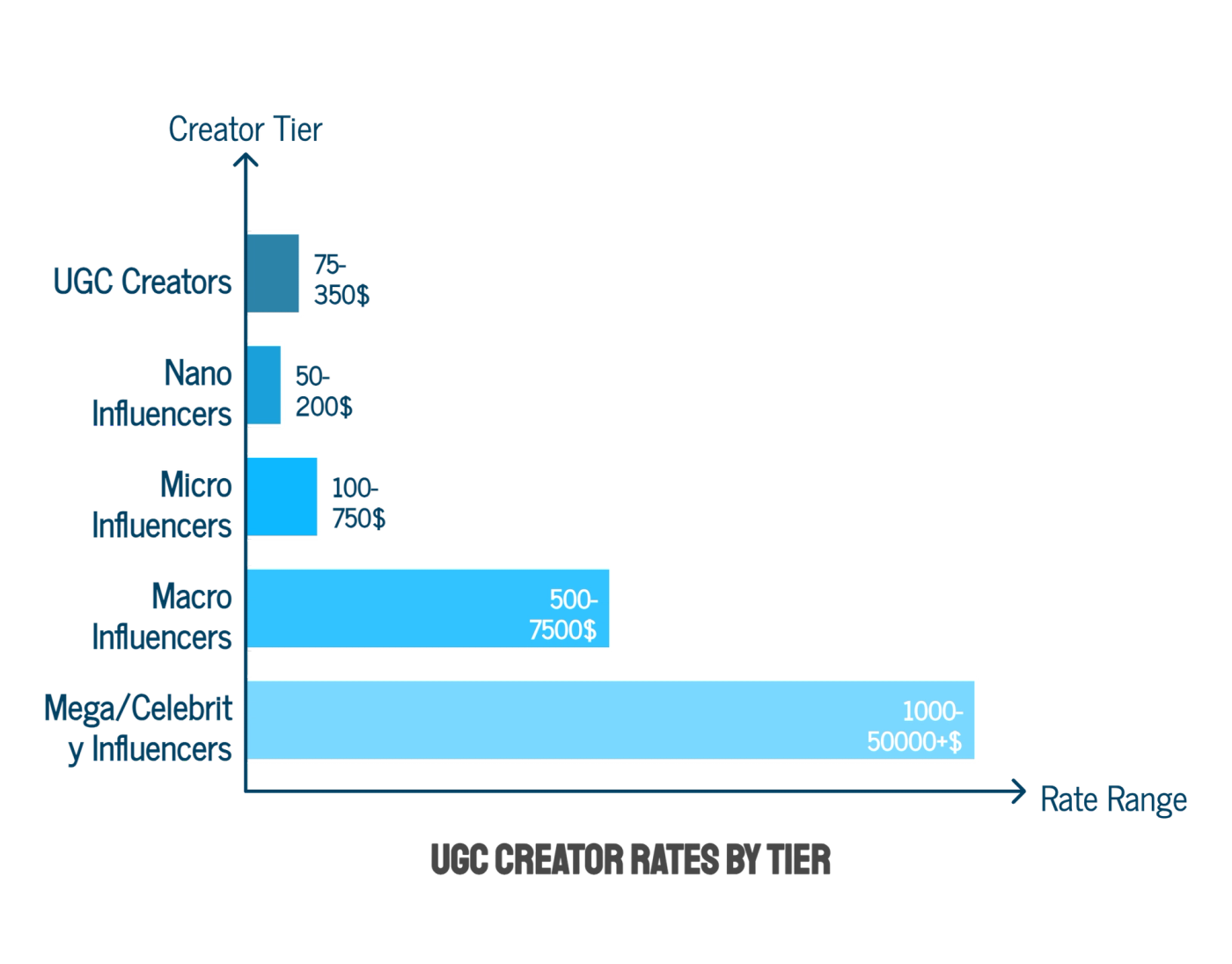
Pure UGC creators produce content for brand use only. They do not post to their own channels, so you're paying for production quality rather than audience access. Rates typically range from $75 to $350 per video depending on format complexity, and this category represents the best cost-per-asset value for brands building content libraries for paid ads and product pages. In some cases, a high-quality UGC creator with no following can legitimately charge more than a nano influencer with a small but real audience.
Nano Influencers (1,000 to 10,000 followers)
Nano influencers are often the most authentic voices in any niche. Their audiences are small but highly engaged, and recommendations carry real weight because followers often feel a personal connection to the creator. Rates are accessible, typically $50 to $200 per post depending on platform and content type, making them a strong choice for testing new products or reaching tight communities.
Want to put this into practice?
SideShift connects you with vetted UGC creators who actually deliver. Start your free trial and post your first job in under 10 minutes.
Micro Influencers (10,000 to 100,000 followers)
Micro influencers offer the most consistent balance of reach, engagement, and cost efficiency. Studies consistently show that this tier generates higher engagement rates than macro and mega creators, and the content tends to feel more credible to audiences. Rates range from $100 to $750 per post depending on platform, niche, and content format. For most brands, micro influencers are the core of a scalable creator program.
Macro Influencers (100,000 to 1 million followers)
Macro creators bring real reach and often a recognizable presence within their category. Rates start around $500 per post and can climb to $7,500 or more depending on platform and deliverable scope. At this tier, usage rights and exclusivity clauses become more significant line items in the negotiation. Content quality and production value are generally higher, but so is the management overhead required to run a successful partnership.
Mega and Celebrity Influencers (1 million+ followers)
Mega influencers and celebrities offer broad awareness reach that smaller tiers cannot match. Rates start in the thousands and scale quickly, with top-tier creators sometimes charging $50,000 or more for a single post. The trade-off is that engagement rates tend to be lower, content feels less personal, and the cost per conversion is rarely competitive with micro or macro partnerships for direct response goals. This tier makes the most sense for brand awareness campaigns with large budgets and specific audience scale requirements.
Why Usage Rights Change Pricing
This is the line item brands most often miss when budgeting creator campaigns, and it is the one that most frequently causes friction between brands and creators.
The base creation fee covers two things: the work of producing the content and the right to post it organically on the creator's own channel. That is it. If you want to do anything beyond that, such as running the video as a paid ad on Meta or TikTok, whitelisting the post so it runs from the creator's handle as a sponsored placement, or repurposing the content on your website, email campaigns, or product pages, you need a usage rights agreement and a separate licensing fee.
Usage rights fees are typically structured as a percentage of the base creation rate. These are directional benchmarks based on common industry practice. Actual licensing fees vary by creator, campaign scope, and negotiation.
- Organic social repurposing: 10 to 20% of base rate for a 3- to 12-month window
- Paid media use (Meta Ads): 25 to 50% of base rate for a 30- to 90-day window
- TikTok Spark Ads: 20 to 40% of base rate for the campaign duration
- Whitelisting: 30 to 50% of base rate for 30 to 60 days
Want to put this into practice?
SideShift connects you with vetted UGC creators who actually deliver. Start your free trial and post your first job in under 10 minutes.
- Perpetual license: 100 to 200% of base rate with no expiration
The practical takeaway is if you plan to use creator content in paid advertising, negotiate usage rights before the campaign starts and factor them into your budget from the beginning. Trying to license content retroactively almost always costs more and takes longer.
Influencer Pricing Per Post vs. UGC Pricing
These are often treated as the same thing. They are not, and the distinction matters when you are building a content budget.
Influencer pricing per post covers two things bundled together: the content itself and access to the creator's audience. When you pay an influencer to post, you're paying for the reach their followers represent, not just the video file.
UGC pricing covers content production only. The creator produces the asset, delivers it to you, and you use it however your agreement allows. They do not post it. There is no audience access component in the price.
The implications for budget are significant. A micro influencer with 50,000 followers might charge $400 to post a product video to their audience. The same creator might charge $150 to produce the same video as a UGC asset for your ad account, with no posting requirement. If your goal is content for paid ads rather than organic distribution, UGC-only agreements will stretch your budget considerably further.
Many brands run both models simultaneously. They work with pure UGC creators to build a high-volume content library for paid ads, and they work with influencers to drive organic reach and awareness. Each has a different cost structure and a different role in the campaign.
Industry-Specific Pricing Differences
Certain industries command higher creator rates than others.
- Beauty: Beauty creators often charge premium rates because content frequently requires product demonstrations, production and editing standards are higher, and competition among brands is intense.
- Technology: Tech creators often charge more because products require deeper explanations, content is typically more complex to produce, and audiences tend to be highly targeted.
- Finance: Finance creators often command some of the highest rates due to the value of their audiences and the compliance requirements associated with financial content.
- Fashion: Fashion pricing varies widely depending on creator positioning, audience demographics, content quality, and the level of brand prestige involved.
As a general rule, the more specialized the knowledge, the more compliance-sensitive the category, or the higher the purchase intent of the audience, the more you should expect to pay and the more justified those rates are.
What Brands Should Budget for Creator Campaigns
Budget ranges vary widely based on campaign scope, creator tier, and whether you are running influencer posts, UGC-only content, or both. Here are realistic starting points for different scenarios:
- Testing phase (first campaign): Most brands starting out should expect to spend $1,000 to $5,000 per month. At this stage, the goal is to gather content, testing hooks and formats, and identify what resonates with your audience before committing to a larger program.
- Growth phase (scaling a working program): Once you have found content formats and creator profiles that convert, a typical growth-stage budget runs $5,000 to $15,000 per month. This covers a mix of micro influencer partnerships for organic reach and UGC-only creators feeding your paid ad account.
Want to put this into practice?
SideShift connects you with vetted UGC creators who actually deliver. Start your free trial and post your first job in under 10 minutes.
- Scale phase (high-volume content operations): Brands running always-on creator programs with consistent paid social support typically spend $15,000 to $50,000 per month or more. At this level the focus shifts from testing to volume, optimization, and content reuse across multiple channels.
How to Evaluate Whether a Creator's Rate Is Fair
Getting a quote from a creator is one thing. Knowing whether it is reasonable is another. Here are the factors worth evaluating before you accept or negotiate.
- Check engagement rate against follower count. A creator charging macro rates with micro engagement numbers is not a fair deal. Use a simple formula: divide total engagement on recent posts by follower count and multiply by 100. Anything below 1% on a platform like TikTok or Instagram is a red flag at the micro or nano tier.
- Look at content quality relative to the rate. Scroll through their recent work. Does the production quality, storytelling, and overall feel match what you need? A creator charging $800 for a Reel should be producing content that looks and performs better than one charging $200.
- Calculate a rough cost per mille (CPM). Divide the quoted rate by estimated reach in thousands. If a creator with 20,000 followers is quoting $500 per post, that is roughly a $25 CPM. Compare that to your paid social CPM benchmarks. If the influencer CPM is significantly higher and the creator has no standout track record, the rate is hard to justify.
- Ask for performance data. Any creator with experience working with brands should be able to share average views, engagement rates, and ideally examples of sponsored content that performed well. If they cannot or will not provide this, factor that into your decision.
- Factor in what you're getting beyond the post. If usage rights, exclusivity, or multiple deliverables are included in the quoted rate, the number may be more reasonable than it appears at first glance. Always compare rates on an apples-to-apples basis.
Build Scalable Creator Campaigns with SideShift
Managing creator outreach, negotiations, contracts, approvals, and payments across multiple partnerships is manageable at a small scale. It becomes a full-time job as campaigns grow. And every hour spent on admin is budget that isn't going toward content.
SideShift gives brands direct access to a network of 800,000+ vetted creators across TikTok, Instagram, YouTube, and more. You post a brief, review applicants against your campaign criteria, and manage the entire workflow from contract to content approval to payment in one place. No DMs, no spreadsheet tracking, no chasing invoices.
Whether you're sourcing your first UGC creator or building a program across dozens of partnerships, the right infrastructure is what keeps creator costs predictable and content volume consistent.
FAQs
How much do influencers charge per video in 2026?
Want to put this into practice?
SideShift connects you with vetted UGC creators who actually deliver. Start your free trial and post your first job in under 10 minutes.
Most creators charge between $100 and $1,500 per video, although rates can be significantly higher depending on audience size, content quality, and usage rights.
What are average TikTok influencer rates?
TikTok influencer rates typically range from $100 to several thousand dollars per video depending on the creator's audience and campaign requirements.
Why do usage rights increase creator pricing?
Usage rights allow brands to repurpose content for advertising and marketing. Because this creates additional value for the brand, creators often charge separate licensing fees.
Are UGC creator rates different from influencer rates?
Yes. UGC creator rates are generally based on content production, while influencer rates often include audience access and content distribution.
How much should a brand budget for a UGC campaign?
Many brands start with budgets between $1,000 and $5,000 per month to test creators, gather content, and identify top-performing creative assets.