


How to Use UGC in Your Paid Ads Strategy (Meta + TikTok)
Boost ad performance with UGC by leveraging authentic creator content on Meta and TikTok, driving higher engagement and conversion rates for your campaigns.
Table of Contents
Most paid ads fail because they look like ads.
Brands can spend months refining polished creatives only to watch performance stall within days of launch. In many cases, replacing studio-produced ads with creator-shot content leads to higher engagement and a noticeable decrease in CPA within the first week.
This shift reflects how platforms like Meta and TikTok distribute content today. Reach is determined by relevance and engagement rather than production quality. Brands that consistently perform well are those that produce native-style content at scale and continuously test new variations.
This guide breaks down how to implement UGC within a paid ads strategy, including sourcing creators, structuring creative tests, and scaling top-performing content across Meta and TikTok.
Why UGC Works for Paid Ads
UGC works because it aligns with user behavior and platform incentives at the same time. People scroll quickly, filter aggressively, and have developed a strong instinct for anything that feels overly produced. When content feels like it came from a real person rather than a brand, it earns a few extra seconds of attention. In paid ads, those seconds are everything.
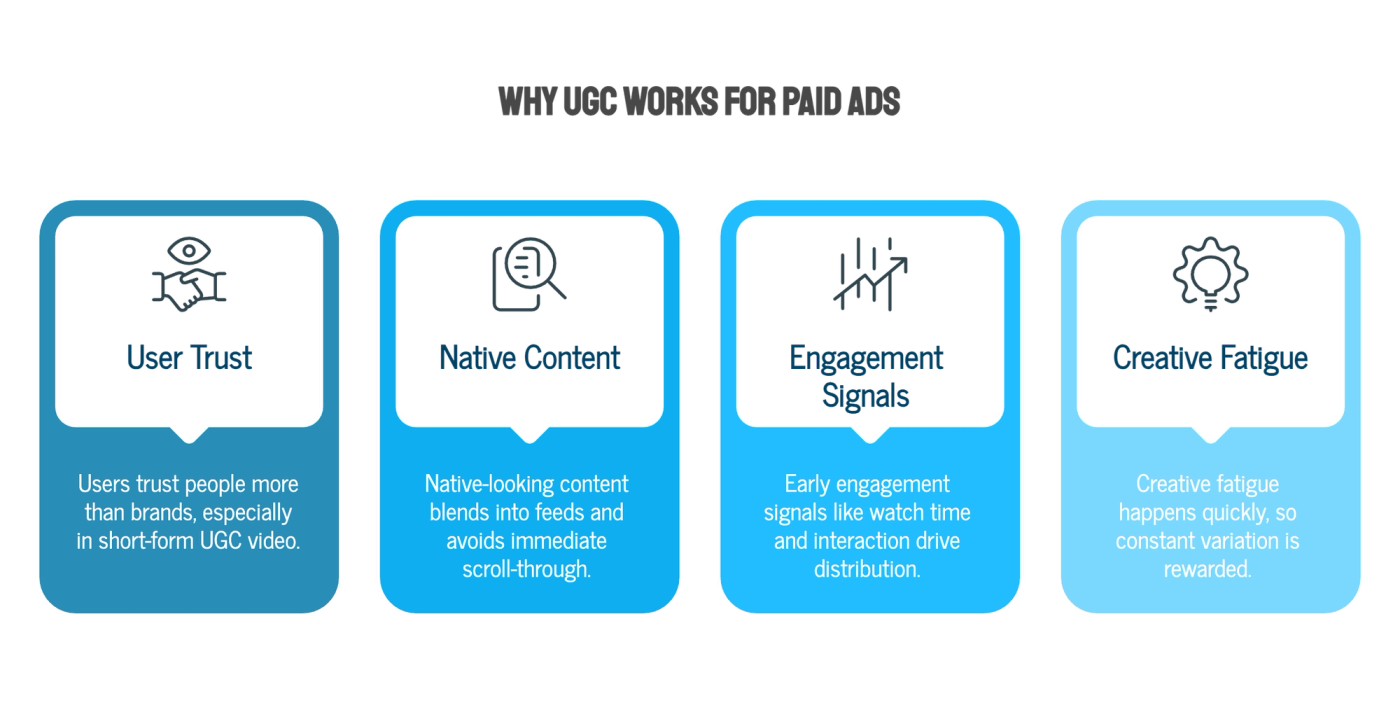
A few underlying dynamics make this especially effective:
- Users trust people more than brands, especially in short-form UGC video
- Native-looking content blends into feeds and avoids immediate scroll-through
- Early engagement signals like watch time and interaction drive distribution
- Creative fatigue happens quickly, so constant variation is rewarded
There’s also a structural advantage. Traditional ad production is slow and expensive, which limits how much you can test. UGC removes that bottleneck. Instead of relying on a handful of creatives, you can generate dozens of variations across different creators, hooks, and messaging angles. That increase in volume directly increases your chances of finding a high-performing ad.
From a performance standpoint, this translates into higher click-through rates, lower acquisition costs, and longer creative lifespans. More importantly, it gives you a system for continuous improvement rather than one-off wins. Combining high-performing UGC with on-site suggestive selling techniques can compound those conversion gains even further.
How to Integrate UGC into Your Paid Ads Strategy
Integrating UGC into paid ads requires a shift in mindset. It’s less about producing a perfect ad and more about building a repeatable testing engine. Brands that struggle with UGC often treat it as an experiment instead of embedding it into their weekly workflow.
The process starts with consistency. You need a steady pipeline of new creatives entering your ad account every week. That means working with multiple creators at once and giving them clear direction while still leaving room for creative freedom. From there, the focus shifts to testing. Launch multiple variations at once, each with different hooks, tones, and angles. Early performance indicators will quickly show which concepts resonate.
To make this more actionable, the integration process usually follows a simple loop:
- Build a weekly pipeline of fresh UGC from multiple creators
- Launch 10 to 30 creative variations at once
- Monitor early performance signals within the first 48 to 72 hours
- Identify top-performing hooks, formats, and messages
Want to put this into practice?
SideShift connects you with vetted UGC creators who actually deliver. Start your free trial and post your first job in under 10 minutes.
- Iterate on winners by producing refined versions
- Scale budget behind proven creatives while continuing to test new ones
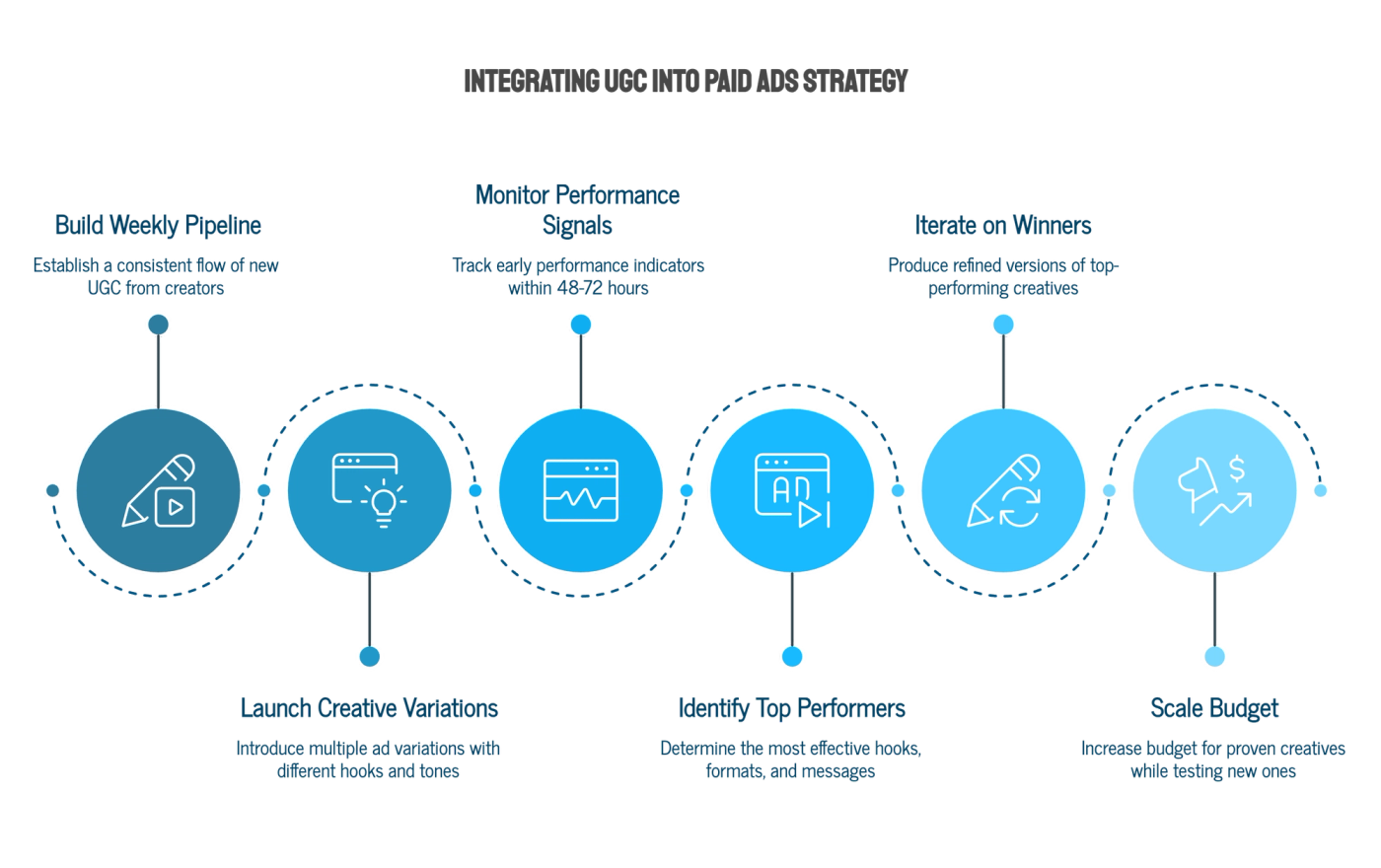
Once you identify winners, the goal is to iterate. The best-performing ads are rarely one-offs. They’re the result of refining a concept across multiple versions. Scaling then becomes a matter of allocating more budget to proven creatives while continuing to feed the system with new variations.
Source Authentic Content
Sourcing the right creators is one of the most overlooked parts of a successful UGC strategy. Many brands default to influencers or creators with large followings, but follower count is no longer the primary driver of performance. What matters is the ability to create content that feels natural, communicates clearly, and captures attention quickly.
Different creators bring different styles, which increases your range of testable content. Over time, patterns will emerge, and you’ll start to see which types of creators consistently drive performance for your brand.
Best Practices for UGC Ads on Meta & TikTok
While UGC is flexible by nature, the highest-performing ads follow repeatable patterns that align with how users consume content. Strong performance usually comes down to how quickly the content captures attention, how clearly it communicates value, and how naturally it fits into the platform.
The hook needs to stop the scroll within the first few seconds, the product should be introduced early, and the value should be obvious without requiring effort from the viewer. Beyond that, structure and sourcing play a major role in consistency.
To strengthen performance across both Meta and TikTok:
1. Prioritize the hook:
Capture attention within the first 1 to 3 seconds with a clear pain point, bold claim, or curiosity-driven opener
2. Use native formats:
Shoot in 9:16, use platform-style captions, and avoid overly polished production that feels like a traditional ad
3. Apply proven frameworks:
Lean into proven UGC video formats like problem-solution, testimonials, unboxings, tutorials, and objection-handling content
4. Source high-quality UGC consistently:
- Work with dedicated UGC creators who understand how to balance authenticity with clarity
- Repurpose organic customer content by securing proper usage rights
5. Use structured content angles (T.A.L.E.S.):
- Talking head for direct, relatable communication
- Authority to highlight problem-solving credibility
- Lifestyle to show real-world use cases
- Exposure or trend-based content to align with platform behavior
- Skills-based tutorials to educate and reduce friction
6. Iterate with data:
Track watch time, CTR, and engagement to guide future creative direction
Meta (Facebook/Instagram) Ads Strategy
On Meta, UGC performs best when it blends authenticity with structured conversion intent. The platform favors advertisers who provide a steady flow of creative variations and use data to optimize quickly.
A strong Meta UGC strategy typically follows this process:
- Launch multiple UGC creatives within each ad set to give the algorithm options
- Test different creators, hooks, and messaging angles at the same time
- Focus on direct-response formats that clearly communicate value and next steps
- Monitor key metrics like CTR, CPA, and conversion rate early in the campaign
- Iterate on winning creatives by refining hooks, visuals, or delivery style
Want to put this into practice?
SideShift connects you with vetted UGC creators who actually deliver. Start your free trial and post your first job in under 10 minutes.
- Refresh creatives every 1 to 2 weeks to prevent fatigue
To further scale performance:
- Use creator licensing or whitelisting: Run ads through a creator handle using Meta partnership ads to increase trust and engagement
- Repurpose top organic content: Turn high-performing posts into paid ads once usage rights are secured
- Test across placements: Distribute UGC across Feed, Stories, and Reels to maximize reach and efficiency
Meta rewards consistency and optimization. UGC enables both by making it easier to test, learn, and scale without slowing down production.
TikTok Ads Strategy
TikTok is built for content-first discovery, which makes UGC the foundation of any effective paid strategy. Ads need to feel native to the platform or they will struggle to gain traction.
A step-by-step approach to TikTok UGC ads:
- Create content that mirrors organic TikTok posts in tone, pacing, and style
- Focus heavily on the hook, as early retention determines distribution
- Launch a high volume of creatives to increase the chances of finding winners
- Test multiple formats such as storytelling, tutorials, testimonials, and trend-based content
- Track performance through watch time, engagement, and completion rate
- Quickly iterate on top-performing concepts with new variations
- Scale spend behind winning creatives while continuing to test new ones
To push performance further:
- Use Spark Ads or creator licensing: Run ads through creator profiles to maintain authenticity and improve engagement
- Lean into trends selectively: Use trending sounds or formats when they align naturally with the product
- Secure usage rights upfront: Ensure contracts clearly define where and how content can be used for paid ads
TikTok rewards speed, volume, and adaptability. Brands that continuously test and refine UGC creatives are far more likely to find breakout-performing ads and scale them efficiently.
Scale UGC for your Paid Ads Strategy with SideShift
At a certain point, the challenge with UGC is no longer whether it works. It’s whether you can produce enough of it to sustain growth.
Managing multiple creators, tracking deliverables, handling contracts, and analyzing performance can quickly become overwhelming without the right infrastructure. This is where most brands slow down, not because the strategy fails, but because execution becomes too complex.
SideShift solves this by turning UGC into a scalable system. Instead of piecing together tools and processes, brands can recruit creators, manage campaigns, and track performance from a single platform. With access to over 800,000 Gen Z creators, you can continuously generate new content, test faster, and double down on what works.
This is how you move beyond isolated wins and build a true growth engine powered by UGC.
Scale your content army with SideShift, where brands and UGC creators win together.
Join SideShift for free today.
FAQs
1. What types of UGC perform best in paid ads?
Short-form videos that feel organic, include a strong hook in the first few seconds, and clearly demonstrate a product or outcome tend to perform best.
2. Can brands use organic UGC directly in paid campaigns?
Yes, but you must secure proper usage rights from the creator before running their content as an ad.
Want to put this into practice?
SideShift connects you with vetted UGC creators who actually deliver. Start your free trial and post your first job in under 10 minutes.
3. How is UGC different from traditional ad creatives?
UGC is designed to look native and authentic, often filmed by creators, whereas traditional ads are more polished and brand-produced.
4. How much should brands budget for UGC ads?
Budgets vary, but many brands allocate a portion of their paid media spend specifically for testing multiple UGC creatives to find top performers.
5. How do you measure success with UGC ads?
Key metrics include click-through rate (CTR), cost per acquisition (CPA), engagement rate, and return on ad spend (ROAS).