
Brand Ambassador Programs: Complete Guide for 2026
Brand ambassador programs turn loyal customers into long-term promoters. Here's how to structure, recruit, and scale one in 2026.
Table of Contents
In 2026, the brands growing fastest on social media are building community programs that turn creators and customers into ongoing promoters.
At SideShift, we’ve watched brands shift marketing spend from single UGC gigs to structured creator ambassador programs with measurable ROI. Instead of paying for one post and hoping it converts, they build UGC systems that generate recurring content, consistent messaging, and compounding trust within a community.
Let’s break down exactly how to build a brand ambassador program that drives revenue to your business and builds long-term trust with your audience.
What are Brand Ambassador Programs?
Brand ambassador programs are structured partnerships where creators, influencers, or loyal customers promote your brand on an ongoing basis.
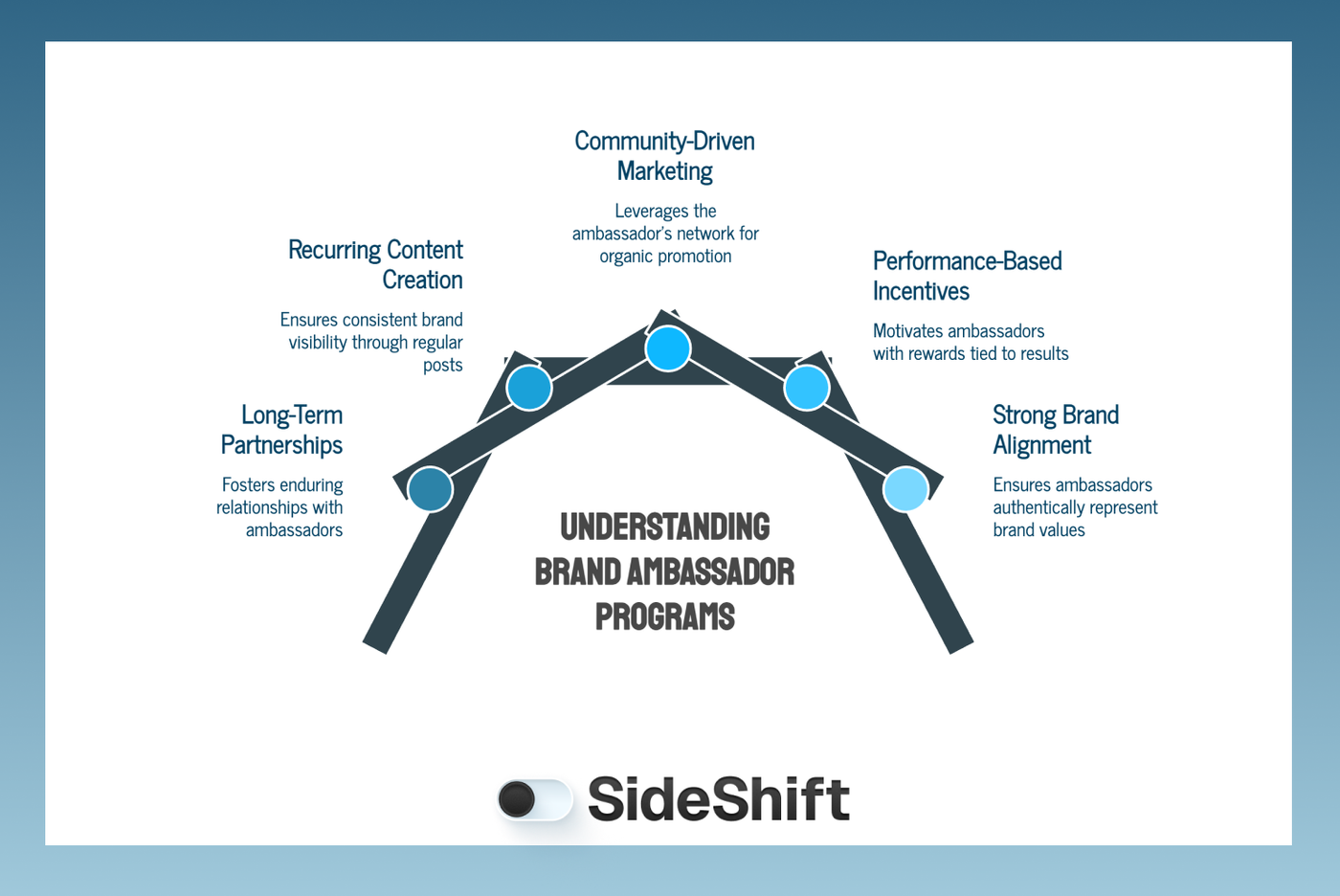
Unlike one-off influencer deals, these programs focus on:
- Long-term influencer partnerships
- Recurring content creation
- Community-driven marketing
- Performance-based incentives
- Strong brand alignment
Ambassadors promote products and represent your brand beyond a single post.
Benefits of Brand Ambassador Programs in 2026
Trust and community have become the most valuable resources in marketing today, and brand ambassador programs are uniquely positioned to cultivate them. A Sprout Social consumer survey found that 49% of consumers make regular purchases because of influencer posts and peer recommendations.
Marketers are responding by shifting away from vanity metrics and focusing on relationship-building, engagement, and trust as drivers of long-term success. In fact, 93% of marketers are maintaining or increasing investment in brand communities, which can include ambassador programs (HubSpot).
When audiences repeatedly see the same creators supporting a brand, credibility grows, and that consistent presence transforms followers into authentic advocates. Unlike paid ads, which can reach broad audiences but often lack personal connection, brand ambassadors amplify your message organically, fostering loyalty, advocacy, and sustained growth.
Types of Brand Ambassador Programs
Not all ambassador programs are the same. The structure depends on your goals.
1. Influencer Ambassador Program
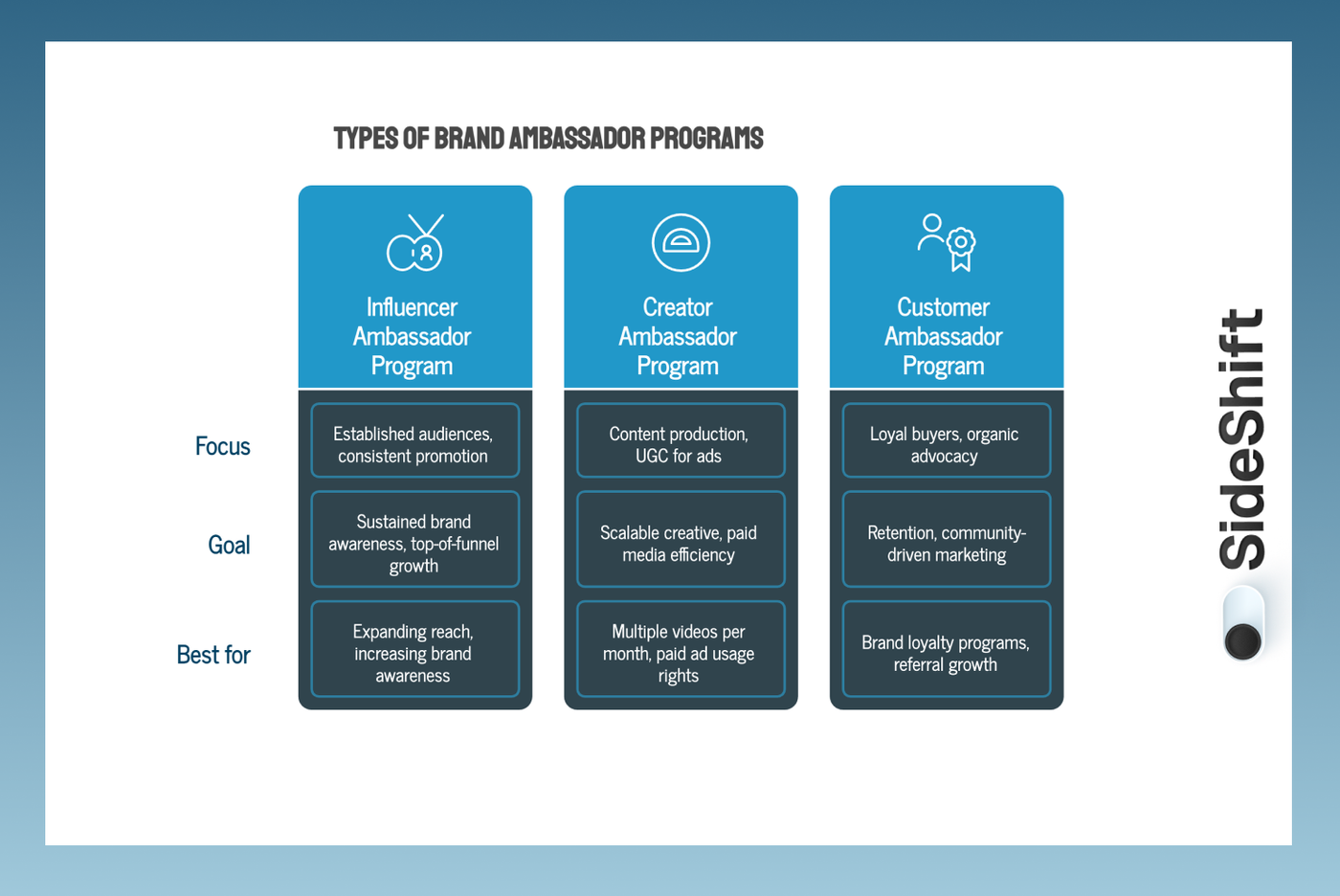
An influencer ambassador program partners with creators who already have established audiences. Instead of one-off sponsored posts, these creators promote your brand consistently over time, reinforcing credibility and recognition.
This model works best when your goal is sustained brand awareness and top-of-funnel growth. Repetition builds familiarity, and familiarity builds trust.
Best for:
- Expanding reach
- Increasing brand awareness
- Strengthening brand positioning
- Long-term influencer partnerships
2. Creator Ambassador Program (UGC-Focused)
This model prioritizes content production over follower size. Brands recruit creators specifically to produce high-performing UGC for ads, social feeds, and landing pages. The focus is on scalable creative, not just audience reach.
In 2026, many brands are shifting toward this structure because creative performance drives paid media efficiency. With consistent monthly deliverables, brands build a content engine instead of chasing sporadic campaigns.
Common structure includes:
- Multiple videos per month
- Paid ad usage rights
- Performance-based incentives
- Structured briefs and messaging alignment
- Cross-channel content distribution
3. Customer Ambassador Program
Customer ambassador programs activate your most loyal buyers. These ambassadors already love your product, which makes their advocacy feel organic and trustworthy.
This approach strengthens retention and builds community-driven marketing momentum. It’s especially effective for brands focused on loyalty and referrals.
Want to put this into practice?
SideShift connects you with vetted UGC creators who actually deliver. Start your free trial and post your first job in under 10 minutes.
Best for:
- Brand loyalty programs
- Referral growth
- Testimonial content
- Community engagement
- Word-of-mouth amplification
Affiliate vs Ambassador Program: What’s the Difference?
Many brands use these terms interchangeably, but they’re not the same. The structure, incentives, and long-term impact are very different.
An affiliate marketing program is primarily transaction-focused. Participants promote your product in exchange for a commission on sales. The relationship is performance-based and typically short-term or campaign-driven.
Affiliate programs usually include:
- Unique tracking links or discount codes
- Commission-only compensation
- Minimal brand integration
- Conversion-focused incentives
A brand ambassador program, on the other hand, is relationship-focused. Ambassadors consistently represent your brand over time, aligning with your messaging, values, and community.
Ambassador programs often include:
- Monthly retainers
- Performance bonuses
- Exclusive perks or early product access
- Community recognition or status
- Long-term influencer partnerships
How to Start a Brand Ambassador Program
Step 1: Define Your Ambassador Program Strategy
Before recruiting anyone, clarify your objectives. A strong brand ambassador strategy starts with knowing what you want the program to accomplish.
Ask yourself:
- Is this awareness-driven or conversion-driven?
- Are you prioritizing reach or content production?
- Will ambassadors post organically or create paid ad creative?
- Is this community-building or revenue-focused?
Your ambassador program structure should directly reflect your growth goals. Misalignment here leads to underperformance later.
Step 2: Set Clear Deliverables
Avoid vague expectations. Ambiguity kills performance, clarity drives alignment.
Define upfront:
- Number of posts per month
- Platforms (TikTok, Instagram, YouTube, etc.)
- Content formats (UGC, testimonials, tutorials)
- Usage rights for ads
- Performance benchmarks
The clearer your expectations, the stronger your long-term influencer partnerships will be.
Step 3: Create Strong Ambassador Program Incentives
Compensation models in 2026 are more strategic than ever. The strongest programs combine stability with upside.
Common structures include:
- Retainer + performance bonus
- Commission on sales
- Free product + tiered rewards
- Exclusive access or community perks
Hybrid models often perform best. For example:
- $600-$900 monthly retainer
- View-based or engagement bonuses
- Commission layers for conversions
This structure attracts higher-quality creators and reinforces consistency over time.
Step 4: Recruit Intentionally
Don’t chase vanity metrics. Large followings don’t guarantee impact.
Prioritize:
- Content quality
- Brand alignment
- Consistent posting habits
- Audience trust and engagement
Community-driven marketing thrives on authenticity, not inflated reach. On SideShift, brands recruit from 500,000+ U.S.-based Gen Z creators, focusing on alignment and performance potential rather than follower count alone.
Step 5: Build a Feedback Loop
The best ambassador marketing programs evolve.
Track performance across:
- Engagement rates
- Content output consistency
- Conversion metrics
- Audience sentiment
Share insights with ambassadors regularly. When creators understand what’s working, they refine faster, and performance compounds.
Growth happens when your program becomes iterative, not static. The more data they have, the better they perform.
Grow Your Ambassador Program with SideShift
Scaling ambassador marketing requires infrastructure. SideShift helps brands recruit aligned creators, structure deliverables, track performance, and scale long-term partnerships without losing brand consistency.
If you’re ready to move beyond one-off campaigns and build a system that compounds trust and revenue, it’s time to structure your ambassador program for scale.
Build a high-performing brand ambassador program with creators on SideShift today.
Want to put this into practice?
SideShift connects you with vetted UGC creators who actually deliver. Start your free trial and post your first job in under 10 minutes.
Start your free trial on SideShift.
FAQs
1. What is a brand ambassador program?
A brand ambassador program is a structured partnership where creators, influencers, or loyal customers promote your brand consistently over time, typically through recurring content and long-term agreements.
2. How do you start a brand ambassador program?
Define your strategy, set clear deliverables, structure incentives, recruit aligned creators, and build a performance feedback loop. Clarity and consistency are key.
3. What’s the difference between an affiliate and ambassador program?
Affiliate programs focus on commission-based sales. Ambassador programs focus on long-term brand representation, often including retainers, perks, and deeper brand integration.
4. How much should you pay brand ambassadors?
Compensation varies by scope and deliverables. Many 2026 programs include $600-$900 monthly retainers, plus performance bonuses or commission layers.
5. Are brand ambassador programs worth it?
Yes. Long-term ambassador programs increase brand recognition, customer trust, and retention, often outperforming short-term influencer campaigns in both engagement and ROI.