
What Is a Brand Representative and Why Do Brands Use Them?
Brand reps promote products authentically in exchange for pay, product, or perks. Here's what the role actually involves and why brands are using them at scale.
Table of Contents
A brand representative is someone a company partners with to promote its products or services, typically through content creation, community presence, ambassadorship, or ongoing advocacy.
The term “brand representative” gets used loosely across the creator economy, sometimes meaning a paid ambassador, an unpaid product tester, or something closer to a full UGC content partner. The ambiguity creates real confusion for brands trying to build these programs.
This article breaks down exactly what a brand representative is, what the role typically involves, why brands use them, and how the model has evolved now that content volume and authenticity matter more than follower count.
What Is a Brand Representative?
A brand representative is someone who promotes a company's products or services on behalf of that brand, typically in exchange for compensation, free product, commission, or some combination of the three. The role sits somewhere between a traditional brand ambassador and a content creator, depending on how the brand structures the program.
A brand ambassador is typically a longer-term, higher-visibility partnership built around personal endorsement, with a recognizable face tied to a brand's identity. A content creator, on the other hand, is often engaged for output: videos, photos, reviews. A brand representative can lean either way. Some programs prioritize ongoing advocacy and community presence, while others are essentially content production arrangements with a relational layer on top.
In the early days of social media, brand rep programs were almost exclusively influencer-driven: a brand would partner with a creator who had a significant following and pay them to post about the product to their audience. The value exchange was straightforward. The creator had visibility, the brand wanted access to that community, and the partnership transferred some of that trust to the product.
That model still exists, but it has expanded significantly. Today, brand representative programs increasingly recruit creators who may have modest followings or no following at all, not just for reach, but for content. Brands now need authentic, high-volume, short-form content that can be deployed across paid media, organic social, email, and product pages. A brand rep who produces 20 quality videos per month can often deliver more value than a macro influencer who only posts twice.
What Does a Brand Representative Do?
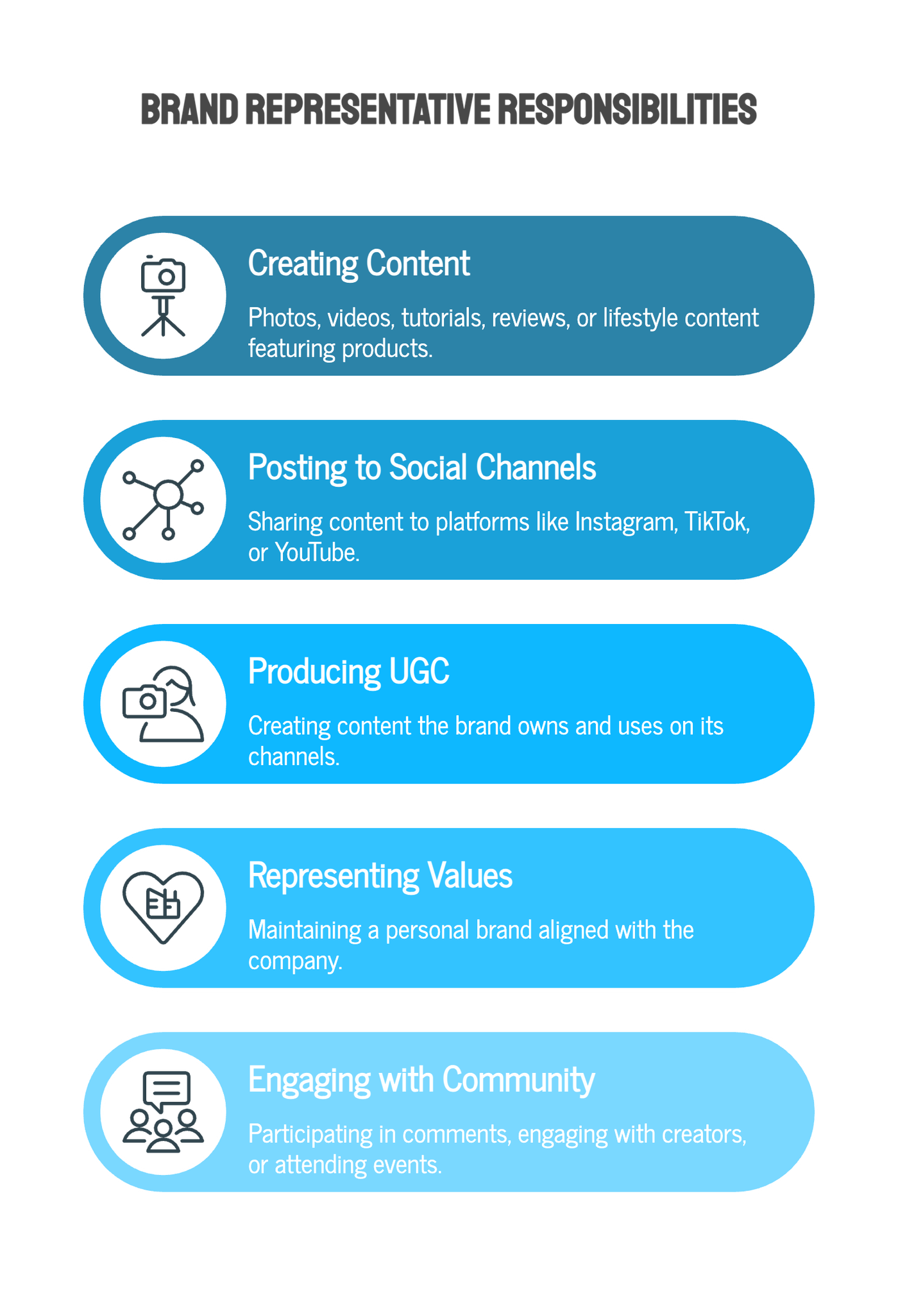
The specific responsibilities of a brand representative vary by program, but most roles include some combination of the following:
- Creating content: photos, short-form videos, unboxing clips, tutorials, reviews, or lifestyle content featuring the brand's products
- Posting to personal social channels: sharing content to Instagram, TikTok, YouTube, or other platforms, depending on the brand's target audience
- Producing UGC for brand use: creating content the brand owns the rights to and deploys through its own paid or organic channels
- Representing the brand's values: maintaining a personal brand and online presence that aligns with the company they're representing
- Engaging with community: participating in comment sections, engaging with other creators in the niche, or attending events
The weight placed on each of these responsibilities depends entirely on how the brand structures their program. A brand that primarily wants owned content assets will care more about production volume and creative quality than follower count. A brand that wants audience distribution will prioritize reach and engagement rate. Most modern programs blend both objectives.
Want to put this into practice?
SideShift connects you with vetted UGC creators who actually deliver. Start your free trial and post your first job in under 10 minutes.
Why Brands Use Brand Representatives
The shift toward brand representative programs at scale reflects a broader change in how performance-driven marketing works. Several forces are pushing brands in this direction simultaneously.
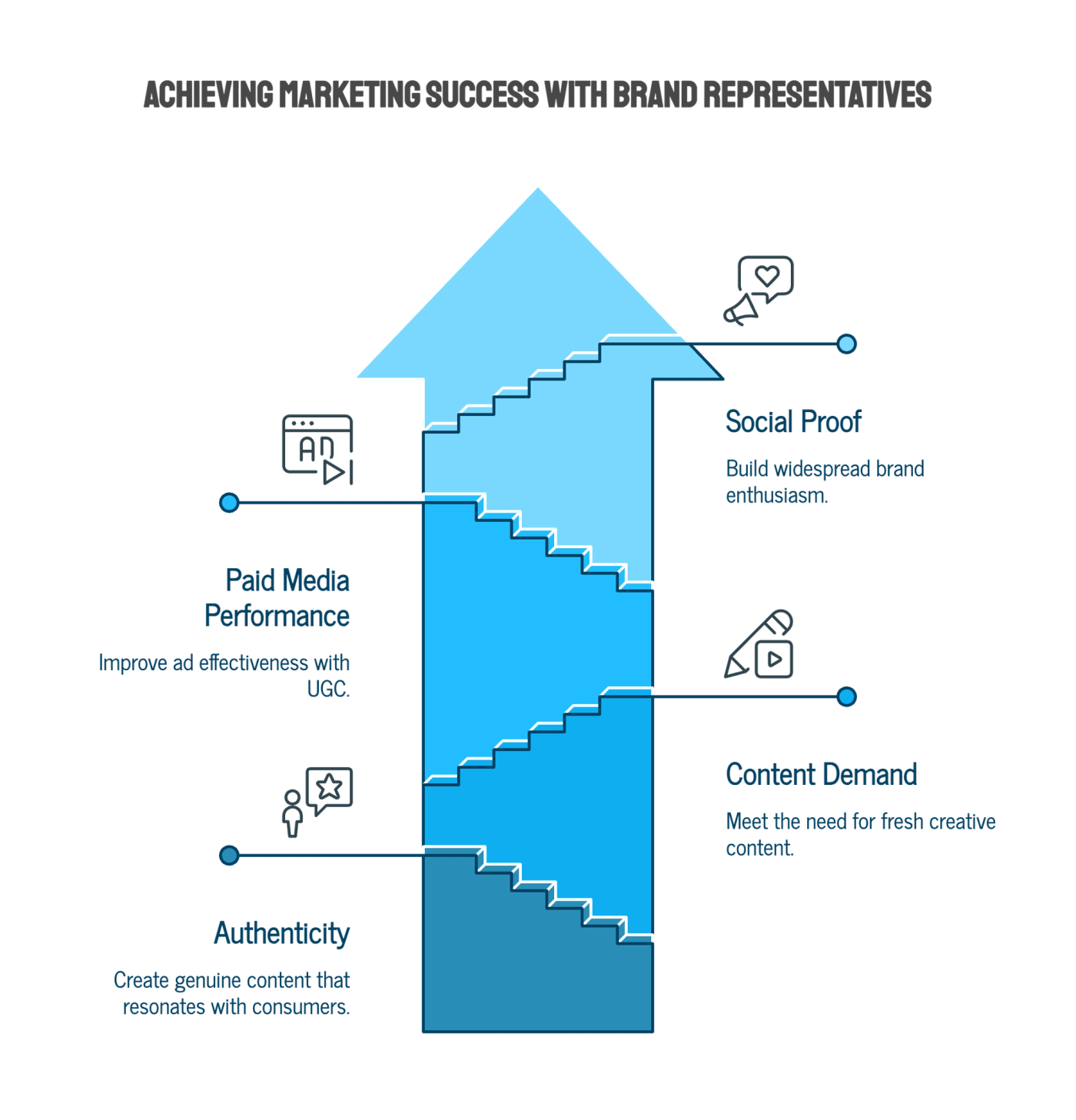
Authenticity Converts Better Than Advertising
Consumer skepticism toward traditional advertising has been well-documented for years, but the gap between polished brand creative and creator-produced content has grown sharply with the rise of short-form video. On platforms like TikTok and Instagram Reels, content that looks and feels organic consistently outperforms content that looks produced.
A study testing video ads across 11 brands found that UGC TikTok videos scored 8% higher than brand-created TikTok videos on overall quality and 68% higher than conventional ads, driven largely by emotional engagement. UGC also outscored Facebook ads on emotional engagement by more than 3x.
Brand representatives, particularly those who speak genuinely about products they actually use, create the kind of authentic content that audiences engage with rather than scroll past.
Content Demand Has Outpaced In-House Capacity
A brand running active paid social campaigns across Meta, TikTok, and YouTube needs a constant supply of fresh creative. Testing multiple hooks, formats, product angles, and calls to action across those platforms simultaneously requires content volume that no internal creative team can sustainably produce. Brand representative programs solve this by distributing content creation across a network of creators, generating dozens or hundreds of assets per month at a fraction of the cost of agency-produced creative.
UGC Outperforms Brand Creative in Paid Media
This is the data point that has pushed the most performance-focused brands into creator programs. User-generated content used as paid ad creative consistently produces lower cost-per-click, higher click-through rates, and better conversion rates than polished brand-produced creative in the majority of direct-to-consumer categories. When brand representatives produce content that functions as both organic social posts and paid creative assets, the brand is essentially getting two channels worth of value from a single content investment.
It Builds Long-Term Social Proof at Scale
A brand with five ambassador partners has five visible advocates. A brand with 50 active brand representatives has 50 pieces of fresh content circulating simultaneously, creating the impression of widespread organic enthusiasm. That social proof compounds over time, making the brand feel culturally present in a way that a small number of high-profile partnerships cannot replicate.
Types of Brand Representative Programs
Not all brand rep programs are structured the same way. Understanding the different models helps brands evaluate fit before committing.
Paid Brand Ambassador Programs
The creator receives a fixed monthly fee or per-deliverable rate in exchange for a set amount of content and posting. This is the most professional and creator-friendly model, with clear expectations, defined compensation, and contractual deliverables on both sides.
A fitness apparel brand might sign three creators as paid ambassadors for a six-month term, with each posting weekly, representing the brand at events, and weaving the product into their regular content in a way that feels personal rather than transactional.
Want to put this into practice?
SideShift connects you with vetted UGC creators who actually deliver. Start your free trial and post your first job in under 10 minutes.
In practice, SideShift's recommended pay structure for ongoing creator relationships falls into this category: monthly retainers between $600 and $900 for daily posting, with performance bonuses tied to views or conversions layered on top.
Product-for-Content Programs
The brand provides free products in exchange for content or posts, with no cash payment. This model typically works at the very early stage of a brand building awareness on a tight budget. The challenge is that product-only compensation can attract creators who may not be fully committed to quality or consistency, since the financial incentive is minimal.
Think: an early-stage apparel brand might send free pieces to 20 micro-creators in exchange for unboxing or styling videos, using this as a low-cost way to generate initial social proof before the brand has the budget to pay for content outright.
Commission-Based Programs
Creators earn a percentage of sales generated through their unique referral link or promo code. This affiliate marketing model carries the least upfront cost for brands and is designed to align creator incentives with sales outcomes. In practice, it works best when paired with a base retainer, because commission-only structures tend to attract lower-quality creator participation and lead to inconsistent content volume.
For instance, a supplement brand running a commission-only program might find that most creators post once at sign-up and then go quiet, whereas adding even a modest base payment alongside the commission structure keeps creators posting consistently month over month.
Hybrid Programs
The most effective brand representative structures combine a base retainer with performance bonuses. The retainer provides financial stability, which attracts quality creators and incentivizes consistent output. The performance component rewards creators whose content genuinely drives views, engagement, or conversions. Hybrid models often produce better campaign outcomes than either pure retainer or pure performance structures alone.
For example, a mid-size home goods brand might pay creators a $700 monthly retainer for a set content volume, then layer in a bonus for any video that crosses 50,000 views, keeping baseline output steady while giving creators a direct incentive to push their best work.
What Makes a Good Brand Representative?
For brands building these programs, the instinct is often to prioritize follower count first. In practice, the creators who perform best as brand representatives share a different set of qualities.
- Engagement quality: High engagement rates matter more than inflated follower counts. Creators with active comment sections, meaningful audience interaction, and strong community trust typically drive better conversion and brand recall than creators with large but passive audiences. Brands should evaluate how audiences respond to sponsored content specifically, not just overall vanity metrics.
- Content consistency: A creator who posts regularly and maintains a coherent presence in their niche will outperform an inconsistent creator with a larger following. Consistency signals that they'll actually deliver on their contracted obligations.
- Genuine niche alignment: A brand representative who actually uses and cares about products in your category creates more convincing content than someone posting about your product as one of twenty unrelated partnerships. Audience trust is built on specificity and authenticity.
Want to put this into practice?
SideShift connects you with vetted UGC creators who actually deliver. Start your free trial and post your first job in under 10 minutes.
- Video production capability: For brands running short-form content programs on TikTok and Instagram, creators who can shoot, edit, and deliver quality vertical video consistently are more valuable than creators with photography skills only. The format has shifted decisively toward video.
- Responsiveness and professionalism: A creator who communicates clearly, meets deadlines, and follows creative briefs without constant back-and-forth is worth significantly more to a brand's operational efficiency than a technically talented creator who is difficult to manage.
How Brand Representative Programs Have Evolved With UGC
The modern brand representative program looks meaningfully different from the ambassador model that dominated five years ago. The biggest shift is the decoupling of content value from distribution value.
Historically, a brand rep's primary function was to broadcast brand messaging to their own audience. Today, many of the most effective brand rep programs recruit creators specifically for content production, with the brand handling distribution through its own paid and owned channels.
This matters because it fundamentally changes who qualifies as a valuable brand representative. A creator with 3,000 engaged followers who can produce 10 high-quality product videos per month is an excellent UGC brand rep even though they'd be ignored by traditional influencer marketing standards. The content they produce can be deployed in paid social ads, on product pages, in email campaigns, and across the brand's own social channels, generating far more impressions than the creator's organic reach would suggest.
This evolution has made brand representative programs accessible to a much larger pool of creators and simultaneously more valuable to brands running performance-driven content strategies.
Scale Your Brand Representative Program with SideShift
Recruiting a handful of brand representatives is manageable, but scaling to dozens or hundreds of active creators quickly becomes an operational challenge. As programs grow, sourcing, vetting, contracting, managing deliverables, processing payments, and tracking performance all become interconnected workflows that are difficult to run efficiently without dedicated infrastructure.
SideShift provides that infrastructure in one place. With access to over 800,000 Gen Z UGC creators across the U.S., brands can recruit at scale, launch and manage multi-platform campaigns, and centralize contracts, payouts, and performance tracking. This allows teams to shift their focus from coordination to optimization, identifying top-performing creators faster and continuously improving campaign output over time.
FAQs
1. What is the difference between a brand representative and a brand ambassador?
The terms are often used interchangeably, but there are meaningful distinctions in practice. A brand ambassador typically implies a longer-term, higher-profile partnership with a creator who has significant reach and publicly represents the brand across multiple touchpoints. A brand representative is a broader term that includes creators at any follower level who are producing content or promoting products on behalf of a brand, often as part of a larger program with many participants rather than a single high-profile deal.
Want to put this into practice?
SideShift connects you with vetted UGC creators who actually deliver. Start your free trial and post your first job in under 10 minutes.
2. Do brand representatives get paid?
It depends on the program structure. Professional brand representative programs pay creators either a flat fee per deliverable, a monthly retainer, a commission on sales, or a hybrid of retainer plus performance bonuses. Some early-stage brands run product-for-content programs where compensation is free product rather than cash. For creators serious about treating brand representation as income, paid programs with clear contractual deliverables are the standard worth seeking out.
3. What is the role of a brand representative?
A brand representative’s role is to create awareness, trust, and engagement for a brand through consistent content and audience interaction. Depending on the program, this can include posting social content, demonstrating products in real-life use, sharing reviews or tutorials, participating in campaigns, attending events, generating user-generated content (UGC), and driving sales through affiliate links or discount codes. Beyond simply promoting products, effective brand representatives act as relatable extensions of the brand by translating marketing messages into content that feels authentic to their audience.
4. How many brand representatives does a brand need?
More than most brands initially plan for. A program with three to five representatives produces limited content volume and minimal performance data. A program with twenty to fifty active creators producing content consistently generates enough volume to test different creative approaches, identify what drives engagement and conversion, and build a meaningful library of content assets. The brands running the most effective programs treat creator volume as a strategic lever, not just a budget decision.
5. What should a brand representative contract include?
At minimum, a brand rep contract should specify deliverables (content type, quantity, and posting frequency), compensation structure and payment timeline, content usage rights (whether the brand can repurpose the content in paid ads or other channels), exclusivity terms if applicable, and the duration of the agreement. Clear contracts protect both parties and set professional expectations that lead to better working relationships and more consistent content output.