


How to Pitch UGC to Clients (and Get a Yes): The Agency Guide
This guide examines how to construct a casa, adapt it to different types of clients, and address common objections.
Table of Contents
Every agency account manager has encountered a client who listens to a UGC proposal and responds with some version of, “We’ll think about it.” Cost may be one consideration, but hesitation can also reflect how the proposal itself is framed. When UGC is presented primarily as a set of videos or creator deliverables, clients are left to determine for themselves what those assets are expected to contribute to the marketing strategy.
An effective UGC pitch makes that relationship explicit. It identifies the problem UGC is intended to address, explains how the content will be produced and used, and establishes how the client will evaluate its performance. Relevant case studies and performance data can then support the argument with evidence rather than asking the client to accept the value of UGC as a premise.
This guide examines how to construct that case, adapt it to different types of clients, address common objections, and define a UGC program that an agency can realistically deliver.
Why Clients Say No to UGC Before They Understand It
Most objections to a UGC pitch have nothing to do with UGC itself. They come from a client mentally filing it under the wrong category before the agency has finished explaining it. A client hears “user-generated content” and pictures unboxing videos from a few years ago, low production value, no strategy behind it, nice to have, but not something worth reallocating real budget toward.
Plenty of agencies still pitch UGC as a cheaper alternative to studio production rather than as its own performance channel with different mechanics and different reasons to exist. When the pitch leads with cost savings, the client hears “budget option” instead of “growth strategy,” and budget options are easy to table for next quarter.
A UGC pitch needs to open with what the format does that studio content structurally can't: faster creative velocity, more angles tested per dollar, and content that reads as a recommendation rather than an advertisement. Clients who say no early are usually reacting to an outdated version of UGC that the agency never corrected.
How to Position UGC to Different Clients
A UGC content strategy pitch that works for a fast-moving DTC brand will not resonate the same with a 40-year-old category leader, and the reverse is just as true. Positioning has to shift with the client's actual risk tolerance, not just their industry.
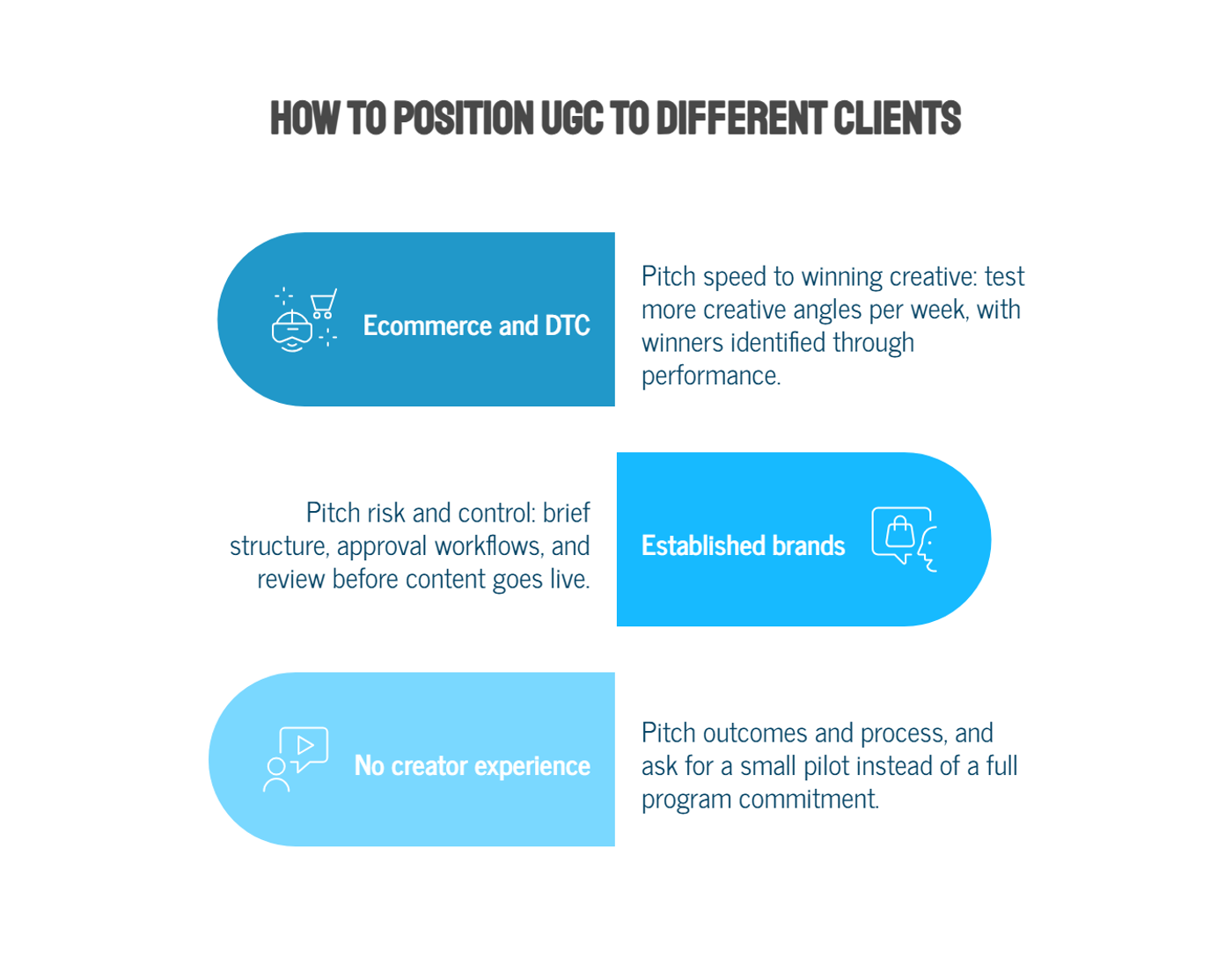
Pitching Ecommerce and DTC Clients on Speed to Winning Creative
DTC clients already understand testing. They run split tests on landing pages and email subject lines without needing to be convinced of the value of iteration.
The pitch here should lean into that existing comfort: UGC lets them test more creative angles per week than a studio production schedule allows, and the winners get identified through performance, not internal opinion. This audience responds to volume and speed, so the pitch should center on how many concepts can be in the market within the first few weeks, not just the first deliverable.
Pitching Established Brand Clients on Risk and Control
Want to put this into practice?
SideShift connects you with vetted UGC creators who actually deliver. Start your free trial and post your first job in under 10 minutes.
Legacy and enterprise clients care less about speed and more about what could go wrong. Their instinct is to protect brand consistency, and an unfamiliar creator producing content outside a studio environment can feel like a risk they don't need to take.
The pitch should lead with control: brief structure, approval workflows, and the fact that every piece of content is reviewed before it goes live. Frame UGC as an additional channel running alongside existing brand campaigns, not a replacement for them, and the risk conversation gets much shorter.
Pitching Clients with No Creator Marketing Experience at All
Some clients don't have an objection yet because they don't have a frame of reference. This is the easiest audience to pitch and the easiest to lose through over-explaining.
Keep the pitch grounded in outcomes and process rather than platform jargon, and use a small pilot as the ask instead of a full program commitment. A client with no prior experience is far more likely to say yes to a contained test than to a strategy they don't yet have context for.
How to Handle Client Objections to UGC
Even a well-positioned pitch runs into resistance. The agencies that close consistently aren't the ones who avoid objections; they're the ones who've already built an answer for the four that come up in nearly every meeting.
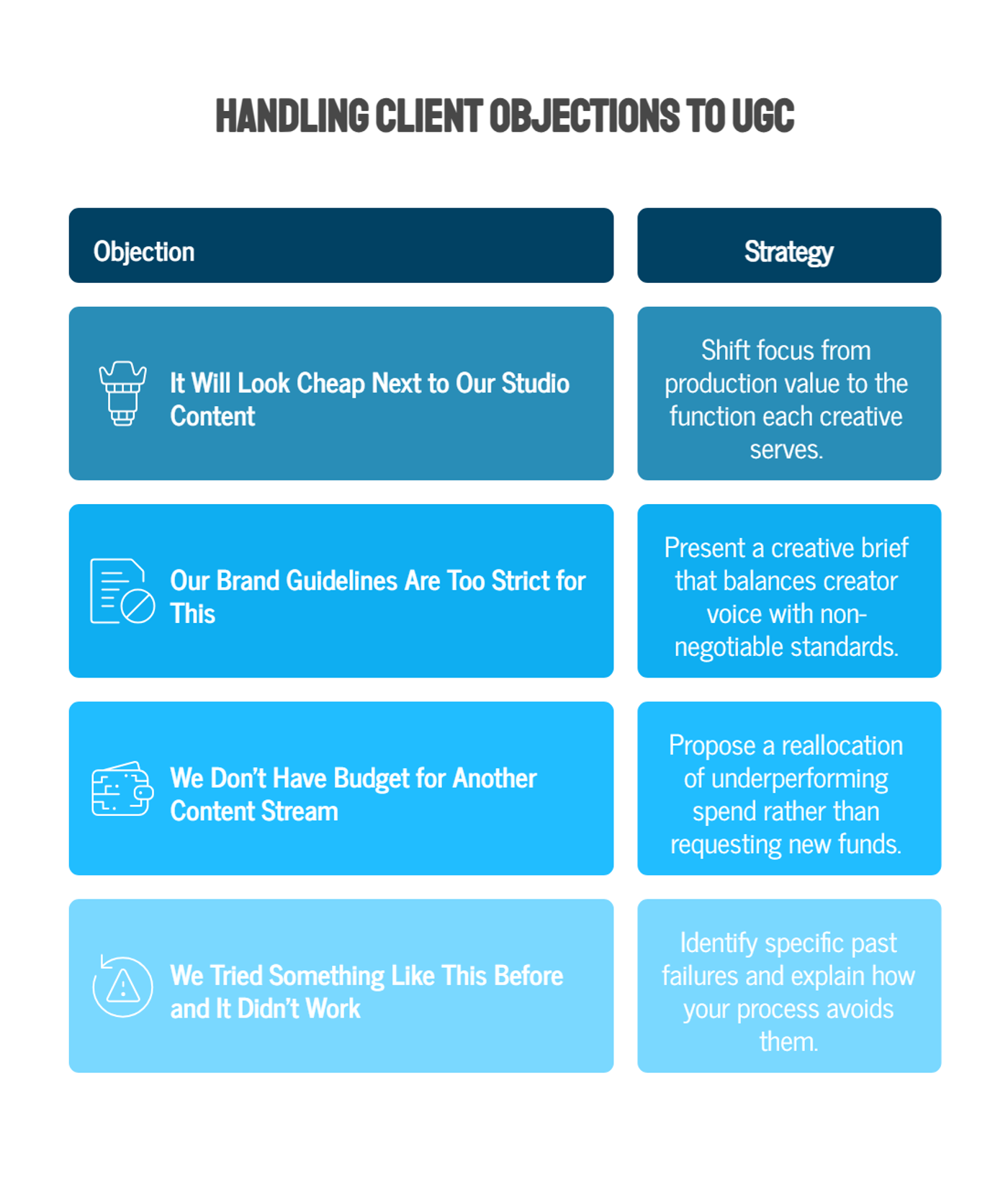
“It Will Look Cheap Next to Our Studio Content”
Studio content and UGC are built for different contexts and different viewer expectations. UGC succeeds in part because it doesn't look like a conventional studio ad, building social proof and allowing it to fit more naturally within the surrounding content on social platforms. The comparison, then, should move away from production value and toward the function each type of creative is intended to serve.
“Our Brand Guidelines Are Too Strict for This”
Strict brand guidelines and UGC aren't incompatible, but the client needs to see that in practice. Bring an example of a creative brief that gives creators room to speak in their own voice while still enforcing non-negotiables like messaging accuracy, disclosure requirements, and prohibited claims. The goal is to show the client a structure they haven't seen yet, not to ask them to loosen standards they're not willing to loosen.
“We Don't Have Budget for Another Content Stream”
If UGC is pitched as an addition to the existing content budget, it competes for new dollars that may not exist. If it's pitched as a reallocation, testing a portion of underperforming spend on a new format before committing to more, it becomes a lower-risk ask. Come in with a specific reallocation recommendation rather than asking the client to find new money.
“We Tried Something Like This Before and It Didn't Work”
This is the hardest objection to overcome because it's based on real experience, even if that experience was shaped by weak execution rather than a weak format. Ask what specifically didn't work: creator quality, turnaround time, briefing, measurement, or lack of iteration. Naming the likely cause and explaining how your process avoids it does more to rebuild trust than restating why UGC works in general.
Want to put this into practice?
SideShift connects you with vetted UGC creators who actually deliver. Start your free trial and post your first job in under 10 minutes.
How to Prepare for Your Pitch
A persuasive UGC proposal should be built around the client's existing marketing strategy, not around a standard agency pitch deck. Before the meeting, the agency should understand where the client currently sources creative, how that creative is being used, what constraints exist, and what evidence the client will need to justify an investment in UGC.
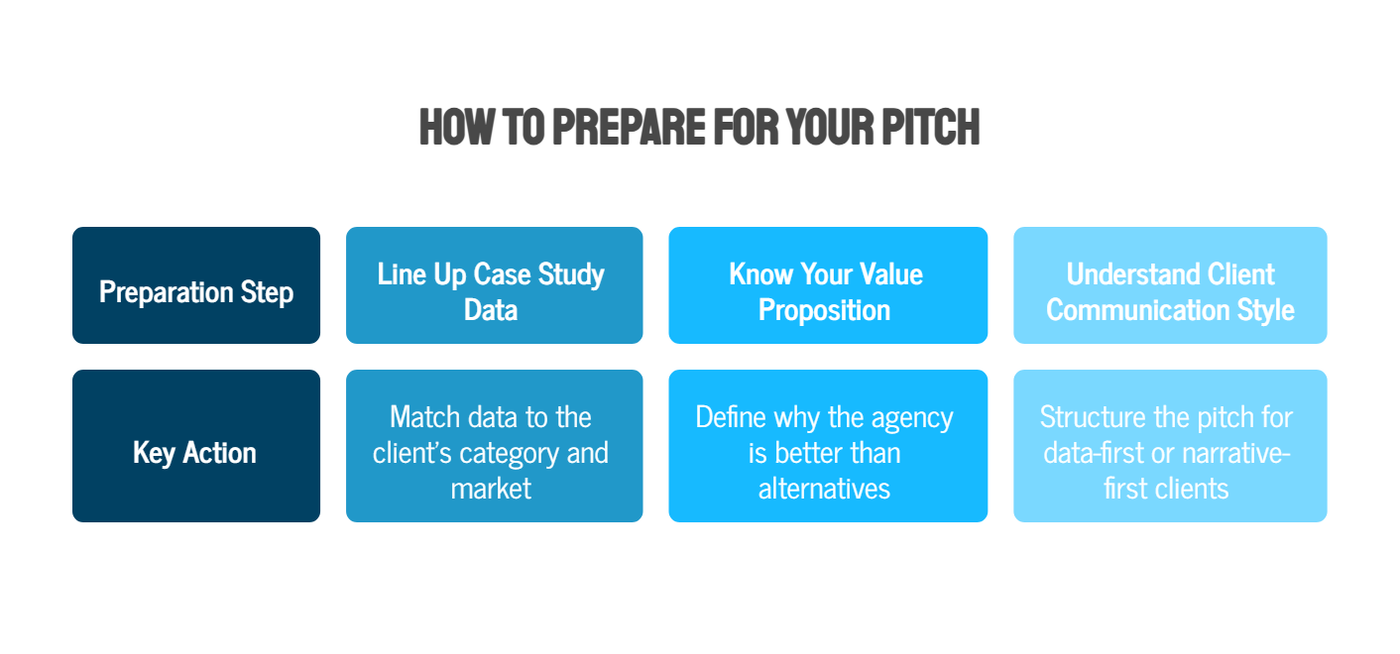
Line Up Case Study Data That Matches Their Category
Case studies are more useful when the client can recognize something about their own market, audience, or marketing problem in the example. A beauty brand will generally learn more from another beauty campaign than from an unrelated SaaS result, while a B2B client may need evidence that creator-led content can reach a more specialized audience in the first place.
The value of a case study like this gives the client a more relevant model for how UGC might function within their own strategy: the volume of content produced, the platforms used, the objective being measured, and what happened to successful creative afterward. Agencies should select case studies on that basis rather than filling a pitch deck with the largest numbers available.
Know Your Value Proposition Cold
Every agency pitching UGC should be able to answer, without hesitation, why a client should choose them over another agency or an in-house attempt at the same thing. If that answer is vague internally, it will be vague in the room. This is also where the agency's production infrastructure matters. A pitch that promises volume and speed needs a real system behind it to deliver both.
Understand the Client's Communication Style Before You Walk In
Some clients want data first and story second. Others want to understand the strategic narrative before they'll engage with a chart. Structuring the same pitch differently for each audience isn't dishonest, it's just accounting for how people actually process a proposal. A data-first client sitting through 10 minutes of narrative before reaching a single number will disengage before the pitch gets to the ask.
How to Turn One Approved Program Into a Long-Term Creative Partnership
An initial UGC program gives both the agency and the client an opportunity to establish what the format can contribute before committing to a larger investment. The scope should therefore account for what happens after the first set of assets is delivered. Clear performance criteria, a plan for testing the content, and a process for applying those findings to subsequent creative make it possible to evaluate whether the program should continue or expand.
Running UGC Alongside Studio Work
UGC does not need to replace studio-produced creative to justify its role in the media mix. Running both gives the client an opportunity to evaluate how different creative approaches perform within the same broader strategy. Depending on the campaign, that may include differences in engagement, click-through rate, acquisition cost, conversion rate, or the number of viable creative concepts produced.
Want to put this into practice?
SideShift connects you with vetted UGC creators who actually deliver. Start your free trial and post your first job in under 10 minutes.
This comparison also gives future budget decisions a clearer basis. If UGC demonstrates value for a particular audience, placement, or campaign objective, the client can increase investment based on observed performance rather than a general assumption that more UGC will produce better results.
Letting Performance Data Decide
The criteria for evaluating a UGC program should be agreed upon before content enters the market. Otherwise, agencies and clients can reach the end of the same campaign with different interpretations of whether it was successful.
The appropriate measures will depend on the purpose of the program. A campaign designed to generate paid social creative should be evaluated differently from one intended to increase organic reach or build a reusable content library. Establishing those measures in advance makes the renewal discussion less subjective and provides a clearer basis for deciding what to retain, what to change, and where additional investment may be justified.
Back Every UGC Pitch with Production Power from SideShift
Selling UGC to one client is relatively straightforward. Offering it consistently across an agency client base introduces a different challenge where every new account adds creators to source, briefs to manage, content to approve, performance to report, and payments to process. Without infrastructure designed for that work, growth in UGC revenue can also mean a corresponding increase in administrative work.
SideShift is designed to give agencies infrastructure to manage campaigns for multiple clients from one dashboard, maintain creator rosters across accounts, create client-specific reporting, and handle creator payments, invoicing, and campaign administration within the same platform.
Instead of selling a one-time package of creator assets, your agency can present a repeatable program for sourcing creators, producing and testing new content, reporting results, and applying those findings to the next round of work. The operational model is already in place if the client decides to expand.
For agencies looking to make UGC a larger part of their service offering, SideShift provides the infrastructure to manage that growth across clients without rebuilding the process for every new account.
FAQs
1. How do I price a UGC pitch for a client who's never bought UGC before?
Anchor the price to a defined scope, a set number of creators, deliverables, and a testing window, rather than an open-ended retainer. First-time UGC clients respond better to a bounded pilot with a clear price than to a broad program they can't yet evaluate the value of.
2. What proof points work best when a client hasn't run UGC campaigns before?
Category-relevant case studies matter more than volume of proof. One result from a comparable brand size, audience, or sales cycle carries more weight than five results from unrelated industries. If category-specific proof isn't available, lead with the process and measurement plan instead of overselling generic outcomes.
3. How do I pitch UGC to a client who's committed to traditional ad creative?
Position UGC as a complement running alongside existing studio production, not a replacement for it. Clients committed to traditional creative are more willing to test a new format when it doesn't require abandoning what they're already invested in.
Want to put this into practice?
SideShift connects you with vetted UGC creators who actually deliver. Start your free trial and post your first job in under 10 minutes.
4. How many creators should I propose in an initial UGC pitch?
A smaller, focused group tends to work better for a first program than a large roster, since it keeps briefing and quality control manageable while the agency and client establish a working process together. The creator count can expand once the initial results validate the approach.
5. What's a realistic timeline to show results after a client says yes to UGC?
Set expectations for a full testing cycle rather than a single ad's performance, since early results from one or two pieces of content rarely reflect what the format can do at volume. Most agencies find it takes a few weeks of consistent content and iteration before performance data is reliable enough to guide a scaling decision.