


UGC Licensing: A Complete Guide for Brands & Creators
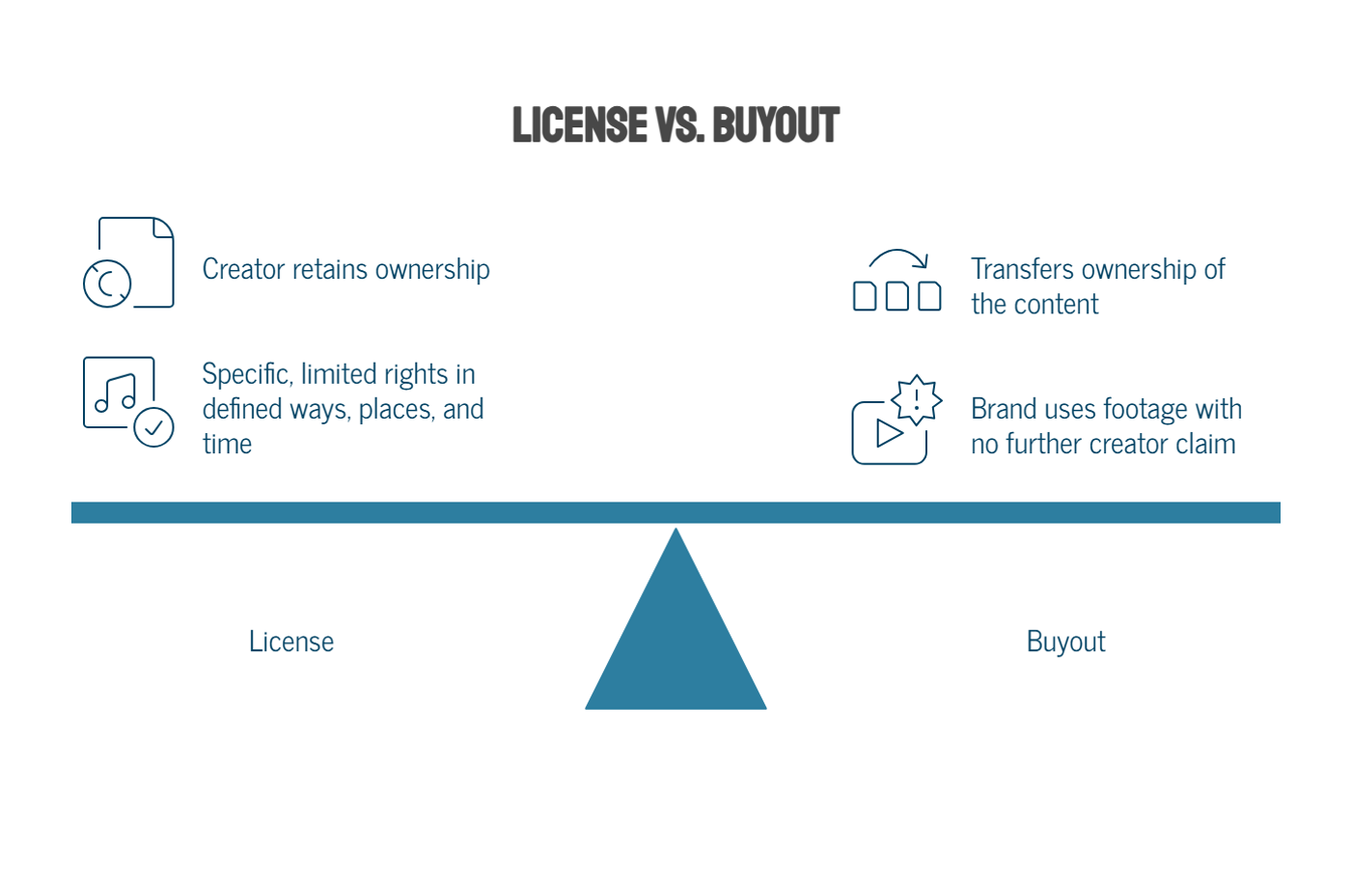
A license grants specific, limited rights. A buyout transfers ownership of the content itself, permanently, typically through a full assignment of copyright.
Table of Contents
A UGC licensing agreement transfers specific usage rights from a creator to a brand for a defined period. Unlike a buyout, where the brand owns the content outright, a license is bounded by time, geography, and channel.
Many UGC deals are structured as licenses rather than buyouts, and knowing which one you’re signing shapes how the agreement gets drafted, priced, and enforced if something goes wrong.
This guide is general information for brands and creators, not legal advice. Licensing rules vary by country and situation, so have a qualified attorney review any agreement before you sign it.
License vs. Buyout: The Core Distinction
A license grants specific, limited rights. The creator retains ownership of the underlying content and gives the brand permission to use it in defined ways, for a defined stretch of time, in defined places.
A buyout transfers ownership of the content itself, permanently, typically through a full assignment of copyright or, in limited cases, a work-made-for-hire clause. Once a buyout closes, the creator has no further claim on how, where, or how long the brand uses that footage.
The confusion between the two shows up often in creator briefs, where “full usage rights” gets used to mean both things depending on who's writing it. A UGC usage rights grant and a buyout can look nearly identical on paper if the license term runs long enough, but the legal mechanics underneath are different, and that difference tends to matter most once a dispute reaches a lawyer.
Why Choose a License Over a Buyout?
Buyouts sound appealing on the surface: Pay once, own it forever, never think about renewal.
In practice, many brands find a license is the better fit. The cost alone makes the case: You're paying for the specific channels and duration you'll actually use, not every conceivable future application of the content.
There's flexibility too. If a piece of content performs well, a paid extension lets you scale usage up without having locked your budget into an asset you weren't sure would earn its keep. And when a creator relationship sours or the content just underperforms, walking away is simple. The license expires and that's the end of it.
Unwinding a buyout, by contrast, isn't really possible. You own the content either way, even after the relationship with the creator has fallen apart, and some brands find that outcome less appealing than it sounded going in.
Buyouts still make sense in narrow cases: a hero campaign asset the brand plans to run for years, or a creator relationship where ongoing licensing overhead genuinely doesn't pencil out. As a default, though, many UGC programs run on licenses, with buyouts saved for cases like these.
The 5 Components of a UGC Licensing Agreement
A licensing agreement that holds up in a dispute covers five things clearly.
- Licensed content: Name the specific assets covered, whether that's a single video, a batch of deliverables from one shoot, or everything a creator produces under a broader retainer. Vague scoping here is a common source of disputes.
Want to put this into practice?
SideShift connects you with vetted UGC creators who actually deliver. Start your free trial and post your first job in under 10 minutes.
- Permitted uses: Spell out which channels, ad placements, and formats are included. Organic social, paid ads, email, your website, and print all count as separate uses unless the agreement says otherwise, and a creator who agreed to organic posting shouldn't end up on a billboard without ever signing off on it.
- License term: Every agreement needs a start date and an end date, plus a clear answer on what happens with renewal. (For guidance on how long different use cases typically need, our breakdown of how long UGC usage rights should last covers the standard windows by channel.)
- License fee and payment terms: State the base rate and any duration or scope multiplier, then be specific about when payment is actually due relative to delivery and go-live.
- Restrictions and obligations: This is where FTC disclosure requirements, takedown timelines, and sublicensing permissions belong. A creator's FTC disclosure obligations don't disappear just because the usage rights are properly licensed, so both need to live in the same document.
Common License Types: Exclusive, Non-Exclusive, Sole, and Sublicensable
UGC agreements can include a non-exclusive license, which allows creators to license the same or similar content to other brands, potentially including competitors. This is generally a more affordable licensing structure and is common in standard UGC deals.
An exclusive license removes that overlap. Only your brand can use the content, and depending on how the clause is written, the creator may also be barred from using it themselves. Exclusivity commands a premium precisely because it costs the creator future opportunities.
A sole license sits between the two. The creator agrees not to license the content to anyone else, but retains the right to use or post it themselves. It's a middle ground that shows up more often in creator-owned content than in brand-commissioned UGC.
Sublicensable rights are a separate question from all three. A standard license usually doesn't let a brand hand the content to its agency, its media buyer, or a retail partner to run independently. If your team works through an agency or plans to distribute the asset to partners, it's worth including clear sublicensing permissions in the agreement to avoid potential usage restrictions or disputes down the line.
How to Price a UGC License
Most UGC licenses start with a base creation fee and add charges for how the content will be used and for how long. Rates vary by creator, category, and platform, so treat any figure as a starting point rather than a fixed rule.
Some guides price paid usage by the month instead, at around 20% to 30% of the base rate for each month the content runs as an ad. That model makes longer terms climb quickly. For runs of six to twelve months, many brands negotiate a fixed license fee with smaller monthly extensions beyond the included period, which keeps the budget predictable. Perpetual rights sit at the top of the range, often priced at two to three times the base rate in published benchmarks.
Want to put this into practice?
SideShift connects you with vetted UGC creators who actually deliver. Start your free trial and post your first job in under 10 minutes.
Exclusivity and sublicensing are usually priced as separate add-ons on top of the usage fee. There’s no single published standard for either. The cost tends to rise with the length of the exclusivity window, how competitive the category is, and how many parties the sublicense covers, whether that’s an agency, a retailer, or a partner.
Duration and scope are separate levers, and they’re easier to negotiate that way. A term license typically sets the time period, channels, and territories as distinct terms. A brand could hold a 12-month, non-exclusive, non-sublicensable license at a modest rate, or a 90-day exclusive, sublicensable license for considerably more. Working out which combination the campaign actually needs, instead of defaulting to the broadest grant available, keeps licensing costs in proportion to what the content is doing for you.
License Renewal: Auto-Renew vs. Manual Extension
Renewal terms deserve their own line in the contract rather than a passing mention. Auto-renewal clauses, where usage continues at the same rate unless either party gives notice, work well for ongoing relationships where both sides expect the arrangement to continue. They fall apart when the language is vague about pricing, since "renews automatically" without a stated renewal rate leaves the creator locked into last year's price even if their rates have since gone up.
Manual extension puts the decision back in both parties' hands at the end of each term. Nothing continues without a new signature, which means more administrative touchpoints but far less ambiguity about what's currently licensed and at what price. Brands running a small, high-value creator roster tend to prefer manual extensions specifically because they force a periodic check-in on whether the content is still worth the license fee.
When a License Terminates Early
A handful of triggers can end a license before its natural expiration. On the creator side, violating an exclusivity clause or missing FTC disclosure requirements may give the brand grounds to terminate and, depending on the contract, recover fees already paid.
A missed payment can work the same way in reverse, giving the creator similar recourse, and the brand usually has to stop running the content right away. Sometimes neither party is the problem.
An FTC compliance issue may also lead to termination, since running sponsored content without proper disclosure can expose the brand to legal risk.
And when nobody's at fault, both sides can simply agree to end things, typically with a defined wind-down window for any content still live.
Contracts that spell these triggers out from the start save both sides from negotiating termination terms in the middle of an active dispute, when neither party is thinking clearly about what's fair.
What License Language Actually Looks Like
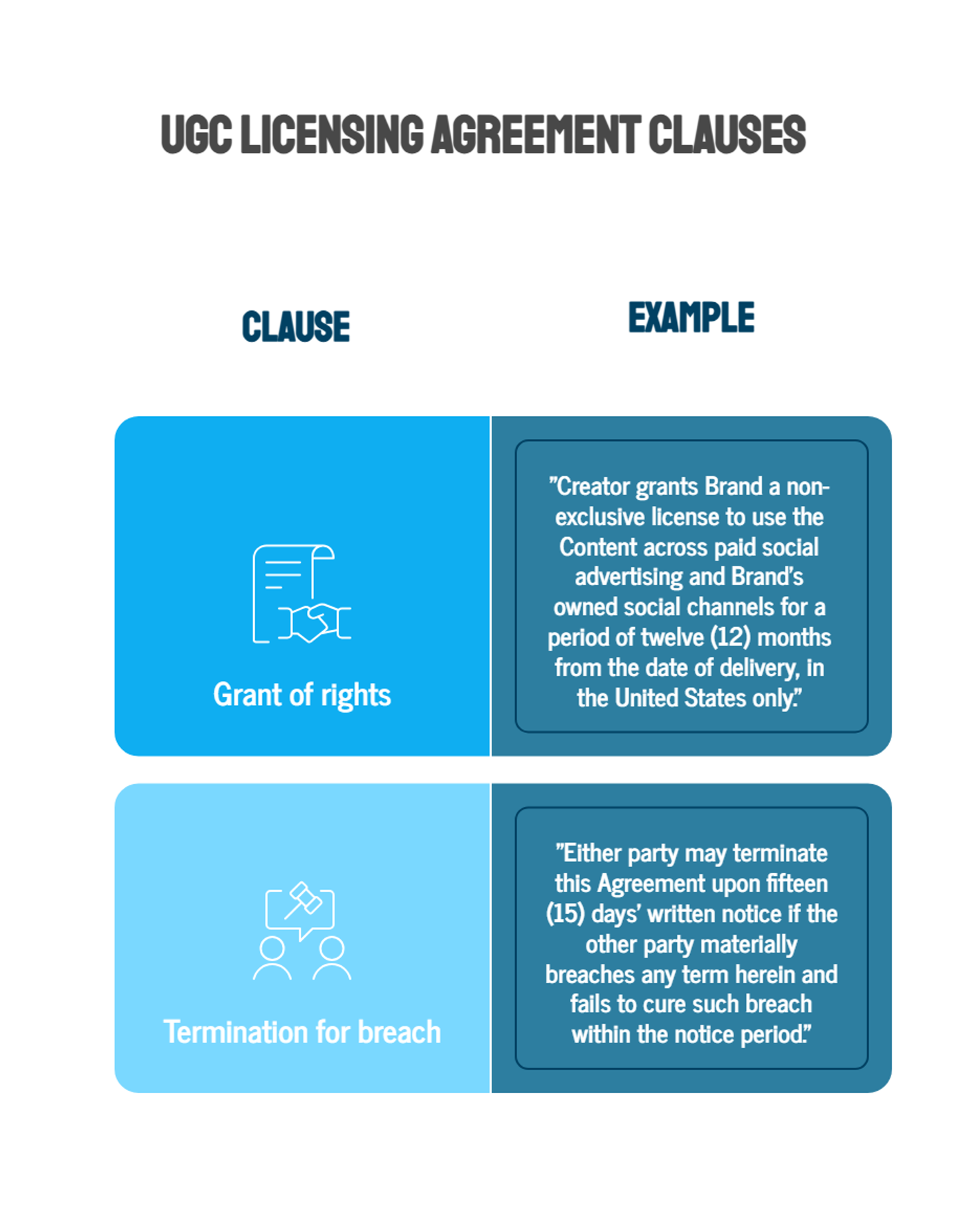
Most of this guide has covered concepts. Here's roughly what two of the more important clauses look like in practice, in plain language rather than dense legalese:
- Grant of rights: “Creator grants Brand a non-exclusive license to use the Content across paid social advertising and Brand's owned social channels for a period of twelve (12) months from the date of delivery, in the United States only.”
Want to put this into practice?
SideShift connects you with vetted UGC creators who actually deliver. Start your free trial and post your first job in under 10 minutes.
- Termination for breach: “Either party may terminate this Agreement upon fifteen (15) days' written notice if the other party materially breaches any term herein and fails to cure such breach within the notice period.”
Neither clause does anything unusual. The value is in specificity. Name the exact channels, the exact territory, and how many days each side has to act, rather than leaving any of it open to interpretation later. If you want a full set of these clauses ready to drop into your own paperwork, our UGC contract template walks through the complete document.
Licensing Derivative Works: Cutting, Remixing, and Translating UGC
A standard license covers using the content as delivered. It usually does not automatically cover derivative works: cutting a long-form video into six-second ad snippets, remixing footage with new music or graphics, or translating captions and voiceover into other languages for international markets. This trips up more brands than almost any other clause, because editing content feels like a routine part of running ads, not a separate legal question.
If your team regularly repurposes creator footage into multiple ad formats, the licensing agreement needs to say so explicitly, granting the right to edit, crop, remix, and translate the content rather than assuming that a general usage grant covers it. More creators are pushing back when they feel their work was materially altered without permission, and a derivative works clause heads that conversation off before it starts.
How International Licensing Changes the Math
A license that works cleanly in the U.S. can run into friction the moment a campaign goes global. U.S. copyright law allows fairly complete transfer of rights through a licensing agreement, but many countries, particularly across the EU, recognize moral rights that a creator cannot fully sign away no matter what the contract says, including the right to object to how their work is altered or attributed.
The Copyright Alliance notes that exclusive licenses in the U.S. effectively transfer ownership of the licensed rights to the licensee, a framework that doesn't map directly onto jurisdictions where the underlying moral rights stay with the creator regardless of what's licensed.
For brands running campaigns across multiple regions, this usually means naming the specific territories covered rather than defaulting to worldwide rights, and building in language that respects local moral rights protections rather than assuming a U.S.-style buyout clause will hold up the same way in every market.
Manage Creator Relationships with SideShift
Licensing terms are easy to get right on paper and hard to keep track of in practice, especially once a brand is running dozens of active creator contracts at different stages of their term. SideShift keeps creator engagement organized in one place instead of scattered across email threads and spreadsheets, from contracts and deliverables to the day-to-day back-and-forth.
The platform also connects directly to payments, so brands can see payment status for any creator without digging through a separate system. Whether you're managing a handful of creators or scaling a full content engine, that connection between contract terms and the money moving against them is where most manual systems break down.
Want to put this into practice?
SideShift connects you with vetted UGC creators who actually deliver. Start your free trial and post your first job in under 10 minutes.
FAQs
1. What's the difference between licensing and buying UGC?
Licensing grants the brand specific, time-bound rights while the creator keeps ownership of the content. Buying, or a buyout, transfers full ownership permanently. Many UGC deals are licenses, since they usually cost less and let the brand pay only for the rights it needs.
2. Can I sublicense UGC to my agency?
Only if the agreement explicitly grants sublicensing rights. Some licensing agreements may limit usage to the brand itself, depending on the terms. If an agency, media buyer, or retail partner needs to use the content independently, it's worth clarifying those permissions in the contract.
3. What happens if I want to keep using the content after the license expires?
You need a renewal or extension, agreed and priced before the original term ends. Continuing to run content past its license date without a new agreement puts the brand in breach, even if the original relationship with the creator was friendly.
4. Do I need a separate license for each ad platform?
Not necessarily, but the agreement should name the platforms covered rather than using vague language like “paid social.” Meta, TikTok, and YouTube can each be named under one license, or scoped separately if you expect to add platforms later and want the flexibility to negotiate those individually.
5. Can a creator revoke a license early?
Early termination may be possible if either party breaches the agreement, such as through missed payments or content use outside the permitted scope. Depending on the contract terms, a license with a defined duration may limit either party's ability to end the agreement early without cause. That's why it's important to clearly outline termination conditions from the start.