


UGC Contract: What Brands & Creators Need to Include (2026 Guide)
A UGC contract protects brands and creators. See exactly what to include, sample clauses, and a complete contract template you can adapt for any UGC deal.
Table of Contents
A UGC contract should cover parties, scope of work, deliverables, payment, usage rights, exclusivity, FTC disclosure, revisions, kill fee, and termination. A standard UGC agreement runs two to four pages. Most brand-creator disputes trace back to missing or vague clauses in two or three of these sections, not to any single catastrophic failure.
A UGC creator contract that looks thorough on the surface can still leave both sides exposed if the usage rights section is one vague sentence or the payment terms never mention a schedule. This guide walks through what needs to be in a UGC contract to make it effective, what strong clause language looks like, and where brands and creators most often get it wrong.
Why a Written UGC Contract Matters, Even for a $200 Deal
A lot of smaller UGC deals start informally. A brand reaches out, the creator agrees to a rate and deliverables, they settle on a deadline, and the project moves forward without a contract.
That can work, but it leaves a lot of important details open to interpretation. When is payment due? How many revisions are included? Can the brand run the content as an ad? How long can they use it? What happens if the project is canceled after the creator has already started working?
A UGC contract answers these questions before they become an issue. And it does not need to be lengthy or overly legal. Even for a $200 project, a straightforward written agreement outlining deliverables, payment terms, usage rights, revisions, and deadlines can give both the brand and creator a clear understanding of what they agreed to.
The 10 Essential Sections of a UGC Contract
Below is the core structure that shows up in most effective UGC content creator contracts, along with what belongs in each section.
1. Parties and Effective Date
Start with the full legal names of the creator and brand, any relevant business entities, and the date the agreement takes effect. This sounds basic, but it establishes exactly who is entering the agreement and who is responsible for fulfilling its terms.
If an agency is hiring a creator on behalf of a client, for example, the contract should make clear which company is actually responsible for payment and which parties receive usage rights.
2. Scope of Work
Spell out exactly what the creator is being hired to produce. Include the type of content, quantity, approximate length, format, required messaging or product mentions, and any agreed-upon creative requirements.
"Three UGC videos" leaves considerably more room for interpretation than "three 30–45 second vertical videos delivered as edited 9:16 MP4 files." If raw footage, alternate hooks, still images, captions, or additional aspect ratios are expected, those should be listed as separate deliverables rather than assumed to be included.
3. Timeline
Define the major dates in the project, including when products or creative briefs will be provided, when the first draft is due, how long the brand has to provide feedback, and when final assets will be delivered.
Timelines should account for both parties. A creator cannot reasonably be expected to maintain a final delivery date if a product arrives a week late or feedback that was expected within two days takes nine. Including dependencies like these makes it easier to determine when a deadline should move rather than treating every delay as the creator's responsibility.
Want to put this into practice?
SideShift connects you with vetted UGC creators who actually deliver. Start your free trial and post your first job in under 10 minutes.
4. Payment
State the total compensation, when payment is due, how it will be paid, and whether the creator receives any amount upfront. For larger projects, payment may be divided into milestones, such as 50% at signing and 50% after final delivery.
The contract should also clarify what triggers payment. "Payment upon completion" can mean different things to each party. A specific term such as "within 15 days of final asset delivery" gives both sides an identifiable due date. Any reimbursable expenses, late fees, platform fees, or additional charges should also be addressed here.
5. Usage Rights
Usage rights determine what the brand is actually purchasing beyond the creation of the content. The agreement should specify where the content can appear, how long the brand can use it, the geographic territory covered, and whether the rights are exclusive or non-exclusive.
This section should distinguish between organic and paid usage. Permission to repost a creator's video on a brand's Instagram account does not automatically mean the brand can turn that video into a Meta ad, use it in an email campaign, place it on a product page, or run it through the creator's account as a partnership ad. Those uses have different commercial value and should be negotiated accordingly.
6. Content Approval and Revision Process
Define how drafts will be reviewed, who is responsible for approving them, how feedback should be submitted, and how many revision rounds are included in the original fee.
It also helps to distinguish a revision from a reshoot. Changing text on screen or trimming a clip is very different from asking the creator to film an entirely new concept. The agreement can establish when feedback falls outside the original scope and what the creator will charge for additional revisions, reshoots, or new deliverables.
7. FTC Disclosure Requirements
For content that involves an endorsement or material relationship, the contract should require compliance with applicable advertising disclosure rules. That may include clearly identifying sponsored content with language such as "ad," "sponsored," or another disclosure appropriate to the platform and circumstances.
This responsibility should not be left entirely to the creator. Brands should provide accurate claims and instructions, while creators should avoid making unsupported claims or hiding required disclosures.
Putting those expectations in the agreement helps establish compliance as a shared part of the campaign rather than something addressed immediately before publishing.
8. Confidentiality and NDA Terms
Confidentiality provisions are especially relevant when creators receive information that is not yet public, such as unreleased products, launch dates, campaign concepts, pricing changes, customer information, or internal performance data.
The clause should identify what information is considered confidential and how long that obligation lasts. It should also be specific enough that creators understand what they can and cannot share. An overly broad confidentiality clause can create unnecessary restrictions, while an overly vague one may provide little practical protection.
Want to put this into practice?
SideShift connects you with vetted UGC creators who actually deliver. Start your free trial and post your first job in under 10 minutes.
9. Kill Fee and Termination
Projects do not always make it to publication. A campaign may be canceled, a launch may move, or a brand may change direction after the creator has already spent time scripting, filming, or editing.
A kill fee establishes what the creator is owed if the project ends before completion. The amount can depend on how much work has already been completed. For example, cancellation before filming may carry a smaller fee than cancellation after the creator has delivered a finished first draft.
The contract should also explain when either party can terminate the agreement and what happens to completed content and payments afterward.
10. Indemnification and Liability
This section addresses responsibility when something goes legally wrong. Depending on the agreement, it may cover issues such as copyright infringement, false advertising claims, unauthorized use of third-party material, or content that violates another person's rights.
The important point is to allocate responsibility according to what each party actually controls. A creator may be responsible for music or footage they add without permission, while a brand may be responsible for product claims, scripts, trademarks, or other materials it instructs the creator to use. The contract may also limit the amount either party can be held liable for, rather than leaving that exposure undefined.
Sample Clause Language for UGC Contracts
Knowing what belongs in a UGC contract is one thing. Translating those terms into clear contract language is another. The goal is to make the agreement specific enough that both parties know what they can expect from the project.
The examples below show how some of the terms discussed above might be written into an agreement. They are starting points rather than universal language and should be adjusted to reflect the actual campaign.
Sample Usage Rights Clause
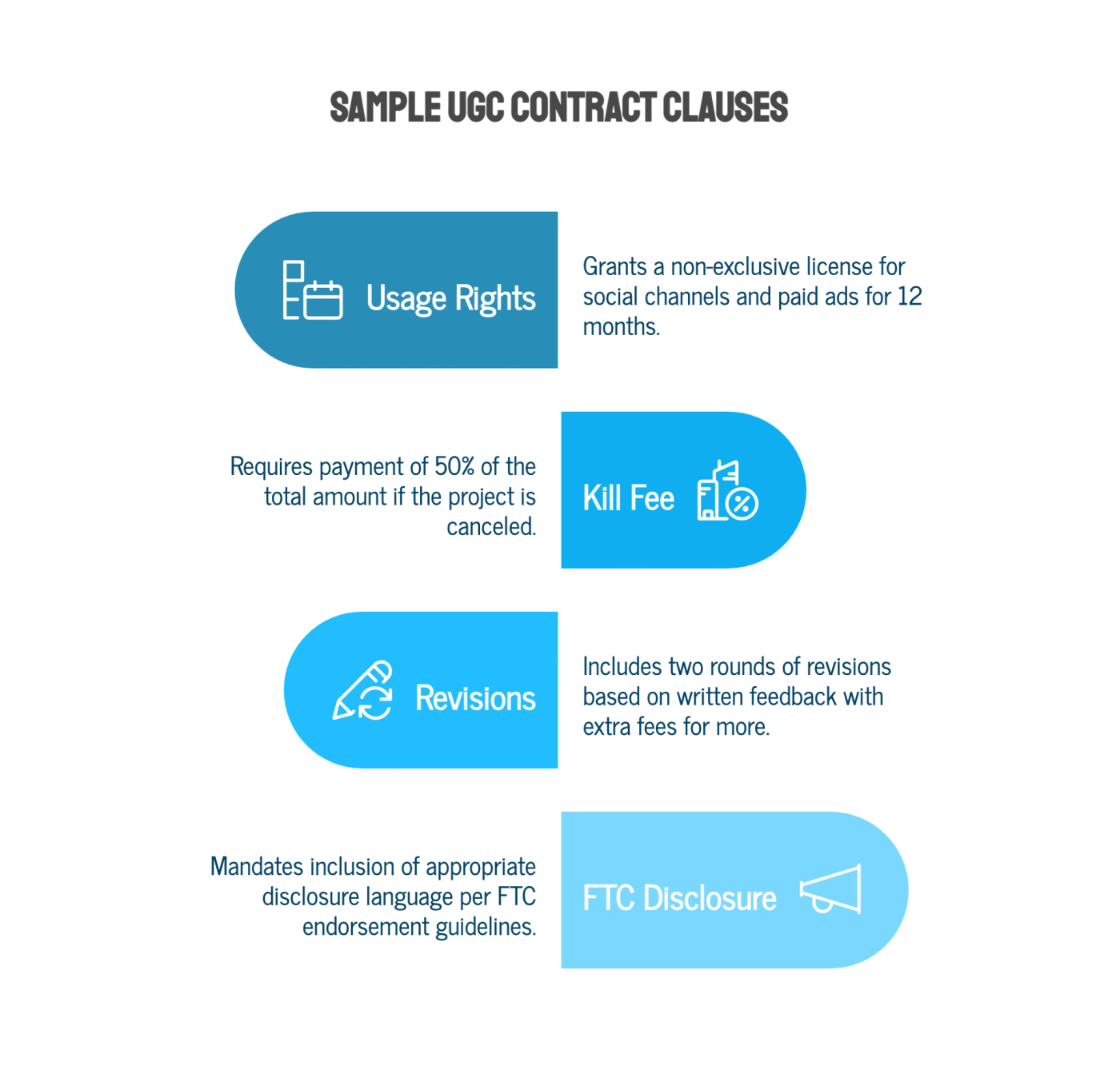
"Brand is granted a non-exclusive license to use the Content across owned social channels and paid advertising for a period of 12 months from the date of delivery. Any use beyond this period requires a separate written agreement."
This clause establishes where the content can be used, how it can be used, and for how long. If the brand also wants website, email, retail, whitelisting, partnership ads, or other usage, those rights should be added specifically rather than assumed to fall under the original license.
Sample Kill Fee Clause
"If Brand cancels this agreement after Creator has begun production but before final delivery, [Brand] agrees to pay 50% of the total contracted amount as a kill fee."
A kill fee protects the creator from completing unpaid work when a project is canceled for reasons outside their control. The contract should also define when "production" begins. Depending on the project, that could mean concept development, scripting, filming, or another agreed milestone.
Sample Revisions Clause
"Creator will provide up to two rounds of revisions based on Brand's written feedback. Additional revision rounds will be billed at an agreed hourly or flat rate."
Want to put this into practice?
SideShift connects you with vetted UGC creators who actually deliver. Start your free trial and post your first job in under 10 minutes.
This sets a boundary around what is included in the original project fee. A stronger revision clause can also define what qualifies as a revision versus a new request. Minor editing changes may be included, for example, while a new concept or reshoot caused by a change in the brand's brief may require an additional fee.
FTC Disclosure Clause
"Creator agrees to include appropriate disclosure language on sponsored Content in accordance with applicable FTC endorsement guidelines."
Disclosure requirements depend on the nature of the relationship and how the content is presented. The contract can establish that compliant disclosure is required while also clarifying the brand's responsibility for providing accurate product claims, campaign instructions, and any other information the creator needs to produce compliant content.
Sample clauses like these turn broad expectations into terms that can actually be referenced during a project. "The brand can use the video" becomes a defined 12-month license. "Revisions are included" becomes two rounds of written feedback. "You'll still get paid if we cancel" becomes a specific percentage triggered at a specific stage.
Common Contract Mistakes Brands Make
Brands tend to make the same handful of mistakes on repeat.
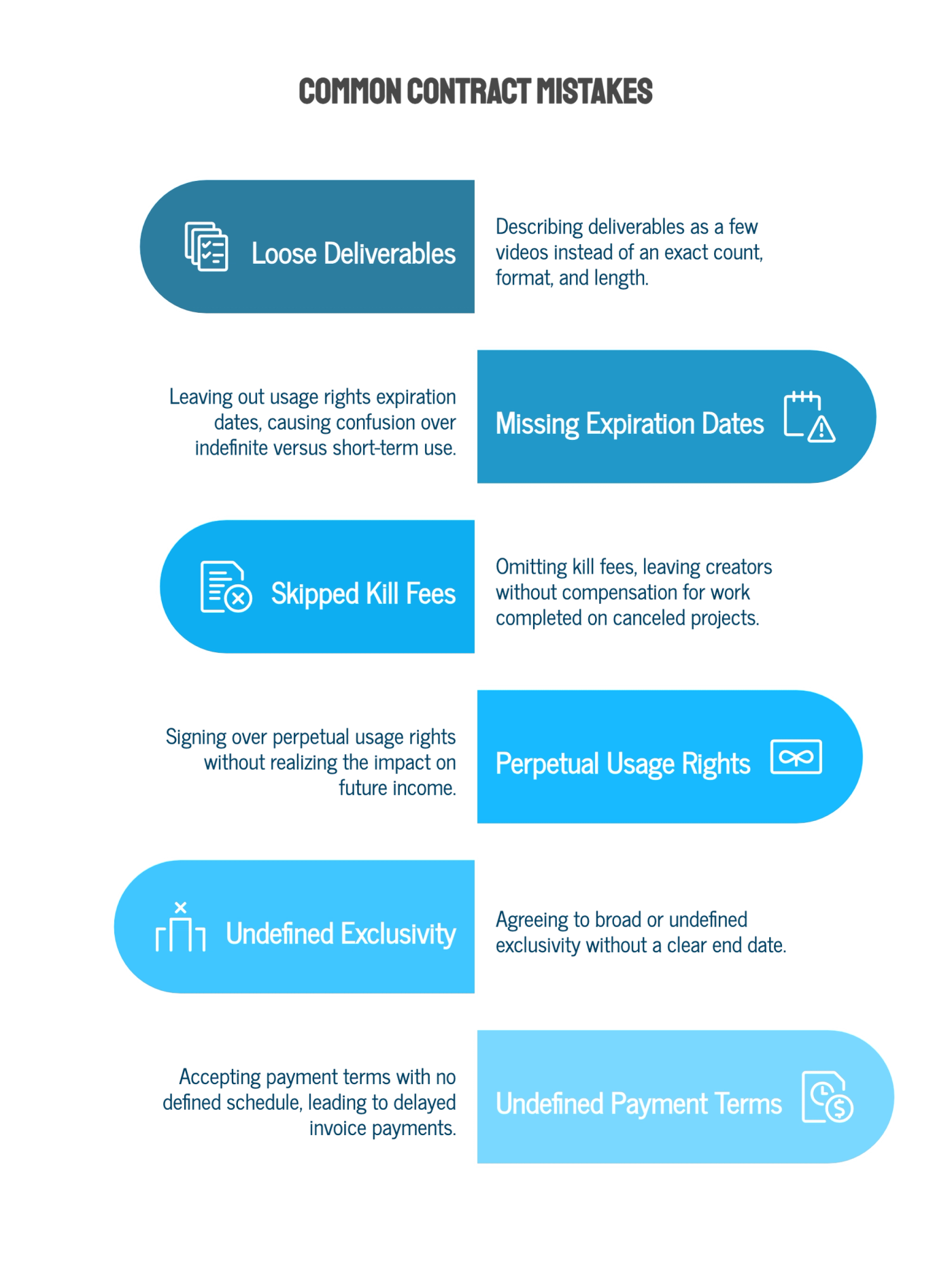
- Deliverables get described loosely, something like "a few videos," instead of an exact count, format, and length.
- Usage rights expiration dates get left out entirely, which means a brand assumes indefinite use while the creator assumes a much shorter window.
- Kill fees are often skipped altogether, so a canceled project leaves the creator with no compensation for work already completed.
Common Contract Mistakes Creators Make
Creators run into a different set of problems.
- Signing over perpetual usage rights without realizing what that means for future income is one of the most costly.
- Agreeing to broad or undefined exclusivity, sometimes without a clear end date, which can block them from working with adjacent brands for far longer than intended.
- Accepting payment terms with no defined schedule, which can leave them chasing invoices weeks after delivery.
When to Use a Built-In Agreement vs. a Custom Legal Contract
Not every UGC collaboration needs a lengthy custom contract. For a straightforward project with a limited number of deliverables, brands and creators can often work from a standard agreement that clearly defines the scope, payment terms, deadlines, revisions, and usage rights.
A custom legal contract becomes more relevant as the value or complexity of the relationship increases. Long-term ambassador partnerships, exclusivity agreements, international campaigns, broad paid media rights, intellectual property transfers, or deals involving significant compensation may introduce terms that a standard agreement was never designed to address.
There is no specific dollar amount at which a custom contract suddenly becomes necessary. A better question is whether the agreement introduces rights, obligations, or financial exposure that the parties' standard terms do not adequately cover. As that complexity increases, having an attorney review or draft the agreement may be worth the additional cost.
Want to put this into practice?
SideShift connects you with vetted UGC creators who actually deliver. Start your free trial and post your first job in under 10 minutes.
When to Involve a Lawyer
Most standard UGC deals don't need legal review. A lawyer becomes worth the cost when a contract involves six-figure usage rights, exclusivity across an entire product category, international creators subject to different contract law, or any custom IP transfer beyond standard content licensing.
This guide is not legal advice, and brands or creators working through a high-stakes agreement should have it reviewed by a qualified attorney in their jurisdiction.
Sample UGC Contract Template
The following outline shows how these sections can come together in a basic UGC agreement. The specific terms should always be adjusted to the collaboration, and brands or creators may want legal review for higher-value or more complex agreements.
UGC Content Creation Agreement. This Agreement is entered into as of [Effective Date] between [Brand Legal Name], located at [Brand Address] ("Brand"), and [Creator Legal Name/Business Name], located at [Creator Address] ("Creator").
1. Recitals. Brand wishes to engage Creator to produce user-generated content related to [Product/Service/Campaign], and Creator agrees to provide the content described below according to the terms of this Agreement.
2. Scope of Work and Deliverables. Creator will produce and deliver [Number] UGC video(s), approximately [Length] seconds each, delivered in [Format/Resolution], featuring [Product/Key Message], with required talking points per the attached creative brief. Additional deliverables (raw footage, alternate hooks, photos, story frames, etc.) and any creator posting requirements should be listed separately. Any deliverables not expressly listed above fall outside the agreed scope and may require an additional fee.
3. Timeline and Delivery Dates. Brand will provide all required products, briefs, talking points, and other production materials by [Date]. Creator will provide the first draft by [Date] and final approved deliverables by [Date]. Brand will provide consolidated feedback within [Number] business days of receiving each draft. Delays in product delivery, creative direction, approvals, or feedback may result in corresponding changes to Creator's delivery dates.
4. Payment Terms. Brand will pay Creator a total project fee of $[Amount], structured as [e.g., 50% non-refundable retainer upon signing and the remaining 50% due within 15 days of final content delivery]. Work requested outside the agreed scope will be billed at [Hourly Rate/Flat Fee] upon approval by both parties. Each party is responsible for its own applicable taxes unless otherwise required by law.
5. Expenses, Invoicing, and Late Payments. Production expenses outside the original scope must be approved by Brand before they are incurred. Creator will issue invoices according to the payment schedule above. Invoices unpaid after [Number] calendar days may be subject to a late fee of [Percentage]%, to the extent permitted by applicable law.
6. Ownership. Unless otherwise agreed in writing, Creator retains ownership of the Content created under this Agreement. Brand receives only the usage rights expressly granted below. Those rights become effective upon [full payment/other agreed trigger].
7. Usage Rights and Licensing. Creator grants Brand a [non-exclusive/exclusive] license to use the approved Content for [organic brand-owned social media, paid social advertising, website/e-commerce, email marketing, other agreed channels]. The license will remain in effect for [Number] months beginning [on final delivery/on first publication/etc.] and applies within [Territory]. Use beyond the agreed channels, territory, or licensing period requires a separate written agreement and may require additional licensing fees.
Want to put this into practice?
SideShift connects you with vetted UGC creators who actually deliver. Start your free trial and post your first job in under 10 minutes.
8. Usage Restrictions. Unless expressly included above, Brand does not receive rights to perpetual or unlimited usage; broadcast, television, streaming, print, or out-of-home advertising; whitelisting or advertising through Creator-owned accounts; transfer or sublicense of the Content to third parties; use of the Content for merchandise or product resale; or material alteration of Creator's likeness, statements, or Content beyond agreed editing permissions. Any additional rights must be agreed to in writing.
9. Creator Portfolio Rights. Unless otherwise restricted by an agreed confidentiality or embargo period, Creator may display completed and publicly released Content in Creator's portfolio, website, social media, presentations, and other self-promotional materials.
10. Approval and Revisions. Creator will provide up to [Number] rounds of revisions based on Brand's consolidated written feedback. Included revisions cover reasonable changes within the approved concept and original creative brief. Additional revisions, reshoots, new concepts, changes in creative direction, or requests that materially expand the original scope may require additional fees.
11. FTC Disclosures and Advertising Compliance. Where Creator publishes sponsored Content to Creator-owned channels and a material connection requires disclosure, Creator agrees to make clear and conspicuous disclosures in accordance with applicable FTC endorsement requirements. Brand is responsible for providing accurate product information, approved claims, required disclaimers, and other campaign-specific instructions necessary for Creator to complete the work. Neither party will knowingly instruct the other to make false, misleading, or unsupported representations.
12. Confidentiality. Creator agrees not to disclose non-public information provided by Brand in connection with the collaboration, including unreleased products, campaign strategies, launch plans, pricing, proprietary materials, or other information identified as confidential. This restriction does not apply to information that becomes publicly available through no breach of this Agreement or that must be disclosed by law. Any confidentiality obligations intended to continue after termination should be identified in this section.
13. Representations and Warranties. Each party represents that it has the authority to enter into this Agreement. Creator represents that original Content independently created for the project will not knowingly infringe third-party copyrights, trademarks, publicity rights, or other intellectual property rights and that Creator will obtain appropriate rights for third-party materials Creator independently introduces into the Content. Brand represents that it has the necessary rights to products, trademarks, scripts, claims, creative assets, and other materials it provides to Creator and authorizes Creator to use. Any agreed category exclusivity or restrictions on Creator working with competing brands should also be stated here, including the applicable category and duration.
14. Independent Contractor. Creator is engaged as an independent contractor and not as an employee of Brand. Except for the requirements established in the approved brief and this Agreement, Creator retains control over Creator's production methods, equipment, scheduling, and creative execution.
15. Cancellation, Kill Fee, and Termination. Either party may terminate this Agreement in writing subject to the terms below. If Brand cancels after Creator has begun work but before final delivery for reasons unrelated to Creator's breach, Brand will pay [Percentage]% of the total project fee as a kill fee. Brand will also remain responsible for approved non-refundable expenses and any additional completed work that the parties have agreed is payable. If Creator terminates the project without completing the agreed work, the Agreement should specify whether any unused portion of advance payments will be returned. Upon termination, Brand receives no right to use unfinished or unpaid Content unless otherwise agreed in writing.
Want to put this into practice?
SideShift connects you with vetted UGC creators who actually deliver. Start your free trial and post your first job in under 10 minutes.
16. Indemnification and Liability. Each party is responsible for materials, claims, representations, and conduct within its reasonable control. Creator is responsible for third-party materials Creator independently introduces into the Content without authorization. Brand is responsible for product claims, scripts, trademarks, products, and other materials supplied or required by Brand. Any indemnification obligations should identify the types of third-party claims covered and any applicable procedures or limitations. To the extent permitted by applicable law, the Agreement may also establish agreed limitations on either party's liability.
17. General Terms. Modifications: any modification to this Agreement must be made in writing and agreed to by both parties. Governing Law: this Agreement will be governed by the laws of [State/Country]. Electronic Signatures: electronic signatures and electronically executed copies of this Agreement will be treated as valid signatures to the extent permitted by applicable law. Entire Agreement: this Agreement represents the complete understanding between the parties regarding the collaboration and supersedes prior written or verbal discussions concerning the same subject matter.
18. Signatures. By signing below, both parties acknowledge that they have read, understood, and agreed to the terms of this Agreement, with signature blocks for Brand (name, title, signature, date) and Creator (name, business name if applicable, signature, date).
Build Contracts Into Your Creator Workflow with SideShift
A UGC contract example is only useful if someone actually follows through on updating and sending it for every single collaboration. That's where most manual processes break down. Spreadsheets and email threads make it easy for a scope-of-work clause to fall out of a copy-paste, or for a kill fee to get dropped from one deal to the next.
SideShift builds contract terms directly into the creator management workflow, so every deal carries the same protections without anyone having to rebuild the agreement from a blank page. Payments, usage rights, and deliverables stay tied together in one system instead of scattered across tools.
And for brands managing UGC at scale, contracts are only one part of the administrative workload. Creator sourcing, communication, approvals, and payments all have to be managed across potentially dozens or hundreds of collaborations. SideShift helps centralize more of that creator workflow, including briefing and contract management, rather than relying on a combination of DMs, spreadsheets, invoices, and separate payment tools.
FAQs
1. Do I need a lawyer for a UGC contract?
Not for most standard deals. Built-in templates cover the essentials for single-deliverable or short-term collaborations. A lawyer is worth involving for high-value deals, multi-territory rights, or custom IP transfer.
Want to put this into practice?
SideShift connects you with vetted UGC creators who actually deliver. Start your free trial and post your first job in under 10 minutes.
2. What's the difference between a UGC contract and a brief?
A brief outlines creative direction and content expectations. A contract governs the legal and financial terms of the collaboration, including payment, usage rights, and what happens if either side doesn't deliver. Most collaborations need both.
3. Can I use the same contract for every creator?
A consistent template works well as a base, but scope, payment, and usage terms should be adjusted for each specific deal rather than reused word for word.
4. What happens if the creator misses the deadline?
This should be addressed directly in the contract's timeline and termination sections. Some agreements build in a grace period; others tie missed deadlines to the kill fee clause.
5. Do U.S. laws apply to international creators?
Not automatically. Contracts with creators outside the U.S. should specify which jurisdiction's law governs the agreement, since default assumptions about applicable law can vary significantly by country.