


How Long Should UGC Usage Rights Last?
If you're negotiating a UGC usage rights agreement right now, the question you're really asking is how long to license UGC before you have to come back and renegotiate.
Table of Contents
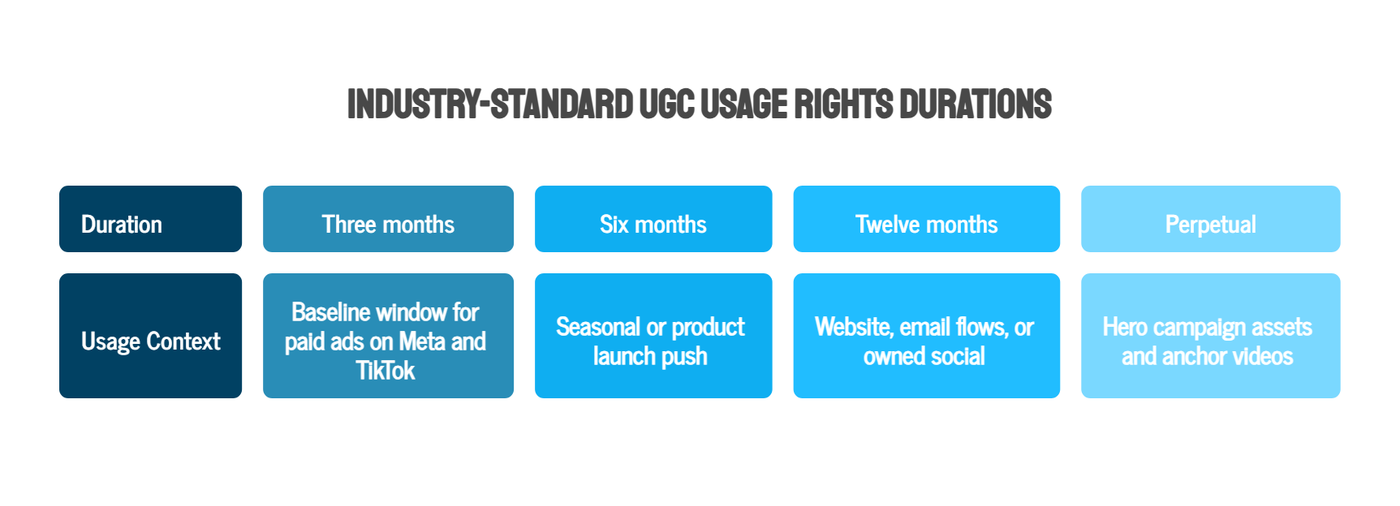
Most UGC usage rights are often negotiated in terms of three months, six months, or 12 months, depending on the campaign's needs and the agreement between the parties.
Six months can cover a longer campaign or multiple campaign phases. Twelve months fits evergreen brand assets you plan to keep running well past the original shoot date. Perpetual rights sit above all three, typically at two to four times the base fee, and they lock the content in indefinitely, which only pays off when the asset is genuinely foundational to your brand.
If you're negotiating a UGC usage rights agreement right now, the question you're really asking is how long to license UGC before you have to come back and renegotiate. That answer depends less on habit and more on where the content is going to live.
What Are the Industry-Standard UGC Usage Rights Durations?
Four tiers show up again and again once you look across enough creator contracts.
- Three months (the default): This is the baseline window for paid ads on Meta and TikTok. It matches how quickly ad creative fatigues anyway, so brands rarely lose much by capping rights here. If a piece of content is still converting at day 85, that's a good problem, and it usually means you're already planning the extension conversation.
- Six months (campaign length): A quarter-plus of runway suits a full seasonal or product launch push, especially when the same asset gets reworked into several ad variants. Six months also gives your team enough breathing room to test, pause, and relaunch a winning creative without hitting a wall mid-flight.
- Twelve months (evergreen): Content bound for your website, email flows, or owned social falls here. These channels don't burn through creative the way paid ads do, so a full year of coverage is standard and usually included in the base rate rather than priced as an add-on.
- Perpetual (rare): Reserve this for hero campaign assets: the anchor video for a rebrand, a testimonial that becomes your homepage centerpiece, footage tied to a major product launch you expect to reference for years. Perpetual UGC rights make sense here because the content's value doesn't decay the way a single ad creative does.
How Rights Duration Affects Price
UGC license length and price move together, and most agencies and creator platforms price around a fairly consistent multiplier.
- A 30-day usage window may be priced close to the base creation fee, depending on the agreement.
- A 90-day paid usage license may cost more than the base rate, depending on the scope of usage.
- A six-month license may involve a higher fee in exchange for a longer period of use.
- A full-year license may command a higher rate than a shorter-term agreement, particularly when it covers paid advertising.
- Perpetual rights may require a substantially higher upfront fee than time-limited licenses, particularly for creators whose content has strong commercial value.
The additional cost of extended usage can reflect the value of continued access to the content, as well as any exclusivity restrictions or other terms included in the agreement. Before agreeing to a rate, brands should clarify which channels, placements, and usage periods the license covers.
Want to put this into practice?
SideShift connects you with vetted UGC creators who actually deliver. Start your free trial and post your first job in under 10 minutes.
Match Your UGC Rights Timeline to the Use Case
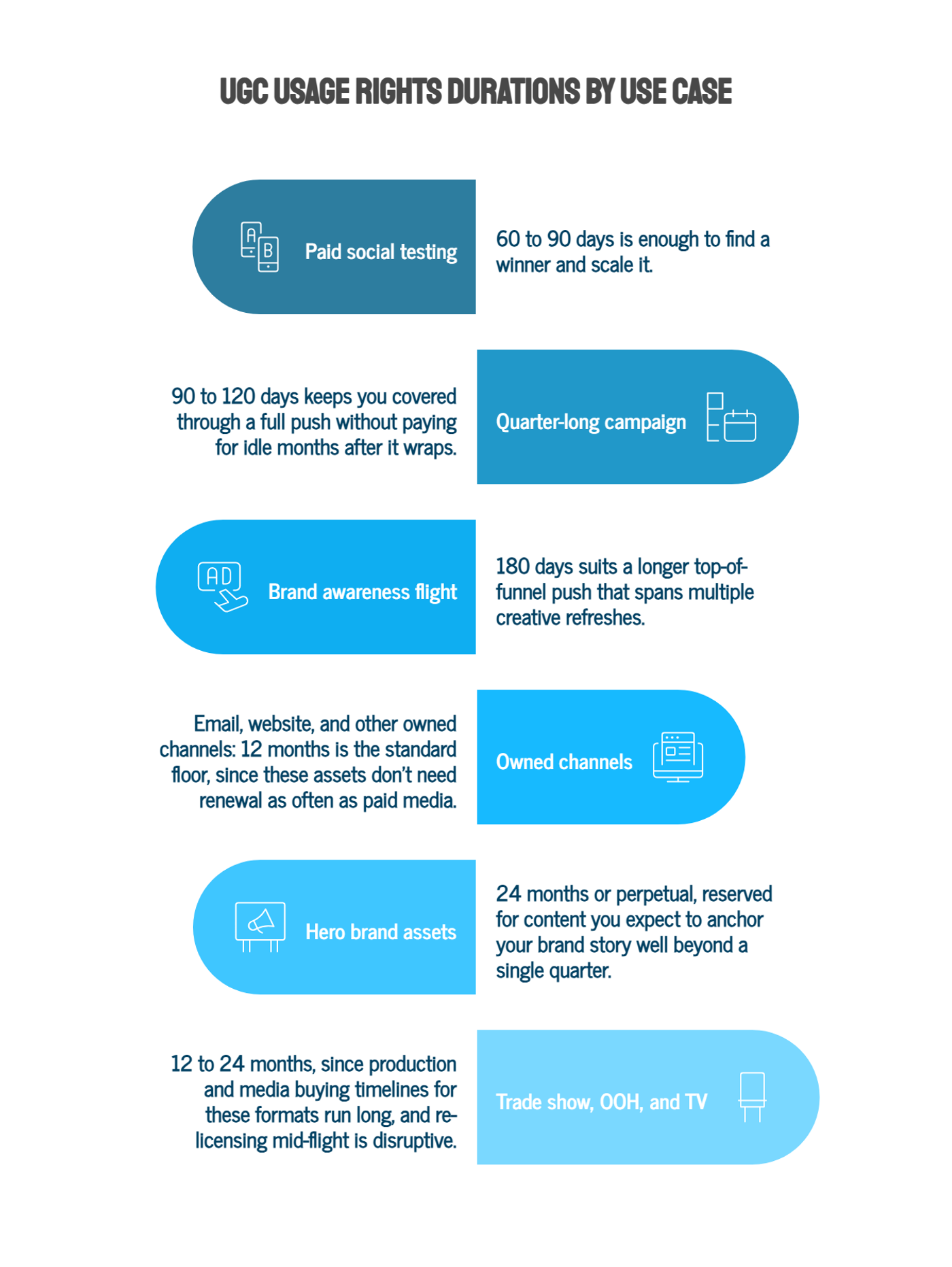
The fastest way to overpay, or worse, underbuy and get caught without the rights you need mid-campaign, is treating duration as an afterthought. Match it to the channel instead.
- Paid social testing: 60 to 90 days is enough to find a winner and scale it.
- Quarter-long campaign: 90 to 120 days keeps you covered through a full push without paying for idle months after it wraps.
- Brand awareness flight: 180 days suits a longer top-of-funnel push that spans multiple creative refreshes.
- Email, website, and other owned channels: 12 months is the standard floor, since these assets don't need renewal as often as paid media.
- Hero brand campaign assets: 24 months or perpetual, reserved for content you expect to anchor your brand story well beyond a single quarter.
- Trade show, OOH, and TV: 12 to 24 months, since production and media buying timelines for these formats run long, and re-licensing mid-flight is disruptive.
Brands that build these defaults into their intake process spend far less time negotiating duration contract by contract.
What Is the UGC Rights Auto-Renewal Trap?
Vague contract language creates more disputes than almost anything else in UGC licensing. A brand assumes “ongoing use” means indefinite. A creator assumes the same phrase means the original three-month window gets extended, and nothing more. Neither party is wrong exactly, because the contract never said.
The trap tends to show up in one of two ways. Sometimes the agreement never states an end date, so the brand keeps running the ad past the point either party intended. Other times it includes soft renewal language, something like “usage continues unless otherwise notified,” and nobody flags it until the creator sees their footage running eight months after a 90-day deal. Either way, the creator ends up feeling shortchanged, and the brand ends up pulling working creative from an active campaign.
Every UGC contract should state a specific start date, a specific end date, and what happens by default when that date passes, whether usage stops automatically, converts to a month-to-month rate, or requires a signed extension, written into the contract itself rather than settled after the fact.
What to Negotiate Into a UGC Usage Rights Agreement
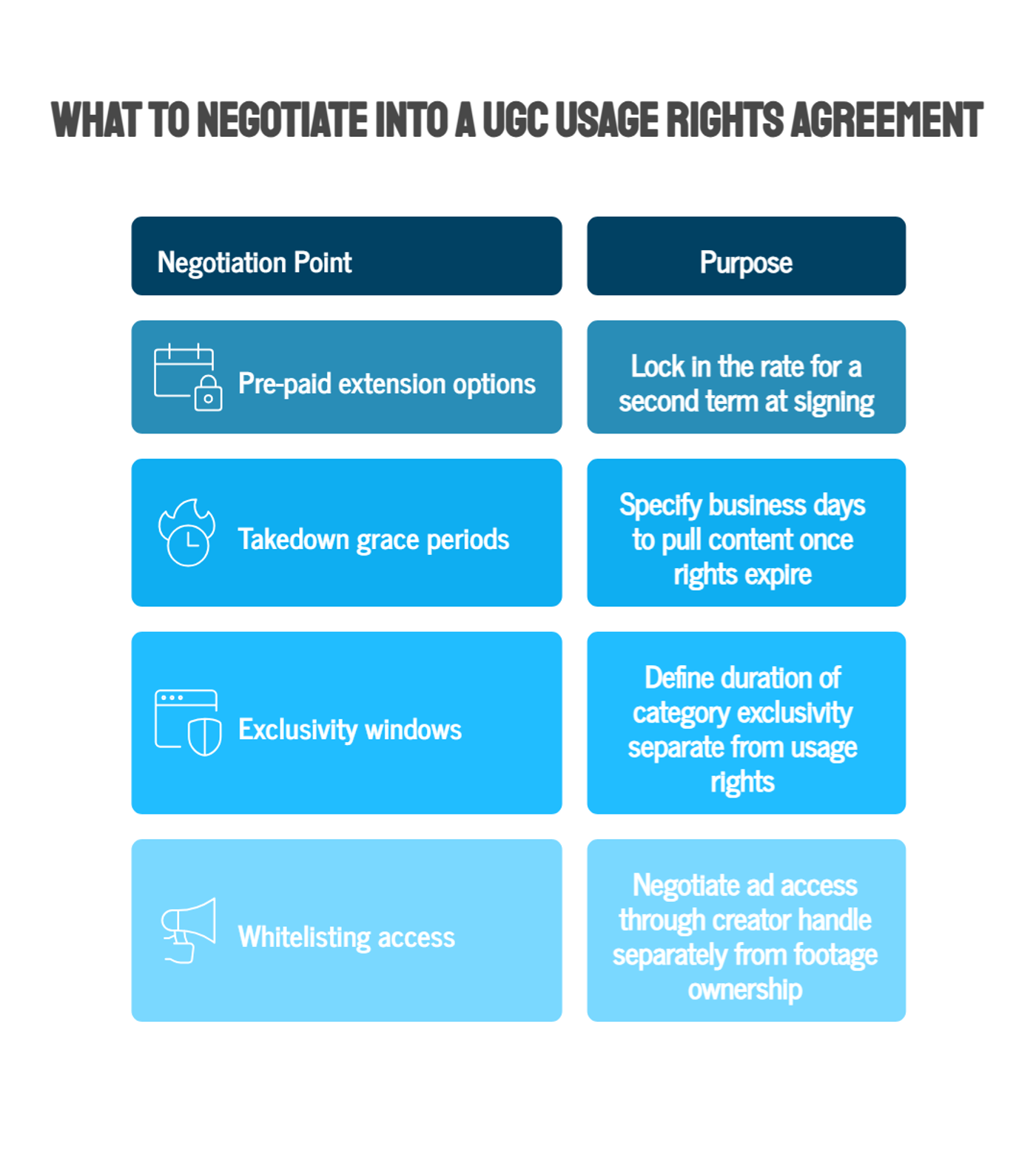
Beyond the headline duration, a handful of clauses determine whether the agreement actually protects both sides.
- Pre-paid extension options: Lock in the rate for a second term at signing, so if the content performs, you're not renegotiating from a weaker position later. Creators tend to welcome this, since it guarantees future income rather than leaving it to chance.
- Takedown grace periods: Specify how many business days a brand has to pull content once rights expire, so "the rights lapsed" and "the ad is still live" can't coexist for weeks.
- Exclusivity windows: Duration and exclusivity are related but separate terms, priced separately. A creator can grant 12 months of usage rights while only agreeing to 60 days of category exclusivity, meaning they're free to work with a competitor well before your license on the footage runs out.
Want to put this into practice?
SideShift connects you with vetted UGC creators who actually deliver. Start your free trial and post your first job in under 10 minutes.
- Whitelisting access, if you need it: Running ads through the creator's own handle is a different right than owning the footage, and influencer whitelisting is usually negotiated and timed on its own schedule rather than bundled into the base usage license.
Brands that spell out these terms in the UGC licensing agreement up front avoid most of the disputes that show up later, once content is already live.
Why Perpetual Rights Can Hurt Creators Long Term
Perpetual UGC rights look appealing to a brand doing the math once: pay a bigger check up front, never think about renewal again. From the creator's side, though, a perpetual buyout means giving up all future negotiating leverage on that content in exchange for a single payment that has to guess at years of value the brand hasn't realized yet.
Industry pricing data puts perpetual licenses at two to four times a creator's base rate, which sounds generous until you compare it to what a creator earns re-licensing a top-performing asset year after year instead. A creator on 12-month terms with a pre-negotiated renewal rate can end up earning more over three or four years than one who sold perpetual rights outright. Brands should weigh that trade-off before defaulting to perpetual purely for administrative simplicity.
How Does Rights Duration Interact With FTC Disclosure Rules?
Usage rights and disclosure obligations are two separate clocks, and mixing them up creates a compliance risk. Licensing rights determine how long a brand can legally use a piece of content. FTC disclosure requirements determine whether that content has to carry a clear sponsorship label, and that requirement doesn't expire alongside the license.
If a video originally ran with a proper #ad disclosure and you extend the usage rights a year later, the disclosure still needs to be present and conspicuous in whatever new placement you run it in. The FTC has made clear that disclosures need to be difficult to miss and easy to understand in the exact format the content is currently running in, not just wherever it originally appeared.
Teams that only track the license expiration date often miss this: The content can be perfectly licensed and still be running without a proper disclosure. If your team handles a meaningful volume of sponsored content, add a review of FTC disclosure rules for UGC creators to your standing rights renewal checklist.
Managing UGC Campaigns with SideShift
Tracking rights duration across a growing roster of creators gets messy fast once you're juggling more than a handful of active contracts. Expiration dates live in one inbox, contract terms in another, and by the time someone notices a license has lapsed, the ad has often already run for weeks past its window.
SideShift centralizes UGC contracts, payments, campaign deliverables and data analysis in one place. Brands can see exactly which assets are approaching their rights deadline, extend the ones worth keeping, and let the rest expire on schedule without a scramble. Whether you're working with a handful of creators or scaling a full always-on content engine, having rights duration tracked alongside the rest of your creator operations means one less way for a campaign to subtly go out of compliance.
Want to put this into practice?
SideShift connects you with vetted UGC creators who actually deliver. Start your free trial and post your first job in under 10 minutes.
FAQs
1. Can I extend UGC usage rights after they expire?
Usually, but it requires a new agreement rather than an automatic continuation. To avoid a gap in coverage, negotiate and document any extension before the original term ends. If the license has already expired, obtain permission before resuming use.
2. What happens to my ads when usage rights expire?
Any paid placements running that creative need to come down, or the brand risks using content without a valid license. A takedown grace period, agreed in advance, gives your team a defined window to pull or replace it.
3. Should brands always negotiate perpetual UGC rights?
No. Perpetual rights suit a small number of foundational assets. Paying three to four times base rate for content you'll only use for one campaign is a waste of budget. Match the license length to how long you'll use the asset.
4. Do organic-only usage rights expire too?
Often not the same way paid rights do. Many agreements grant indefinite organic posting rights on owned channels as part of the base fee, while paid promotion needs a separate, time-limited license. Confirm which category a given duration covers.
5. What's the difference between rights duration and exclusivity?
Duration controls how long you can use a piece of content. Exclusivity controls whether the creator can work with competing brands during that period. They're negotiated and priced separately.