


1099 vs W-2: How to Classify UGC Creators in 2026
Learn how 1099 vs W-2 classification applies to UGC creators, what the IRS rules say, and what brands should know about getting it right.
Table of Contents
The 1099 vs W-2 distinction generally reflects whether a worker is treated as an independent contractor or an employee. Independent contractors typically run their own business, control how they work, and handle their own tax obligations. Employees usually work under your direction, on your schedule, with taxes withheld from their paychecks and other employment protections potentially applying.
For UGC creators, an independent-contractor arrangement may be common, particularly when a creator works with multiple brands, uses their own equipment, and has control over how and when they produce the agreed-upon content.
This guide explains the factors that can support an independent-contractor relationship, situations in which a creator relationship may raise employee-classification questions, and what brands should know about paying creators at scale.
Note that this article is for general informational purposes, and classification questions are worth discussing with an employment attorney or CPA.
What's the Difference Between a 1099 Contractor and a W-2 Employee?
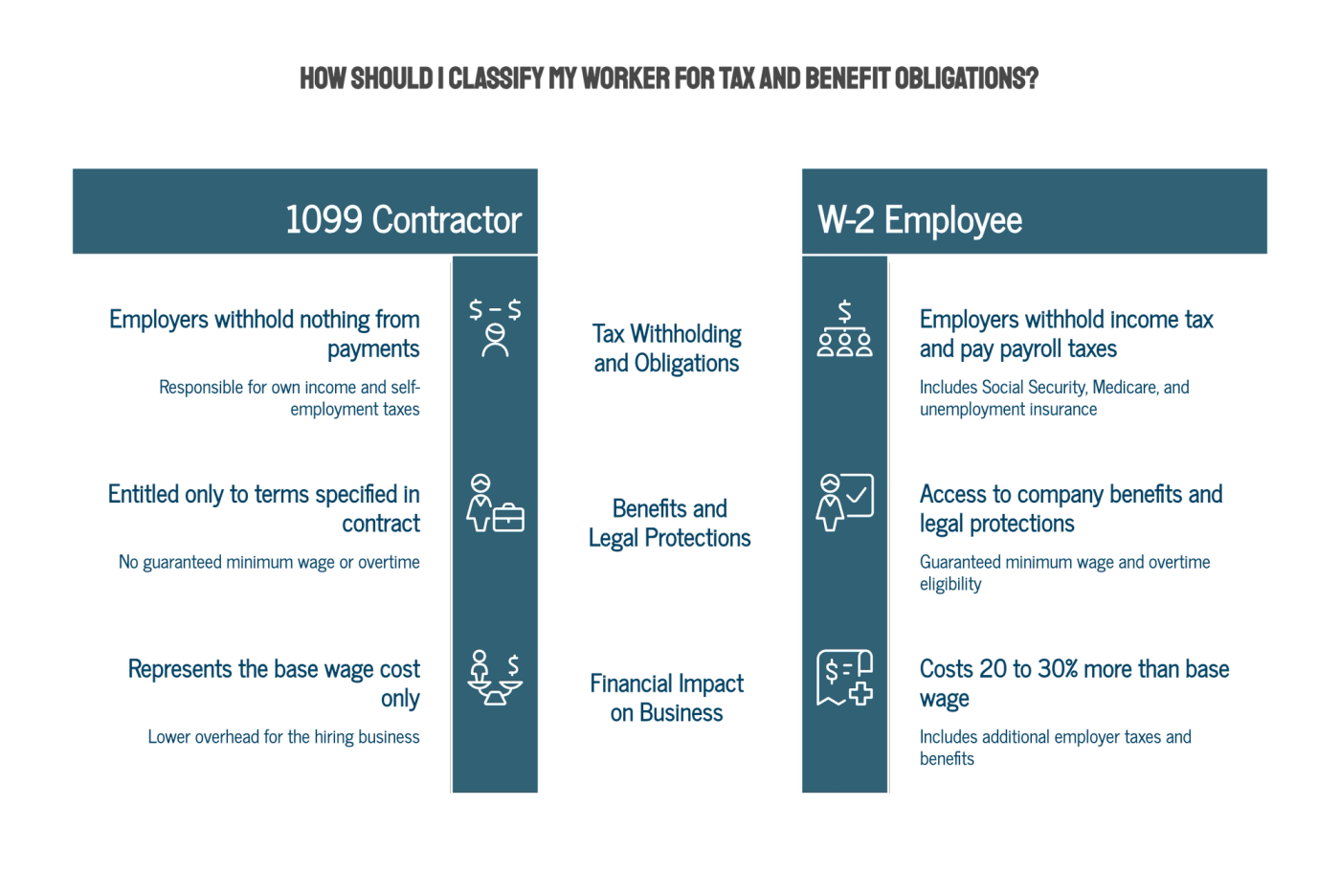
The label controls three practical things: taxes, benefits, and legal protections.
On taxes, employers withhold nothing for a 1099 contractor. They receive the gross payment and handle their own income and self-employment taxes. Your obligation as a business working with independent contractors is issuing a Form 1099-NEC if you pay them $2,000 or more in a calendar year under the threshold that took effect in 2026.
For a W-2 employee, you withhold income tax, pay the employer share of Social Security and Medicare, and typically owe unemployment insurance and workers' compensation on top.
On benefits and protections, contractors get what the contract says and nothing more. Employees get minimum wage, overtime eligibility, and access to whatever benefits you offer other employees.
The cost gap explains why classification is policed. An employee costs roughly 20 to 30% more than their wage once employer taxes and benefits are counted, which creates an obvious temptation to call everyone a contractor. Regulators know this, which is why the tests focus on how the relationship actually works rather than what your contract calls it.
Why Are UGC Creators Often 1099 Contractors?
The IRS evaluates classification through three lenses: behavioral control, financial control, and the nature of the relationship. Run a typical UGC engagement through all three, and several common characteristics may point toward an independent-contractor relationship.
- Behavioral control asks who directs how the work gets done. You hand a creator a brief with the message, the format, and the deadline, and the creator decides how to film it, where, when, and with what gear. Creative direction in a brief generally specifies the deliverable rather than controlling the creator's day-to-day working process.
- Financial control asks whether the worker has their own business economics. Creators invest in their own cameras, lighting, and editing software, set their own rates, work for multiple brands at once, and can profit or lose money based on how they run their operation. These factors can point toward contractor status.
- The relationship factor asks about permanence and integration. A creator engaged per project, per brief, or per campaign, without benefits and without an expectation of indefinite employment, looks more like an outside vendor than an employee. Working with creators through a marketplace can also be consistent with an independent business model, particularly when creators choose among briefs from multiple brands, although the marketplace itself does not determine worker classification.
Want to put this into practice?
SideShift connects you with vetted UGC creators who actually deliver. Start your free trial and post your first job in under 10 minutes.
When Could a Creator Relationship Drift Into W-2 Territory?
Classification questions in the creator economy rarely begin on day one. They tend to develop gradually as a successful contractor relationship evolves into one that functions more like traditional employment.
That's why classification is often better understood as an ongoing question rather than a one-time decision. Here are some common drift signals to watch for:
- The business sets the creator's schedule. Requiring specific working hours, daily availability, or attendance at recurring internal meetings can indicate a level of behavioral control more consistent with employment.
- The creator effectively works only for one business. Exclusivity agreements or situations where one client's workload consumes nearly all of a creator's capacity can weaken the argument that the creator operates an independent business.
- The business provides the equipment and tools. When content is consistently produced using company-owned cameras, office space, editing software, or other business resources, the financial-control analysis may begin to shift.
- The relationship becomes ongoing and integrated. A creator producing content indefinitely, embedded within a marketing team's day-to-day workflow without a clearly defined project or end date, may begin to resemble an employee rather than an independent contractor.
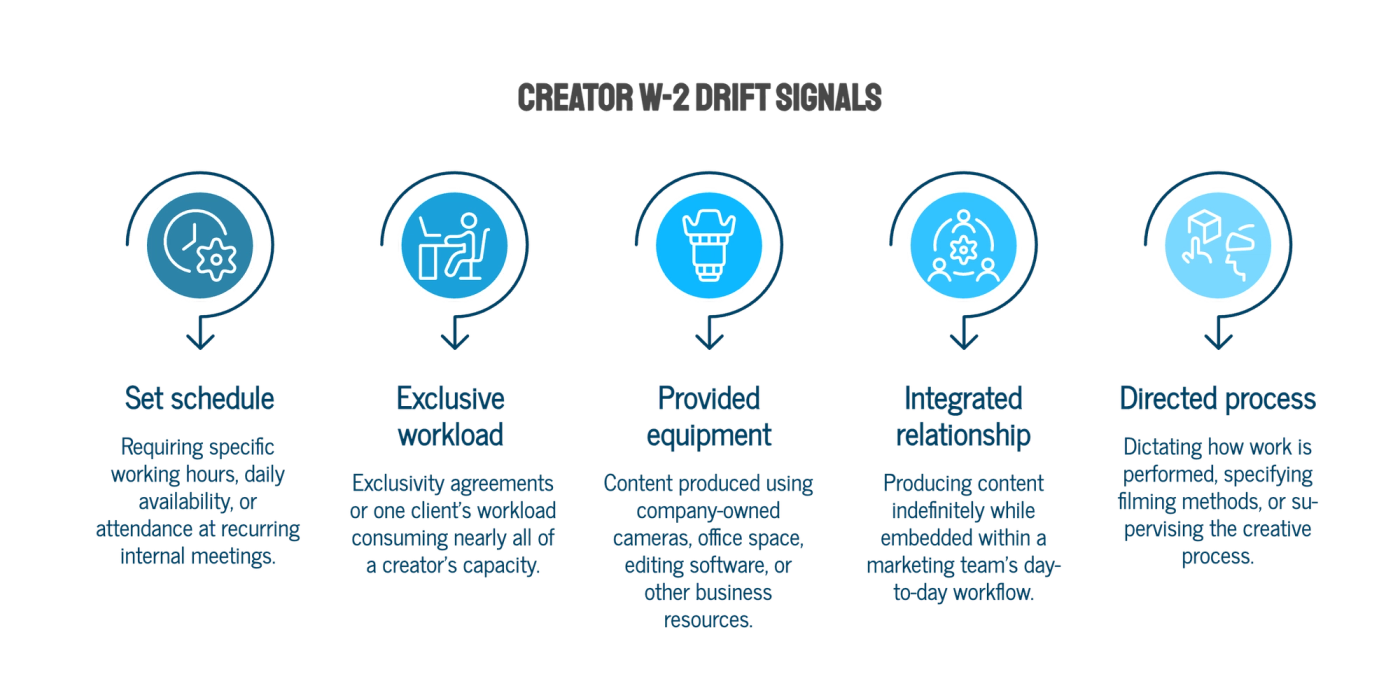
The business begins directing the process, not just the outcome. Reviewing and approving completed deliverables is standard. However, dictating how the work must be performed, such as specifying filming methods, directing production step by step, or supervising work throughout the creative process, can point toward an employment relationship.
None of these factors alone automatically converts an independent contractor into an employee. Classification tests generally evaluate the relationship as a whole. When several of these indicators are present, consulting legal or HR counsel can help clarify whether the current arrangement remains appropriate.
What Are the Federal Classification Rules in 2026?
Two agencies matter, and they use different tests.
The IRS applies its longstanding common law test, the three-factor framework above, for tax purposes. Nothing about that test changed this year, though the reporting threshold did: the 1099-NEC filing threshold rose from $600 to $2,000 starting with 2026 payments.
The Department of Labor governs wage-and-hour classification under the Fair Labor Standards Act, and this is where 2026 brought real movement. The DOL stopped enforcing the Biden-era 2024 classification rule in May 2025, and on February 26, 2026, it formally proposed rescinding that rule and replacing it with a new approach.
The proposed replacement centers on two primary factors: the degree of control over the work, and the worker's opportunity for profit or loss based on their own initiative and investment. These factors can favor contractor status in a typical UGC arrangement, depending on how the relationship actually works. One wrinkle worth knowing: although the DOL is not currently enforcing the 2024 rule, the rule remains relevant in private litigation, meaning it may still play a role while the rulemaking plays out.
Want to put this into practice?
SideShift connects you with vetted UGC creators who actually deliver. Start your free trial and post your first job in under 10 minutes.
States add a third layer. California's ABC test, and similar tests in states like Massachusetts and New Jersey, presume employment unless the hiring business proves otherwise. These state rules can be more restrictive than the federal standards. If your creators are concentrated in a strict-test state, that's another item for the attorney conversation.
What Does Misclassification Actually Cost a Brand?
Getting it wrong means the government treats your contractor as having been an employee all along, and the bill runs backward. Typical exposure can include unpaid employer payroll taxes and taxes that should have been withheld, along with applicable penalties and interest. Depending on the circumstances and the laws that apply, a business may also face retroactive overtime and minimum wage claims under the FLSA, as well as state-level penalties.
Multiply any of that across dozens of creators and several years, and a classification mistake can become one of the more expensive errors a marketing operation can make.
The realistic risk for most UGC brands is low precisely because the standard arrangement is so clearly contractor-shaped. The brands that get burned are usually the ones that let the relationship drift, keet treating the worker as a contractor, and leave a paper trail of employee-style control.
What Helps Keep Creator Classification Clean?
Some practices can help support a clear contractor relationship as creator programs grow. Written contractor agreements can clarify the project scope, deliverables, and the creator's independence, although the document only helps if the actual working relationship matches it.
Collecting a W-9 from U.S. creators at onboarding, regardless of payment size, tends to keep records consistent. Structuring pay per deliverable or per project, rather than per hour, may also matter, since hourly pay can be one factor considered when evaluating the relationship. And briefing the outcome before stepping back from the process leaves creators room to decide how the content gets made.
A UGC platform can bake these habits into the workflow. On SideShift, creators submit tax information during onboarding, briefs define deliverables rather than working hours, creators can work across many brands, and payments run per project. The structure that makes creator marketplaces operationally efficient tends to be the same structure that helps each engagement look like what it is.
Keep Every Creator Engagement Clean by Default
Classification risk grows in the gaps: the missing W-9, the informal arrangement that drifted, the creator who somehow ended up on a schedule. Closing those gaps manually across 50 creators is its own part-time job, and it's the kind of administrative work that platforms exist to absorb.
None of these factors alone automatically converts an independent contractor into an employee. Classification tests generally evaluate the relationship as a whole.
Post your next brief on SideShift and every creator who accepts it arrives with terms signed, tax forms filed, and a per-project payment structure already in place. You get the content volume, creators keep their independence, and your year-end paperwork assembles itself.
Want to put this into practice?
SideShift connects you with vetted UGC creators who actually deliver. Start your free trial and post your first job in under 10 minutes.
FAQs
1. Are UGC creators employees or independent contractors?Almost always independent contractors. A creator who works per project, uses their own equipment, sets their own process, and serves multiple brands satisfies every major classification test for contractor status. Employment questions only arise when a brand controls the creator's schedule, process, or exclusivity over a long period.
2. Do you need to send a 1099 to UGC creators?Yes, businesses generally need to issue a Form 1099-NEC for U.S. creators who meet the applicable payment threshold, which is $2,000 or more in a calendar year under the federal threshold that took effect in 2026. Many businesses collect a W-9 from creators during onboarding, since payment totals may not be known in advance. Some states may also have reporting requirements at lower thresholds.
3. Can a UGC creator ever be a W-2 employee?Yes. A creator working full-time for one brand, on the brand's schedule and equipment, producing content indefinitely as part of the marketing team, may be more consistent with an employee relationship. Brands building in-house content teams often hire creators on W-2 terms when the role is structured as an ongoing employment position.
4. What is the penalty for misclassifying a creator?Exposure typically includes back payroll taxes, withholding you failed to make, penalties and interest, and potential retroactive wage claims. State penalties may also apply, and willful misclassification in strict states can cost five figures per violation. The total scales with how many workers were misclassified and for how long.
5. Does hiring creators through a platform change their classification?The platform doesn't change the legal test, but it does tend to reinforce contractor-style arrangements in practice. Creators on a marketplace choose their own projects, work for many brands, negotiate per deliverable, and document their independence through the platform's contracts and tax collection. The actual working relationship remains the key consideration.