


UGC Creator Tax Forms: W-9, 1099 & W-8BEN Guide
Learn about W-9s, W-8BENs, 1099-NECs, and the 2026 tax rules brands should know when working with UGC creators.
Table of Contents
Hiring UGC creators has never been easier. Managing the paperwork behind those partnerships is another story.
As creator programs scale, many brands discover that paying creators is only half the process. Collecting the correct documentation, understanding tax obligations, and maintaining accurate records are essential for staying compliant.
Whether a brand works with five creators or 500, following a standardized tax workflow helps reduce administrative headaches and minimizes compliance risk.
This guide explains which tax forms are commonly used by UGC creators and brands in 2026, when they're typically collected, and how to keep the process organized.
The answers below cover the common cases. Tax requirements vary depending on factors such as location, business structure, and individual circumstances. For guidance specific to your business or tax situation, consider consulting a qualified CPA or tax advisor.
Which Tax Forms Do Brands Need When Paying UGC Creators?
The tax forms for UGC creators come down to three documents. A W-9 collects a U.S. creator's taxpayer information before you pay them. A 1099-NEC reports qualifying payments to the IRS after year-end. A W-8BEN is generally used instead of a W-9 for individual international creators and can document their foreign status for U.S. tax purposes.
Collect the right form at onboarding, track payments through the year, and file by the deadline, and creator tax compliance becomes a routine instead of a scramble.
Your obligations depend on two questions: where is the creator, and how much did you pay them this year?
For U.S. creators, you generally collect a Form W-9 before payment and file a Form 1099-NEC after year-end if their total reportable payments reach the applicable reporting threshold. For international creators, you collect a Form W-8BEN (or W-8BEN-E if the creator operates through a company) and may not have a Form 1099-NEC filing obligation, depending on the circumstances. The form provides documentation of the creator's foreign status for U.S. tax purposes.
One form you may not need to handle directly is the 1099-K. If you pay creators through a third-party payment platform, the platform may be responsible for 1099-K reporting, and the 1099-K threshold reverted to $20,000 and 200 transactions under current law, putting it out of range for most individual creator relationships anyway.
At SideShift, tax collection happens during payout onboarding, before a creator becomes eligible to withdraw funds rather than a last-minute January cleanup. Creators submit their personal information based on the local and federal requirements for wherever in the world they live.
For most brands, the key forms to understand are the W-9, 1099-NEC, and W-8BEN, but the exact requirements can depend on the payment and the creator's circumstances.
When Do You Collect a W-9 from a Creator?
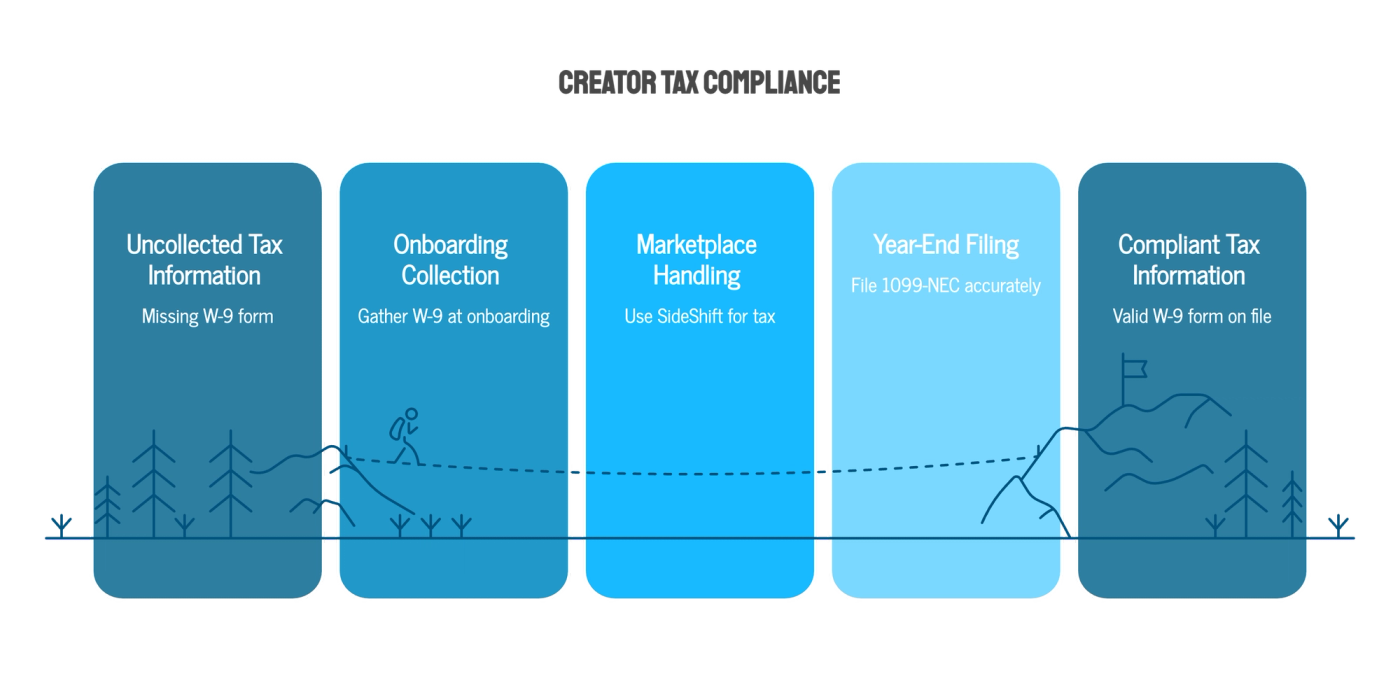
Collect accurate tax information before the first dollar leaves your account, or use a marketplace like SideShift that handles the process for you. January is too late to discover that a creator registered under a stage name, used the wrong legal entity, changed countries, submitted an invalid taxpayer identification number, or never completed the required form.
Want to put this into practice?
SideShift connects you with vetted UGC creators who actually deliver. Start your free trial and post your first job in under 10 minutes.
The W-9 gives you the creator's legal name, address, taxpayer identification number, and business classification, which is everything you need to file their 1099-NEC later.
Collecting it at onboarding rather than at year-end matters because you can't predict in January which creators will cross the reporting threshold by December, and chasing tax forms from creators you last worked with eight months ago is one of the worst administrative tasks in marketing. A creator with no reason to answer your email in December had every reason to answer it back when answering it was the condition for getting paid.
There's also a financial reason to insist on the form. If you pay a U.S. contractor without a valid W-9 on file, IRS backup withholding rules can require you to withhold 24% of their payment, which turns a missing form into an actual payment issue. Making the W-9 a hard gate before a creator's first withdrawal, as part of the platform onboarding process, can help reduce this risk and avoid a last-minute scramble.
When Do You File a 1099-NEC?
File a 1099-NEC for each U.S. creator who meets the applicable reporting requirements, including the $2,000 payment threshold for 2026. The threshold rose from $600 to $2,000 for payments made on or after January 1, 2026, under the One Big Beautiful Bill Act, and it will be indexed to inflation in future years. (Our 1099 vs W-2 guide for UGC creators covers why nearly all creators receive a 1099-NEC rather than a W-2 in the first place.)
The deadline is January 31 following the tax year, both for the copy you send to the IRS and the copy you send to the creator. Electronic filing is mandatory once you're filing 10 or more information returns in total, a bar that any brand running a substantial creator program clears immediately.
However, federal relief doesn't automatically mean state relief. State reporting requirements can differ from the federal rules, and some states may still use different thresholds. If your creators are concentrated in specific states, check the requirements for those states or consult a tax professional.
What Forms Do International Creators Need?
A creator outside the U.S. generally completes a Form W-8BEN instead of a W-9, certifying their foreign status. Creators operating through a foreign company use the W-8BEN-E version. You don't file these forms with the IRS; you keep them on record as your documentation for why no 1099-NEC exists for that creator. A W-8BEN generally remains valid for three calendar years after the year it's signed, so build re-collection into your process rather than treating it as one-and-done.
A creator's nationality, residence, legal entity, physical work location, and type of income can all matter. A creator living abroad who produces content entirely outside the U.S. is a different case from a foreign creator who flies in to shoot, and a contract structured around licensing or royalties is different from a flat service fee. Those are the cases worth an hour of a CPA's time.
Want to put this into practice?
SideShift connects you with vetted UGC creators who actually deliver. Start your free trial and post your first job in under 10 minutes.
What Records Should You Keep Year-Round?
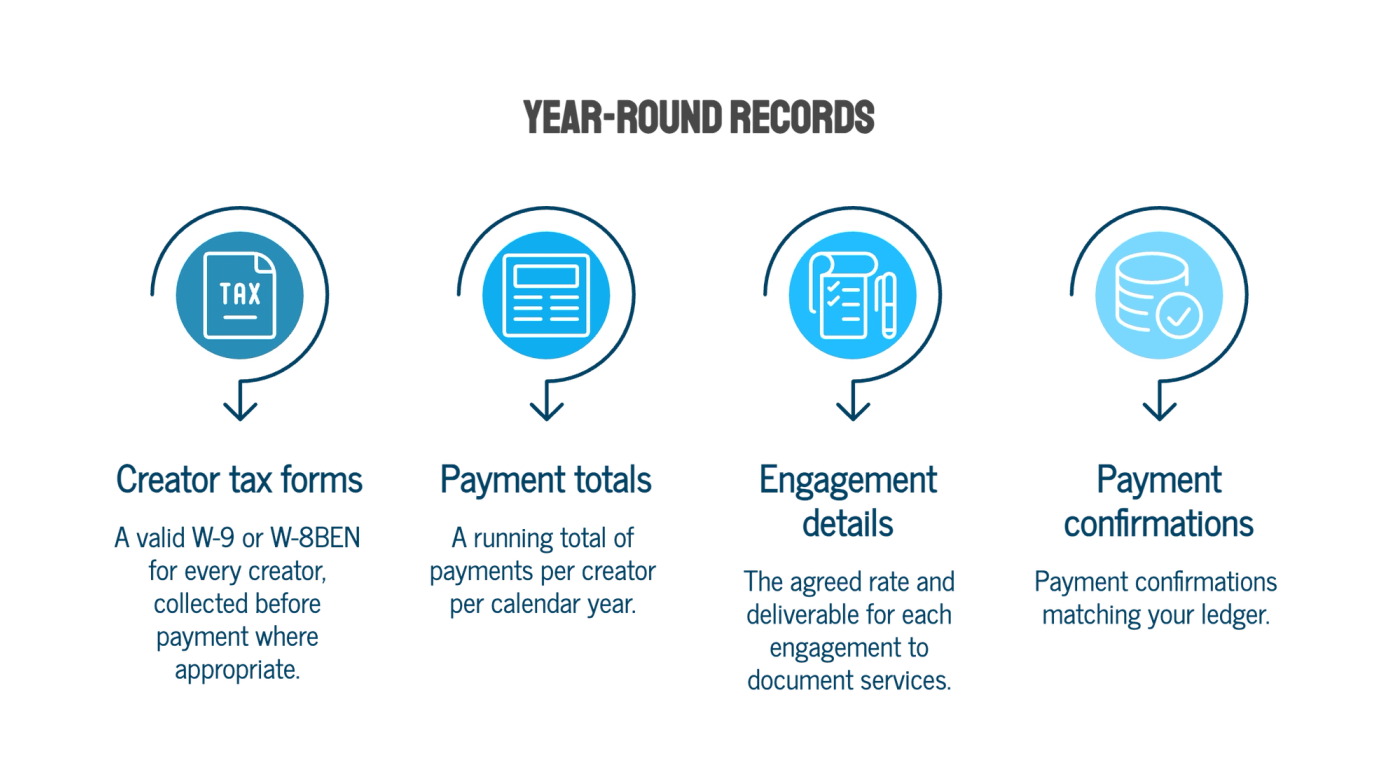
January is painless when four things are already in place: a valid W-9 or W-8BEN for every creator, collected before payment where appropriate; a running total of payments per creator per calendar year; the agreed rate and deliverable for each engagement, which helps document the nature of the services being paid for; and payment confirmations matching your ledger.
The failure pattern is rarely a missing concept. Brands know these records should exist. The failure is fragmentation, with tax forms in email, payment totals in a spreadsheet, rates in Slack threads, and confirmations in a PayPal account someone else administers. Reassembling that annually costs days, and any creator who slipped through without a form costs more. Keeping the entire chain in one system, from onboarding through payment, is the difference between a January report and a January project.
How Do You Automate Creator Tax Compliance?
Make tax information part of the onboarding process, then let software enforce the workflow. On SideShift, creators provide the required information early on, payments are tracked throughout the year, and year-end reporting draws from records the system built all year. The same structure that makes bulk payouts possible, creators onboarding themselves once with verified details, is the structure that makes tax season a report rather than a reconstruction.
If you're running creators outside a platform, you can approximate this with discipline: a signed form as a hard gate before payment one, a single payment ledger, and a quarterly check that totals and forms still match.
Use SideShift to Manage Creator Tax Compliance
Every compliance problem in a creator program traces back to a moment when paying someone was easier than documenting them, but the cost of that shortcut doesn't show up for ten months.
SideShift collects the appropriate tax information from every creator, whether U.S. or international, tracks every payment against every creator all year, and hands you clean records when filing season arrives. You run the briefs and the content; the paperwork assembles itself in the background.
FAQs
1. What tax form do you need before paying a UGC creator?Generally, you need a Form W-9 for U.S. creators, or a Form W-8BEN for international creators (W-8BEN-E if they operate through a company). Collect it before the first payment rather than at year-end, since it provides information needed for reporting and can help you avoid backup withholding issues.
2. Do international creators get a 1099-NEC?No. A creator who has certified foreign status on a W-8BEN and performs their work outside the U.S. generally doesn't require a 1099-NEC. The W-8BEN you keep on file is your documentation. If a foreign creator works while physically in the U.S., different rules can apply, and that's a scenario for a tax professional.
3. What happens if a creator refuses to submit a W-9?You may be required to apply 24% backup withholding to their payments and remit it to the IRS, which most creators find worse than filling out the form. The cleaner solution is making the W-9 a condition of the first payment, so the situation never arises.
Want to put this into practice?
SideShift connects you with vetted UGC creators who actually deliver. Start your free trial and post your first job in under 10 minutes.
4. When are 1099-NEC forms due?January 31 following the tax year, for both the IRS copy and the creator's copy. Electronic filing is required once you file 10 or more total information returns, which covers essentially any brand working with creators at scale.