
9 Ways to Advertise Your Business and Reach More Customers
Find out how to advertise your business online and offline with strategies that help increase visibility, attract customers, and grow your brand.
Table of Contents
If you’re wondering how to advertise your business, it’s possible that you tried a few traditional strategies but haven’t seen results so far. The truth is, buying a single billboard and posting a few pictures on Facebook don’t work the way they did 15 years ago.
Today, buyers trust people before they trust ads. A lot of the power is in the hands of creators, influencers, and real day-to-day consumers. Businesses can’t be casual about social media anymore, while also not giving up completely on offline tactics.
To properly advertise your business, it helps to build a mix of channels that reinforce each other, with creators and customers doing some of the talking for you. Below, you’ll find nine different strategies worth trying, from free foundational moves to scalable approaches you can build on over time.
9 Ways to Advertise Your Business
These methods aren’t mutually exclusive. In fact, most businesses would benefit from combining multiple strategies in one marketing plan. But you don’t need to do all of them either. Select what makes sense for your business.
1. Claim Your Google Business Profile
If your business isn’t showing up when someone searches “near me,” you’re invisible to customers looking for your products or services. Claiming your Google Business Profile is free, takes minutes, and makes your business look more professional and solid. It’s the single highest-leverage, lowest-effort item on this list.
Add:
- Business location, hours of operation, phone number, website or social media links
- High-quality photos that show off the space, products, services, and/or the team
Don’t be afraid to ask happy customers to leave a review. Some will naturally share their experience without being asked, but many won’t think to leave one unless they’re gently reminded. A quick follow-up asking for feedback can make a big difference. Google reviews are public and can influence whether the next potential customer decides to give your business a chance.
2. Build a Well-Optimized Website
If what you sell can be bought online, your business website can act as a 24/7 salesperson. But that only works if people can find it and want to stick around once they land. Those are two separate goals: getting seen, and giving visitors a reason to stay.
Search Engine Optimization (SEO) helps your website rank higher in search results, giving your business more visibility beyond your Google Business Profile listing. Research relevant keywords customers actually type in, answer their questions better than the page currently ranking above you, and structure your website content around the terms your competitors are missing.
Getting them to stay is a different part of the equation: user experience. Make sure the technical structure of your website is in good shape. A good website loads fast, is mobile-friendly, and doesn’t drown visitors in unnecessary pop-ups. Design matters too. A clean layout and clear visual hierarchy help visitors find what they need without feeling lost or overwhelmed.
3. Share Expertise on Niche Communities
Shared knowledge can become free exposure for your business. Search for niche communities relevant to your industry on platforms like Reddit, Quora, and Facebook, and see if people have any questions about a service or product that you can answer using your professional experience.
Want to put this into practice?
SideShift connects you with vetted UGC creators who actually deliver. Start your free trial and post your first job in under 10 minutes.
But avoid outright promoting yourself. The goal is to be genuinely helpful and gain visibility by organically interacting with potential customers. On top of that, some online communities don’t allow direct promotion and may ban users who violate their anti-promotion rules.
4. Collaborate with Other Local Businesses
You don’t have to reach every customer alone. Businesses that share an audience but aren’t direct competitors can advertise to each other’s customers by teaming up. Here are a few ways this plays out in practice:
- Create a combo. A coffee shop and a bakery next door split a “breakfast combo” discount, each promoting it to their own customer base.
- Display each other’s materials. Leave the neighboring business’s flyers at your checkout counter and ask them for the same favor in return.
- Refer customers directly. A wedding photographer who regularly refers clients to a specific caterer and vice versa can build a referral loop that costs nothing but a conversation.
Two small audiences that trust each other’s recommendation combine into a much bigger one, without either business spending a cent on ads to reach it.
5. Build a Referral or Loyalty Program
Your existing customers are your cheapest acquisition channel. A referral incentive, even a modest discount for both parties, turns satisfied buyers into an indirect marketing team. Pair it with a loyalty program that rewards repeat purchases and you’re reaching your best potential customers: people who already trust your brand.
Dropbox’s referral program gives customers extra storage when someone they refer creates a new account. On the loyalty side, Starbucks Rewards gives customers stars on every purchase, which they can then redeem for free drinks or food, giving people a reason to keep buying Starbucks.
You don’t need a massive customer base to use the same approach: a coffee shop offering a free drink for referrals or a salon giving a discount for each new booking runs on the exact same logic. Search for ideas online and adapt what works for your business.
6. Get Involved in Your Community
Attend local and industry events, trade shows, and street fairs, or sponsor community initiatives. These are spaces where you get to make your case in person, collect contact information, share your business cards, and build relationships. This is particularly valuable for local businesses and business owners in the service industry.
The value here compounds over time rather than paying off in a single interaction. A landscaping company that sets up a booth at a home and garden expo might not close a deal on the spot, but the conversations, business cards, and before-and-after photos shared that day can turn into quotes and referrals for months afterward.
7. Be Consistent on Social Media
Social media is the display window for any business and most owners know this. But many make the mistake of being inconsistent and not having a real content strategy. To promote your business on social media, you shouldn’t simply post a few pictures or a funny video once in a while. Instead, build an online presence to become a recognizable brand.
Want to put this into practice?
SideShift connects you with vetted UGC creators who actually deliver. Start your free trial and post your first job in under 10 minutes.
It’s a good idea to combine your team’s own content with posts from customers and creators: your content builds brand voice, while creator content adds the trust and authenticity a brand account can’t replicate alone. A post from your own account says “Here’s who we are.” A post from a real customer or creator says “Here’s why you should believe them.”
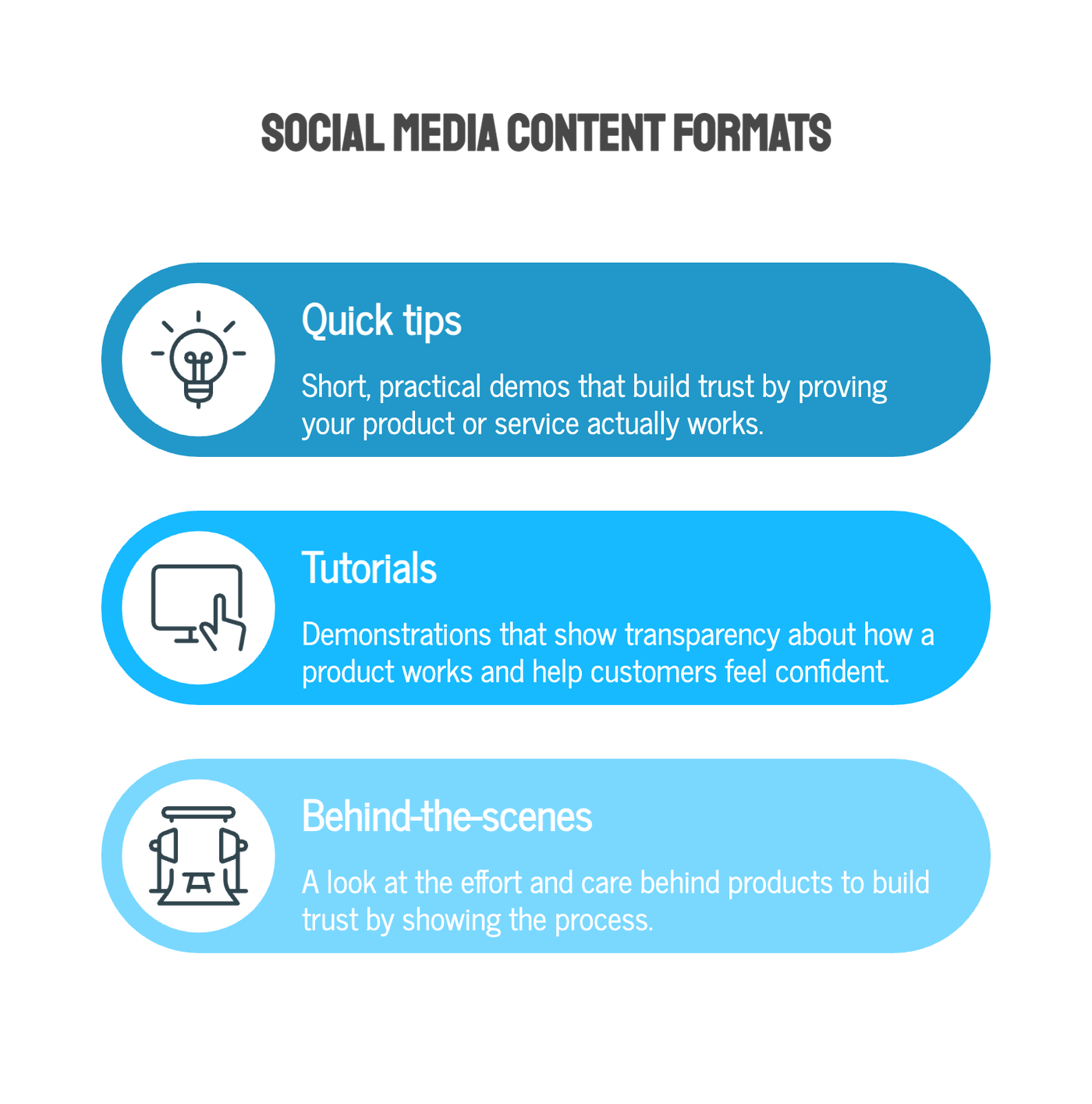
Instead of deciding what to post on the spot, create a content calendar. Define how many times a week you want (and will actually be able) to post, and lay out a few content ideas for each day. Some content formats that typically work for businesses:
- Quick tips: Short, practical demos build trust by proving your product or service actually works. A cleaning products company might share a quick video on how to remove lipstick stains from white clothes using one of their products, or send the product to a creator to show the same tip in their own words.
- Tutorials: Demonstrations show transparency about how a product works and help customers feel more confident in their decision to purchase. A kitchen appliance brand could show how to actually get the most out of a stand mixer, dough hook attachment, different speed settings, and cleanup shortcuts.
- Behind-the-scenes moments: These give customers a look at the effort and care behind what they’re buying, building trust by showing the process rather than just the finished product. A bakery might show the final stages of preparing a wedding cake and sweet treats for the guests, then pair it with a real customer’s candid reaction video from the actual event.
Remember that you don’t need to be on every platform that exists if the customers that you want aren’t there. Pick the two platforms where your audience actually spends time rather than spreading yourself thin across all of them.
Instagram tends to work well for visually driven brands (food, beauty, home goods) that benefit from polished photos, Reels, and Stories, while TikTok is often better suited for brands that can lean into short-form, personality-driven content and trend participation, often through creator partnerships rather than polished brand video. YouTube is great for long-form content, like in-depth tutorials and reviews.
8. Use User-Generated Content (UGC)
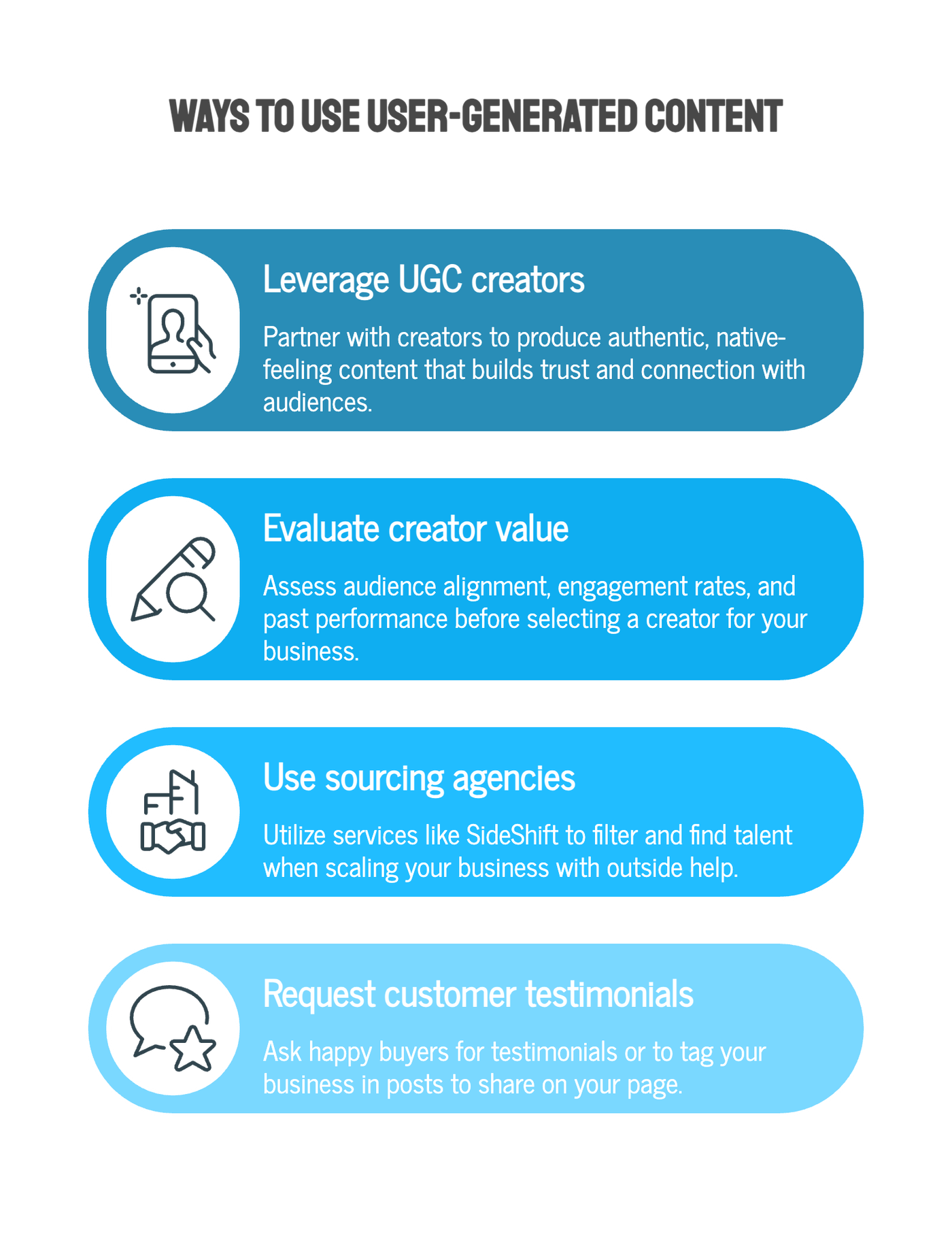
UGC is content created by real customers or creators rather than your in-house team. This content can be used on your social media platforms to further promote your product or service by showing how it works in practice. An unboxing video, a candid review, a straightforward product demo: these feel like a recommendation from a friend, not a pitch from a brand.
UGC creators don’t necessarily have huge followings. Their power relies on their relationship with their audience and the ability to create content that feels natural and native to the platform, building real connection and trust.
Want to put this into practice?
SideShift connects you with vetted UGC creators who actually deliver. Start your free trial and post your first job in under 10 minutes.
It also has a cost and volume benefit. A single UGC creator can produce dozens of authentic videos over an ongoing partnership, for a fraction of what a traditional ad shoot costs, giving you a constant pipeline of fresh creative to test across paid and organic channels.
But don’t blindly pick any creator who seems cool enough. Instead, evaluate the value they bring for your business:
- Does their audience match your ideal customer?
- Do they have a good engagement rate (real comments, saves, shares) or just a lot of followers?
- Have they ever worked with a brand before? If yes, did they make good quality content? Did they have any results?
If you’re in a position to scale your business and have outside help, a creator-sourcing agency like SideShift can do the work of filtering talent for you.
Aside from creators, you can also ask happy buyers for a quick testimonial or to tag your business when they post their purchase so you can share on your page.
9. Invest In Paid Social Campaigns
Organic reach has a few barriers that paid social campaigns break. For a cost, paid social lets you target your ad by interest, behavior, and lookalike audiences, bringing in an even more targeted group of potential customers.
On Instagram and TikTok, you create ads through Meta’s Ads Manager and TikTok’s Ads Manager, respectively. On YouTube, ads are created through Google Ads. All platforms have their own tutorials and comprehensive guides on how to create paid campaigns.
Paid social campaigns can also meet UGC content. You can repurpose organic content an UGC creator made for you as an ad (as long as you have usage rights that give you authorization to reuse that content) or boost existing content from the creator’s account with TikTok Spark Ads or Meta’s Partnership Ads tool.
This way you can get the best of both worlds: the creator’s credibility and organic engagement with the greater reach potential and segmentation of an ad.
Use UGC to Advertise Your Business with SideShift
If your business is growing beyond local reach, expanding your online presence, or looking for a more consistent way to create content, working with creators can help you get there faster.
SideShift exists specifically to solve the creator sourcing bottleneck, connecting brands with vetted creators who can create authentic content quickly, bringing in quality and real results for your business. Whether you’re considering organic posts or ads, you can find the talent you need all in one place.
You get access to a network of 800,000+ UGC creators from every niche, from food and beverage to financial services. Contracts, payments, and performance tracking are all managed inside the platform, so don’t waste time handling paperwork and spreadsheets.
FAQs
1. How can you advertise your business on Google?
Claim and complete your Google Business Profile with your address, phone, photos, hours, and services. From there, encourage happy customers to leave reviews. Enhance your website with search engine optimization techniques so it can appear in search results.
Want to put this into practice?
SideShift connects you with vetted UGC creators who actually deliver. Start your free trial and post your first job in under 10 minutes.
2. How to advertise your business on Facebook?
Set up your page and post consistently to build organic reach. Layer in Facebook Ads to create paid campaigns targeted by location, interest, or lookalike audiences once you know what content resonates.
3. What’s the best way to advertise a small business?
Be active on social media and online communities that can give your business visibility, build a referral or loyalty program, then invest in paid ads or creator partnerships once you have the budget. Mixing free and paid channels spreads your risk.
4. How to advertise your business on social media?
Pick platforms where your customers actually spend time rather than posting everywhere. Share expertise, tutorials, behind-the-scenes content, and user-generated content instead of pure promotion. Pair organic posts with a small paid budget to extend reach.
5. How can you advertise your business for free?
Claim your Google Business Profile, post organically on social media, and ask happy customers for referrals or reviews. Partner with a complementary local business to cross-promote each other’s offers and get involved in local events.