


6 Tips to Improve Influencer Engagement in 2026
High follower counts don't guarantee high engagement. Here are six tactics influencers use to build audiences that actually respond.
Table of Contents
How do some influencer accounts grow thousands of engaged followers while others post just as consistently and get nothing back? It often comes down to what they're optimizing for, and many creators are optimizing for the wrong thing.
An influencer can gain 50,000 followers from a single viral post, only to watch their engagement rate fall over the following months, because the audience that arrived for that one moment isn't the audience that comes back for the next thing.
The opposite, a highly engaged audience built on genuine connection, even if smaller, is what makes a creator valuable to brands and sets them up for long-term success. And building it takes staying relevant to the same people long enough that they start seeking you out.
This guide explains the engagement signals that matter most and six practical tactics influencers can use to build a more engaged, loyal audience.
What Counts as Engagement
Follower count tells you how many people could see your content. Engagement tells you how many actually stopped, responded, and came back.
In practice, engagement is often a better indicator of a creator's impact than audience size alone. Research consistently shows that smaller creators generate stronger engagement per follower than larger ones, not because of luck, but because tighter audiences respond more actively to content that feels made for them.
To improve influencer engagement, you first need to understand what it actually looks like. Here are the interactions that matter most:
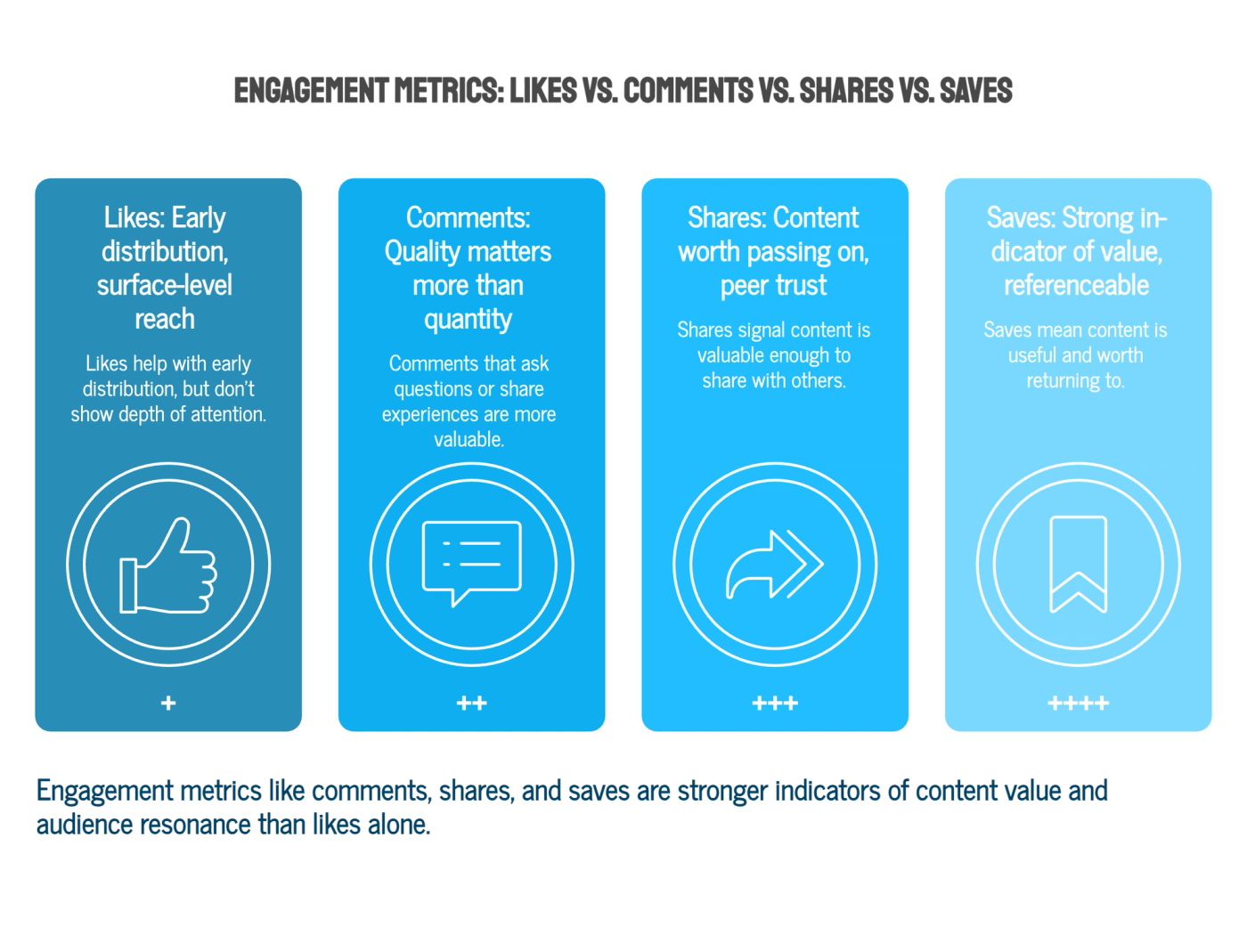
- Likes can help with early distribution, even though they don't say much about depth of attention. A post with lots of likes but no other interaction usually signals surface-level reach rather than strong resonance.
- Comments carry more weight than likes, but their quality matters more than their quantity. Comments that ask questions, share experiences, or start discussions tell more than generic reactions like emojis or "love this!"
- Shares signal that a viewer thought the content was worth passing on, and each person it reaches arrives with a layer of peer trust already attached.
- Saves are a strong indicator of value. They usually mean the content is useful, referenceable, or worth coming back to later. On platforms like Instagram, and to a lesser extent TikTok, they're treated as a positive signal that people found the content genuinely valuable.
Each of these signals can be influenced by the way you create and share your content.
6 Ways to Grow Engagement as an Influencer
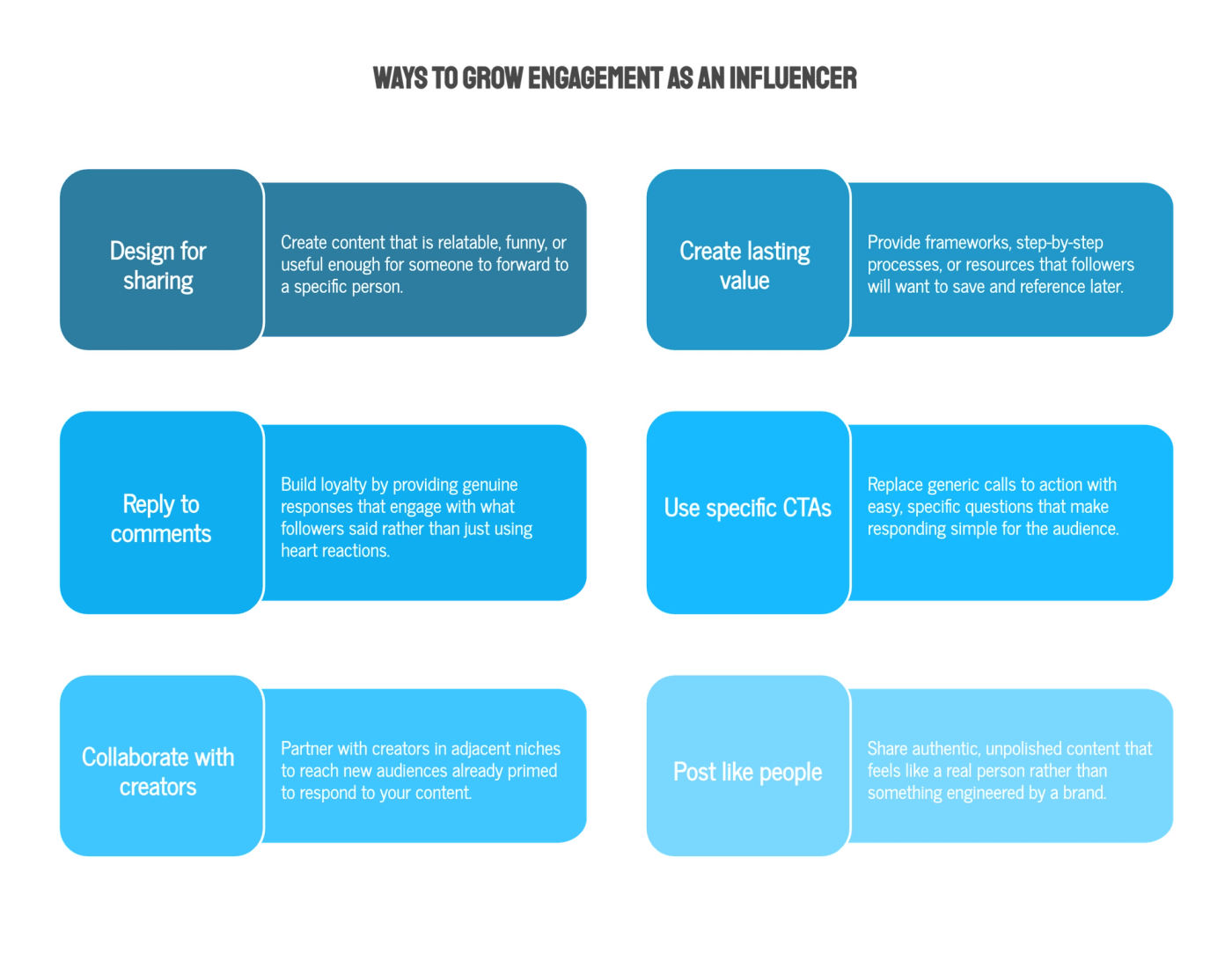
So, how do influencers grow engagement? Not by accident. It comes down to deliberate choices about what to make, how to structure it, and how to show up once it's live.
1. Design Your Posts for Shares and DMs, Not Just Likes
Create content that someone would forward to a specific person in their life. A post goes viral in DMs because it's relatable in a precise way, funny enough to make someone think of a friend, or useful enough to speak directly to a situation they know someone is in. "You need to see this" is the response you want.
Want to put this into practice?
SideShift connects you with vetted UGC creators who actually deliver. Start your free trial and post your first job in under 10 minutes.
Choose topics with a specific person in mind, not a general audience like "people interested in skincare" but a more specific target like "someone who just started a routine and is frustrated that it's not working yet." Precision makes content more shareable, not less.
Ask: Does your hook make the intended recipient obvious? Does your content feel broad where it should feel personal? Would you honestly send this Reel to a friend yourself? If the answer to the last question is no, that's a good place to start rethinking it.
2. Make Content People Will Come Back To
A save is a vote of confidence that a post has lasting value. It also tells the algorithm the content is worth distributing further.
That could be a framework someone can apply, a step-by-step process they'll want to follow later, a comparison they'll want to show someone else, a resource they'll need to find again. These are things that are more useful as a reference than as a one-time watch.
For example, a skincare creator could share the five-step routine that cleared their skin, not just which products, but the order, the amount, and what to realistically expect in the first two weeks. A finance creator could explain the actual formula for calculating whether refinancing makes sense, with a worked example in the caption. A food creator could include exact quantities in the caption rather than sending viewers to a link in bio. Each of these makes the post more useful to return to.
3. Reply to Comments to Build Loyalty
A follower who receives a genuine reply, not just a heart reaction, but a response that engages with what they said, is significantly more likely to comment again on future posts, share the content, and consistently show up. Over time, that behavior across a comment section is the difference between a passive following and a real community.
Reply with a follow-up question, an additional piece of context the comment sparked, or a direct acknowledgment of something specific the person said. These turn a comment section into a conversation. "Thank you so much!" does not.
4. Use Specific CTAs, Not Generic Ones
"Comment below" is a call to action, but it's not a very good one.
The problem is that it asks people to come up with something from nothing. And most people just won't do that. Compare that to something like "which of these two would you actually use, A or B," which is an easy choice and takes a couple of seconds to answer.
Better CTAs make responding feel simple. That could be an either/or question ("which setup would you actually use?"), an opinion that invites disagreement ("unpopular opinion: X is overrated, fight me in the comments!"), an open loop where their answer feeds into something ("drop your answer before I reveal mine"), or something based on experience ("if you've dealt with this, what did you do?").
The main thing to avoid is just cycling through the same two or three CTAs no matter what the post is about. People notice, and they stop engaging.
Want to put this into practice?
SideShift connects you with vetted UGC creators who actually deliver. Start your free trial and post your first job in under 10 minutes.
5. Collaborate Across Creator Accounts
Collaboration grows engagement because it puts your content in front of an audience that's already primed to respond. They follow the other creator because they trust them, which makes them more likely to engage with content that creator is associated with.
When two creators' audiences come together in the same comment section, you get more perspectives, and the conversation tends to pick up speed naturally.
The key idea is to collaborate with adjacent, not identical, audiences. Two creators in the exact same niche are often just speaking to the same people. But when you bridge related spaces like fitness and nutrition, you introduce your content to people already interested in the broader topic, just from a different angle. That's usually more valuable than reaching the same audience twice.
6. Post Like a Real Person, Not a Brand
The content that tends to drive the most engagement often doesn't feel like "content" at all. A phone-filmed take from a car. A morning routine without ring lights. A reaction recorded right after something happens. These feel native to the feed in a way more polished, produced content often doesn't.
This is also why user-generated-content (UGC) consistently outperforms branded content. Brands that feature UGC on social see around 28% higher engagement than brand-only content. The principle is the same whether you're a brand or a creator: content performs better when it feels like a real person sharing something, not something engineered to perform.
What Might Be Killing Your Engagement
Just as important as knowing how to build engagement as an influencer is understanding what can quietly kill it. Here's what to avoid:
- Posting inconsistently: When you post erratically, your audience struggles to build a habit around your content. It also weakens the consistency signals platforms use to predict performance, which can reduce your initial reach.
- Overloading on sponsored content: If you promote too many brands too frequently, audiences can start to disengage. Over time, your content may feel more promotional than personal, which can reduce trust and lower engagement even on organic posts.
- Chasing trends that don't fit your niche: Jumping on trending audio or formats that don't match your usual content can confuse your existing audience. People follow you for a reason. When that consistency disappears, engagement often does too. The relevance that built your audience is also what keeps them interacting.
Connect with the Right Brands and Creators on SideShift
The creators landing consistent brand deals aren't just the ones with the biggest followings. They're the ones who know how to engage an audience, with hooks that grab attention, genuine content that builds trust, and audiences that comment, save, and share because the content is worth it. And those are exactly the creators brands are actively looking for.
SideShift is where both sides connect. Creators apply to brand campaigns, sign contracts, and get paid within the platform, no cold outreach, no back-and-forth. Brands get access to 800,000+ vetted creators and can launch UGC campaigns without the manual sourcing process.
Want to put this into practice?
SideShift connects you with vetted UGC creators who actually deliver. Start your free trial and post your first job in under 10 minutes.
Whether you're building an audience or scaling a campaign, SideShift makes the next step easier.
FAQs
1. How do influencers grow engagement?
The tactics that consistently move engagement target the signals algorithms weight most heavily: saves, shares, DM sends, and watch time. Creators who grow genuine engagement make content worth saving, reply to comments early, use specific CTAs that make responding easy, and keep their content authentic rather than overly produced.
2. What is a good engagement rate for an influencer?
These are directional benchmarks rather than fixed rules, since engagement rate varies by niche, platform, and content format. As a general reference, nano-influencers typically average between 5% and 8% on Instagram and TikTok, micro-influencers between 3% and 6%, and macro influencers tend to see 1% to 3%. Anything significantly below benchmark for a given tier and niche is worth investigating.
3. Does posting more often increase engagement?
Not automatically. Posting a lot without a steady rhythm can actually hurt engagement because your audience doesn't know when to expect your content, and platforms have less consistent performance data to work with. What matters more is a sustainable cadence people can get used to, not just higher volume.
4. How do brands know if an influencer's engagement is real?
Four signals matter most. First, engagement rate relative to follower size. Unusually low rates can be a red flag. Second, the balance of saves and shares versus likes. Lots of likes but few saves or shares often signals shallow engagement. Third, engagement trends over time. Steady or improving rates are more reliable than declining ones. Fourth, comment quality. Real questions and conversations matter more than emoji-heavy or generic replies.
5. What's the difference between influencer engagement and UGC engagement?
Influencer engagement is built on an existing relationship between a creator and their audience, driven by trust and familiarity within that community. UGC engagement comes from how the content itself performs, because it feels native and authentic rather than tied to a specific creator. In practice, influencer content benefits from audience loyalty, while UGC is used by brands to scale content that can perform well even without a built-in following.