


Brand Ambassador vs. Affiliate: What's the Difference in 2026?
Here's how to tell brand ambassador and affiliate apart, what each one actually costs, and real examples of brands running both well.
Table of Contents
Brand ambassador vs. affiliate: What do they do? How do they get paid? Which one do you need? For brands that are new to this, these are questions that pop up before a decision is made. And for untrained eyes, it’s easy to confuse one for another.
A customer posts about a product because they genuinely love it. A creator posts a vlog using the product, followed by a link to purchase. Both show up in your feed looking almost identical, with similar talking points about the product and caption energy.
But underneath, they're running on completely different logic. Brand ambassadors and affiliates both help brands grow through other people's audiences, but the arrangement, the pay, and the expectations couldn't be more different. Mixing the two up is how brands end up paying for the wrong kind of relationship.
Here's how to tell them apart, what each one actually costs, and real examples of brands running both well.
What Is a Brand Ambassador?
A brand ambassador is someone who represents a brand on an ongoing basis, not for a single post. It’s a long-term relationship built on genuine affinity for the product. Brands typically vet candidates for ambassador programs on things like audience fit, content quality, and whether the person already loves the brand before any contract exists.
The relationship is built around identity. An ambassador's job is to be visibly associated with the brand over time through regular posts, event appearances, or simply wearing the gear in daily life, so that association itself becomes the asset. That's why ambassador programs are selective, structured, and often have perks that grow as someone proves themselves.
Examples of Ambassador Programs
- Lululemon's Ambassador Program recruits yoga instructors, trainers, and local fitness figures who already embody the brand's lifestyle, offering product, event access, and community status rather than a straightforward paycheck.
- Gymshark built much of its early growth on a visible roster of fitness influencers who wear and post the brand consistently, turning Instagram into the brand's primary storefront.
- Red Bull's athlete program is the most extreme version of this model, sponsoring extreme-sports athletes long-term so the brand becomes inseparable from the lifestyle itself.
- Sephora Squad selects a cohort of beauty creators each year for a paid, structured ambassadorship that includes products, campaigns, and community perks.
For smaller brands, an ambassador program could look a lot simpler than any of the above: a handful of loyal, repeat customers given a standing discount code, early access to new launches, and a mention in your Instagram Stories whenever they post. The mechanics are the same as Lululemon's or Sephora's, selective, relationship-based, built on real affinity, just running at a scale that fits a smaller budget and requires a smaller team to manage it.
What Is an Affiliate?
An affiliate promotes a brand's products in exchange for a commission on sales their links or codes generate. There's usually no vetting process beyond signing up, no long-term exclusivity, and no expectation of brand loyalty. The relationship is transactional by design: the affiliate shares a tracked link, a customer buys something through it, and the affiliate gets paid a percentage or a flat fee.
Want to put this into practice?
SideShift connects you with vetted UGC creators who actually deliver. Start your free trial and post your first job in under 10 minutes.
Affiliates are typically creators with an audience (a blogger, a YouTuber, an influencer, a streamer), but they can also be a coupon site and even another business. What matters isn't how they feel about the brand, it's whether their links convert. Because the arrangement is performance-based, brands can run affiliate programs at scale, with hundreds or thousands of participants.
Affiliate Programs Examples
- Amazon Associates is the affiliate program most people encounter first, paying roughly 1% to 10% commission depending on product category, with a short 24-hour tracking window that rewards high-volume content over brand loyalty.
- LTK lets creators tag products across multiple retailers and earn commission whenever followers shop through their curated links, without being tied to a single brand.
- Bluehost's affiliate program pays a flat $65 per sale regardless of which hosting plan the customer buys, a structure built purely to reward conversions, not relationship depth.
- Awin and CJ Affiliate are networks, not single programs, connecting thousands of retailers with affiliates who pick and choose which products to promote based on commission rates alone.
For smaller brands, an affiliate program could look a lot leaner than a full network listing: a simple referral link generated through your ecommerce platform, offered to any happy customer or micro-creator who asks, with a flat 10-15% commission and no minimum follower count required. No negotiation, no vetting call, just a link that tracks itself.
Brand Ambassador vs. Affiliate: The Core Differences
The differences between the two become clear once you look at how each relationship is structured, compensated, and managed day to day.
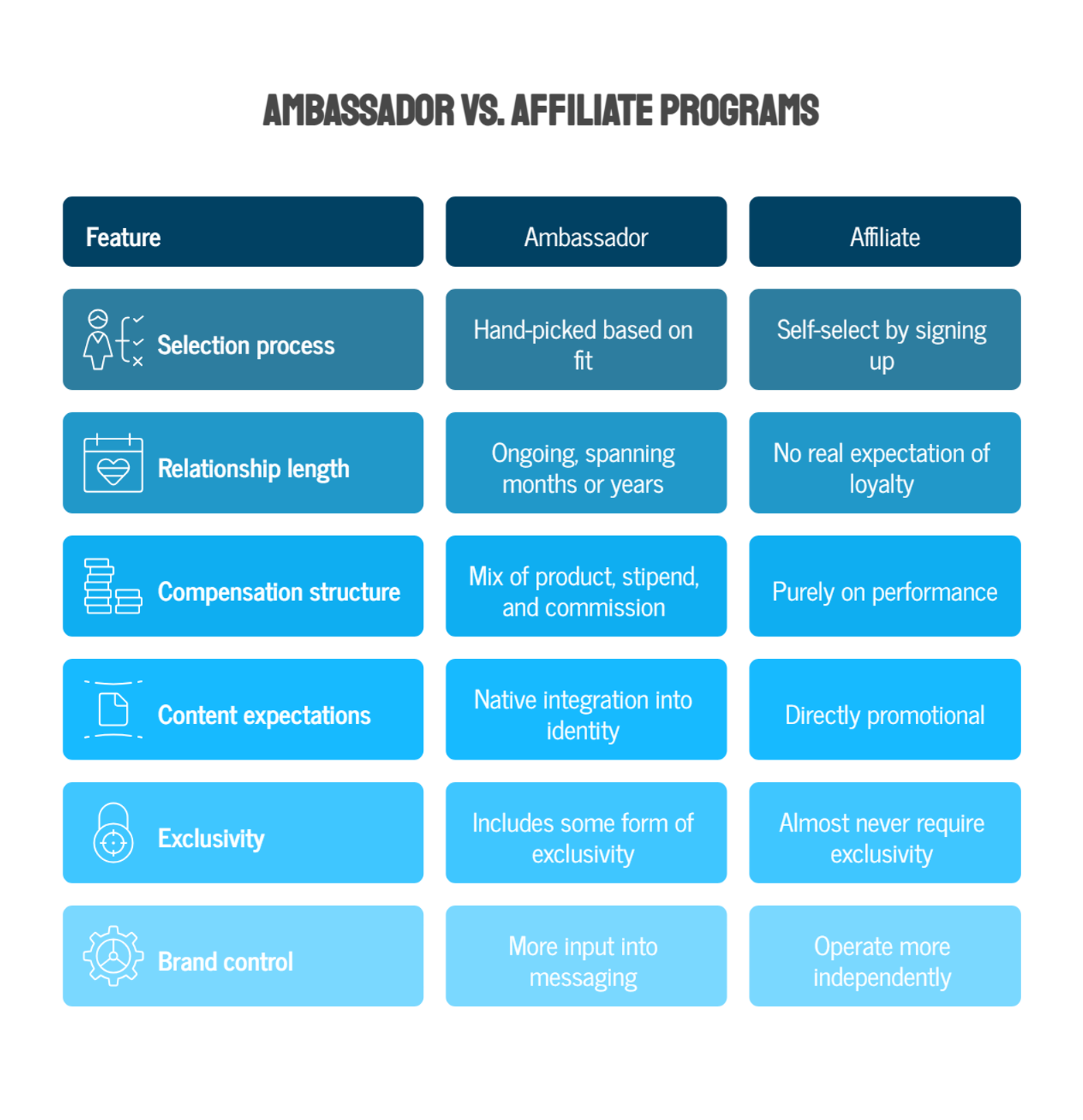
- Selection process: Ambassadors are usually hand-picked based on fit, whether they’re existing fans of the brand, their content quality, and whether their audience overlaps with the target customer base. Affiliates mostly self-select by signing up, with little to no vetting beyond basic eligibility.
- Relationship length: Ambassador programs are ongoing, often spanning months or years, with renewal tied to performance and continued alignment. Affiliate relationships can be just as long, but there's no real expectation of loyalty. An affiliate can promote a competing brand right alongside yours with no conflict.
- Compensation structure: Ambassadors are typically paid through a mix of free product, a flat stipend, and a commission layered on top, and other perks. Affiliates are paid purely on performance, a percentage of each sale or a flat fee per conversion, with no payout if nothing sells.
- Content expectations: Ambassadors are expected to integrate the brand into their regular content and identity, it should feel native, not like an ad. Affiliates are expected to drive clicks and conversions, so their content often leans more directly promotional, think “shop my link” posts and coupon codes.
- Exclusivity: Many ambassador agreements include some form of exclusivity, restricting the ambassador from repping a direct competitor. Affiliate programs almost never require exclusivity, since the whole model depends on casting a wide net of participants.
Want to put this into practice?
SideShift connects you with vetted UGC creators who actually deliver. Start your free trial and post your first job in under 10 minutes.
- Brand control: Because ambassadors represent the brand's identity, companies tend to have more input into messaging, content guidelines, and approval processes. Affiliates operate more independently, brands provide links, assets, and commission terms, then largely let affiliates run their own promotion however they see fit.
Taken together, these differences come down to one underlying tradeoff: ambassadors trade scale for depth, a smaller group, more investment, more brand control. Affiliates trade depth for scale, a much wider pool of participants with almost no oversight required.
Neither approach is better in the abstract, it depends entirely on what the brand actually needs that partnership to accomplish.
How Pay Structures Actually Compare
It's worth breaking out pay specifically, since this is where the two models diverge the most in practice.
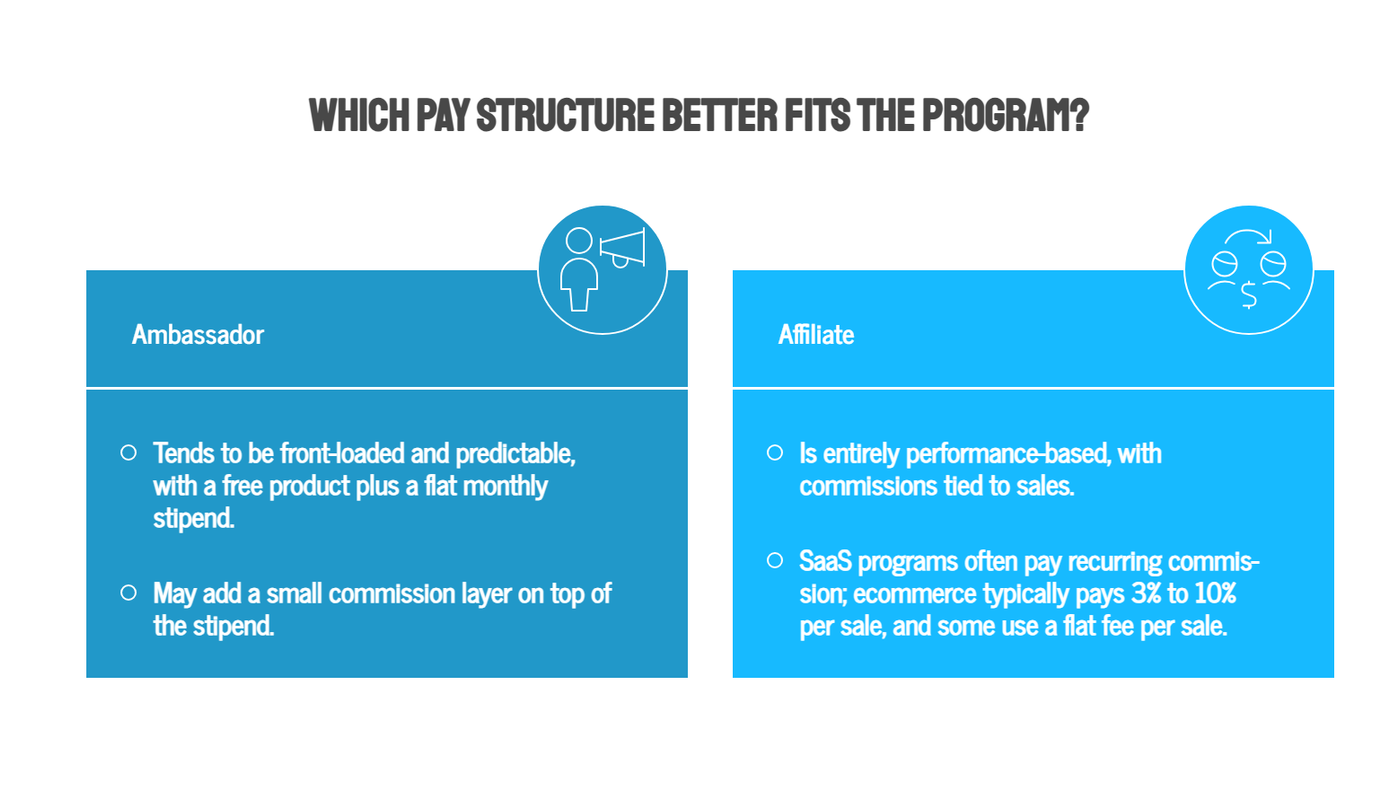
- Ambassador compensation tends to be front-loaded and predictable. A brand might offer a free product plus a flat monthly stipend, say, $500 to $5,000 depending on the ambassador's reach and the brand's budget, regardless of how many sales that person directly generates in a given month. Some programs add a small commission layer on top, but the core value exchange is visibility and loyalty, not pure performance.
- Affiliate compensation is entirely performance-based. Commission rates vary wildly by industry: SaaS affiliate programs often pay recurring commission because customer lifetime value supports it, while ecommerce affiliate programs typically land between 3% and 10% per sale. Some, like Bluehost, use a flat fee per sale instead of a percentage.
The practical tradeoff is this: Ambassador programs cost money upfront with a bet on long-term brand equity, while affiliate programs cost nothing until a sale actually happens, but offer little in the way of sustained brand association.
Affiliate Program vs. Brand Ambassador: Which Model Is Right for Your Brand?
The two aren't mutually exclusive. In fact, many brands run both simultaneously for different goals. Sephora is a clean example: the Sephora Squad functions as a paid ambassador program for brand-building, while the broader Beauty Insider ecosystem drives affiliate-style commissions through creators who aren't part of the formal squad at all.
A few questions help clarify which model fits a given goal:
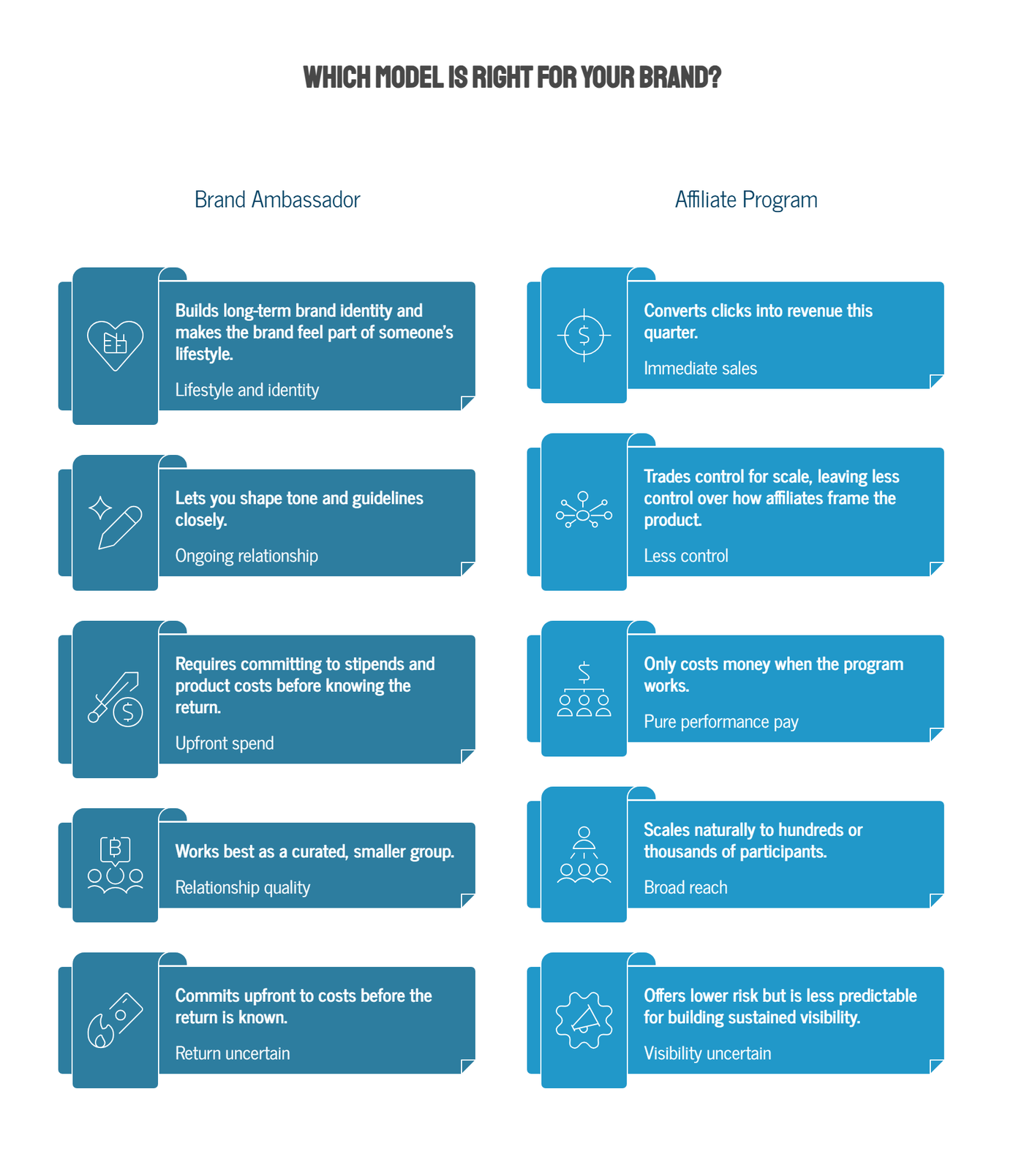
- Are you trying to build long-term brand identity or drive immediate sales? If the goal is making your brand feel like part of someone's lifestyle, ambassadors do that better. If the goal is converting clicks into revenue this quarter, affiliates are the more direct lever.
- How much control do you need over messaging? Ambassador programs let you shape tone and guidelines closely, since you're building an ongoing relationship. Affiliate programs trade control for scale, so you have less control over how every affiliate frames your product.
- What's your budget tolerance for upfront spend versus pure performance pay? Ambassador programs require committing to stipends and product costs before you know the return. Affiliate programs only cost money when they work, which is lower-risk but also less predictable for building sustained visibility.
- How big does the program need to be? Ambassador programs work best as a curated, smaller group, because the whole value is in the relationship quality. Affiliate programs scale naturally to hundreds or thousands of participants without losing their core function.
Want to put this into practice?
SideShift connects you with vetted UGC creators who actually deliver. Start your free trial and post your first job in under 10 minutes.
Many brands land on a layered approach: a small, carefully selected ambassador group for brand presence and content, paired with an open affiliate program that lets a much wider pool of people earn commission on sales, without needing to vet or manage each one individually.
Find Creators to Represent Your Brand with SideShift
Brand ambassadors and affiliates solve different problems and neither replaces the other. Brands getting the most out of creator partnerships in 2026 tend to run both, using ambassadors to build identity and affiliates to convert the audience that identity attracts.
Regardless of what you choose, working with the right people who know how to talk about your product is what takes your brand to the next level.
SideShift provides access to a pool of 1M+ pre-vetted creators to help you run multiple campaigns and build long-lasting ambassador programs with people who use and understand your products.
FAQs
1. Can someone be both a brand ambassador and an affiliate for the same brand?
Yes, and it's increasingly common. A brand might give an ambassador a personal discount code that also earns them commission, blending the brand-building relationship with a performance incentive.
2. Do brand ambassadors get paid a salary?
Rarely a true salary. Most ambassador programs pay through free product, a flat stipend, or event perks, with only larger or celebrity-level ambassadorships approaching anything like a formal paycheck.
3. Which model is cheaper for a small brand to start with?
Affiliate programs are generally cheaper to launch since you only pay on confirmed sales, with no upfront stipend or product cost required to get the program running.
4. How do brands track affiliate sales accurately?
Most use tracked links or unique discount codes through a platform like ShareASale, CJ Affiliate, or Amazon Associates, which record the referring affiliate and attribute the sale automatically within a set cookie window.
5. Can an affiliate eventually become a brand ambassador?
Yes, this is a common progression. Brands often watch their affiliate performance data to spot people who consistently drive strong, authentic-feeling sales, then invite those top performers into a more formal ambassador relationship with added perks and closer brand involvement.