


Bulk Creator Payouts: How to Pay 100+ Creators in One Click (2026)
Paying 100+ creators manually wastes hours per week. Learn the 2026 best practices for bulk creator payouts and automation.
Table of Contents
It's Friday afternoon and you're 40 rows into a payment spreadsheet. Creator number 41 changed her PayPal email and didn't tell anyone. Creator 52 is in Portugal and wants a bank transfer. Creator 67 has DMed you three times asking where last month's payment went, and honestly, you're not sure either. Somewhere around row 80 you realize this is your fourth hour of paying people this week, and none of it made a single ad perform better.
Bulk creator payouts exist to delete that afternoon from your calendar. Instead of processing each creator as a separate transaction, you approve one batch, fund it once, and the system distributes creator payments to 100+ creators simultaneously, with tax records and confirmations handled automatically.
This guide covers how bulk payouts work, what a real system needs to include, and the 2026 compliance changes that affect anyone paying creators at scale.
Why Does Paying Creators One by One Break Down at Scale?
At five creators, manual payments are a minor chore. At 20, they're an errand. Past 50, they become a part-time job with real failure costs.
In June 2026 alone, roughly $5 million moved through SideShift to creators, but before we built that system, our own founders were the ones stuck in the spreadsheet, reconciling payments by hand across Slack threads, contracts, and campaign trackers.
If each payment takes five minutes to verify, send, and record, 100 creators consume more than eight hours a month, a full workday spent on a task that produces nothing. And that assumes zero errors, which never happens. Mistyped account details, currency mismatches, and duplicate payments all generate support threads that take far longer to resolve than the original payment took to send.
Creators also talk to each other, and payment reliability is one of the first things they compare. For most, brand work is a meaningful share of their income, so a late payment is a missed bill. A creator who chases you for money once will hesitate before accepting your next brief; one who chases you twice usually won't accept it at all. Since your best-performing creators are the hardest to replace, slow payments effectively tax your top talent first.
What Does a Bulk Creator Payout System Actually Include?
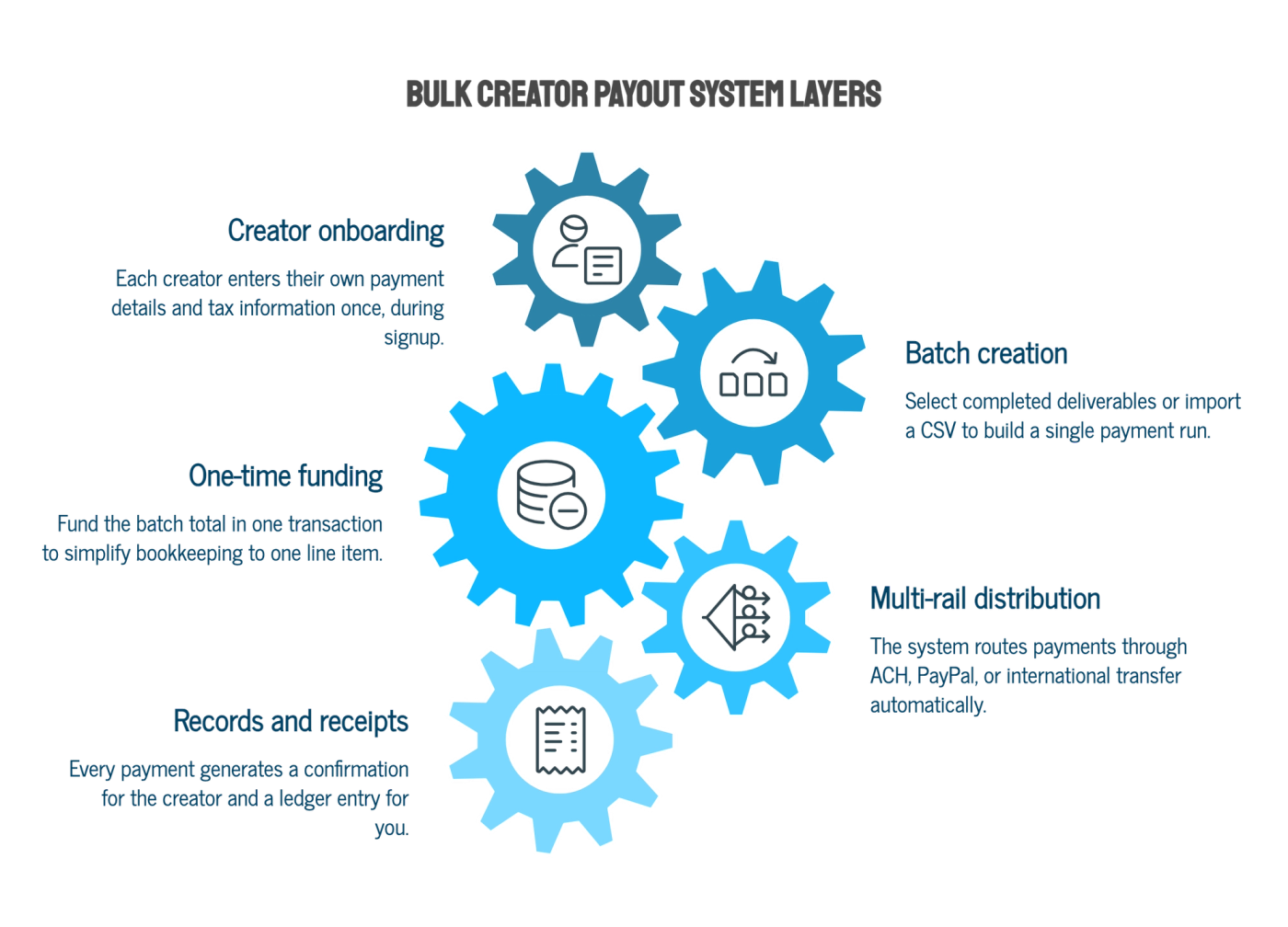
A real bulk payout system covers five layers:
- Creator onboarding: Each creator enters their own payment details and tax information once, during signup. This removes you from the data-entry loop entirely, which is where most errors originate.
- Batch creation: You select completed deliverables, or import a CSV of creators and amounts, and the system builds a single payment run you can review before anything moves.
- One-time funding: You fund the batch total in one transaction rather than initiating 100 separate transfers, which also simplifies your bookkeeping to one line item.
- Multi-rail distribution: The system routes each payment through the right method for each creator, whether that's ACH, PayPal, or an international transfer, without you managing the differences.
- Records and receipts: Every payment generates a confirmation for the creator and a ledger entry for you, so January tax season starts with a report instead of an archaeology project.
Want to put this into practice?
SideShift connects you with vetted UGC creators who actually deliver. Start your free trial and post your first job in under 10 minutes.
If a tool only handles the middle steps and still leaves you collecting bank details over email, it has automated the easy part and kept the dangerous part manual.
How Do You Run a Bulk Payout in One Click?
You need a UGC or influencer platform to do this. Standalone mass-payment tools can batch transfers, but they can't see which content got approved, what rate was agreed in the brief, or which creators finished their deliverables, so you're still building the payment list by hand every month.
A creator-management platform keeps payment tied to the same system as your briefs, submissions, and approvals, instead of a separate spreadsheet or payment app you have to update by hand every time something changes.
What Changed for Creator Payment Compliance in 2026?
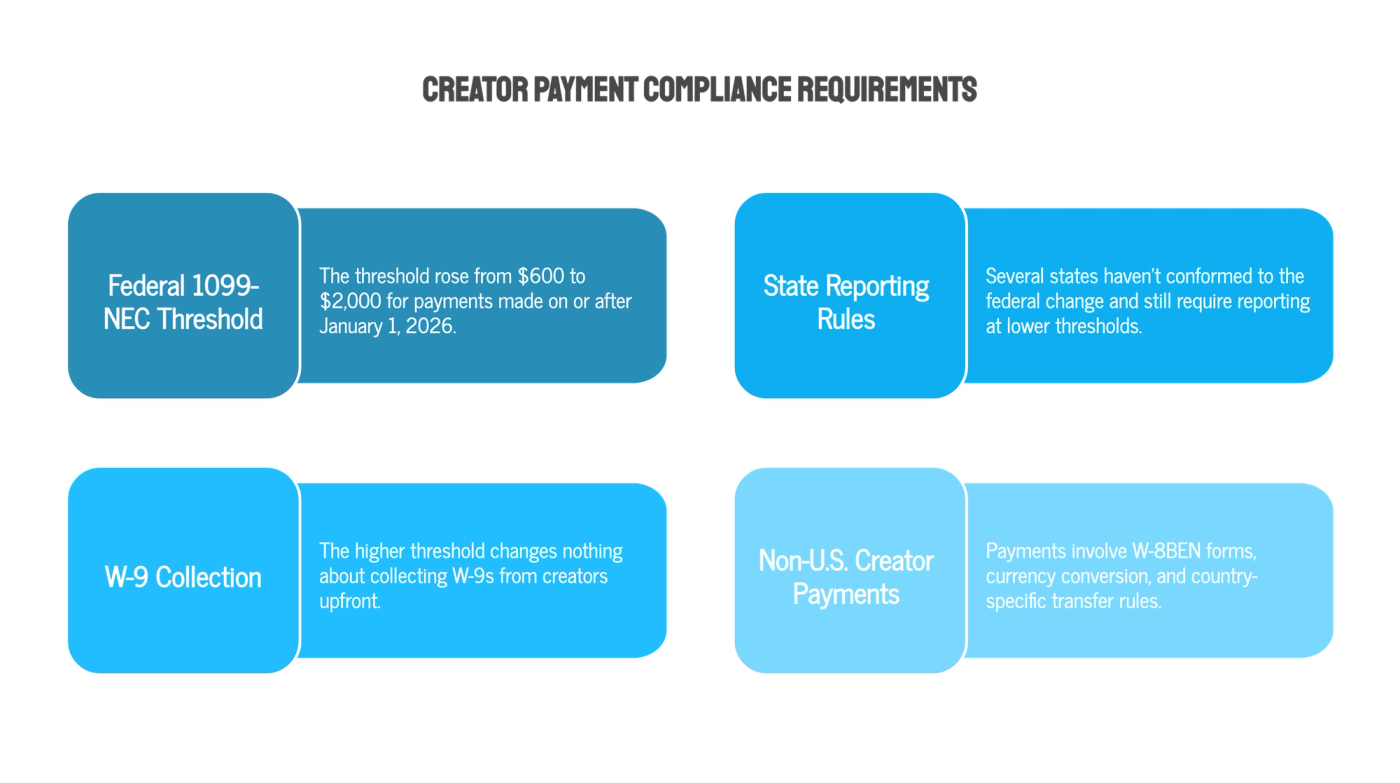
This year brought the biggest contractor reporting change in decades. Under the One Big Beautiful Bill Act, the federal 1099-NEC threshold rose from $600 to $2,000 for payments made on or after January 1, 2026, with the threshold indexed to inflation starting in 2027. If you pay a U.S. creator $1,800 this year, you no longer owe the IRS a form for it. Cross $2,000 with any single creator and you still do.
Several states haven't conformed to the federal change and still require reporting at lower thresholds, so a creator's state can trigger a filing the IRS doesn't require. The higher threshold also changes nothing about collecting W-9s. You rarely know in January which creators will cross $2,000 by December, so the only safe practice is collecting tax information from everyone upfront, which is exactly what platform-based onboarding does by default.
Payments to non-U.S. creators generally involve W-8BEN forms rather than 1099s, plus currency conversion and country-specific transfer rules. This is where manual payment operations fail hardest and where a payout system earns its keep, since the compliance logic is built in rather than something you research per country.
How Much Time and Money Do Bulk Payouts Actually Save?
Run your own numbers with three inputs: creators paid per month, minutes per manual payment, and your error rate.
A brand paying 100 creators monthly at five minutes each spends roughly 100 hours a year on payment processing. At even a modest internal cost of $50 per hour, that's $5,000 of labor annually, before counting error resolution, which typically adds 30 to 60 minutes per incident. Batch processing collapses those 100 hours into roughly one hour a month of review and approval.
At SideShift's scale, once you count payment calculations, tax-document collection, identity verification, creator support, and reconciliation, the bulk payout automation saves "at least dozens, and probably hundreds, of operational hours each month" says SideShift COO Canyon Pergande.
Faster, predictable payouts also improve your acceptance rates on future briefs, and at high volume that matters more than the labor savings. The whole premise of running 100+ creators is that creator variety drives ad performance. Variety only exists if creators keep showing up, and creators keep showing up for brands that pay like clockwork.
Want to put this into practice?
SideShift connects you with vetted UGC creators who actually deliver. Start your free trial and post your first job in under 10 minutes.
If you're somewhere between 10 and 100 creators right now, this is the window that matters. "Build the process for 100 creators while you still have 10," Pergande says. Standardize your contracts, approvals, and payment schedule before the volume arrives, and "do not let Venmo, PayPal, email, or a spreadsheet become your accounting system." Once you hit 100 creators, every small ambiguity in your process becomes 100 separate conversations.
Manage Bulk Payouts Easily on SideShift
Every month you run payments manually, you're spending a workday on administration and quietly training your best creators to prioritize other brands. Both costs compound, and neither shows up on an invoice.
SideShift builds bulk payouts into the same platform that handles your briefs, applications, content delivery, and tax form collection. Creators onboard once with their payment and tax details, approved content queues payments automatically, and you clear the entire month with a single batch approval, whether you're paying eight creators or 300. Agencies running multiple client accounts can process each client's batch separately while managing everything from one login.
Post your next brief on SideShift and let the payment spreadsheet die the death it deserves.
FAQs
1. What is the fastest way to pay 100 creators at once?
A batch payout through a creator platform like SideShift is your best bet. Processing time for the whole batch is typically minutes, with creators receiving funds in one to three business days depending on payment method.
2. Do you need to send a 1099 to every creator you pay?
For 2026, U.S. federal rules require a 1099-NEC only for creators you pay $2,000 or more in a calendar year, up from the previous $600 threshold. Some states still require reporting at lower amounts, and you should collect a W-9 from every US creator regardless, since you can't predict who will cross the threshold.
3. How do bulk payouts work for international creators?
The system routes each payment through a method available in the creator's country and handles currency conversion. Tax documentation differs too, with non-US creators typically submitting a W-8BEN instead of a W-9. A payout platform applies the right form and transfer method per creator automatically.
4. Can you import creator payments from a CSV file?
Yes, CSV import is standard in bulk payout tools. You upload a file listing creators and amounts, the system matches each row to an onboarded creator profile, and flags any mismatches before you approve the batch. It's the practical bridge if your campaign tracking currently lives in spreadsheets.
5. What happens if one payment in a batch fails?
The rest of the batch processes normally. The failed payment, usually caused by outdated account details, returns to a pending state, the creator gets prompted to update their information, and the payment retries without you rebuilding the batch. This is a major advantage over bank-initiated bulk transfers, where one bad row can hold up the file.