


How to Pay UGC Creators Internationally (2026 Complete Guide)
Paying creators in 50+ countries means navigating FX, tax forms, banking, and compliance. See the 2026 guide to international creator payouts.
Table of Contents
The best applicant for your last brief lives in Manila. The second best is in Lisbon, the third in São Paulo. You approved all three, the content performed, and then your bank quoted $45 per international wire, asked for a SWIFT code one creator didn't recognize, and delivered a payment that arrived four days later and $60 short after intermediary fees nobody mentioned. The creators did their jobs perfectly. Paying them was the part that failed you.
Creator talent has no geography, and the growing talent pool of UGC creators is global. SideShift is a UGC marketplace connecting brands with over 800,000 creators across the globe. Brands routinely run campaigns where half the accepted applicants sit outside the U.S. and cross-border payouts are built into the platform for exactly that reason.
The patterns below reflect the common challenges that emerge when international payments are processed at scale: which corridors are expensive, where payments stall, and what creators actually experience when money crosses a border.
Why Is Paying International Creators Harder than Paying Domestic Ones?
A domestic payment has one currency, one banking system, and one tax form. An international payment multiplies every variable. The money changes currency somewhere, and someone pays for that conversion, visibly or invisibly. The receiving country has its own banking rails, its own preferred payment apps, and sometimes restrictions on what can be received and how.
Fees appear at more points: sending fees, intermediary bank fees, receiving fees, and exchange-rate margins that don't look like fees at all. And your tax documentation changes, since U.S. creators usually complete a W-9 while foreign individual creators generally use a W-8BEN.
None of these problems is individually hard. The difficulty is that each creator's country combines them differently, so a payment process that works for your creator in Portugal fails for your creator in Nigeria, and manual payment operations end up maintaining a mental map of country-specific quirks that lives in one person's head.
What Payment Methods Work for International Creators?
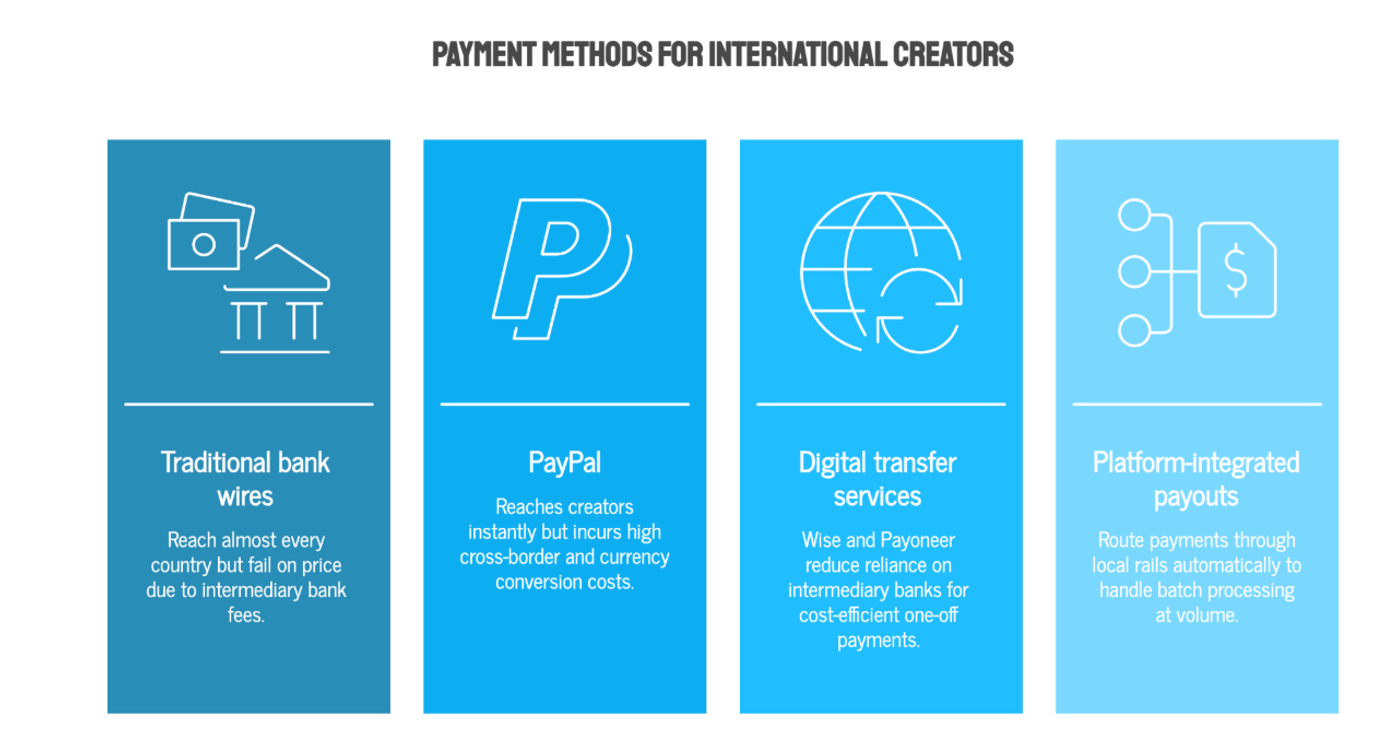
Four methods dominate, and the cost differences between them are dramatic.
- Traditional bank wires reach almost every country and fail on price. World Bank data puts banks' average cost for cross-border transfers at 14.99%, before counting flat sending fees. The reason wires stay expensive is structural: your bank rarely has a direct relationship with a creator's bank in Manila or São Paulo, so the payment hops through intermediary banks that each take a cut you never see quoted. That's also why wires are slow and hard to trace. No single institution owns the full journey.
- PayPal reaches most creators instantly and charges for the convenience. Cross-border fees and currency conversion costs can add up, with the exact cost varying by country, transaction type, and currency. PayPal converts at its own rate, and creators in many countries may also pay fees to withdraw funds to a local bank, so a $500 payment can land as $455 in your books and $430 in theirs.
- Digital transfer services in the Wise and Payoneer category are often more cost-efficient for one-off payments because they can reduce reliance on intermediary banks by using local payment infrastructure in many markets. The tradeoff is operational, not financial. Each payment is still its own transaction, initiated by a person.
Want to put this into practice?
SideShift connects you with vetted UGC creators who actually deliver. Start your free trial and post your first job in under 10 minutes.
- Platform-integrated payouts route each creator's payment through available local payment rails automatically, and their real advantage arrives at volume. Sending 20 individual Wise transfers means 20 manual transactions, 20 chances to fat-finger an account number, and 20 "did you send it yet?" emails. A platform batch handles a mixed U.S.-and-international creator list in one approval.
Currency and Exchange Rates in International Creator Payments
Paying in USD is the common default, and it shifts conversion to the creator's side, where their bank or wallet converts at whatever rate it chooses. Simple for you, occasionally expensive for them, and creators in countries with weak local conversion options will quietly factor that loss into the rates they quote you.
Paying in the creator's local currency reverses this: you absorb a known conversion cost upfront, the creator receives exactly the number they expected, and your effective rate becomes slightly less predictable while your creator relationships become more so.
At scale, the second option through a platform usually wins, since some platforms can offer more competitive FX rates than traditional banks, and the predictability compounds into the retention effect we keep returning to in this series.
Creators remember exactly two things about how you pay: whether the amount was right and whether it was on time. Currency handling determines the first.
How Do You Scale Payouts Across Dozens of Countries?
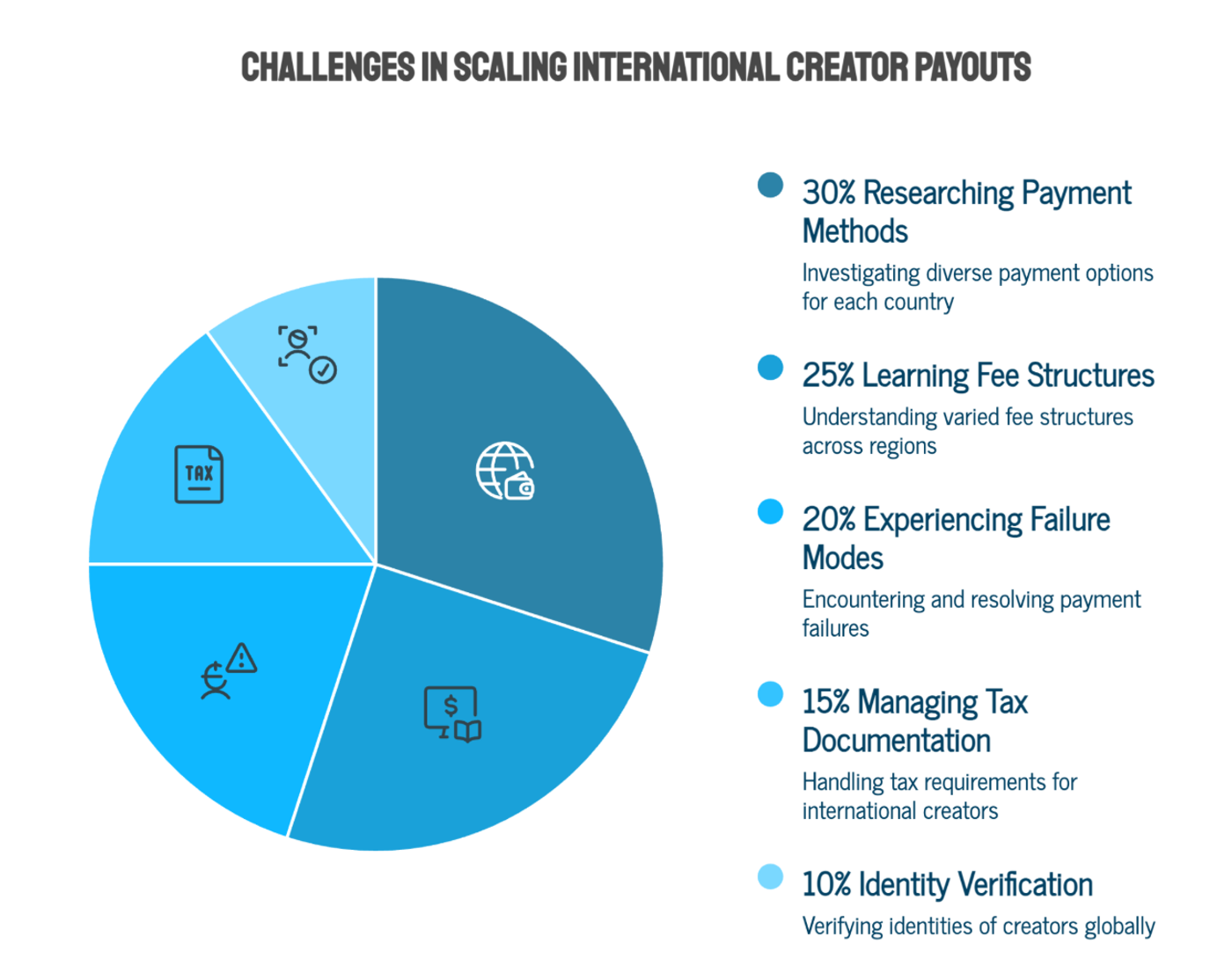
The manual version tops out fast. Every new creator country adds a payment method to research, a fee structure to learn, and a failure mode to eventually experience. Before long, the person running payments becomes the single point of failure for an increasingly complicated map. Brands usually feel this between 10 and 20 international creators, which is well below the volume where creator variety starts driving real ad performance.
On SideShift, creators complete a standardized onboarding process, submitting the payment details, rather than forcing brands to piece together one-off processes for every new hire.
At scale, international payments mean navigating tax documentation, identity verification, currency conversion, local payout methods, transaction fees, and country-specific restrictions. Platforms like SideShift centralize that infrastructure across onboarding, contracting, and payouts, so brands don't have to manage those requirements market by market.
That can also expand the creator pool. Strong UGC performers price in markets where your dollar goes further, but payment complexity can make those creators harder to access. Removing that friction lets brands look beyond the markets that are easiest to pay and find strong talent at more efficient rates.
Pay UGC Creators Internationally on SideShift
Every international creator you don't work with because paying them seems hard is talent conceded to a competitor with better payment infrastructure. The fix costs almost nothing to test.
SideShift handles cross-border payouts inside the same platform that runs your briefs and content delivery. Creators anywhere onboard with their local payment details and tax forms, and your batch approval pays your whole roster, domestic and international, in one action at rates that don't quietly eat the payment along the way.
Want to put this into practice?
SideShift connects you with vetted UGC creators who actually deliver. Start your free trial and post your first job in under 10 minutes.
Post a brief, accept the best applicants regardless of their time zone, and let the platform worry about the corridors.
FAQs
1. What is the cheapest way to pay international UGC creators?
Digital cross-border transfer services and platform-integrated payouts, which average around 3.5% per World Bank data, compared to roughly 15% through traditional banks. At recurring volume, platform batches add the labor savings of paying every creator in one approval rather than per transfer.
2. Do international creators need a W-9?
No. U.S. creators generally provide a W-9, while foreign individual creators generally use a W-8BEN. Creators operating through a foreign company generally use the W-8BEN-E instead. The appropriate documentation can vary based on the creator's status and circumstances, so brands should confirm their specific requirements with a qualified tax professional.
3. Should you pay international creators in USD or their local currency?
Local currency is often the better relationship decision, since the creator knows the amount they'll receive in their local currency and you absorb the conversion cost upfront. Conversion costs and rates vary by provider, so state the payment currency in the brief so conversion never becomes a surprise.
4. How long do international creator payments take?
Bank wires can take two to five business days and may lose time at intermediary banks. Digital transfer services and platform payouts can be faster, with some corridors settling within one to two business days or even the same day. Speed varies by receiving country, payment method, and provider.