
What is a Good Conversion Rate?
Good conversion rates vary by industry: ecommerce 2–3%, B2B SaaS 5–7%, lead gen 10%+, helping benchmark performance.
Table of Contents
A good conversion rate in 2026 is typically between about 2% and 5% for most ecommerce websites, with top-performing brands often reaching 8%-10% or higher, depending on traffic quality and funnel optimization.
The answer really depends on your industry, traffic quality, pricing, and funnel stage. In this guide, we’ll explain what conversion rate actually measures, share 2026 benchmarks, break down conversion rates by industry, and explain how to build social proof with UGC to improve your conversion rate.
What is a Conversion Rate?
A conversion rate measures the percentage of visitors who complete a desired action on your website.
Conversion Rate = (Conversions ÷ Visitors) × 100
Example:
- 10,000 visitors
- 300 purchases
- Conversion rate = 3%
For ecommerce brands, the denominator of the conversion rate is the total number of visitors or sessions, while the numerator is the number of completed desired actions, such as purchases, signups, demo requests, or account creations. Each conversion rate provides unique insight into how efficiently your website turns interest into action, helping you identify opportunities to increase revenue without relying on more traffic.
Conversions can include purchases, email signups, demo bookings, free trial registrations, or account creations. Similarly, the denominator can be measured as total sessions, unique visitors, or other traffic metrics, depending on the goal being tracked.
What is Considered a Good Conversion Rate in 2026?
Most websites fall somewhere between 1% and 3% conversion rates. However, strong-performing businesses consistently exceed this range.
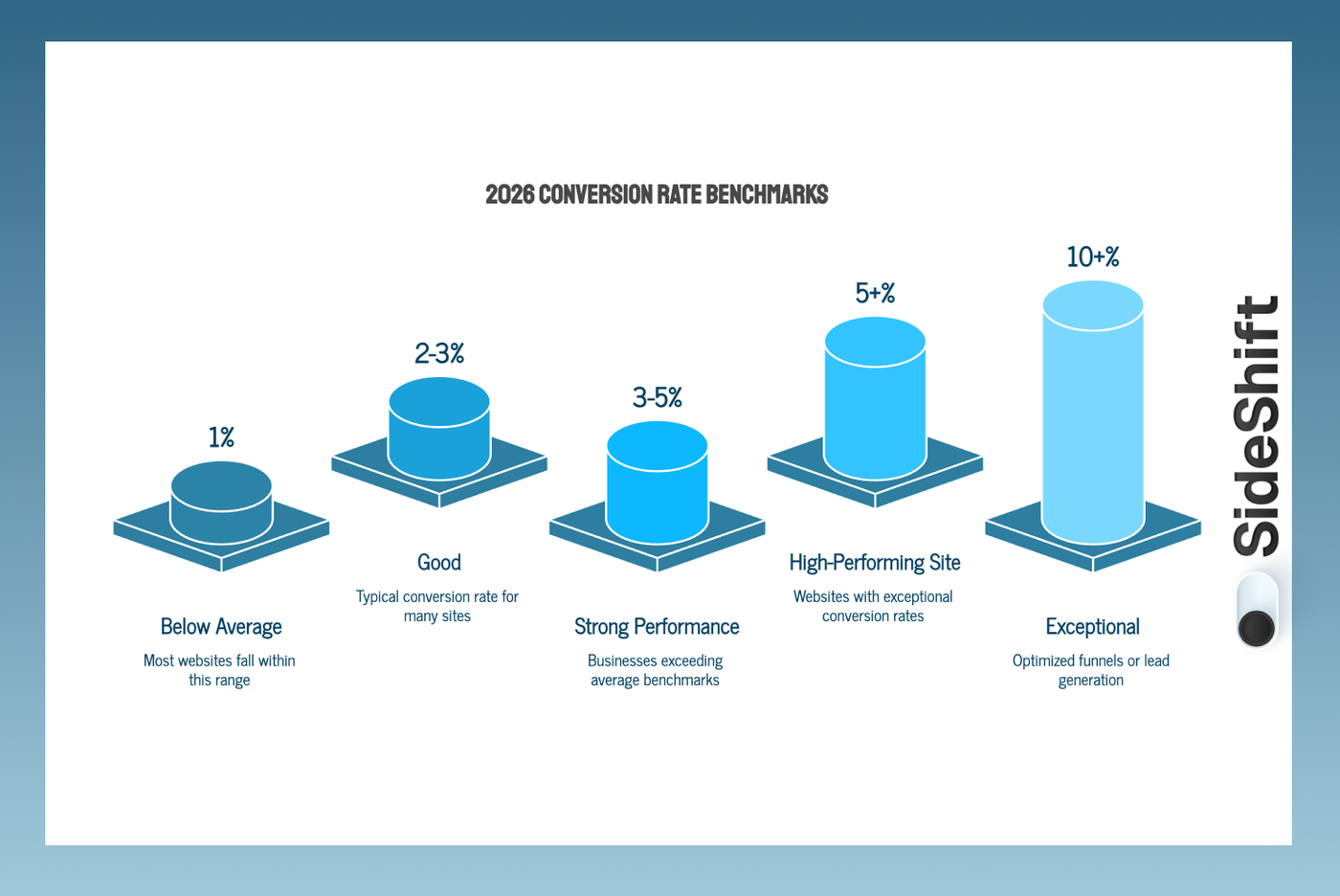
Typical benchmarks in 2026:
- 1% → Below average
- 2-3% → Good conversion rate for many websites
- 3-5% → Strong performance
- 5%+ → High-performing site
- 10%+ → Exceptional (usually optimized funnels or lead generation)
A good conversion rate is above your industry average and improving over time. For ecommerce specifically, many brands aim for at least 2-3% as a baseline.
In the world of social media, a strong conversion rate benchmark is around 1% from viewer to sign-up when engagement rates are near 10% on the content. For example, a video with 1 million views and a compelling call-to-action should generate 10,000+ new sign-ups.
Ecommerce Conversion Rate Benchmarks (2026)
Most online stores convert between 2% and 3%, but top ecommerce brands often reach 3-5% or higher, depending on product category and traffic quality.
Average ecommerce benchmarks:
- New or smaller stores: 1-2%
- Established ecommerce brands: 2-3%
- High-performing ecommerce brands: 3-5%
- Top-tier optimized stores: 5%+
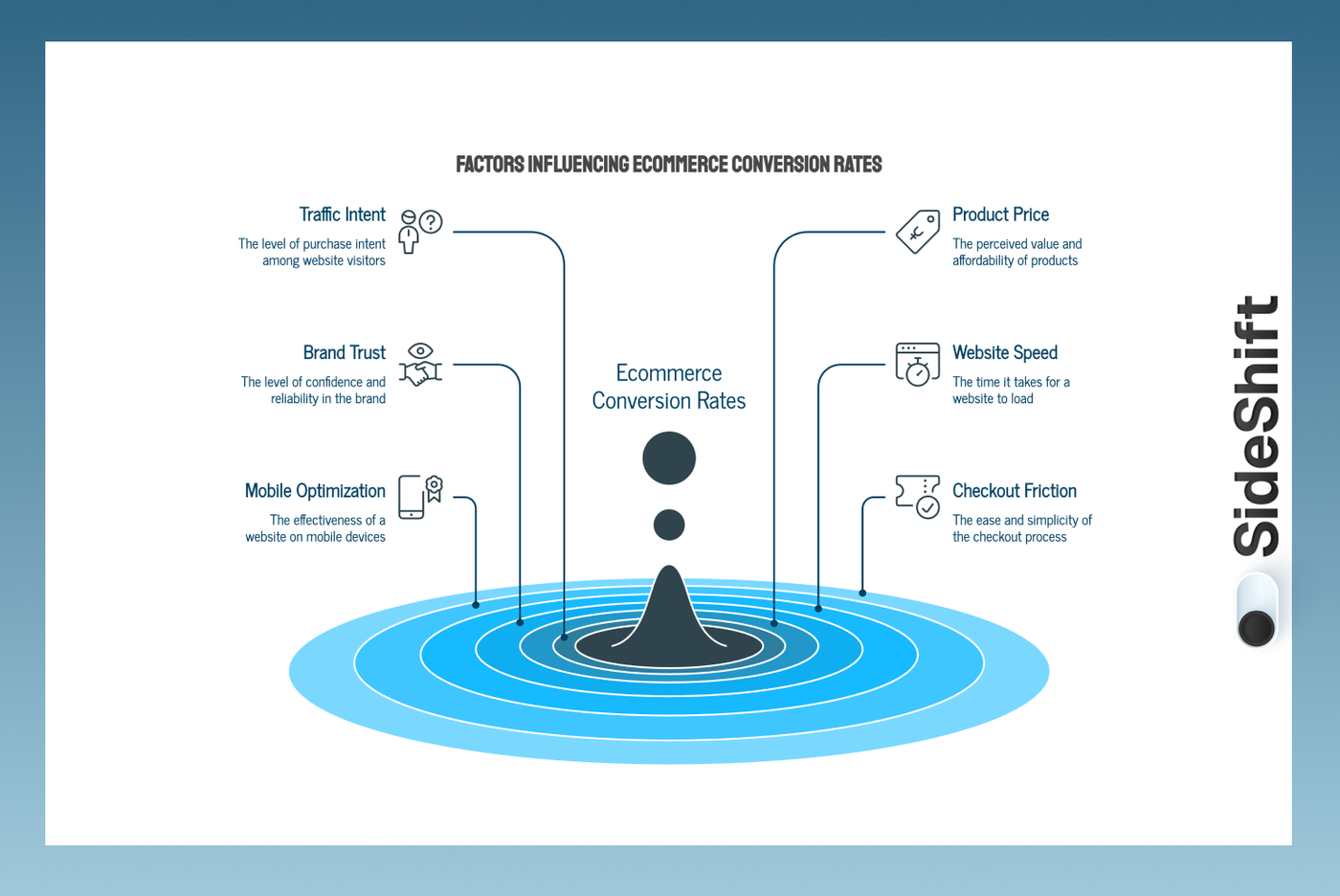
Several factors influence ecommerce conversion rates:
- Traffic intent
- Product price
- Brand trust
- Website speed
- Mobile optimization
- Checkout friction
Traffic source also plays a big role in conversion rates, as different channels attract varying levels of purchase intent. For example, email marketing typically delivers the highest conversion rates, search traffic captures high-intent visitors and converts strongly, retargeting ads often outperform cold traffic, and social media generally has a lower average conversion but offers strong scale potential.
Conversion Rate Benchmarks by Industry
Different industries naturally convert at different rates because of buying behavior and sales cycles.
Here are common benchmarks for 2026:
- Ecommerce: 2-3% average
- B2B SaaS: 5-7% average
- Lead generation websites: 8-12% average
Want to put this into practice?
SideShift connects you with vetted UGC creators who actually deliver. Start your free trial and post your first job in under 10 minutes.
- Subscription services: 4-8%
- Marketplaces: 3-6%
Some industries with strong brand loyalty or repeat purchases may exceed these averages.
For example, beauty, supplements, and niche consumer brands often convert higher than general retail.
What is Considered a High Conversion Rate?
A high conversion rate typically means your site performs well above industry averages.
Examples of strong performance:
- Ecommerce store converting at 4-6%
- Optimized landing page converting at 10%+
- High-intent SaaS trial page converting at 12%+
- Returning customer traffic converting at 15%+
High conversion rates usually happen when:
- Traffic is highly targeted
- Brand trust is strong
- Product-market fit is clear
- User experience is optimized
In other words, high conversion rates are usually the result of multiple improvements working together rather than a single optimization.
6 Factors That Impact Conversion Rates
Conversion rates vary widely depending on several performance drivers.
- Traffic Quality - Visitors with purchase intent convert much higher than cold audiences.
- Website Speed - Slow sites reduce conversions significantly, especially on mobile.
- Product-Market Fit - If the product solves a clear problem, conversions increase naturally.
- Social Proof - Reviews, testimonials, and real user-generated content increase trust.
- Pricing Strategy - Bundles, discounts, and perceived value influence purchase decisions.
- Mobile Optimization - Mobile traffic now dominates ecommerce, but often converts lower if not optimized.
Brands that improve these factors typically see meaningful conversion lifts.
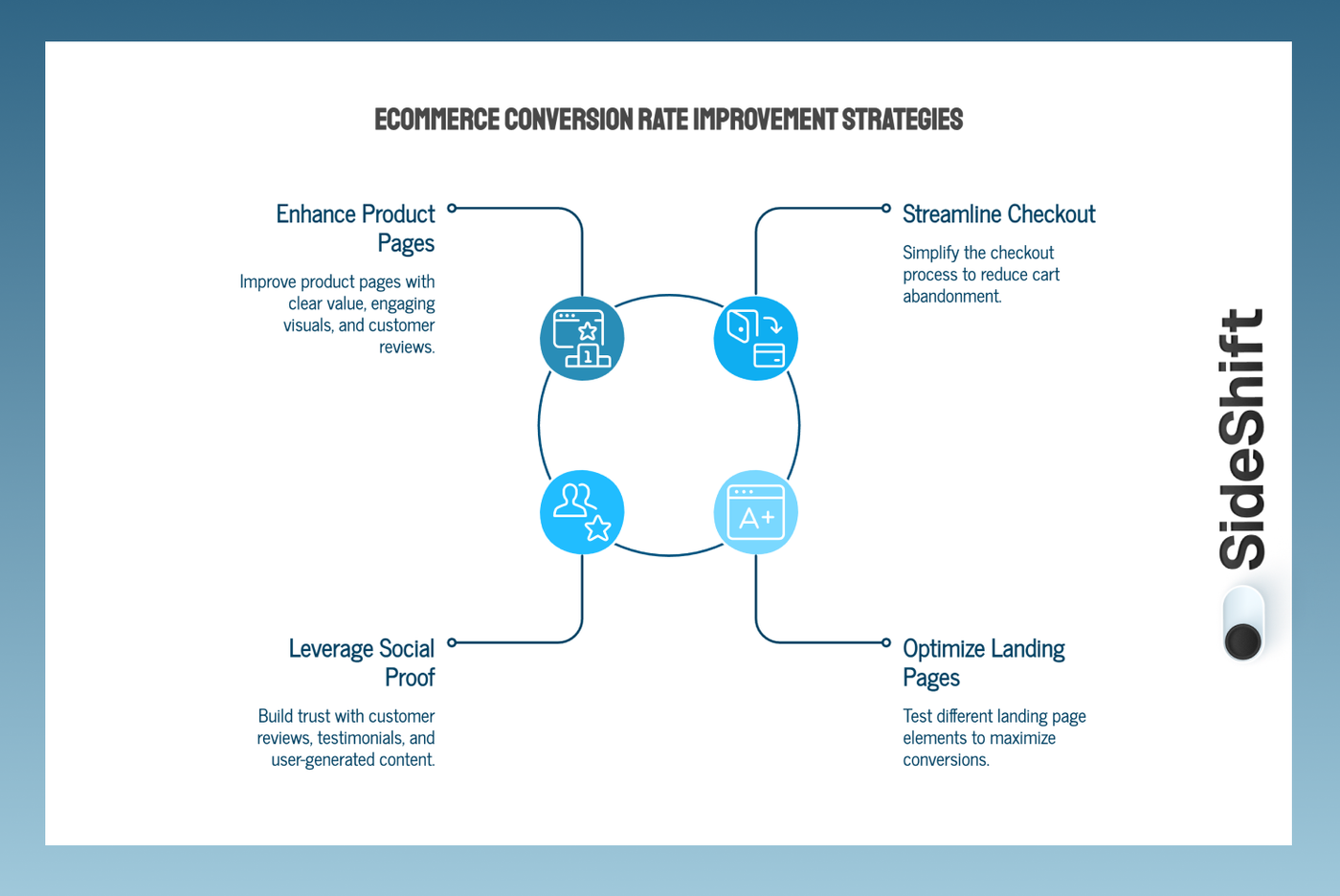
4 Ways to Improve Ecommerce Conversion Rate
Improving conversion rate is often the fastest way to increase revenue without increasing ad spend.
Improve Product Pages
High-performing product pages clearly communicate the value of your product while engaging customers both visually and emotionally.
Include a clear value proposition, compelling product imagery, short-form videos or user-generated content, customer reviews, and benefit-focused copy that explains why your product matters.
Reviews are especially powerful, with up to 98% of consumers wanting to read reviews before making a purchase. Seeing relatable customers share genuine experiences builds trust and boosts confidence, making shoppers more likely to complete a purchase.
Optimizing these elements helps visitors quickly understand your offering and increases the likelihood they’ll convert.
Reduce Checkout Friction
Many conversions are lost during the checkout process. Simplifying this step can have a huge impact on your overall conversion rate.\
Reduce the number of steps, enable guest checkout, offer multiple payment options, clearly communicate shipping costs, and ensure the design is mobile-friendly.
Making the purchase process smooth and intuitive keeps customers from abandoning their carts.
Use Social Proof
Trust is one of the strongest drivers of conversion, and social proof is how you build it.
Incorporate social proof throughout your site to reassure potential buyers. This can include customer reviews, creator content, testimonial ads, and other forms of user-generated content.
Social proof reassures visitors and increases their confidence, making them far more likely to complete a purchase.
Gen Z, in particular, places a high level of trust in online reviews, with 76% ranking them as the second most important factor after product quality when deciding whether to buy. This reflects a broader trend: people trust their peers more than brands.
Want to put this into practice?
SideShift connects you with vetted UGC creators who actually deliver. Start your free trial and post your first job in under 10 minutes.
Test Landing Pages
Conversion rate optimization often requires experimentation. Test different headlines, offers, page layouts, call-to-action buttons, and product messaging to see what resonates most with your audience. Even small improvements in these areas can significantly boost revenue and overall performance.
Improve Your Conversion Rate with SideShift
Building social proof can significantly boost your conversion rate. User-generated content builds trust online faster than traditional product marketing, making it more effective at turning browsers into buyers. One of the biggest drivers of higher conversions today is authentic content from creators.
With SideShift, brands can connect with creators who align with their audience, produce authentic product content at scale, and test multiple creatives across campaigns. Instead of relying on a single polished ad, brands can launch a variety of creator-driven assets that increase engagement and buying confidence. This approach helps turn traffic into customers more efficiently.
Start improving your conversion rate with creator-led marketing on SideShift.
Activate your free trial on SideShift today.
FAQs
1. What is a good conversion rate for ecommerce?
Most ecommerce stores aim for 2-3% as a healthy baseline, while strong brands often reach 3-5% or higher with optimized product pages and traffic quality.
2. What is considered a high conversion rate?
A high conversion rate usually means above 5% for ecommerce or 10%+ for landing pages and lead generation funnels.
3. Why is my conversion rate low?
Common causes include low-intent traffic, poorly designed product pages, slow site speed, weak trust signals, and friction during checkout. By optimizing your product pages, improving site performance, building trust with reviews or UGC, and simplifying the checkout process, you can significantly increase conversions.
4. How can I increase my conversion rate quickly?
Focus on improving your product pages, adding social proof and user-generated content, reducing checkout friction, testing different offers and landing pages, and optimizing the mobile experience. Each of these steps can help turn more visitors into customers without needing to drive additional traffic.
5. What are the average ecommerce conversion rate benchmarks in 2026?
- Average ecommerce store: 2-3%
- Strong-performing store: 3-5%
- High-performing brand: 5%+