


What Is YouTube Influencer Marketing and How Does It Work?
YouTube influencer marketing drives high-intent traffic and lasting ROI. Here's how brands structure creator campaigns that convert on the platform.
Table of Contents
YouTube influencer marketing operates on a different logic than every other social platform, and brands that understand that difference build campaigns with substantially better returns. While TikTok rewards virality and Instagram rewards aesthetics, YouTube rewards depth. Viewers come there with intent: they're searching for something, trying to learn something, or committing 20 minutes to a creator they genuinely trust.
That intent-driven environment is one of the most valuable contexts a brand can show up in, and is reflected in how quickly brands are shifting budgets toward YouTube creator content. Data points to YouTube sponsorships jumping by 54% year-over-year in the first half of 2025, generating 19.1 billion total views across tracked sponsored videos.
This guide breaks down exactly how YouTube influencer marketing works, what makes it structurally different from other platforms, how to build campaigns that perform, and where YouTube Shorts is opening new doors for brands that want the scale of short-form content combined with its search-driven staying power.
What Makes YouTube Influencer Marketing Structurally Different
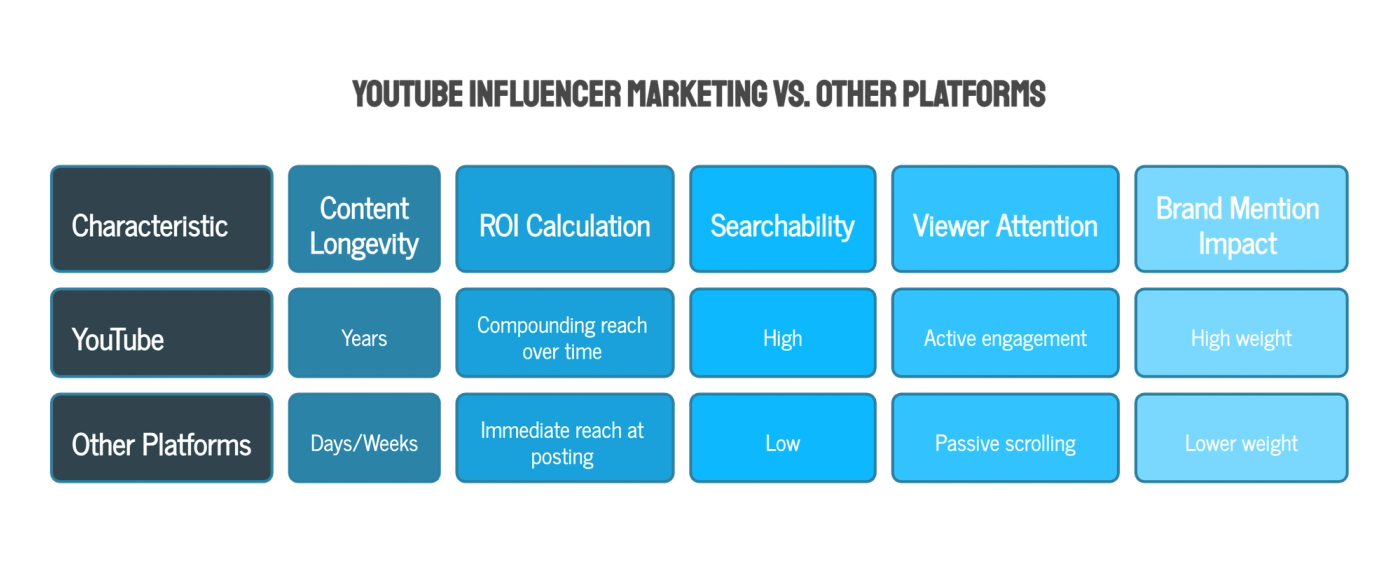
The fundamental difference between YouTube and every other major social platform is content longevity. A TikTok post has a shelf life measured in days. An Instagram Reel fades from feeds within a week. A YouTube video with strong SEO can drive traffic, views, and conversions for years after it's posted.
This changes the ROI calculation for YouTube influencer campaigns significantly. When a creator mentions your brand in a well-optimized video, that mention doesn't just reach their current subscriber base at the time of posting. It reaches every person who finds that video through YouTube search in the months and years that follow.
For brands in categories where people actively search for information, such as software, personal finance, fitness, beauty, tech, and education, this compounding reach is genuinely difficult to replicate on any other platform.
YouTube also produces a different quality of attention than short-form platforms. A viewer who clicks on a 12-minute video and watches it through has made an active choice to engage, they're not passively scrolling past content.
That level of voluntary attention is significantly harder to achieve on platforms built around the “mindless scroll,” and it's the reason brand mentions inside long-form YouTube content tend to land with more weight than a mid-feed ad or a 30-second Reel.
The Different Types of YouTube Creators
YouTube's creator ecosystem spans a wider range of content formats and production styles than any other platform. Understanding the distinctions helps brands identify where their budget will work hardest.
Long-Form Creators (10-60+ minute videos)
These are the traditional backbone of YouTube influencer marketing. Long-form creators typically have deeply loyal subscriber bases built around specific niches: gaming, personal finance, cooking, fitness, tech reviews, beauty tutorials, and more. Sponsorship integrations within long-form videos, whether dedicated segments, mid-roll mentions, or full product reviews, benefit from the high trust and attention that long-form content generates.
YouTube Shorts Creators
Shorts has matured into a meaningful distribution channel within the platform's ecosystem. Creators producing vertical short-form content natively for YouTube Shorts bring the discoverability of YouTube's search and recommendation engine to a faster, more iterative content format. For brands that want short-form content with YouTube's SEO advantage, Shorts creator partnerships are an increasingly compelling option.
Want to put this into practice?
SideShift connects you with vetted UGC creators who actually deliver. Start your free trial and post your first job in under 10 minutes.
Dedicated Review and Tutorial Creators
This category deserves specific attention for brands where purchase consideration is high. A creator who builds their channel around in-depth product reviews or how-to tutorials is showing up at exactly the moment when their audience is actively researching a buying decision. A well-placed sponsorship or organic product integration in a review video puts your brand in front of high-intent viewers at the most valuable moment in the funnel.
UGC Creators for YouTube Ad Creative
YouTube's ad system, particularly TrueView and non-skippable pre-roll formats, increasingly rewards content that looks and feels like organic creator video rather than traditional ad creative. UGC creators who produce authentic talking-head or demonstration-style video for brands provide assets that can run across YouTube's paid system while maintaining the native feel that drives stronger completion rates and lower cost per view.
How Brands Can Partner With YouTube Creators
Unlike Instagram or TikTok where sponsored content is usually a standalone post, YouTube integrations take several distinct forms, each with different implications for performance and cost.
Dedicated Sponsorship Videos
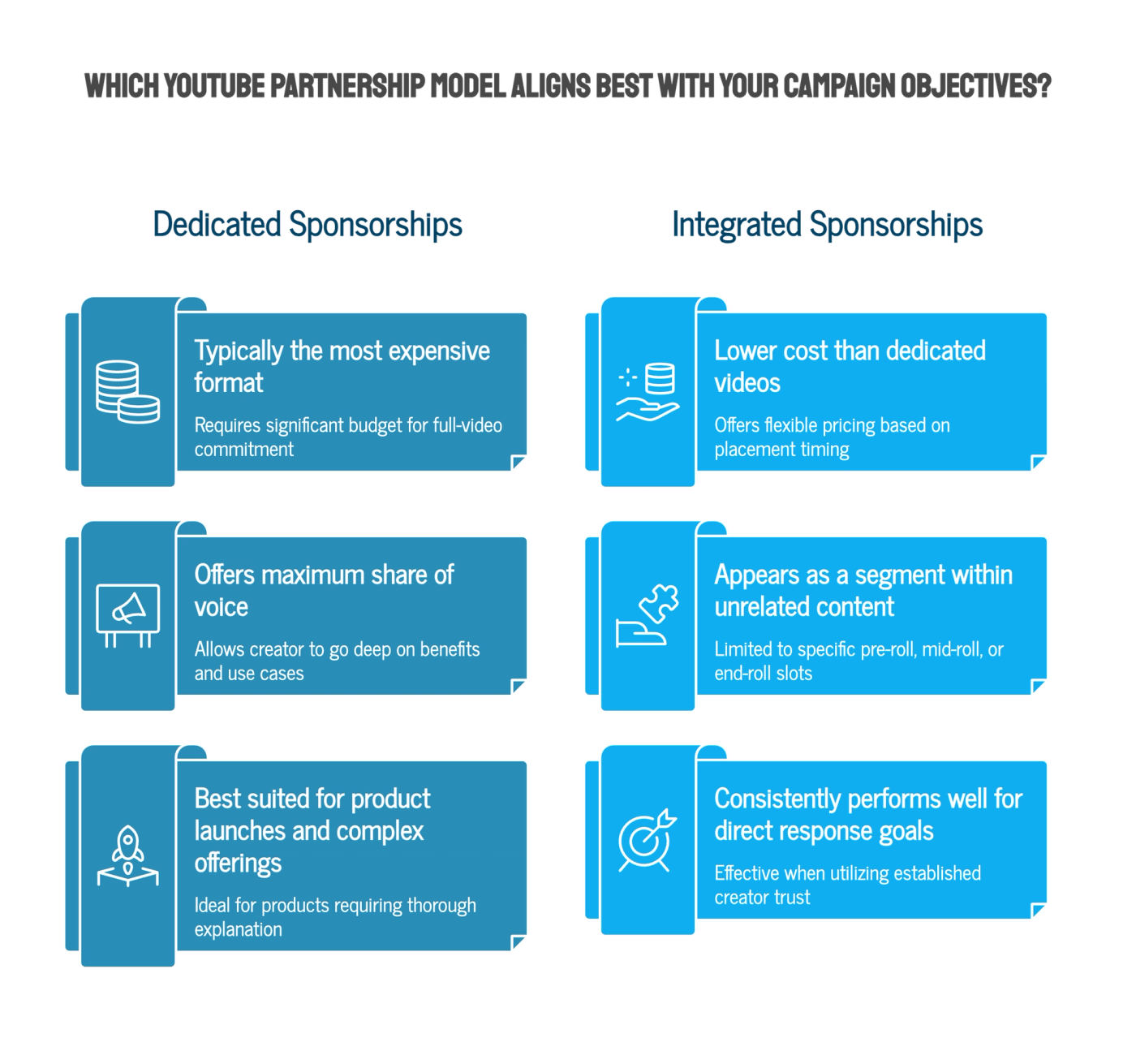
The entire video is built around your brand. This is typically the most expensive format, but offers maximum share of voice and allows the creator to go deep on your product's benefits, use cases, and differentiators. It’s best suited for product launches, complex offerings that benefit from explanation, or brands where a thorough review drives significantly higher conversion than a brief mention.
Integrated Sponsorships (Pre-roll, Mid-roll, End-roll)
Your brand appears as a segment within an otherwise unrelated video. Pre-roll integrations appear at the start of the video before the main content, capturing viewers at peak attention. Mid-roll integrations appear partway through, typically after the creator has established engagement and trust. End-roll placements are lower cost but receive lower attention as viewers drop off before the video ends. Mid-roll integrations from trusted creators in relevant niches consistently perform well for direct response goals.
Affiliate and Commission-Based Partnerships
Rather than a flat sponsorship fee, brands provide creators with unique discount codes or affiliate links and pay a commission on resulting sales. This model aligns creator incentives directly with conversion, works well for e-commerce and subscription brands, and reduces upfront risk. The downside is that creators without a direct commercial incentive may deprioritize your integration in favor of guaranteed-fee opportunities.
YouTube Shorts Integrations
Shorter, more native integrations designed specifically for the Shorts format. They’re lower cost than long-form integrations and better suited for brands where a quick demonstration or recommendation is enough to drive action. The discovery potential of Shorts means well-performing integrations can reach audiences well beyond the creator's existing subscriber base.
How to Build a YouTube Influencer Campaign Step by Step
YouTube influencer campaigns take longer to build and longer to brief than short-form platforms, but they also outlast them. Knowing how to start influencer marketing on YouTube means understanding that the work upfront (finding the right creator, nailing the brief, and optimizing for search) is what determines whether a campaign keeps delivering six months after it goes live.
Want to put this into practice?
SideShift connects you with vetted UGC creators who actually deliver. Start your free trial and post your first job in under 10 minutes.
Step 1: Match Your Goal to the Right YouTube Format
YouTube serves multiple stages of the marketing funnel, but it serves each one differently. Getting this alignment right before you start reaching out to creators determines whether your campaign budget is working efficiently.
- Top of funnel awareness: long-form creator partnerships in relevant niches, where the goal is brand exposure to highly targeted, engaged audiences over time
- Mid-funnel consideration: dedicated review or tutorial integrations that give your product substantive screen time during high-intent research moments
- Bottom-funnel conversion: affiliate code integrations, Shorts campaigns, or YouTube ad creative built from UGC that targets warm audiences already familiar with your brand
Step 2: Narrow Down Creator Niches
YouTube's strength is niche specificity. There are creators with dedicated audiences for virtually every product category, and the more precisely your creator niche aligns with your target customer's interests, the higher the conversion efficiency of your campaign.
When evaluating creator niches, think about:
- Where does your target customer go on YouTube when they're not looking for your product? What are they watching?
- Is your product something people actively search for reviews or tutorials about? If so, search YouTube for those terms and see which creators are already dominating those results.
- Are there adjacent niches where your product naturally fits into the lifestyle or workflow of the creator's audience?
Step 3: Find the Right Creators
Knowing how to find YouTube influencers for your brand is more complex than finding influencers for TikTok or Instagram. YouTube has no native creator marketplace with filtering tools like TikTok, and its search function is built for content discovery, not creator discovery.
Most brands rely on one of three approaches:
- Manual search: Search keywords relevant to your category and identify channels that consistently rank for those terms. It’s time-intensive and doesn't scale. YouTube surfaces content, not creator profiles, so assessing fit requires clicking into each channel individually. Works for sourcing a handful of partners, but breaks down quickly beyond that.
- Agency sourcing: Agencies bring existing creator relationships and can move faster on outreach. The limitation is roster depth. Agencies tend to work within established creators, which limits access to emerging talent who might be a stronger niche fit at a lower cost. Better suited for brands with larger budgets and less need for niche specificity.
- Creator marketplace: Platforms like SideShift give brands access to pre-vetted creator networks across YouTube and other platforms, with filtering by niche, audience size, engagement rate, and content category. Creators have already been screened for authenticity and content quality, which significantly reduces the time spent on discovery and vetting, especially for brands running campaigns at volume.
Step 4: Evaluate Creators Beyond Subscriber Count
Subscriber count on YouTube has the same limitation as follower count on other platforms: it tells you audience size but nothing about engagement quality, content relevance, or sponsorship performance.
Want to put this into practice?
SideShift connects you with vetted UGC creators who actually deliver. Start your free trial and post your first job in under 10 minutes.
When vetting YouTube creators, prioritize:
- Average view count per video relative to subscribers: A channel with 500,000 subscribers averaging 50,000 views per video has a 10% view rate. Channels with strong view-to-subscriber ratios indicate active, returning audiences rather than passive or purchased subscriber bases.
- Audience retention rate: YouTube Analytics shows creators how long viewers watch their videos. Creators with strong average view duration are holding attention, which is the environment you want your sponsorship to appear in.
- Comment quality and creator responsiveness: Are viewers asking questions, sharing opinions, and tagging others? Does the creator respond? Active comment sections signal genuine community.
- Sponsorship integration style: Watch how the creator handles existing brand integrations. Do they feel natural and genuinely endorsed, or are they clearly read from a script? Authentic delivery significantly affects sponsorship conversion rates.
- Niche relevance and audience demographics: The more precisely the creator's content and audience align with your product category, the less selling your sponsorship has to do.
Step 5: Structure the Deal and Brief Correctly
YouTube sponsorship deals involve more variables than short-form platform integrations, and getting the structure right protects your investment.
Key deal elements to establish upfront:
- Integration format and placement: This can include pre-roll, mid-roll, dedicated video, or Shorts. Be specific.
- Minimum mention requirements: What must the creator cover, show, or demonstrate? How long should the integration run?
- Usage rights: Can you repurpose the integration or clips from the video for your own paid ads? This is worth negotiating for because strong creator content often has value beyond the original YouTube placement.
- Exclusivity: Are you restricting the creator from working with direct competitors for a defined period? Exclusivity clauses cost more but protect your investment in categories where competitor mentions could neutralize your sponsorship.
- Performance tracking: Unique discount codes, UTM-tagged links, or affiliate tracking URLs are non-negotiable for measuring actual campaign ROI.
Your brief should give the creator enough context to speak authentically about your product while establishing clear non-negotiables around brand safety, claims, and required messaging points. The best YouTube sponsorships sound like the creator actually uses and believes in the product, because the ones that do convert at higher rates.
Step 6: Measure the Full Funnel, Not Just Clicks
YouTube's attribution is more complex than platforms with direct swipe-up functionality, and brands that only measure last-click attribution consistently undervalue YouTube's contribution to their overall marketing performance.
Metrics worth tracking across a YouTube campaign:
- Promo code redemptions and affiliate link clicks for direct conversion measurement
- Branded search volume lift in the weeks following a campaign, which signals awareness generated by viewers who didn't convert immediately
- YouTube ad performance if you're repurposing creator content as paid pre-roll, including view-through rate and cost per view
- Traffic from YouTube in Google Analytics broken out by the campaign period
- Subscriber and engagement trends on your own brand YouTube channel if creator campaigns are driving viewers there
How YouTube Shorts Expand Reach
Want to put this into practice?
SideShift connects you with vetted UGC creators who actually deliver. Start your free trial and post your first job in under 10 minutes.
YouTube Shorts have introduced something genuinely new to the YouTube creator economy: the ability to run higher-volume, faster-iterating creator content within YouTube's ecosystem and benefit from its search and recommendation infrastructure simultaneously.
For brands that have been running high-volume UGC campaigns on TikTok and Instagram, YouTube Shorts represents a logical expansion. The content format is similar, the production requirements are comparable, and the distribution potential adds YouTube's search engine advantage on top of algorithmic reach. A Shorts video that gains traction can drive sustained traffic through YouTube's recommendation system in a way that TikTok content typically doesn't.
This is particularly relevant for brands where search intent plays a role in the purchase journey. A product review or demonstration formatted as a YouTube Short can surface in both YouTube search results and the Shorts feed, creating two distinct discovery paths from a single piece of content.
Scale Your YouTube Creator Strategy with SideShift
The brands building durable advantages on YouTube are the ones producing consistent creator content, testing formats across both long-form and Shorts, and building the operational infrastructure to manage creator relationships at scale without it consuming the entire marketing team's bandwidth.
SideShift connects brands with over 800,000 U.S.-based Gen Z creators, including creators producing content across YouTube Shorts and other short-form formats that feed directly into YouTube's ecosystem. For marketing teams looking to build a high-volume UGC pipeline that extends to YouTube, SideShift's platform handles job posting, creator recruitment, contracts, and payouts in one place. Plans start at $299/month, with enterprise options for brands running campaigns at significant scale.
YouTube rewards consistency, quality, and niche relevance. SideShift provides the creator infrastructure to deliver all three without the operational overhead that typically makes YouTube creator programs unsustainable for growing marketing teams.
FAQs
1. How much does YouTube influencer marketing cost for brands?
Costs vary significantly based on creator tier and integration format. Nano and micro YouTubers typically charge $200-$2,000 per integration, mid-tier creators range from $2,000-$10,000, and macro creators can command $20,000-$100,000+ for dedicated videos. YouTube Shorts integrations and UGC content for YouTube ad creative typically cost considerably less, starting around $100-$500 per asset. SideShift's plans begin at $299/month and give brands a scalable infrastructure for managing creator sourcing, contracts, and payments without adding headcount.
2. How do you measure ROI from a YouTube influencer campaign?
The most reliable direct measurement comes from unique promo codes and UTM-tagged affiliate links, which attribute conversions directly to specific creators and videos. Beyond direct attribution, track branded search volume lift, referral traffic from YouTube in analytics, and view-through performance if you're running creator content as paid pre-roll ads. YouTube campaigns often drive significant mid-funnel impact that doesn't show up in last-click attribution, so measuring across the full funnel gives you a more accurate picture of actual ROI.
3. What's the difference between a YouTube sponsorship and a UGC creator campaign for YouTube?
A YouTube sponsorship places your brand within a creator's video for distribution to their existing subscriber base. You're paying for access to their audience and their trust relationship with that audience. A UGC creator campaign for YouTube produces short-form content assets that your brand owns and deploys through YouTube's paid ad system or your own channel. The creator's subscriber count is irrelevant in the UGC model. You're buying content quality and authenticity, not distribution access.
Want to put this into practice?
SideShift connects you with vetted UGC creators who actually deliver. Start your free trial and post your first job in under 10 minutes.
4. Should brands focus on long-form YouTube videos or YouTube Shorts for influencer campaigns?
Both serve different strategic purposes and work best in combination. Long-form integrations drive deeper consideration and conversion among high-intent audiences, making them strong for mid-to-bottom funnel goals. YouTube Shorts campaigns allow faster content iteration, lower per-unit costs, and broader top-of-funnel reach through the Shorts discovery feed. Brands with meaningful YouTube budgets typically run both simultaneously, using Shorts for volume and testing while using long-form partnerships for conversion-focused campaigns in high-intent niches.
5. How do you find the right YouTube creators for your brand's niche?
Start by searching YouTube for the terms your target customer would use when researching your product category. The creators ranking for those terms already have audiences actively seeking information relevant to your brand. Evaluate them on view-to-subscriber ratio, comment quality, audience demographics, and how naturally they handle existing sponsorships. For brands that need to source creators at scale without manual research for every campaign, creator marketplaces like SideShift provide access to pre-vetted creator pools with built-in tools for outreach, contracting, and payment management.