


Cost Per Acquisition (CPA) for Creator & Influencer Campaigns
CPA in influencer marketing = total campaign cost / new customers acquired. See average CPAs by platform, how to lower yours, and what counts as good.
Table of Contents
How much did that influencer campaign actually cost you?
Not in creator fees. Not in impressions. Not in engagement. In customers.
A campaign can generate strong engagement, thousands of clicks, and a deck full of positive metrics. But when someone asks what it cost to acquire a customer, the answer is much less clear.
Cost per acquisition (CPA) is the metric that closes that gap. It connects creator spend to customer growth and helps brands understand whether a campaign is generating business results or simply generating activity.
When you know your CPA across creators, platforms, and campaigns, you stop optimizing for content you like and start optimizing for customers you acquire. This guide covers how to calculate CPA for influencer campaigns, what benchmarks look like in 2026, how CPA compares to other influencer ROI metrics, and how to lower your acquisition costs without sacrificing creative performance.
What Is Cost Per Acquisition in Influencer Marketing?
Cost per acquisition (CPA) measures how much it costs to win one new customer through a given campaign or creator. The formula is simple:
Total Campaign Cost ÷ New Customers Acquired = CPA
"Total campaign cost" includes everything from creator fees, gifted product, paid amplification, agency fees, creative production, and any platform costs tied to that campaign. If you leave any of those out, your CPA will look better than it is, and you'll scale based on a number that doesn't hold up under scrutiny.
"New customers" means net new, not returning buyers who happen to convert through a creator's link. Mixing the two muddies the number and inflates the case for influencer spend in ways that don't reflect real acquisition performance.
Consider a creator campaign that costs $24,000 in creator fees and another $6,000 in content production, shipping, and paid media. The total campaign investment comes to $30,000. If the campaign generates 500 new customers, the CPA is $60 ($30,000 ÷ 500).
Why CPA Has Become the Default Metric for Serious Influencer Programs
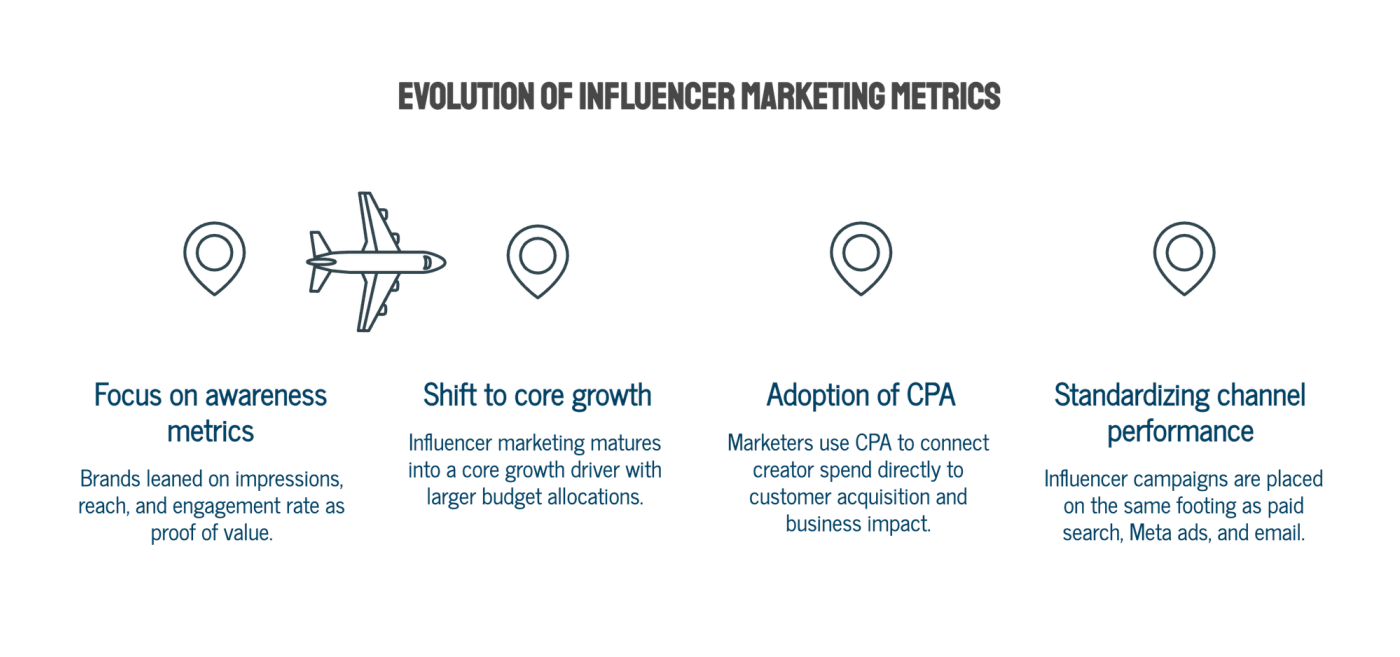
A few years ago, brands running influencer campaigns leaned on impressions, reach, and engagement rate as proof of value. Those metrics still matter for awareness, but they don't close a budget review.
As influencer marketing matures from an experimental channel to a core growth driver, brands are dedicating larger portions of their budgets to creator partnerships. Worldwide, 26% of marketing agencies and brands allocate more than 40% of their marketing budgets to influencer marketing. That shift has elevated the importance of CPA, giving marketers a way to connect creator spend directly to customer acquisition and business impact.
CPA answers the question executives actually ask: "What did a customer cost us?" It puts influencer campaigns on the same footing as paid search, Meta ads, and email, making it possible to allocate budget across channels based on real performance rather than creative intuition.
What Goes Into Your Total Campaign Cost
This is where brands most often miscalculate. CPA only works as a planning and optimization tool if the cost side of the equation is complete.
Want to put this into practice?
SideShift connects you with vetted UGC creators who actually deliver. Start your free trial and post your first job in under 10 minutes.
Creator fees are often one of the largest line items in an influencer campaign, though costs can vary considerably from one partnership to the next. Factors such as audience size, platform, content requirements, usage rights, exclusivity, and campaign scope can all influence pricing.
In some cases, platforms that require more production effort or longer-form content may command higher rates than simpler short-form executions. Regardless of the creator or platform, compensation should be included alongside all other campaign expenses when calculating CPA.
Beyond creator fees, a complete campaign cost includes:
- Product gifting or sampling costs, especially for seeding campaigns where not every creator is paid a flat fee
- Paid amplification, if you're boosting creator content as whitelisted or dark post ads
- Creative resizing and editing for repurposing content across placements
- Affiliate platform or tracking tool costs, if you're using software to manage links and attribution
- Agency or management fees, if you're not running the campaign entirely in-house
Repurposing influencer clips into paid ads often increases CTR and lowers CPAs relative to brand-produced ads, which means the amplification spend layered onto a creator campaign can pay for itself. But it still belongs in your CPA calculation.
Average CPA Benchmarks for Influencer Marketing
There's no universal CPA benchmark for influencer marketing. A healthy CPA depends on factors such as product price, profit margin, creator fit, offer strength, landing page experience, and customer lifetime value.
Rather than comparing your CPA to a generic industry average, focus on whether you're acquiring customers profitably. A CPA that works for a subscription business with high customer lifetime value may be unsustainable for a brand selling a one-time $20 product.
As a general rule, your CPA should remain comfortably below your customer lifetime value (LTV). If you're spending nearly as much to acquire a customer as that customer is worth to the business, scaling the campaign becomes difficult regardless of how strong the engagement or reach metrics appear.
CPA vs. ROAS vs. CPE: Which Metric Should You Prioritize?
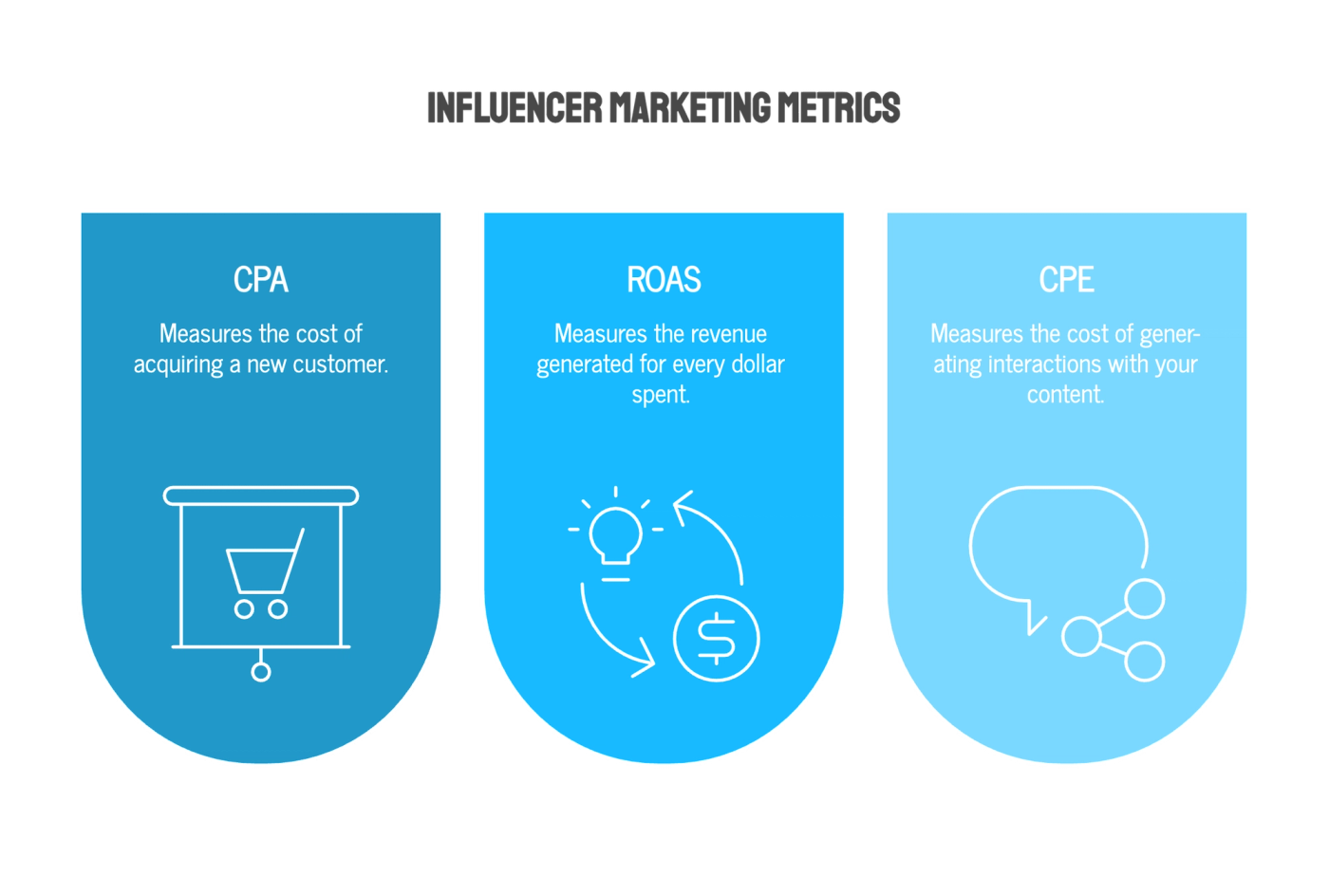
These three metrics answer different questions, and the right one to prioritize depends on your campaign objective.
- CPA (Cost Per Acquisition) measures the cost of acquiring a new customer. It's often the most useful metric for acquisition-focused campaigns where customer growth is the primary goal.
- ROAS (Return on Ad Spend) measures the revenue generated for every dollar spent. It can be helpful when evaluating overall revenue efficiency, especially across campaigns that influence both new and returning customers.
- CPE (Cost Per Engagement) measures the cost of generating interactions with your content, such as likes, comments, shares, and saves. It can help marketers understand which creators and content formats are generating the strongest audience response relative to spend.
For acquisition-focused campaigns, CPA is often the metric that matters most. For campaigns balancing awareness and conversion goals, ROAS can provide additional context. And for creative testing, CPE can help identify which content is resonating before larger budget decisions are made.
How Attribution Affects Your CPA Number
Your CPA is only as accurate as your attribution model.
Want to put this into practice?
SideShift connects you with vetted UGC creators who actually deliver. Start your free trial and post your first job in under 10 minutes.
One of the most common challenges in creator marketing is determining which touchpoint deserves credit for a conversion. A customer might watch a creator's TikTok, visit the website later, sign up for an email list, click a retargeting ad a few days afterward, and then make a purchase. Depending on the attribution model being used, different marketing channels could receive credit for the same conversion.
This is why attribution matters. If you're relying on a narrow measurement approach, you may underestimate the role creators play in driving consideration and purchase intent earlier in the customer journey.
The practical tools for improving attribution are relatively straightforward: unique UTM parameters for each creator, dedicated landing pages, trackable links, and promo codes tied to specific campaigns or partnerships. These tools create a clearer connection between creator content and customer actions, making it easier to calculate CPA with greater confidence.
While no attribution model is perfect, establishing a consistent tracking framework before a campaign launches will generally produce more reliable CPA data than trying to reconstruct performance after the fact.
Performance-Based Compensation Models and What They Mean for CPA
As CPA tracking has improved, some brands have started incorporating performance-based elements into creator partnerships. Rather than relying exclusively on flat fees or commission-only structures, many agreements blend guaranteed compensation with incentives tied to campaign performance.
A common approach is to provide a base fee for content creation and audience access, while layering in bonuses tied to outcomes such as conversions, revenue, traffic, or other agreed-upon campaign KPIs. This allows brands to reward strong performance while still compensating creators for the time, effort, and production costs required to create the content.
For example, a creator might receive a fixed campaign fee alongside additional compensation if the campaign exceeds a predetermined conversion target or customer acquisition goal.
The right structure will depend on the brand, creator, campaign objective, and level of confidence in the tracking and attribution setup. Whatever model is used, both parties should agree on performance metrics, attribution methods, and success criteria before the campaign launches.
Why Your CPA Is High (And Where to Look First)
High CPA on influencer campaigns typically traces back to one of three places: creator-audience mismatch, weak creative, or a conversion bottleneck after the click.
- Creator-audience mismatch: A creator with strong fashion engagement driving traffic to a wellness supplement isn't a creative problem. It's a targeting problem. The audience may enjoy the content without having any real interest in the product being promoted.
- Weak creative: This often shows up as high click volume with low conversion. If people are clicking but not buying, the content may have generated curiosity without building enough trust, urgency, or clarity to drive action. In these situations, stronger messaging, a clearer value proposition, or giving creators more freedom to communicate in their own voice can sometimes improve performance.
- Conversion bottlenecks after the click: Not every high CPA problem originates with the creator. If CPA remains elevated across multiple creators and platforms, the issue may lie in the customer journey after the click. Load speed, offer clarity, checkout friction, and landing page relevance can all influence conversion performance. A creator who sends traffic to a generic homepage instead of a dedicated product page may struggle to convert even if the content itself performs well.
Want to put this into practice?
SideShift connects you with vetted UGC creators who actually deliver. Start your free trial and post your first job in under 10 minutes.
The most effective CPA optimization efforts look at the entire funnel, not just the creator. Strong audience alignment, compelling creative, and a seamless post-click experience all need to work together for acquisition costs to remain efficient.
How to Lower Your CPA on Creator Campaigns
A few tactics consistently move the number in the right direction:
Test more creators before you scale
Running a small pilot before committing to a larger budget can help identify which creators, audiences, and content styles are most effective. Scaling partnerships that have already demonstrated strong performance is typically more efficient than increasing spend based on assumptions.
Prioritize conversion history over vanity metrics
A creator's engagement rate can tell you how their audience responds to content, but it doesn't necessarily tell you whether that audience is likely to buy. When available, conversion history, campaign performance data, and audience fit are often more useful indicators for acquisition-focused campaigns.
Repurpose what works as paid media
Creator content that performs well organically can often be extended through paid media, email, landing pages, and other marketing channels. Repurposing existing assets can increase the return on your content investment and help maximize the value of campaigns that are already working.
Build long-term creator relationships
The first campaign often serves as a learning period for both the brand and the creator. Over time, creators gain a deeper understanding of the product, audience, and messaging, which can lead to more authentic content and more efficient campaign performance. Long-term partnerships also provide more opportunities to test, optimize, and improve results over multiple campaigns.
The most effective CPA improvements rarely come from a single change. They come from making small improvements across creator selection, creative performance, attribution, and the post-click experience.
Track CPA Across Every Creator Campaign on SideShift
Knowing your CPA is only useful if you can see it clearly and act on it fast. SideShift gives you real-time cost and conversion data across every creator campaign in one place, so you can identify your lowest-CPA creators, cut what's draining budget, and scale what's actually driving customers.
FAQs
What is a good CPA for influencer marketing?
There's no universal benchmark. A good CPA depends on your product price point, margin, and channel. As a rule of thumb, your CPA should sit comfortably below your customer lifetime value (LTV). For most DTC brands, a CPA under 30% of LTV is a healthy starting target.
How do you calculate CPA for a creator campaign?
Divide your total campaign spend by the number of new customers acquired: total cost ÷ new customers = CPA. Make sure you're only counting net new customers, not returning buyers, to keep the number accurate.
Want to put this into practice?
SideShift connects you with vetted UGC creators who actually deliver. Start your free trial and post your first job in under 10 minutes.
Why is my CPA so high on influencer campaigns?
High CPA usually comes down to one of three things: the wrong creator fit, weak creative, or a conversion bottleneck after the click. Audit your landing page, offer, and creator audience alignment before scaling or cutting a campaign entirely.
Is CPA or ROAS a better metric for creator campaigns?
It depends on your goal. CPA is cleaner for acquisition-focused campaigns where you want to know the exact cost of a new customer. ROAS is more useful when you're measuring overall revenue return across a mix of new and returning buyers.
How do you lower your CPA on creator campaigns?
Focus on creators with proven conversion history over vanity metrics, give creators more freedom to brief in their own voice, use promo codes or landing pages to reduce friction, and test offers before scaling spend.