


Attribution Models for UGC & Influencer Marketing
Attribution is the hardest problem in creator marketing. Compare 7 attribution models (last-click, MMM, incrementality) and pick the right one for your stack.

Table of Contents
Your creator campaign generated sales. You just can't prove how many.
If you can't prove creator impact, it's hard to justify creator budgets.
Ask any brand running creator campaigns what their biggest measurement headache is, and attribution comes up fast.
The challenge isn't a lack of data. Creator campaigns generate enormous amounts of signal through Urchin Tracking Module (UTM) clicks, promo code redemptions, comment sentiment, branded search lifts, and organic shares that continue influencing customers long after the original post goes live. The challenge is that the customer journey between a creator's content and a checkout is rarely linear.
This guide breaks down how the major attribution models work, what each one captures (and misses) for UGC and influencer campaigns specifically, and how to build a measurement approach that gives you answers you can actually act on.
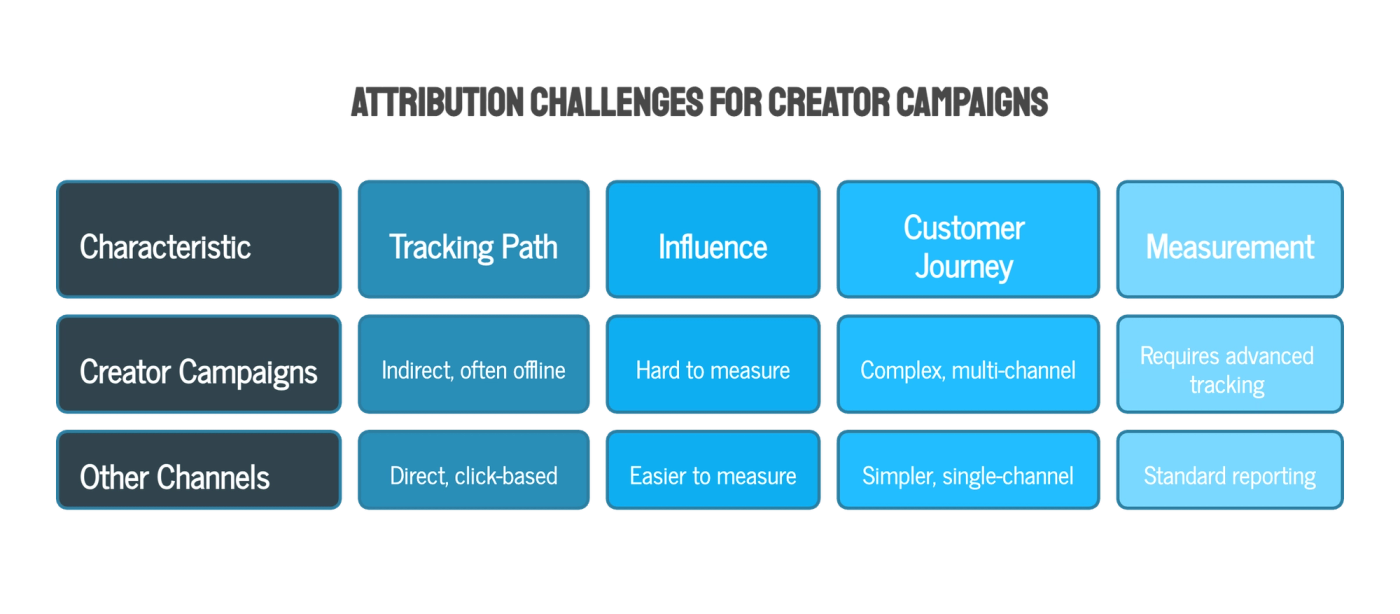
Why Attribution Is Harder for Creator Campaigns Than Other Channels
Most attribution frameworks were originally built around channels where customer actions can be tracked through clicks, impressions, and direct conversions. Creator content doesn't always follow that path.
A sponsored Instagram post can be shared in a group chat. A TikTok can spark a conversation that leads someone to search for the brand days later. A creator recommendation might influence a purchase long before a customer ever clicks a trackable link. Much of that influence happens outside traditional attribution systems.
The result is that creator marketing often affects customer behavior in ways that are difficult to measure through click-based reporting alone. By the time a customer converts, they may have interacted with multiple channels, pieces of content, and brand touchpoints along the way.
Brands that establish tracking links, UTM structures, promo codes, landing pages, and reporting frameworks before a campaign launches are typically able to measure creator performance with far more confidence than brands trying to piece together attribution after the fact.
The 7 Attribution Models Brands Use for Creator Campaigns
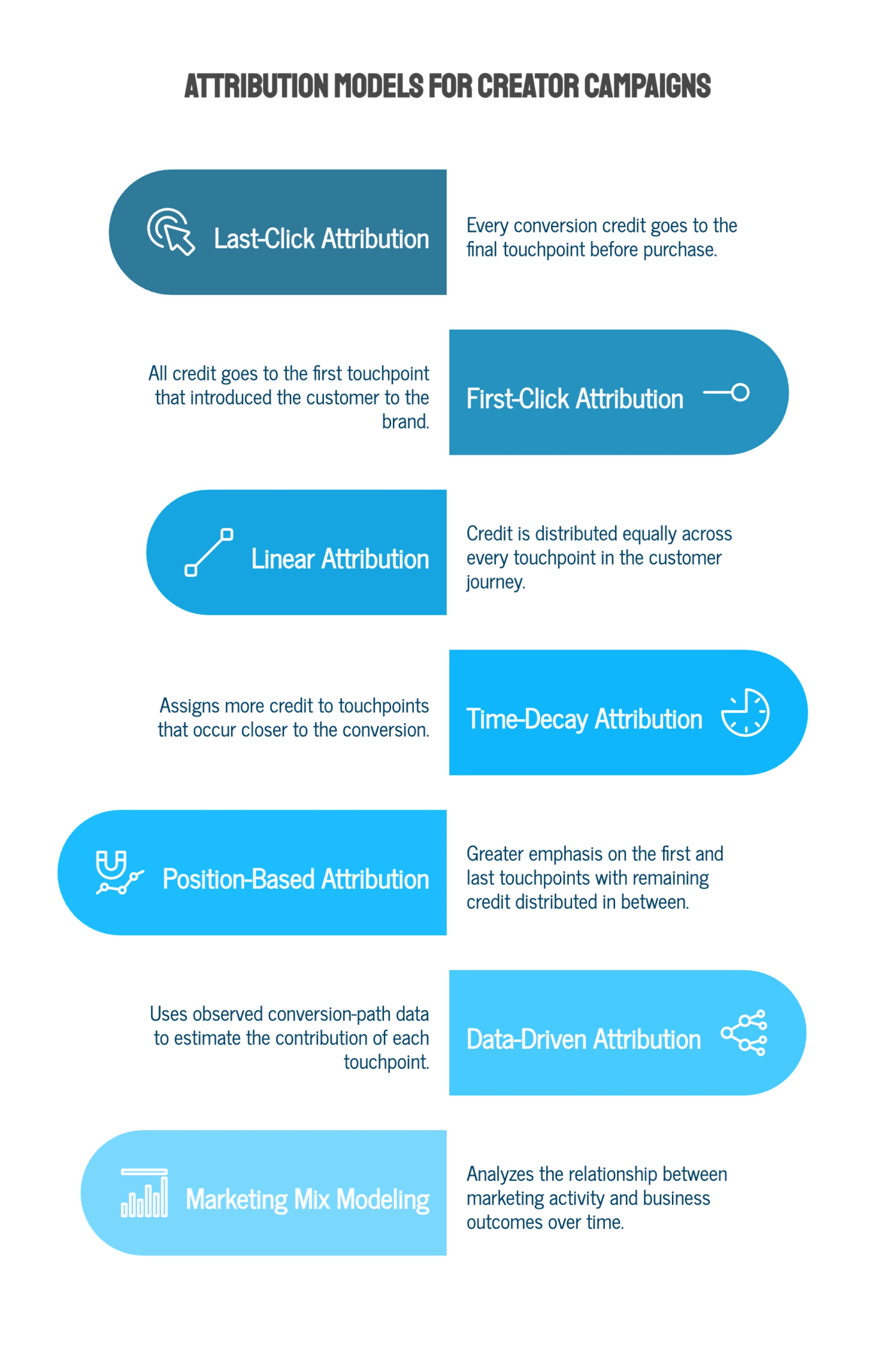
Understanding how each model assigns credit is the starting point for choosing the right one. These range from simple single-touch approaches to sophisticated statistical methods.
1. Last-Click Attribution
Best for: Campaigns with short purchase cycles and direct paths to conversion
With last-click attribution, every conversion credit goes to the final touchpoint before purchase. The influencer who introduced the customer gets nothing; the retargeting ad that closed the sale gets everything.
Last-click attribution gives 100% of the credit to the final interaction before conversion. It's simple to implement and easy to understand, but it doesn't account for the touchpoints that influenced the customer earlier in the journey.
2. First-Click Attribution
Best for: Awareness-focused campaigns where customer discovery is the primary objective
This is the inverse of last-click attribution. All credit goes to the first touchpoint that introduced the customer to the brand.
For creator campaigns focused on awareness and discovery, first-click attribution can provide visibility into which channels are generating initial interest. The trade-off is that it doesn't account for the interactions that helped move the customer toward a purchase later in the journey.
Want to put this into practice?
SideShift connects you with vetted UGC creators who actually deliver. Start your free trial and post your first job in under 10 minutes.
3. Linear Attribution
Best for: Brands looking for a simple multi-touch attribution model
With linear attribution, credit is distributed equally across every touchpoint in the customer journey.
If a creator's post was one of five interactions before purchase, it receives the same amount of credit as the other four touchpoints. This approach recognizes that multiple interactions often contribute to a conversion, though it assumes every touchpoint played an equal role.
4. Time-Decay Attribution
Best for: Brands with shorter consideration cycles and frequent customer interactions
Time-decay attribution assigns more credit to touchpoints that occur closer to the conversion.
A creator post from six weeks ago receives less credit than an email sent yesterday. This approach reflects the idea that recent interactions may have a stronger influence on the final decision, though it can reduce the perceived impact of earlier awareness-building content.
5. Position-Based (U-Shaped) Attribution
Best for: Brands that want a balance between awareness and conversion credit
Position-based attribution places greater emphasis on the first and last touchpoints in the customer journey, with the remaining credit distributed across interactions in between.
The model reflects the idea that discovery and conversion are often two of the most important moments in the purchase process, while still acknowledging the role of supporting touchpoints.
6. Data-Driven (AI-Powered) Attribution
Best for: Brands with robust tracking infrastructure and meaningful conversion volume
Data-driven attribution uses observed conversion-path data to estimate the contribution of each touchpoint rather than relying on a fixed set of rules.
Because the model adapts to actual customer behavior, attribution weights can vary from one business to another depending on the available data and customer journey patterns.
7. Marketing Mix Modeling (MMM)
Best for: Organizations looking to understand the broader contribution of influencer marketing alongside other channels
Marketing mix modeling takes a top-down approach to measurement. Rather than tracking individual user journeys, it analyzes the relationship between marketing activity and business outcomes over time.
One advantage of MMM is that it does not rely on individual user tracking. The trade-off is that it provides strategic insights at the channel level rather than detailed reporting on individual creators or campaigns.
Incrementality Testing: The Question Attribution Models Can't Answer
Every attribution model described above answers a version of the same question: Which touchpoints were present before a conversion? Incrementality testing asks something different: Would that conversion have happened anyway?
Traditional attribution models help marketers understand how customers move through the purchase journey and which channels contributed along the way. Incrementality testing focuses on measuring the additional impact generated by a campaign by comparing outcomes between audiences that were exposed to the campaign and those that were not.
The mechanics are relatively straightforward: a test group is exposed to creator content while a control group is not. The difference in conversion performance between the two groups represents the estimated lift generated by the campaign beyond what may have occurred naturally.
Incrementality testing can complement attribution reporting by providing an additional perspective on campaign performance. Attribution models help explain how customers converted, while incrementality testing helps evaluate whether the campaign influenced outcomes beyond the baseline level of demand.
Want to put this into practice?
SideShift connects you with vetted UGC creators who actually deliver. Start your free trial and post your first job in under 10 minutes.
No single measurement framework provides a complete picture on its own. Attribution models, incrementality testing, and broader measurement approaches can each contribute different insights depending on the goals of the program, the available data, and the maturity of the marketing organization.
Incrementality testing is often most useful when brands are increasing investment in creator marketing and want additional confidence that growth in attributed conversions reflects genuine business impact rather than changes in measurement alone.
How to Attribute Conversions in UGC and Influencer Marketing
Attribution models are only as good as the data feeding them. Before any model can assign credit, you need a tracking infrastructure that captures what's happening at the creator level.
UTM Parameters
UTM parameters are often the easiest place to start. By assigning each creator a unique tracking link, brands can identify which creators are driving traffic, engagement, and conversions within analytics platforms such as Google Analytics 4 (GA4).
The most important detail is consistency. Each creator should have a unique UTM source, and naming conventions should remain standardized across campaigns. If multiple creators share the same tracking link, it becomes difficult to accurately compare performance.
Promo Codes
Promo codes help fill in gaps that tracking links can miss. A customer might discover a product through creator content, return to the website days later, and convert without ever clicking the original link. In those situations, a creator-specific promo code can provide an additional attribution signal.
Promo codes are useful, but they shouldn't be viewed as a complete measurement solution. Not every customer remembers to use a code at checkout, and some buyers may convert without any promotional incentive at all.
Server-Side Tracking
As privacy regulations evolve and browser-based tracking becomes less reliable, many brands are investing more heavily in server-side measurement.
Unlike browser-based tracking, server-side tracking relies on data collected directly through backend systems, which can help preserve attribution visibility when customers move across devices, sessions, or browsing environments.
Complete Attribution Framework
No single tracking method captures every customer journey perfectly. The most reliable attribution frameworks combine multiple signals, including UTM parameters, creator-specific promo codes, tracking links, and broader conversion reporting.
For creator and UGC campaigns specifically, it's also helpful to monitor assisted conversions. Creator content often introduces customers to a brand long before a purchase occurs, meaning its influence may extend beyond the final conversion path reflected in standard reports.
As creator programs grow, managing attribution across dozens of creators, links, promo codes, and campaigns can become a reporting challenge in its own right. Platforms like SideShift help centralize creator tracking so campaign-level performance, creator-level results, and conversion data can be viewed together rather than pulled from multiple analytics tools, affiliate platforms, and spreadsheets.
How to Choose the Right Attribution Model for Your UGC Program
There is no single best attribution model for influencer marketing. The right approach depends on your campaign goals, customer journey, and measurement needs.
Want to put this into practice?
SideShift connects you with vetted UGC creators who actually deliver. Start your free trial and post your first job in under 10 minutes.
If your goal is identifying which creator drove the final conversion, last-click attribution can provide a simple starting point. If you want to understand how creator content influences the broader customer journey, multi-touch attribution models such as linear, time-decay, or position-based attribution often provide more context.
Brands with larger volumes of conversion data may choose to explore data-driven attribution, while brands looking to measure the true business impact of creator marketing may incorporate incrementality testing. At the enterprise level, marketing mix modeling can provide additional insight into how influencer marketing contributes alongside other channels.
In practice, most mature creator programs don't rely on a single attribution model. Different measurement methods answer different questions, which is why many brands combine attribution, incrementality testing, and broader marketing measurement frameworks to evaluate performance.
Connect Content to Conversions on SideShift
Attribution is hard. But it gets a lot easier when your campaign data isn't scattered across spreadsheets, affiliate dashboards, and platform analytics.
SideShift centralizes your creator and UGC performance in one place, so you can connect content to conversions, compare attribution across campaigns, and make budget decisions with confidence.
FAQs
What is attribution in influencer marketing?
Attribution is the process of identifying which creator, piece of content, or touchpoint was responsible for driving a conversion. It tells you where credit belongs so you can make smarter decisions about where to invest your budget.
Why is attribution so difficult for UGC and influencer campaigns?
Unlike paid ads, influencer content lives across multiple platforms, gets reshared organically, and often influences buyers who convert days or weeks later through a completely different channel. That non-linear path makes it hard for any single model to capture the full picture.
What is the difference between last-click and multi-touch attribution?
Last-click gives 100% of the conversion credit to the final touchpoint before purchase. Multi-touch distributes credit across every interaction a buyer had before converting. For influencer marketing, last-click consistently undercounts the role creators play earlier in the funnel.
What is incrementality testing and when should you use it?
Incrementality testing measures whether your creator campaigns are actually driving new conversions or just taking credit for purchases that would have happened anyway. It's best used when you're scaling spend and need to know if your investment is genuinely moving the needle beyond organic baseline.
Which attribution model is best for influencer marketing?
There's no single best model. It depends on your funnel, budget, and tech stack. Most mature brands use a combination: promo codes and UTMs for directional data, multi-touch attribution for upper-funnel visibility, and incrementality testing to validate true impact at scale.