
Moving Beyond Vanity Metrics in Influencer Marketing
Likes and follower counts don't prove ROI. Learn how to move beyond vanity metrics and measure influencer campaigns by results that matter.
Table of Contents
When it comes time to justify your influencer marketing budget, suddenly follower count, views, likes, and comments aren't enough. That's the problem with vanity metrics. They're easy to celebrate but much harder to tie back to business growth.
Vanity metrics like follower count, impressions, and likes look impressive in a report and tell you almost nothing about whether your influencer program is making money.
Here's how to shift your focus to the metrics that actually measure business impact.
What Are Vanity Metrics in Influencer Marketing?
Vanity metrics are numbers that grow easily and impress quickly but don't connect to business outcomes. In influencer marketing, the usual suspects are follower count, impressions, views, likes, and raw comment volume.
None of these are useless, just incomplete. A million impressions tells you a million screens loaded your content. Whether anyone remembered your brand, clicked through, or bought something is a separate question those numbers can't answer.
The opposite of a vanity metric is an actionable one: a number that changes how you spend your next dollar. Conversion rate, cost per acquisition (CPA), and revenue per creator all pass that test.
Why Do Vanity Metrics Feel So Convincing?
The path of least resistance simply runs through vanity metrics, which gives underperforming campaigns a good-looking place to hide.
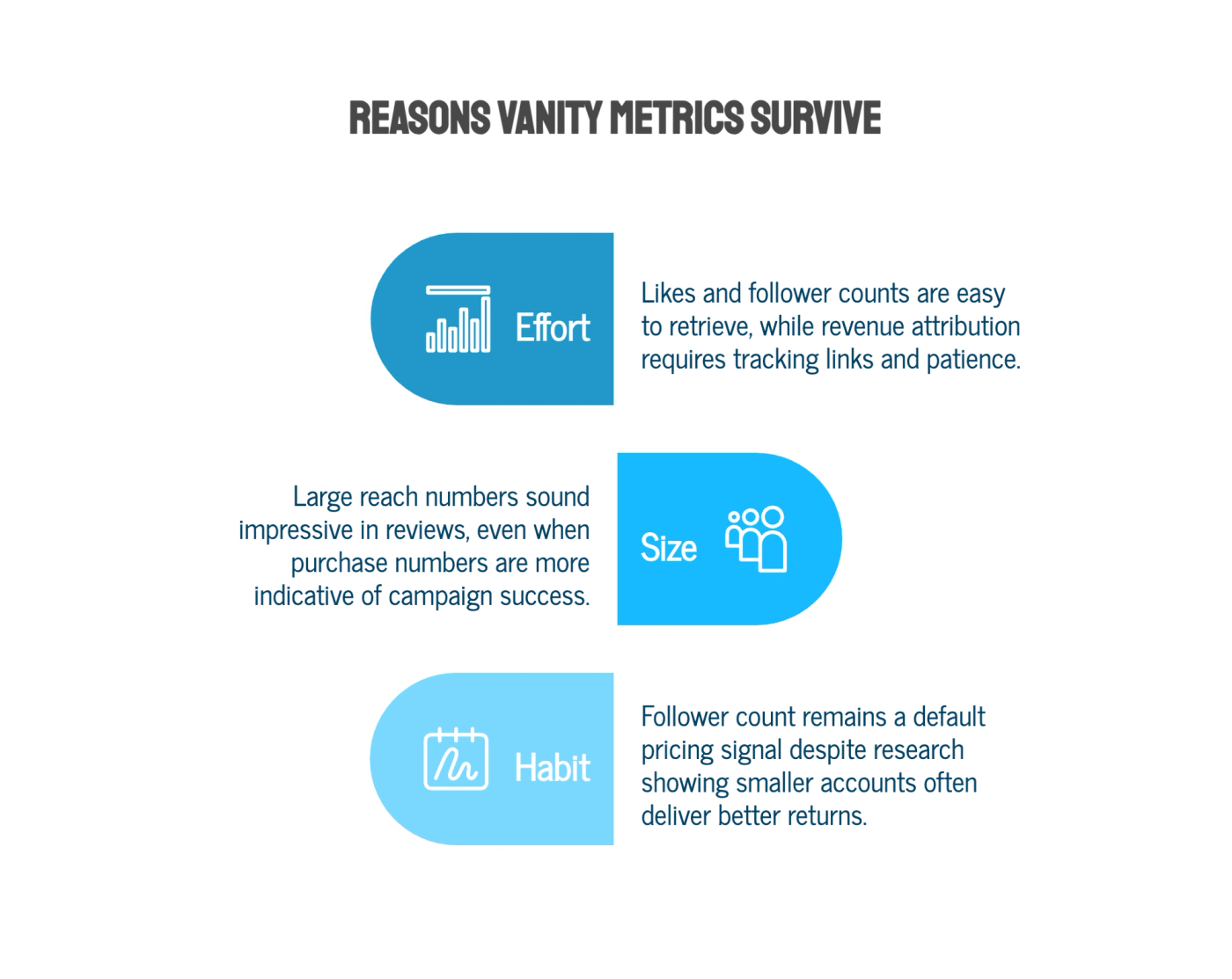
Vanity metrics survive for three reasons, and each one shows up in how reports actually get made.
1. Effort: Likes and follower counts sit right on the post, while revenue attribution takes tracking links, promo codes, and a few weeks of patience (and maybe a couple more layers of calculation) to get to the truly informative numbers. This is an example of what economists call availability bias: the number that costs nothing to retrieve gets treated as the number that matters.
1. Size: "We reached 2 million people" sounds better in a quarterly review than "we generated 340 purchases," even when the second statement is the one that really matters. A reach number mostly reflects the size of the platform; a purchase number reflects how well the campaign worked. It's easy to present the former as if it were the latter. Reach is still a valuable metric, but it isn't the only signal of campaign success.
1. Habit: Follower count was the default pricing signal for years, dating back to when being an influencer was a brand-new profession, and plenty of rate cards are still built that way. When brands pay based on audience size, creators optimize for audience size, and the market keeps rewarding a metric everyone privately admits is flawed. Research supports the skepticism, finding that influencers with fewer than 10,000 followers often delivered better returns than accounts many times their size. The growth of UGC campaigns as a cost-effective alternative to traditional influencer marketing points in the same direction. When creator content is judged on how well it converts rather than how many views it gets, follower count barely factors in at all.
"Follower count is one of the weakest predictors of performance in our campaigns," says Canyon Pergande, co-founder and COO of SideShift. "Some of our best programs start with creators opening brand-new, campaign-specific accounts, meaning the combined following is literally zero on day one. We're hiring creators for their ability to make content that earns distribution, not renting an audience they already have."
Want to put this into practice?
SideShift connects you with vetted UGC creators who actually deliver. Start your free trial and post your first job in under 10 minutes.
Which Influencer Marketing Metrics Actually Matter?
The right influencer KPIs depend on your goal, but for most B2B and DTC programs, these three do the heavy lifting.
"Views aren't useless, just incomplete," Pergande says. "The real questions are what it cost to generate them and what happened afterward."
Conversion Rate
Of the people who clicked a creator's link, how many took the action you wanted? Conversion rate is the cleanest signal that a creator's audience actually trusts their recommendations.
Conversion Rate = (Conversions ÷ Clicks) × 100
If a creator's link drove 2,500 clicks and 100 purchases, their conversion rate is 4%. That number matters more than audience size: a creator with 20,000 followers converting at 4% will outperform a creator with 500,000 followers converting at 0.2% almost every time.
Cost Per Acquisition (CPA)
Take everything you paid a creator and divide it by the number of customers they produced. "Everything" means the full cost: fee, product cost, shipping, and usage rights.
CPA = Total Creator Cost ÷ New Customers Acquired
A creator paid $1,400 all-in who drives 50 customers lands at a $28 CPA. Cost per acquisition lets you compare creators against each other and against your paid ads. If your Meta ads acquire customers at $45 and that creator acquires them at $28, the creator deserves a bigger budget.
Influencer Marketing ROI
This is the number your CFO actually wants: what came back relative to what went in.
ROI = (Attributed Revenue − Total Campaign Cost) ÷ Total Campaign Cost × 100
A campaign that cost $5,000 and drove $20,000 in attributed revenue returns 300%. If you'd rather not build the spreadsheet yourself, our free ROI calculator projects what a creator program actually delivers, using conservative estimates built on real case study data rather than best-case hype.
Statista reports that influencer marketing has grown into a market worth $32 billion in 2026, and that level of investment eventually demands the same ROI discipline as any other legacy marketing channel.
How Do You Build a Measurement Framework for Influencer Marketing Beyond Follower Count?
The good news is that this doesn't require an analytics team or an entirely new software category. It just requires a repeatable framework, and it becomes much easier when everything lives in one place.
SideShift serves as the home base for your entire influencer marketing program. With everything managed in one platform, creator communication, briefs, campaign goals, payouts, and performance data all live in the same dashboard. That means measurement becomes part of your workflow instead of a separate project.
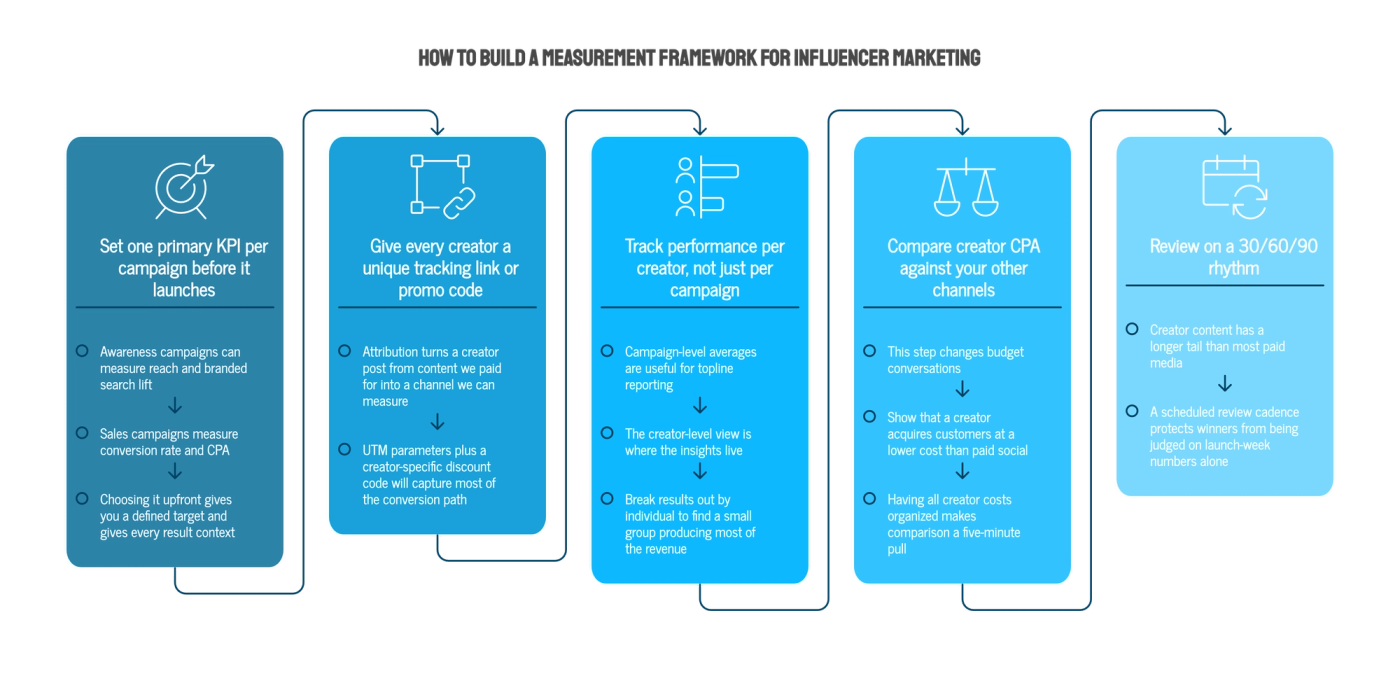
Here's the five-step framework we see working across influencer programs of every size to shift the focus away from vanity metrics and toward actionable insights:
Want to put this into practice?
SideShift connects you with vetted UGC creators who actually deliver. Start your free trial and post your first job in under 10 minutes.
1. Set one primary KPI per campaign before it launches. Awareness campaigns can measure reach and branded search lift, while sales campaigns measure conversion rate and CPA. Choosing it upfront gives you a defined target and gives every result context.
1. Give every creator a unique tracking link or promo code. Attribution is what turns a creator post from "content we paid for" into "a channel we can measure." UTM parameters plus a creator-specific discount code will capture most of the conversion path. Think with Google's measurement guidance provides a solid primer if your team is new to UTM structure.
2. Track performance per creator, not just per campaign. Campaign-level averages are useful for topline reporting, but the creator-level view is where the insights live. Break results out by individual and you'll typically find a small group producing most of the revenue. SideShift shows both views side by side, so you can report the campaign number to leadership and still know exactly which partners earned the result. Those are the creators worth re-booking, and our guide to long-term creator relationships covers why repeat partners tend to outperform one-off posts.
3. Compare creator CPA against your other channels. This is the step that changes budget conversations. When you can show that a creator acquires customers at $28 while paid social runs $45, influencer marketing stops being the experimental line item and starts competing for real spend. Having all creator costs organized in one platform makes that comparison a five-minute pull instead of a quarter-end reconciliation.
"We report in two layers: the quantitative numbers like spend, CPM, and conversions, and the qualitative story of which hooks, formats, and creators are working," Pergande says. "Leadership responds to the economic story and the decision, not a 40-tab dashboard."
4. Review on a 30/60/90 rhythm. Creator content has a longer tail than most paid media, and some posts keep converting for months. A campaign that looks quiet at day seven can look strong at day 60, so a scheduled review cadence protects your winners from getting judged on launch-week numbers alone. When Remini partnered with SideShift, the early weeks went to testing hooks and formats with modest results. Then the winning format hit, and installs went from 1 million to 20 million in a single month.
When Is Engagement Rate Still Useful?
Engagement rate only becomes a vanity metric when it's presented as the result instead of a signal along the way.
The first job is vetting. Before you hire a creator, engagement rate is one of the fastest ways to spot an inflated audience. A large follower count paired with thin engagement usually points to purchased followers or a following that's gone stale, and catching that before the contract saves you the budget of learning it afterward.
The second job is early diagnosis. Mid-campaign, engagement gives you a read on content performance days before conversion data comes in. In our experience, a post that's quiet in its first 48 hours rarely recovers on conversions, so a weak early signal is your cue to check in with the creator or adjust the next brief while there's still time to act.
Want to put this into practice?
SideShift connects you with vetted UGC creators who actually deliver. Start your free trial and post your first job in under 10 minutes.
Think of engagement rate as a leading indicator and conversion data as the verdict. One predicts, the other proves, and healthy reporting keeps them in that order.
Understand What Your Content Is Really Worth on SideShift
Moving past vanity metrics comes down to prioritizing data and creative that directly impacts the bottom line. Conversion rate, cost per acquisition, and revenue per creator will tell you which partnerships deserve more budget and which ones only look good on Instagram.
SideShift makes the operational side of campaign performance tracking easy. Every creator payout runs through one platform, so your spend data is already organized by creator and campaign, ready to line up against your revenue data. And when you find your top performers, fast, reliable payouts keep them coming back.
FAQs
1. What are vanity metrics in influencer marketing?
Vanity metrics are surface-level numbers such as follower count, likes, views, and impressions. They show that content was seen but don't prove it drove clicks, conversions, or revenue.
1. Is engagement rate a vanity metric?
It depends on how you use it. As a vetting and diagnostic tool, engagement rate is genuinely useful. As the headline result of a campaign, it functions as a vanity metric because it doesn't confirm any business outcome.
1. How do you measure influencer marketing ROI without a big analytics stack?
Give each creator a unique UTM link and promo code, track the revenue tied to each, subtract your total creator costs, and divide by those costs. A spreadsheet is enough to start.
1. What's a good cost per acquisition for influencer campaigns?
There's no universal benchmark. The practical target is a CPA at or below what you pay on your other channels, like paid social or search. Beating your own baseline matters more than beating an industry average.
1. Do micro-influencers really convert better than big accounts?
Often, yes. Smaller creators tend to have tighter audience trust, which shows up as higher conversion rates. The reliable approach is to test creators across follower tiers and let per-creator CPA data decide who gets re-booked.