
How Do Influencers Make Money? 6 Ways Creators Earn Income
Sponsorships are only one piece of the puzzle. Learn how influencers make money through brand partnerships, commissions, platform payouts, products, and more.
Table of Contents
If you ask people, “How do influencers make money?” you’ll likely get the same answer: sponsorships. That’s not wrong, but it isn’t the full truth either. Most influencers aren’t relying on a single income stream. Sponsorships are the headline, but they’re rarely the whole picture.
A creator with 40,000 followers might be pulling a flat fee from a beauty brand, a commission from an affiliate link in the same post, a few hundred dollars from platform ad revenue, and a licensing fee from a separate brand that wants to run their content as a paid ad. Four income sources, one piece of content.
Whether you’re a creator looking to diversify your income or a brand trying to understand how creators monetize their audiences, this article breaks down the different income streams shaping the influencer economy.
6 Ways Influencers Earn Money
From sponsored content to selling their own products, influencers have more ways to make money than ever before.
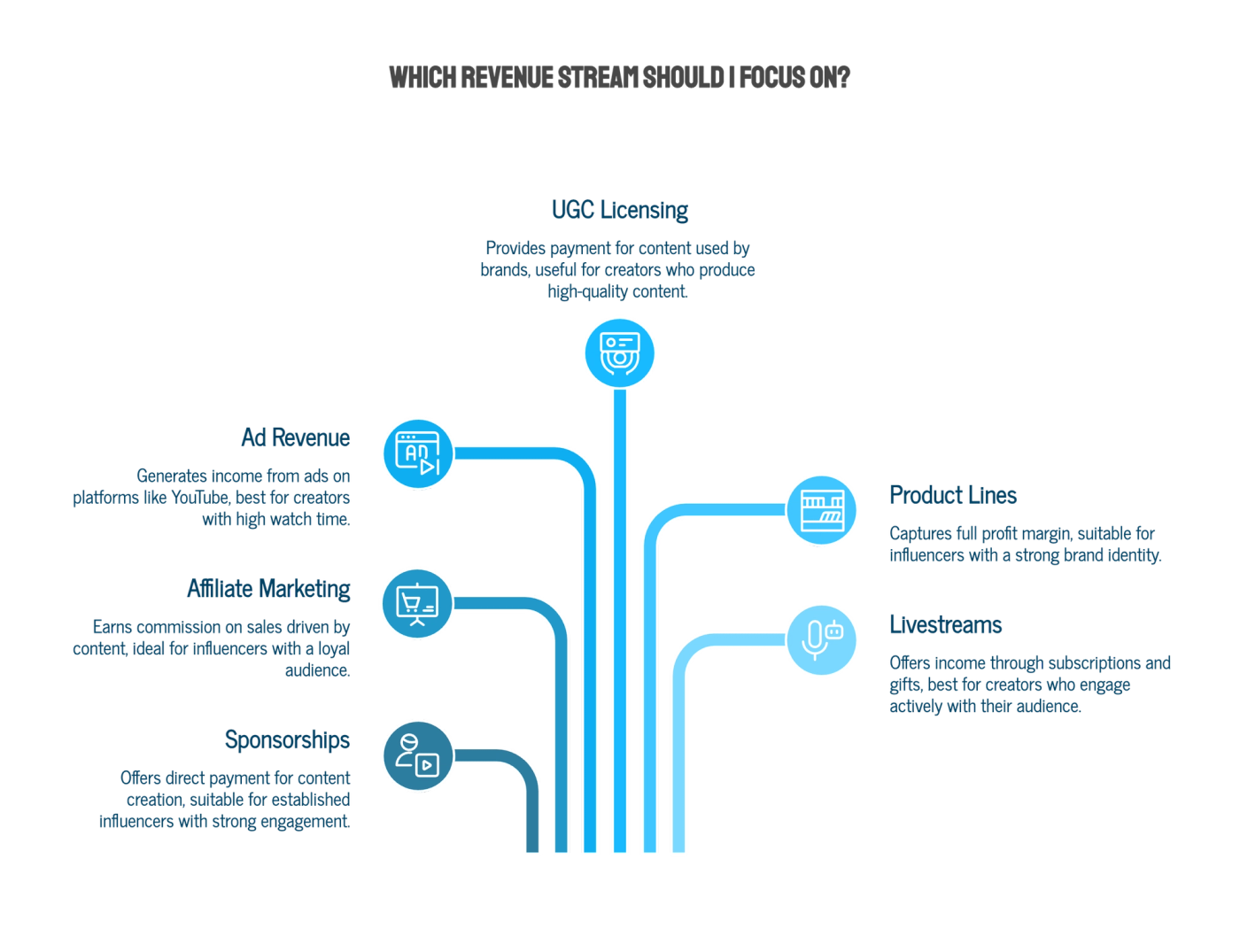
1. Sponsorship and Brand Deals
Sponsorships are the most direct exchange in the creator economy. A brand pays a creator to produce content featuring its product, and the creator delivers it under agreed terms. It’s the closest thing influencer marketing has to traditional advertising.
Influencer rates depend on reach, niche, and format, but most importantly, engagement rate. A creator with 20,000 highly engaged followers in a specific niche (say, at-home Pilates workouts) will often out-earn a creator with 200,000 followers spread across a broad, low-engagement lifestyle audience.
Most sponsorship deals fall into one of three structures:
- Flat fee per post: a single payment for a single deliverable, typically scoped to a specific platform and format (one Reel, one TikTok, one static post).
- Retainer or ambassador deal: a recurring monthly payment in exchange for a set cadence of content over a period of time (six or 12 months, for example).
- Performance-based bonuses: a base fee plus a bonus tied to results, like views hitting a threshold or a cost-per-acquisition (CPA) target on a tracked link.
Brands increasingly ask for usage rights as part of the sponsorship fee, not as a separate request after the fact. If a brand wants to run the content as a paid ad on Meta rather than just leave it on the creator’s own feed, that’s a different right with a different price tag.
2. Affiliate Marketing and Commission-Based Deals
Affiliate marketing flips the model: instead of getting paid to make content, the creator gets paid when that content drives a sale. It’s the mechanism behind Amazon storefronts, unique discount codes, and the coupon-style links stacked in a creator’s bio.
Commission rates vary widely by category, ranging from 1% to 30%. For example, Amazon’s affiliate program pays a fixed commission rate of 10% for luxury beauty products, 4.5% for physical books, kitchen and automotive items, and 2.5% for PC and PC components.
Affiliate deals are often combined with a sponsorship: the creator gets paid to make the content and then earns additional commission if it converts. This hybrid structure has become common enough that it’s worth naming as a subcategory, distinct from a pure affiliate arrangement or a pure flat-fee sponsorship.
Want to put this into practice?
SideShift connects you with vetted UGC creators who actually deliver. Start your free trial and post your first job in under 10 minutes.
3. Ad Revenue and Platform Payouts
Ad revenue is specific to YouTube influencers. Creators in the YouTube Partner Program keep a share of ad revenue served against their videos. Mid-roll ads on longer-form content can generate recurring income for channels with consistent watch time.
YouTube AdSense pays anywhere from $5 to $15 per 1,000 ad views. The actual amount is influenced by a number of factors such as niche, location, and video length (which impacts how many ads can be placed in the video).
On the other hand, creator funds are the money a platform pays creators whose content performs well within the app. The main example of this model is TikTok’s Creator Rewards Program, which pays roughly $0.40 to $1.50 per 1,000 qualified views. TikTok takes into consideration video length, watch time, and engagement.
Platform payouts are useful for turning existing content into incremental income without any extra work. Almost no full-time creator is building a business on creator fund payments alone; they treat them as a background revenue stream rather than a primary one.
4. UGC Content Licensing Deals
In a UGC deal, a creator is paid to produce content, but that content isn’t necessarily posted on the creator’s own channel, though it can be. The brand owns the distribution and the creator is being paid for the production and the usage rights.
This distinction matters financially. A straightforward UGC video, shot and delivered for the brand’s own organic use, is priced differently than the same video licensed for paid media.
Running a creator’s content as a whitelisted ad, where the brand gets to advertise directly through the creator’s account, or as a Spark Ad or a Partnership Ad, might incur a higher fee, because the brand is borrowing the creator’s face and credibility to run its own paid campaign.
5. Product Lines and Owned Merchandise
Selling a product under their own name is the one revenue stream where a creator captures the full margin instead of a commission or a flat fee.
Three product paths dominate here:
- Physical merchandise: Influencers sell apparel, drinkware, and accessories built around a catchphrase, logo, or identity their audience already recognizes.
- Digital products: They create and sell templates, presets, guides, and courses (for example, fitness influencers sell workout plans, while travel influencers sell full itineraries).
- Brand ownership: Highly successful influencers often develop their own brands; especially common in the beauty industry, with influencers creating their own skincare and makeup lines.
This is the only income stream where the risk is 100% in the influencer’s hand, since they invest their own money in production, distribution, and marketing.
6. Livestreams
Some influencers are exclusively streamers, while others use livestreams as an extra source of income. On Twitch, streamers can earn money through subscriptions, while on TikTok, influencers can host livestreams and earn money through digital gifts sent by viewers.
Want to put this into practice?
SideShift connects you with vetted UGC creators who actually deliver. Start your free trial and post your first job in under 10 minutes.
On TikTok Live, viewers buy TikTok Coins with real money, then spend those coins on animated gifts (a rose, a lion) during a livestream. The gifts a creator receives are converted into Diamonds, TikTok’s internal currency, which can then be cashed out once a minimum balance is reached.
The exchange isn’t 1:1 at every stage: TikTok takes a cut at the coin-to-diamond conversion, so a creator typically ends up with roughly half of what the viewer originally spent. It’s a real income stream for creators who stream regularly, but it depends heavily on an engaged audience rather than passive viewers.
YouTube offers a similar monetization option through Super Chat. During a live stream, viewers can pay to have their comment highlighted and pinned to the top of the chat, with the price they pay determining how long it stays pinned. Like TikTok gifting, it rewards creators who stream consistently and actively engage with the chat rather than treating live as a passive broadcast.
How the Revenue Mix Changes by Platform
A creator’s platform often determines which income streams are easiest to build. While sponsorships and affiliate marketing work across channels, each platform has unique features that open up additional ways to earn.
How Do Influencers Make Money on Instagram?
Instagram income leans heavily on sponsorship, brand partnerships, and affiliate marketing.
- Brand deals: Feed posts, Reels, and Stories are common formats for sponsored content and affiliate activity. Features like link stickers make it easy to send followers directly to a product page with a trackable link.
- Whitelisting and Partnership Ads: Meta’s ad tools allow a brand to run a creator’s content directly through the creator’s account. The payment amount and format (flat fee, commission) is decided between the brand and the creator.
Since Meta doesn’t offer a meaningful native ad-revenue-share program comparable to YouTube’s, creators on Instagram depend more on brand relationships for income.
How Do TikTok Influencers Make Money?
TikTok influencers rely on a similar sponsorship and affiliate mix, plus TikTok’s Creator Rewards Program and gifts earned in livestreams. However, there are two additions that are specific to the platform: TikTok Shop and Spark Ads.
- TikTok Shop: Creators tag products directly in their videos and earn commission on in-app purchases, which has become one of the fastest-growing affiliate channels for creators in fashion, beauty, and household goods.
- Spark Ads: Brands can boost a creator’s existing post as a paid ad without needing a repost, which requires separate permission from the creator and is usually priced as an add-on to the base rate.
How Do Influencers Make Money on YouTube?
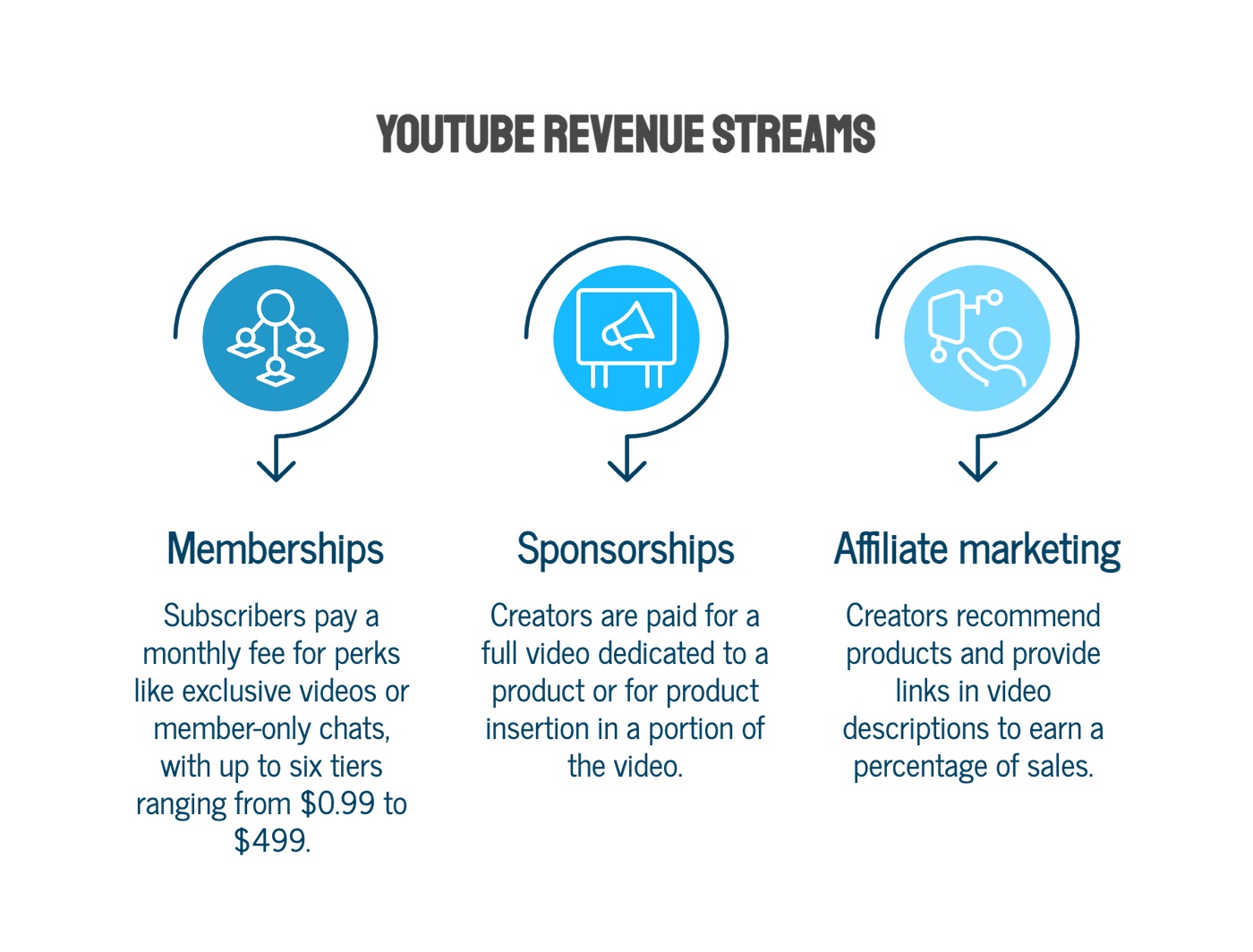
YouTube is the platform where ad revenue can become a primary income stream rather than a supplemental one. On top of that, influencers make money on YouTube with sponsorships, affiliate marketing, and memberships.
- Memberships: Subscribers pay a monthly fee to support the creator and have access to perks, such as exclusive videos or member-only chats. Creators can create up to six membership tiers, with prices ranging from $0.99 to $499.
Want to put this into practice?
SideShift connects you with vetted UGC creators who actually deliver. Start your free trial and post your first job in under 10 minutes.
- Sponsorships: Creators are paid for a full video dedicated to a product or for the product to be inserted in a portion of the video.
- Affiliate marketing: Links in video descriptions are standard practice. The creator recommends a product on the video and directs the viewers to the affiliate links so they can earn a percentage of the sales.
YouTube’s format also supports UGC and licensing deals, which are relevant for brands that want longer-form product demos or reviews they can repurpose as ads elsewhere.
Build Your Social Media Strategy with SideShift
These income streams are not mutually exclusive. Creators earning the most tend to combine three or four of these around the same core content. A single video might be sponsored, carry an affiliate link in the caption, earn a small platform payout from views, and get licensed separately to a second brand as a UGC asset for their paid ads.
While creators have more earning opportunities than ever, turning them into consistent revenue can still be challenging. Finding relevant brands, negotiating fair deals, and managing payments are common hurdles, especially for nano and micro creators. SideShift closes the gap between the two sides of the business, giving creators all the tools needed for successful brand partnerships.
If you’re a creator, you can access 1,500+ brands actively hiring, discover available campaigns, and apply directly. If your profile stands out, brands can directly contact you. For brands, SideShift provides access to a pool of pre-vetted creators while simplifying briefs, approvals, payments, and campaign management in one platform.
Join SideShift for free today.
FAQs
1. Do influencers make more money from affiliate links or brand deals?
It depends on the niche and the audience’s buying behavior. A smaller, highly engaged audience that trusts a creator’s product recommendations can generate more affiliate income than a large, passive audience generates from a single brand deal. Most creators run both simultaneously rather than choosing one.
2. Who actually pays influencers?
Influencers are mostly paid by brands through sponsored content, affiliate links, and ambassador deals. Influencers are also paid by platforms like YouTube and TikTok which split a share of their revenue with high-performing content creators.
3. What’s the difference between a sponsorship and a UGC deal?
In a sponsorship deal, the creator posts the content on their own channel, and the brand is largely paying for the creator’s audience and endorsement. In a UGC deal, the creator is paid to produce content that the brand owns and distributes, often as a paid ad, and the fee reflects production plus usage rights rather than the creator’s own reach.
4. Is platform ad revenue a reliable income source?
It’s more reliable on YouTube, where ad revenue can function as a genuine passive income stream tied to views and watch time. On TikTok, native platform payouts are smaller and less predictable, so most full-time creators treat them as supplemental income rather than a primary revenue source. Instagram doesn’t offer a similar program and creators rely on brand deals.