
UGC Platforms vs Agencies vs In-House: Which Should You Choose?
Should you use a UGC platform, hire an agency, or build in-house? Compare cost, speed, scale, and control across all three models for 2026.
Table of Contents
You’ve probably done this math on a napkin already. The agency quote works out to roughly $500 for a single finished video. The in-house route costs a salary before a single video exists. The creator marketplace looks affordable until you picture yourself chasing invoices from 40 strangers. Every option feels wrong for a different reason, and that’s usually the moment brands stall and keep boosting the same three ads for another quarter.
The UGC platforms vs agencies vs in-house decision comes down to three trade-offs: cost per video, content volume, and how much control you keep. A creator marketplace gets you the most content per dollar. An agency gets you the most done-for-you service per dollar. An in-house team gets you the most brand control per dollar. None of them wins on all three, and this guide turns “it depends” into a decision you can defend in a budget meeting.
The short answer is:
- Choose a UGC platform when volume is the priority and someone internally can write briefs.
- Choose a UGC agency when you have budget but no bandwidth, and you’ll pay a markup for end-to-end service.
- Build in-house when UGC is a permanent channel, your voice requirements are strict, and volume is steady enough to justify salaries.
Of course, “it depends on your priorities” offers little basis for a budget decision. The sections that follow assign concrete figures and scenarios to each model, so your recommendation rests on evidence rather than instinct.
When Does a UGC Platform Make Sense?
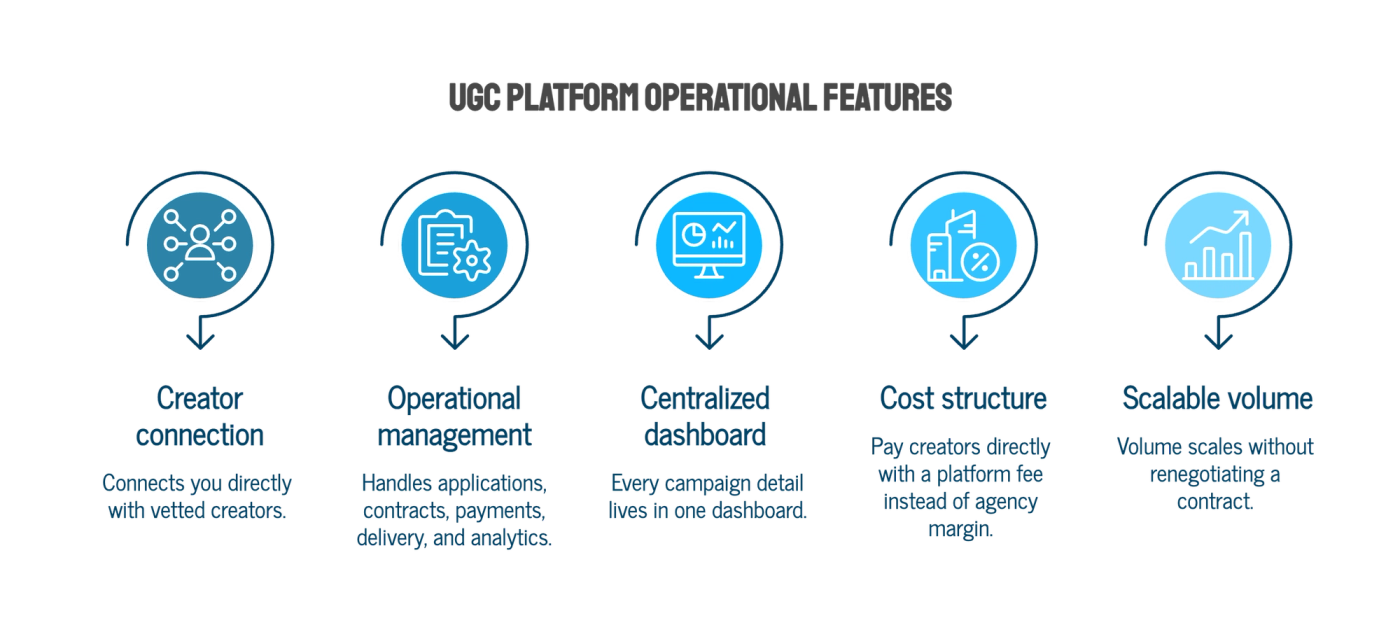
A UGC platform (or creator marketplace) connects you directly with vetted creators and handles the operational layer between you and them: applications, contracts, payments, delivery, and analytics. You write the brief, creators apply, you screen and select, and every campaign detail lives in one dashboard instead of 50 email threads.
You pay creators directly with a platform fee on top rather than an agency margin, so cost per video typically lands well below agency rates, and volume scales without renegotiating a contract. Need five videos this month and 30 next month? You post more briefs. That flexibility is why platforms dominate the creative testing stage, where the winning ad is usually the eighth or ninth variation, not the first.
The strategy work stays with you, though. A platform will not tell you which hooks to test or which angles fit your funnel. Quality also varies more than it does with a curated agency roster, which is why testing multiple creators per concept matters. (If you’re not sure how to write a creator brief, start with our UGC brief guide.)
When Should You Hire a UGC Agency?
A UGC agency bundles strategy, creator sourcing, briefing, production management, and editing into a managed service, usually on a monthly retainer. Growth-stage retainers commonly fall in the $3,000 to $10,000+ per month range for a set number of finished videos, which typically works out to a meaningfully higher cost per video than platform sourcing.
An agency gives you creative strategy, tested angle libraries, and a single accountable partner, which mostly means you’re buying back your own time. For a founder-led brand with no marketing hire, or a marketing team of one drowning in five channels, that trade is often worth making for a season.
Want to put this into practice?
SideShift connects you with vetted UGC creators who actually deliver. Start your free trial and post your first job in under 10 minutes.
Volume is capped by your retainer tier, so doubling your creative testing means renegotiating your contract, not just posting another brief. And you’re renting the relationships. The creators, the performance data, and the institutional knowledge usually live with the agency, and they leave when you do. Check usage rights clauses carefully, since content licensing terms vary widely between agencies.
When Is an In-House UGC Team the Right Call?
In-house means employing the function: a content lead or creative strategist, sometimes creators themselves, plus editing tools and equipment. The industry is genuinely moving this direction at the program level. The Influencer Marketing Hub Benchmark Report 2026 found that roughly two-thirds of brands now run their influencer programs fully in-house.
In-house wins on control and compounding knowledge. Nobody protects brand voice like an employee, every learning stays inside the building, and at consistent high volume the per-video math can eventually beat both alternatives.
The catch is that the fixed costs arrive before the content does. Salaries, software, and ramp-up time mean you’re paying for months before output stabilizes.
A small team also produces a small range of faces and styles, and ad platforms reward variety. Two in-house creators cannot out-diversify 80 marketplace creators, no matter how talented they are. Most mature teams solve this by running a platform underneath their in-house strategy layer. That’s the path SideShift itself took. “We did not make a clean switch from one model to another. We learned that the best model combines all three,” says SideShift Cofounder Canyon. “A platform gives you scale, infrastructure, and data, but software alone does not develop strategy, coach creators, or identify why content is working.”
How Do the Three Models Compare on Cost, Speed, and Control?
Since every vendor pitch frames the numbers differently, here’s the plain-language version.
- On cost per video, platforms are cheapest, typically a fraction of agency rates because you pay creators directly. Agencies sit at the top of the range, with retainers that often translate to $300 to $500 per finished video. In-house is the wildcard: expensive at low volume because salaries dominate the math, and potentially the cheapest of all once output is high and steady.
- On speed and volume, platforms win again. You can go from posted brief to first delivered video in days, and scale from 10 to 50 videos a month without a contract conversation. Agencies deliver reliably but inside a fixed monthly ceiling. In-house teams are the slowest to stand up, often taking a quarter or more to reach stable output, and their ceiling is whatever a small team can physically produce.
- On control and ownership, the order flips. In-house gives you total control of voice, process, and rights. Platforms give you direct creator relationships and rights terms you define per brief. Agencies give you the least direct control, since the creator relationships and performance data sit with them, and ownership of the content itself depends entirely on the contract.
Want to put this into practice?
SideShift connects you with vetted UGC creators who actually deliver. Start your free trial and post your first job in under 10 minutes.
Put those three together and the real question becomes which advantage your stage of growth needs most.
Which Model Fits Your Monthly Volume and Team?
Work backward from two numbers: videos needed per month and internal hours available.
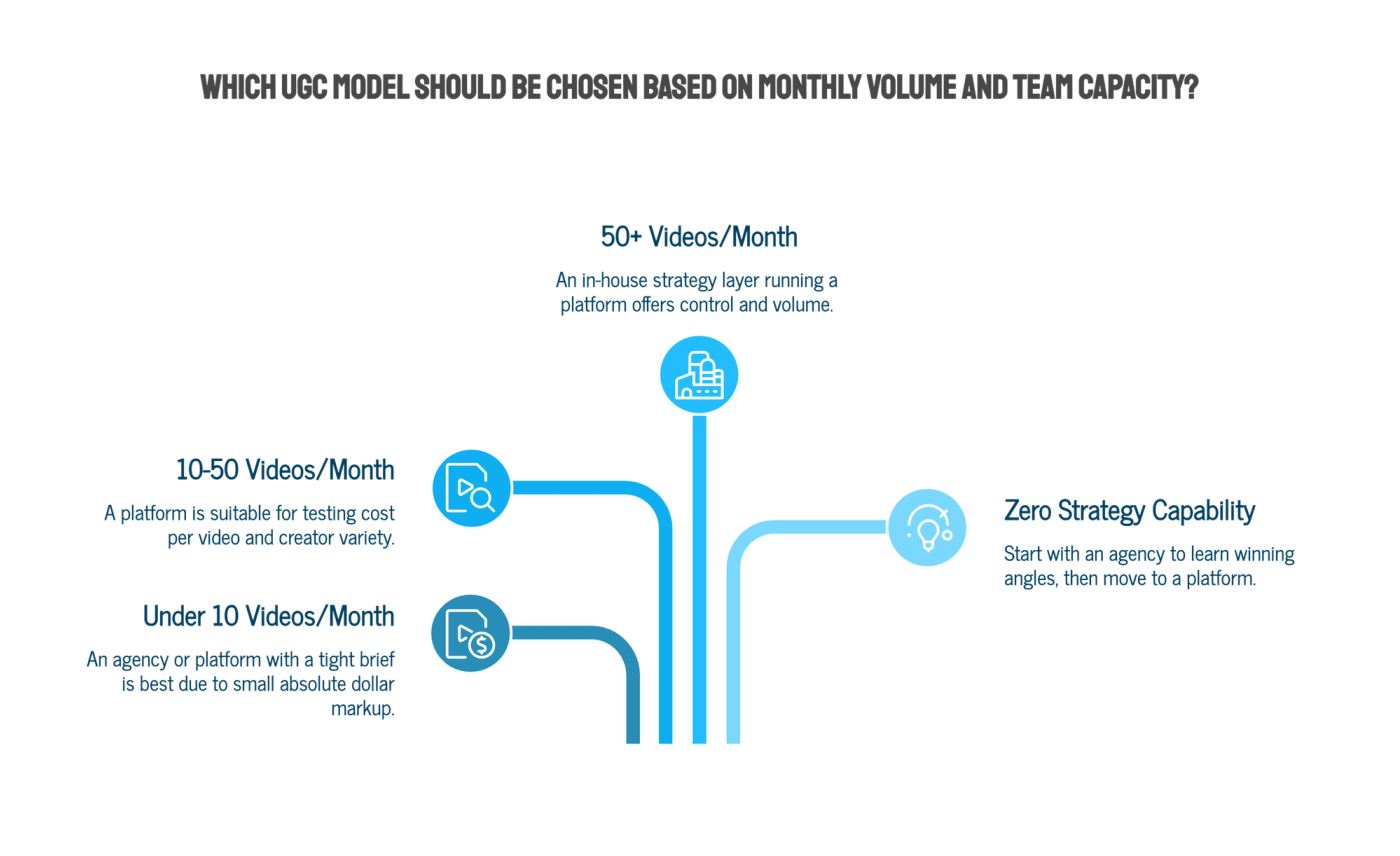
- Under 10 videos a month, no internal bandwidth: An agency, or a platform with a very tight brief will serve you best. At this volume, the agency markup is small in absolute dollars.
- 10 to 50 videos a month, at least one internal owner: A platform suits this stage well. This is the testing zone where cost per video and creator variety decide whether your ad experiments get a fair shot.
- 50+ videos a month, permanent channel: An in-house strategy layer running a platform for production gives you the best of both. You keep control and learnings while renting the volume and variety no internal team can match.
- Any volume, zero strategy capability: Choose agency first, then graduate to a platform once you know what works. Paying an agency to learn your winning angles, then executing them cheaply at scale, is a legitimate sequence.
“The hybrid model starts making sense once creator content becomes an ongoing growth channel rather than a one-off campaign, especially when a brand needs dozens or hundreds of new assets each month,” says Canyon Pergande, COO of SideShift. At lower volume, a managed service usually wins, since the brand hasn’t generated enough repetition or data to justify an internal team. “As volume grows, the platform should gradually take over sourcing, contracts, approvals, payments, and reporting, while the brand brings more strategic ownership in-house.” Pergande says he’d even recommend the model to a company half SideShift’s size but doesn’t recommend hiring an internal creator team until the channel is proven.
Whichever model you pick, the creators who perform become your real asset, and keeping them is cheaper than replacing them. Our guide to influencer relationship management covers how to build that retention layer regardless of sourcing model. And if you’re evaluating specific vendors, our ranking of the 15 best influencer marketing tools breaks down the platform category in detail.
Scale UGC Campaigns with SideShift
The expensive mistake is committing before you have data. Agencies lock you into retainers, in-house locks you into salaries, and both take months to reverse if the math stops working. A platform is the only one of the three you can test for the price of a few videos.
And whichever model you land on, SideShift fits underneath it. In-house teams use us as their production layer, keeping strategy and brand voice internal while sourcing the creator variety no small team can produce on its own.
Agencies run multiple client workspaces on the SideShift platform, managing separate campaigns, creator rosters, and deliverables for each account without the operational sprawl of spreadsheets and email threads. If you’re an individual brand or founder posting your first brief, the workflow is the same one those larger teams use: post a brief, screen applicants within 24 hours, and get your first batch of UGC content production back in days.
Want to put this into practice?
SideShift connects you with vetted UGC creators who actually deliver. Start your free trial and post your first job in under 10 minutes.
FAQs
1. How much does a UGC agency cost per month?
Most growth-stage retainers land above $1,000 per month, typically covering a fixed number of finished videos. At a $4,000 retainer for 12 videos, your effective cost per video is around $330, before any overage fees when you want more volume.
2. Is it cheaper to produce UGC in-house?
Only at sustained high volume. In-house carries fixed costs like salaries, tools, and equipment before the first video ships, so at low or unpredictable volume it’s usually the most expensive option per video. The break-even point arrives when output is steady enough to spread those fixed costs thin.
3. Can you combine a UGC platform with an agency or in-house team?
Yes, and mature programs usually do. A common setup keeps strategy and creative direction in-house or with an agency while a platform supplies the production volume and creator variety. The models compete for budget but complement each other operationally.
4. How many videos per month justify using a UGC platform?
Around 10 per month is where platform economics clearly beat one-off freelancer sourcing, since contracts, payments, and quality control stop being manageable by hand. Below that, per-video sourcing works; above 50, a platform becomes the only realistic way to sustain volume.
5. Who owns the usage rights in each model?
In-house content is fully owned. Platform content rights are defined per brief, so specify duration and paid usage before creators accept. Agency rights vary the most by contract, and it’s the clause worth lawyering, since some agencies license rather than transfer content ownership.