
How to Find Instagram Influencers in Your Niche
Finding Instagram influencers takes more than a hashtag search. Here's how to vet, source, and recruit the right creators for your brand without wasting budget.
Table of Contents
You can spend four hours looking for an Instagram influencer in your niche and still walk away with the wrong one.
Instagram has over two billion monthly active users and a creator ecosystem so large that finding the right influencer for your brand storyline can feel like searching for a specific grain of sand on the beach.
An estimated $4.6 billion is wasted annually on influencer spend reaching audiences that were never real or aligned with the brand’s target customer to begin with.
This guide covers practical methods to reliably find Instagram influencers in your niche, what to look for once you spot them, and how to think about scaling beyond the one-at-a-time search when your campaign needs real volume.
Why Niche Fit Matters More Than Follower Count
Before getting into the how, it's worth understanding what you're actually optimizing for when searching for Instagram influencers. The instinct is to filter by size; find someone with a big following, pay for a post, and let their reach do the work. That logic made more sense 10 years ago when follower count was a reliable proxy for reach and engagement. Today, it's one of the weakest signals available.
What actually predicts campaign performance is niche alignment paired with genuine audience engagement. An Instagram influencer with 22,000 highly engaged followers in a specific niche will often outperform a generalist lifestyle account with 300,000 passive followers.
Migrate Mate is a useful illustration of this in practice. The platform needed to reach migrants looking for legal work in the U.S. This is a highly targeted, specific, skeptical audience that has been burned by scammy visa job boards before. Rather than partnering with broad lifestyle creators, SideShift sourced 15 creators with firsthand immigration experience, visa journeys, and ESL backgrounds. The content led with real stories, not promotional messaging.
In under 45 days, the campaign drove 15M+ organic views and tripled Migrate Mate's user base with one video alone generating 1.5M views and 18K signups in a single day.
This reframe matters because it changes the search criteria entirely. You're not looking for the biggest account in your category. You're looking for the most trusted voice among the specific audience you want to reach.
Method 1: Leverage Hashtag Research
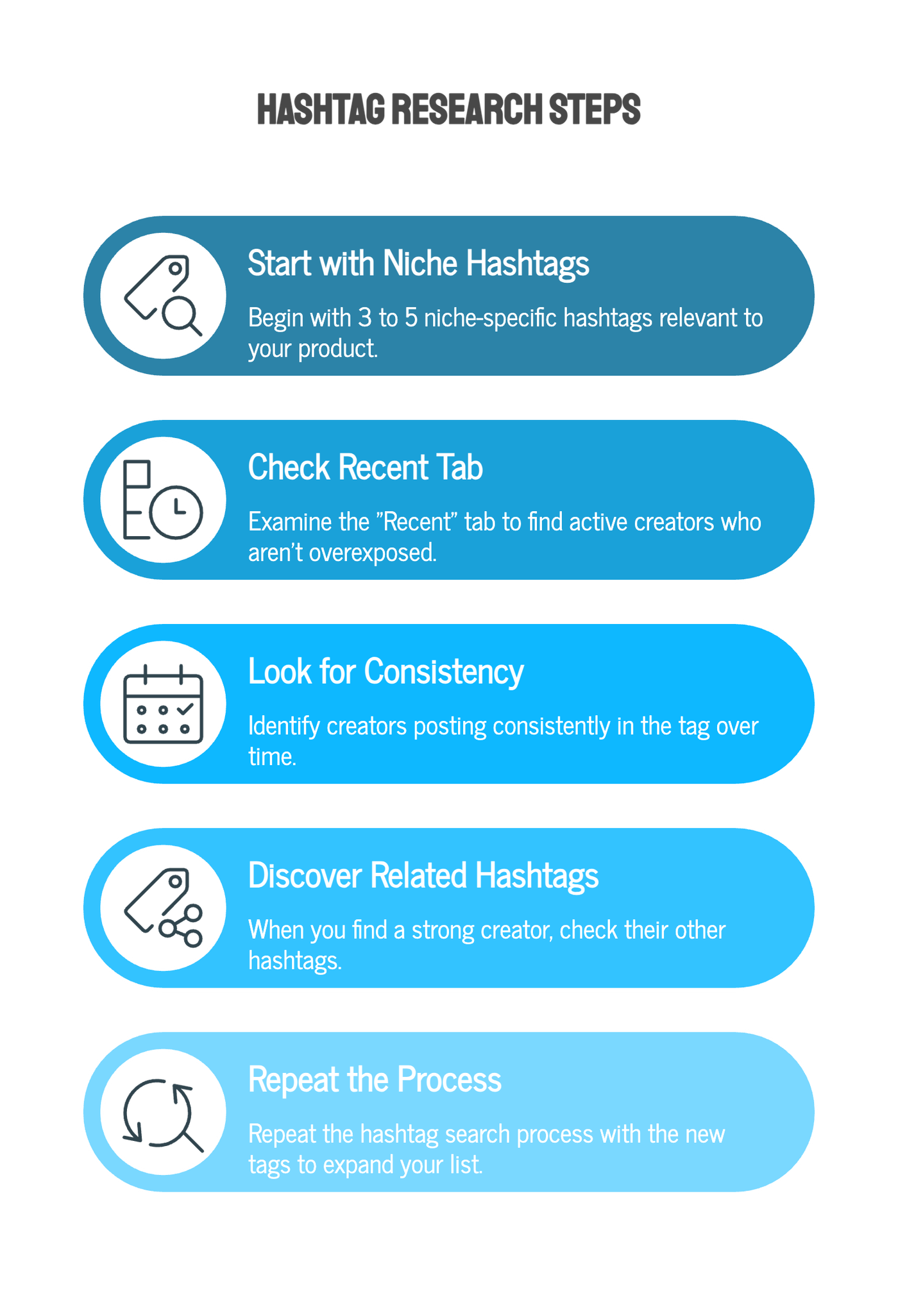
Hashtag search is an accessible starting point for finding Instagram influencers organically, but most brands use it too broadly and get buried in noise. The key is going deeper into niche-specific tags rather than staying at the category level.
If you sell a clean beauty product, searching #skincare returns millions of posts and surfaces mostly large accounts and brands. Instead, search #glasskinroutine, #skintok (which crosses platforms but surfaces active creators), or #dryskinfix. The specificity filters out the noise and surfaces creators who are genuinely embedded in the conversation your target customer is having.
How to work a hashtag search effectively:
- Start with 3 to 5 niche-specific hashtags relevant to your product's use case or benefit.
- Check the “Recent” tab, not just “Top Posts,” to find active creators who aren't already overexposed.
Want to put this into practice?
SideShift connects you with vetted UGC creators who actually deliver. Start your free trial and post your first job in under 10 minutes.
- Look for creators posting consistently in that tag over time, not just once.
- When you find a strong creator, check which other hashtags they use and add those to your list.
- Repeat the process with the new tags to expand your discovery pool.
This method is free and gives you direct access to organic content, but it's time-intensive. Plan for this to be a research process measured in hours, not minutes, especially if you're building a list of twenty or more creators.
Method 2: Mine Your Own Audience
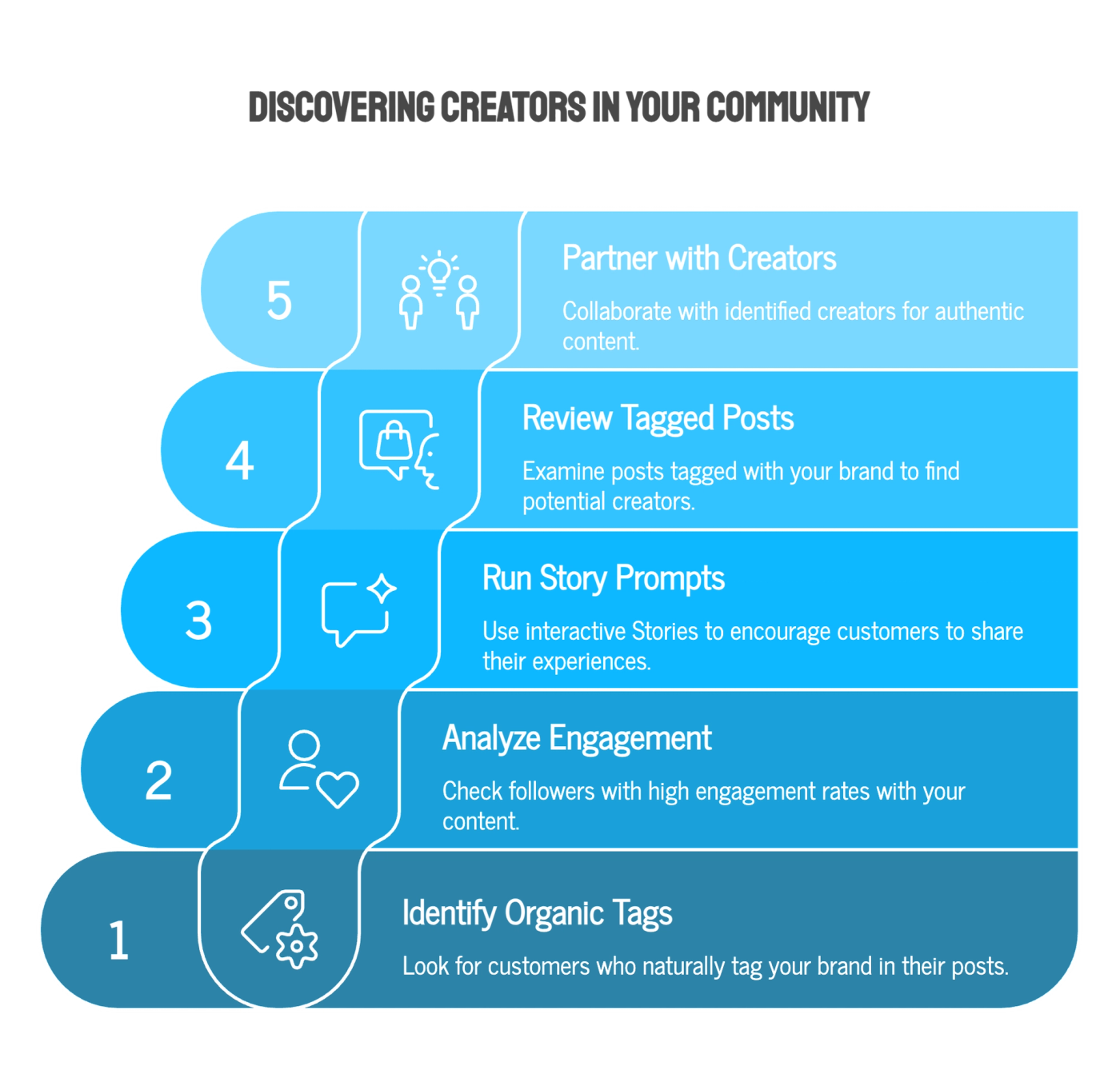
Check whether your existing customers or followers are already creators. This is one of the highest-leverage discovery methods available because the creator already has firsthand product experience, which makes their content more authentic and their audience more receptive.
How to find creators in your existing community:
- Look at who tags your brand in posts or Stories organically.
- Check followers who have above-average engagement with your content.
- Run a simple “share your experience” prompt in Stories and see who responds with quality content.
- Search your brand's tagged posts and review the creators who show up.
A customer-turned-creator is one of the strongest possible partnerships for a brand. The content writes itself because the experience is real, and the pitch to their audience is credible for the same reason.
Method 3: Search Competitor Brand Tags and Mentions
If a creator is organically posting about your competitor or a complementary product, three things are likely true: they're relevant to your niche, their audience is already primed for that category, and they have a demonstrated willingness to create that type of content.
Search your competitors' brand hashtags and tagged posts. Look at who's creating content in that space without being paid to do so. An unprompted mention carries more credibility than a sponsored one, and it tells you the creator already has genuine interest in the category.
You can extend this to product categories rather than just brand names. Explore tags like #proteinpowderreview or #homegymsetup to find creators actively discussing products like yours, then evaluate whether their audience and content style fits your brand.
Method 4: Tap Into Instagram's Native Discovery Features
Instagram has built several features that function as passive discovery engines once you know how to use them.
- Suggested accounts: When you visit a creator's profile and follow or interact with it, Instagram's algorithm will surface similar accounts in the “Suggested for you” section. This is a fast way to build out a creator list from a single strong find. Visit a creator who fits your criteria, check the suggestions, and repeat.
- Explore page with intent: The Explore page is personalized based on your account's activity. If you've been interacting with content in a specific niche, Explore will start surfacing relevant creators you haven't found yet. Use a dedicated brand Instagram account to train the algorithm toward your target niche so the suggestions stay relevant.
- Instagram search by keyword: Instagram expanded its search functionality beyond hashtags to include keyword-based content search. Searching phrases like “morning skincare routine” or “budget home gym” will surface Reels and posts from creators making exactly that content, not just accounts with those words in their bio.
Want to put this into practice?
SideShift connects you with vetted UGC creators who actually deliver. Start your free trial and post your first job in under 10 minutes.
Method 5: Use Third-Party Creator Discovery Tools
For brands that need to move faster or filter by specific metrics, influencer discovery platforms provide capabilities Instagram's native search simply doesn't offer. Tools like SideShift allow you to filter creators by:
- Follower range and engagement rate simultaneously
- Audience demographics (age, location, gender split)
- Niche or content category
- Posting frequency and account growth rate
- Estimated cost per post based on historical data
What to Evaluate Once You Find a Candidate
Finding a creator is only half the work. Vetting them properly is what separates campaigns that perform from campaigns that disappoint.
If you want to know how to identify the right influencers, here’s the vetting checklist:
- Engagement rate: Target 3% or higher. Calculate it by dividing total engagement (likes plus comments) by follower count. Anything under 1% on a mid-size account is a red flag.
- Comment quality: Read the comments. Generic emoji responses and “nice pic!” comments often indicate low-quality or purchased engagement. Specific, conversational comments signal a real community.
- Content consistency: Has the creator stayed in their niche over the past three to six months, or are they bouncing between topics? Consistency signals audience trust and relevance.
- Sponsored content ratio: If more than 30 to 40% of recent posts are paid partnerships, the creator's audience may already be fatigued by ads. Organic credibility matters.
- Story and Reels activity: Feed posts alone are not enough. Active creators post across formats, and Stories in particular drive direct audience engagement.
Connect with Instagram Influencers on SideShift
If you've run through the hashtag searches, vetted dozens of creator profiles, sent cold DMs, and still can't build creator momentum at the scale your campaigns actually need, the process itself is the problem. SideShift was built specifically for what comes after the search.
With access to 800,000+ Gen Z UGC creators across the U.S., SideShift lets brands post jobs, recruit creators at volume, manage contracts, handle payouts, and track campaign performance, all from a single platform. Instead of combing through Instagram profiles one by one, you build a pipeline of pre-vetted talent that applies to work with you. The creators come to you.
For brands running Instagram-heavy campaigns, SideShift is where the manual search problem ends and a repeatable, data-driven creator program begins.
FAQs
1. How can you find Instagram influencers for free?
The most effective free methods are hashtag research using niche-specific tags, searching competitor brand mentions, using Instagram's suggested accounts feature, and mining your own existing audience for creators. These methods work but require significant time investment. For brands that need volume, free manual discovery quickly becomes the bottleneck rather than a sustainable strategy.
2. What is a good engagement rate for an Instagram influencer?
For micro influencers in the 10,000 to 100,000 follower range, a healthy engagement rate is between 3% and 7%. Accounts above 100,000 followers typically see lower rates, often 1% to 3%, simply because larger audiences are harder to maintain at the same intimacy level. Anything under 1% on a mid-size account warrants a closer look at comment quality and follower authenticity before moving forward.
Want to put this into practice?
SideShift connects you with vetted UGC creators who actually deliver. Start your free trial and post your first job in under 10 minutes.
3. How do you know if an Instagram influencer's followers are real?
Look at comment quality first. Specific, conversational comments from accounts with full profiles are strong indicators of real engagement. Generic comments, emoji-only responses, and a mismatch between follower count and engagement volume are red flags. For a more precise audit, tools like HypeAuditor or Modash can analyze follower authenticity and flag accounts with suspicious growth patterns or high percentages of inactive or bot accounts.
4. What's the difference between an Instagram influencer and a UGC creator?
An Instagram influencer distributes content through their own audience. Their value is tied to their reach and the trust their followers have in them. A UGC creator produces content that the brand owns and deploys through its own channels or paid ads. UGC creators don't need large followings because their content isn't meant to live on their page. For brands that want content volume and creative assets they control, UGC creators are often more cost-effective and scalable than traditional influencer partnerships.
5. How many Instagram influencers does your brand need for a successful campaign?
More than most brands expect. Running one or two influencers gives you minimal data and minimal reach diversity. A campaign with ten to twenty micro influencers posting consistently gives you enough variation to identify what content is actually resonating and enough reach to see meaningful performance signals. Brands running high-volume UGC strategies through platforms like SideShift typically operate with dozens of active creators simultaneously, which is what makes real iteration and optimization possible.