


EMV in Influencer Marketing: Formula & Uses (2026)
EMV estimates the equivalent ad spend value of organic creator content. See the formula, when to use EMV, and why some brands have stopped tracking it.

Table of Contents
Earned Media Value, or EMV, puts a dollar figure on the exposure a brand earns from creator content. It's the estimated cost of buying the same reach, views, or engagement through paid ads instead of getting it organically through a creator post.
If you run influencer or UGC campaigns, you've probably seen an EMV number in a campaign report already. It's one of the most commonly cited stats in this industry, and also one of the most argued about. Some brands treat it as their north star metric. Others have quietly stopped reporting it at all.
We'll walk through what EMV actually measures, how to calculate it, and where the formula breaks down.
What Counts as Earned Media in Influencer Marketing?
Before EMV makes sense, it helps to separate the three types of media every brand works with:
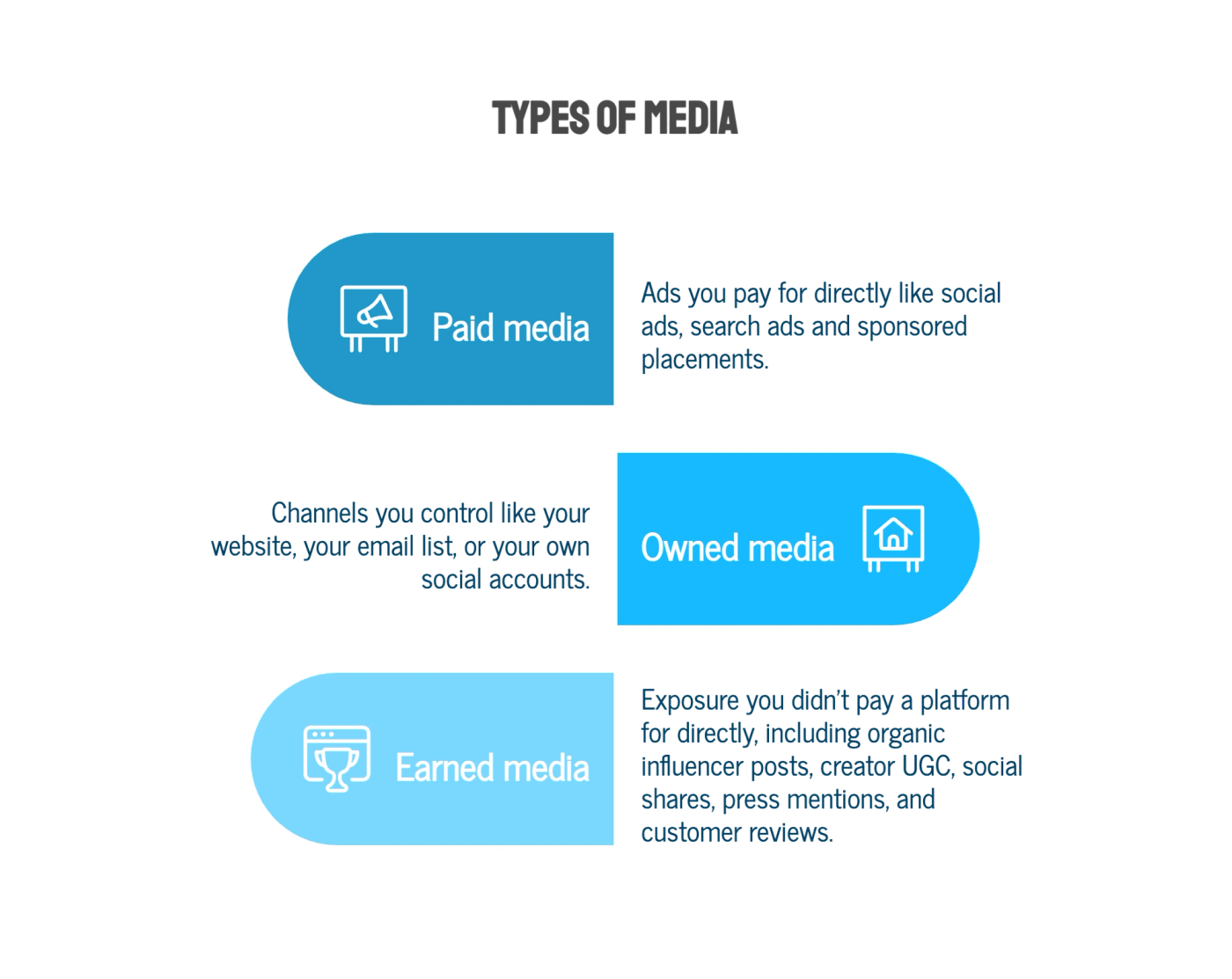
- Paid media: Ads you pay for directly like social ads, search ads and sponsored placements.
- Owned media: Channels you control like your website, your email list, or your own social accounts.
- Earned media: Exposure you didn't pay a platform for directly, including organic influencer posts, creator UGC, social shares, press mentions, and customer reviews.
Earned Media Value applies a dollar estimate to that third category. If a creator's video about your product gets 500,000 views, what would it have cost you to buy 500,000 views through paid media instead? That estimate is the EMV.
How Do You Calculate EMV?
There's no single industry-standard formula, which is part of why EMV draws so much debate. But most calculations follow the same basic structure:
EMV = Total Engagements × CPM-Equivalent Value per Engagement
In practice, most platforms and agencies build this out using a weighted version that accounts for different engagement types:
EMV = (Likes × Value) + (Comments × Value) + (Shares × Value) + (Impressions ÷ 1,000 × CPM Value)
Instagram, TikTok and YouTube each get their own per-engagement value, because a comment on TikTok doesn't carry the same weight as a comment on Instagram, and a view doesn't cost the same as a like.
Where the CPM Values Come From
Some tools use a fixed CPM pulled from average paid social ad rates. Others use a dynamic index that adjusts daily based on platform demand. The Ayzenberg Earned Media Value Index or the Social Index is the most widely referenced version of this, and several major influencer platforms license it or build their own version of the same idea.
A campaign that generates $40,000 in EMV by one tool's math might show $150,000 by another's. Neither number is "wrong" exactly, they're just using different assumptions about what a view or a like is worth.
Here's a simple example:
A creator publishes an Instagram Reel that generates 50,000 impressions, 4,000 likes, and 200 comments
If your CPM-equivalent value is $25 per 1,000 impressions, $0.30 per like, and $0.75 per comment, your EMV calculation looks like this:
- Impressions: 50,000 ÷ 1,000 × $25 = $1,250
- Likes: 4,000 × $0.30 = $1,200
- Comments: 200 × $0.75 = $150
Want to put this into practice?
SideShift connects you with vetted UGC creators who actually deliver. Start your free trial and post your first job in under 10 minutes.
Estimated Media Value (EMV):
$1,250 + $1,200 + $150 = $2,600
If you paid the creator $500, your EMV-to-spend ratio would be:
$2,600 ÷ $500 = 5.2:1
On paper, that's an impressive return. But EMV only estimates the advertising value of engagement, it doesn't tell you whether anyone visited your website, signed up, or made a purchase.
EMV vs. ROI: What's the Real Difference?
Earned Media Value (EMV) and Return on Investment (ROI) are often reported side by side, but they measure two completely different things.
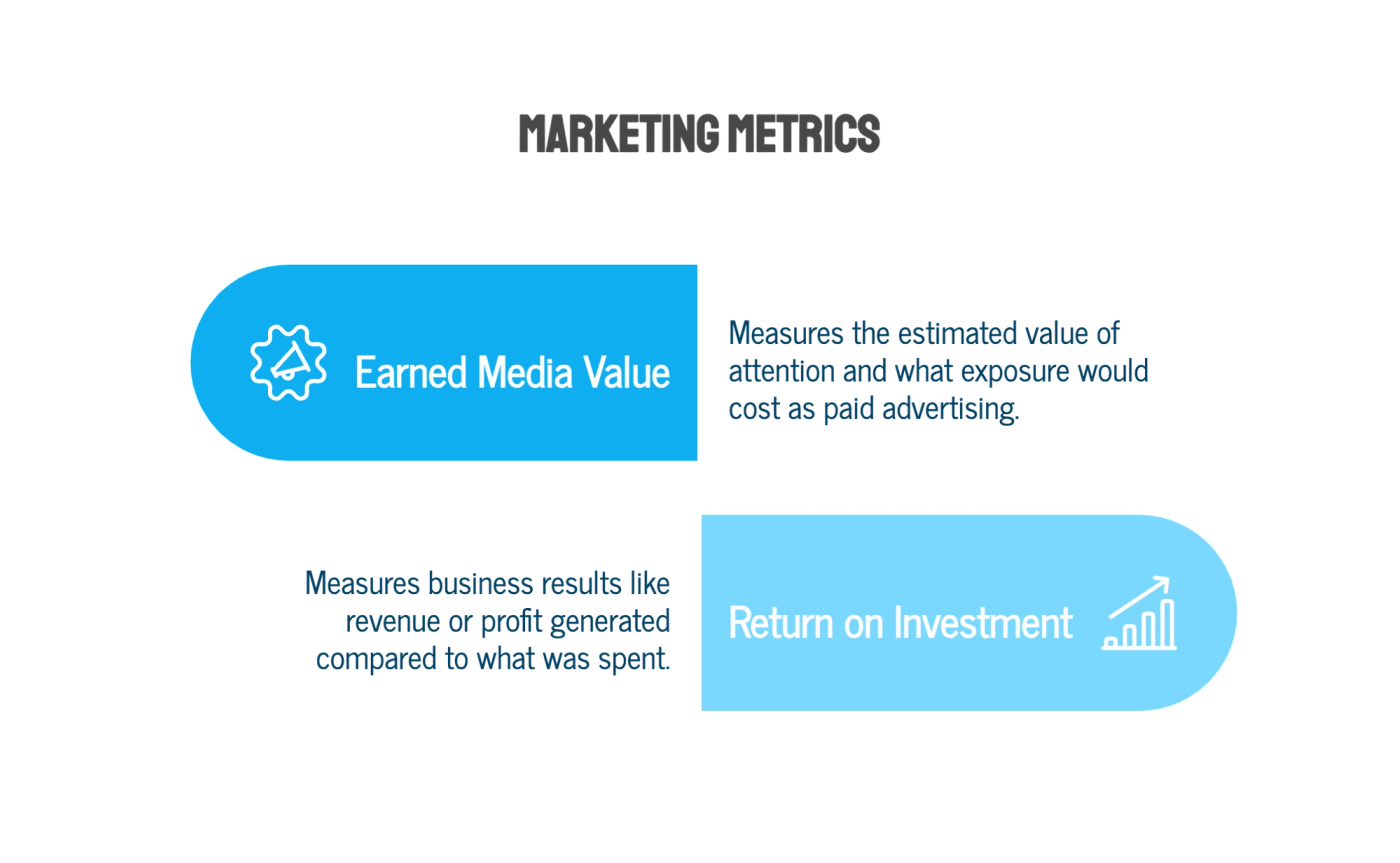
- EMV asks: "What would this exposure have cost if we had purchased it as paid advertising?"
- ROI asks: "How much revenue or profit did this campaign actually generate compared to what we spent?"
A campaign can generate high Earned Media Value but low Return on Investment. For example, a creator's post might receive hundreds of thousands of views and thousands of engagements, resulting in a strong EMV estimate. But if that audience isn't your target customer or if the content generates very few clicks or conversions, the campaign may produce little to no revenue.
The opposite can also happen. A niche creator with a smaller audience may generate modest EMV while driving a high volume of qualified traffic and sales, resulting in an excellent ROI.
Earned Media Value measures the estimated value of attention. Return on Investment measures business results. EMV can provide useful context for understanding brand awareness and exposure, but it should never be used as a substitute for measuring revenue, conversions, or profitability.
Why Some Brands Have Stopped Tracking EMV
EMV isn't going away, but more performance-focused marketing teams have scaled back how much weight they give it for a few specific reasons:
- There's no universal standard. Because every tool calculates EMV differently, you can't reliably compare your EMV against a competitor's or even against last year's campaign if you've switched measurement tools.
- It rewards reach, not relevance. A creator with a huge but disengaged audience can post content that scores well on EMV while converting almost nobody.
- It can be inflated by sentiment-blind counting. Standard EMV math counts every engagement the same, whether the comment is "I need this" or "This is a scam." Negative sentiment doesn't automatically reduce the score.
- It doesn't connect to the metrics finance teams care about. A CFO doesn't want to hear that a campaign was "worth" $80,000 in theoretical ad spend. They want to know how much revenue or pipeline it actually generated.
This is also why advertising value equivalency (AVE), the older PR-world cousin of EMV, has been formally discouraged by measurement bodies like AMEC for over a decade. EMV is a more modern and more defensible version of that idea, but it inherits some of the same weaknesses if it's used in isolation.
Looking at creative-level performance data, such as which specific hooks, formats, or creators are actually driving engagement, helps fill that gap.
When EMV Is Actually Useful
None of this means EMV is worthless. It's a genuinely useful metric in a few specific situations:
Want to put this into practice?
SideShift connects you with vetted UGC creators who actually deliver. Start your free trial and post your first job in under 10 minutes.
- Comparing creators within the same campaign: If you're running 10 creators on the same brief, EMV is a fast way to see who's overperforming or underperforming relative to their fee.
- Justifying budget to leadership: A clear, well-labeled EMV figure ("This is the advertising-equivalent value, not revenue.") can help make the case for increasing creator marketing spend, especially to stakeholders who think in media-buying terms.
- Benchmarking awareness-stage campaigns: If the goal of a campaign was visibility, not conversion, EMV is a more honest fit than trying to force a revenue number out of a brand-awareness push.
Understand What Your Content Is Really Worth with SideShift
EMV is a useful benchmark for estimating the visibility your creator campaigns generate, but it only tells part of the story. To make smarter marketing decisions, you need to know which creators are driving clicks, conversions, revenue, and long-term customer value.
SideShift is an influencer marketing platform built for brands running creator and UGC programs at scale. From discovering creators and managing campaigns to measuring performance, SideShift helps you streamline your entire creator marketing workflow. Instead of relying solely on estimated media value, it gives you the tools to evaluate how your creator partnerships contribute to real business outcomes at the campaign level.
Whether you're running a single campaign or scaling an always-on creator program, SideShift makes it easy to identify your highest-performing creators and optimize future partnerships with confidence.
If you're ready to move beyond vanity metrics and understand the true impact of your influencer marketing, SideShift provides the insights you need to make every creator partnership more effective.
FAQs
1. Is EMV the same as ad spend?
No. EMV estimates what the exposure would have cost if you'd bought it as an ad. It's a hypothetical comparison, not actual money spent or saved.
2. What's a good EMV-to-spend ratio for an influencer campaign?
There's no universal benchmark for a "good" EMV-to-spend ratio because every platform calculates EMV differently, making comparisons across tools unreliable. That said, many brands consider 5:1 (or $5 in estimated media value for every $1 spent) a strong result when using a consistent EMV methodology, while exceptional campaigns, particularly those featuring highly engaged micro- and nano-creators, can reach 10:1 or higher. Ratios below 3:1 may indicate it's worth reviewing creator fit, content quality, or campaign strategy.
3. Can EMV be negative?
Standard EMV formulas don't go negative, since they're based on counting impressions and engagements. Some tools apply a sentiment adjustment that can pull the number down significantly, but a true negative EMV is rare.
4. Is EMV different from advertising value equivalency (AVE)?
Yes. AVE is the older PR-era version of this idea and has been discouraged by measurement bodies for over a decade due to inconsistent, often inflated methodology. EMV is generally considered the more current, more defensible metric, though it shares some of the same limitations if used alone.
Want to put this into practice?
SideShift connects you with vetted UGC creators who actually deliver. Start your free trial and post your first job in under 10 minutes.
5. Should I report EMV to my leadership team?
It depends on what they care about. If they're trying to understand relative ad-spend value, EMV is useful context. If they're asking about revenue or pipeline impact, pair EMV with a hard performance metric like ROI.