
How Much Do Influencer Campaigns Really Cost in 2026?
Learn the true influencer campaign cost in 2026, including influencer rates per post, platform pricing, and how to budget for ROI-driven campaigns.
Table of Contents
Influencer marketing has long been a go-to strategy for brands looking to reach new audiences. But how much does an influencer campaign actually cost in 2026? Whether you’re testing micro-influencers or celebrity endorsements, costs can vary widely depending on platform, creator size, content type, and campaign goals.
What Does the Average Influencer Campaign Cost in 2026?
The cost of influencer campaigns ranges widely, from a few hundred dollars for a nano influencer to tens of thousands for macro, or millions of dollars for celebrity talent.
On average, brands pay between $500 - $5,000 per post for mid-tier influencers, but additional factors like production value, usage rights, and campaign length can drive costs higher. Compared to UGC, influencer campaigns tend to carry higher per-post costs and less scalability, which is why more brands are turning to platforms like SideShift to blend both UGC and influencer content efficiently.
Influencer Pricing by Platform
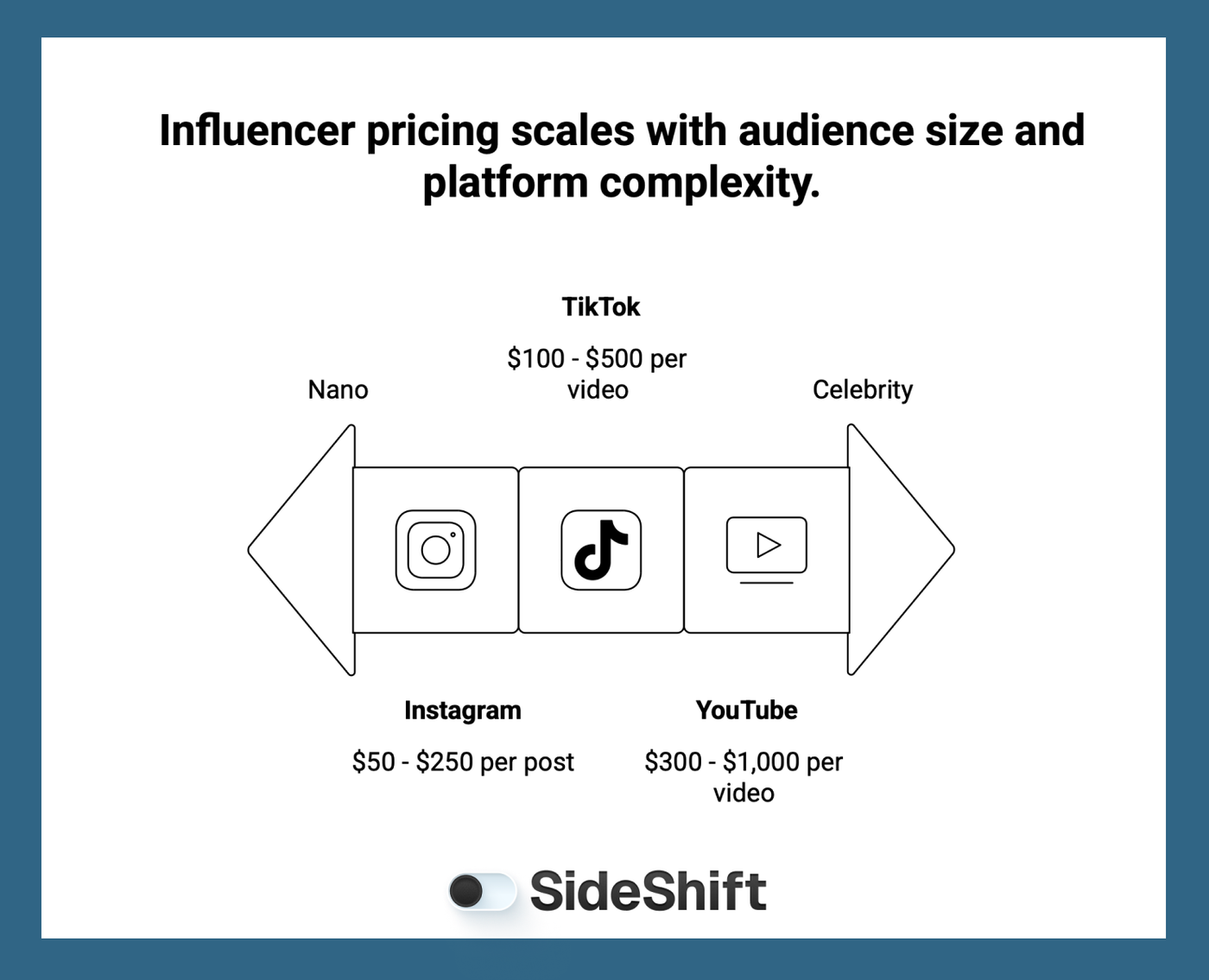
Influencer rates vary widely depending on the platform, audience size, and content type. Here’s a breakdown of typical costs in 2026:
Instagram Influencer Rates Per Post
Instagram remains a top channel for influencer marketing. Rates scale with follower count and engagement:
- Nano (1k - 10k followers): $50 - $250 per post
- Micro (10k - 50k): $250 - $500 per post
- Mid-tier (50k - 500k): $500 - $2,500 per post
- Macro & Celebrity (500k+): $2,500 - $100,000+ per post
Stories, reels, or carousel posts may carry additional fees, and usage rights for paid ads or long-term promotion can increase costs further.
TikTok Influencer Pricing
TikTok pricing depends on both reach and potential virality. Nano and micro-influencers often charge $100 - $500 per video, while creators with larger audiences or high engagement can demand $2,000 - $10,000+ for a single post. Multi-hook, trend-driven content or campaigns requiring licensing usually push costs higher.
YouTube Influencer Marketing Cost
YouTube campaigns are more production-heavy. Even smaller channels can charge $300 - $1,000 for a short video, while mid-tier creators may cost $2,000 - $10,000+, depending on length, editing, and sponsorship disclosure. Full campaigns with multiple videos or high-quality production often exceed $10,000.
Influencer Rates by Creator Size
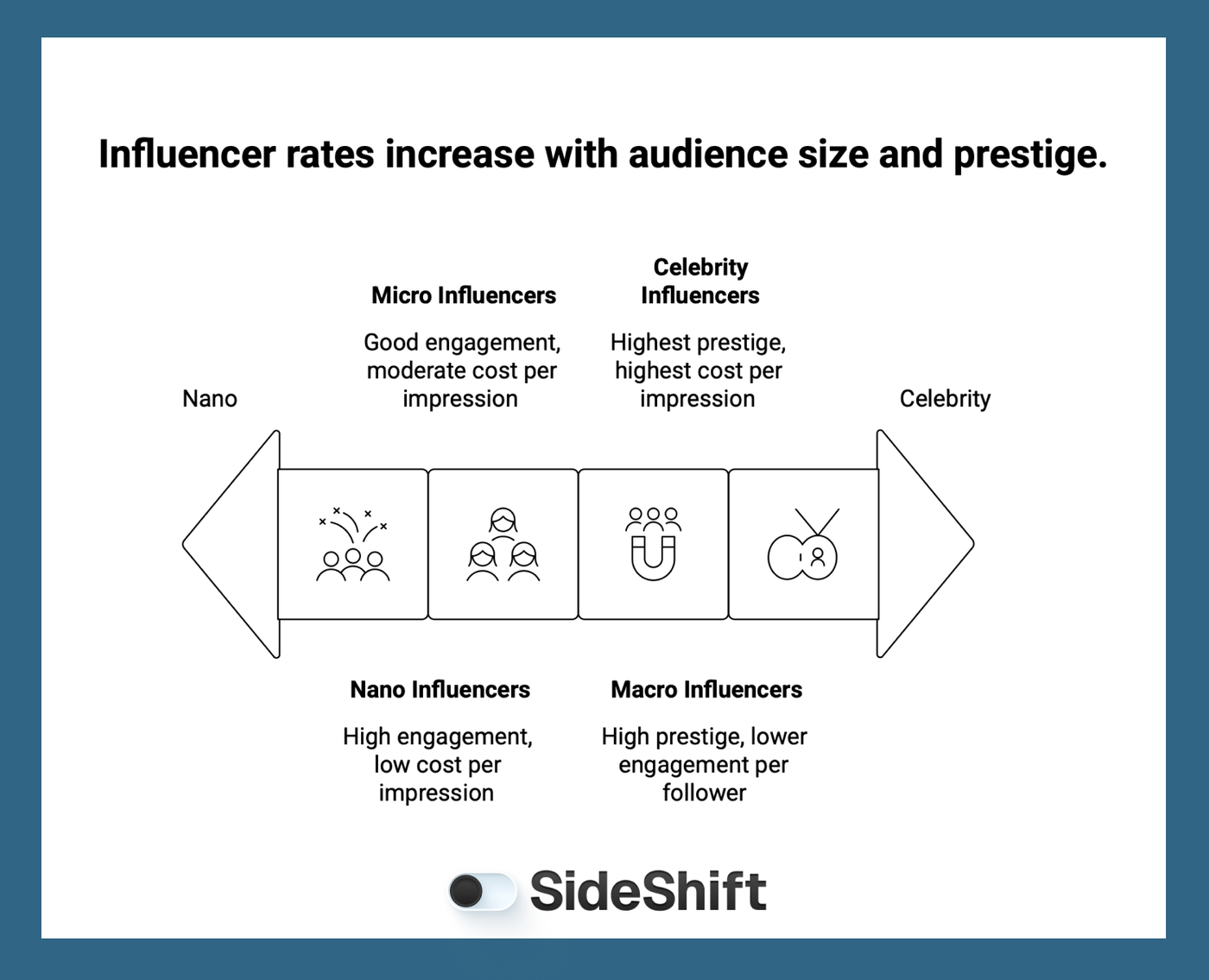
Influencer rates scale predictably with audience size, but engagement rate is just as important. Nano and micro-influencers often deliver higher engagement per follower and lower costs per impression, while macro and celebrity influencers carry higher prestige but far less flexibility for iterative campaigns.
- Nano Influencers (1k - 10k): $50 - $250/post
- Micro Influencers (10k - 50k): $250 - $500/post
- Macro Influencers (100k - 1M+): $2,500 - $10,000/post
- Celebrity Influencers (1M+): $10,000 - $100,000+ per post
Even small-scale campaigns with micro-influencers can add up quickly, making UGC a more affordable, scalable alternative.
Rethinking Influencer Payments: Equity as an Option
Influencer Alix Earle dramatically increased her earnings by taking an equity stake in the prebiotic soda brand Poppi instead of relying solely on her typical high six-figure promotional fees.
When PepsiCo acquired a major stake in Poppi at a valuation near $2 billion in early 2025, Earle’s long-term partnership allowed her to benefit from the company’s growth, cashing out far higher than she would have from a one-time post. Her approach is emerging as a new model for influencers, where they act as partners or investors rather than just content creators, betting on the long-term success of brands they genuinely support.
Want to put this into practice?
SideShift connects you with vetted UGC creators who actually deliver. Start your free trial and post your first job in under 10 minutes.
For brands, this highlights a growing alternative: equity-based arrangements, where creators earn ownership or milestone-based compensation instead of, or alongside, traditional fees.
Equity-based arrangements can align creator incentives with your business goals, ensuring content is authentic and performance-driven. That said, equity isn’t the only path - most brands still rely on UGC and traditional influencer engagements for scalable content. Combining high-quality UGC with selective influencer partnerships lets brands maintain volume, credibility, and ROI, while experimenting with equity arrangements where it makes sense.
UGC Campaign Cost
Unlike traditional influencers, UGC campaigns prioritize content quality over audience size. Brands pay for authentic, native-feeling videos, not access to followers.
At SideShift, we connect brands with hundreds of creators per campaign, allowing dozens or even hundreds of videos to be produced in the same time it would take to manage a handful of influencers. Cost per asset can drop as low as $27 - $50 per video when scaling across multiple creators, making UGC campaigns more budget-friendly and performance-driven than traditional influencer marketing.
What Impacts the Cost of Influencer Campaigns?
Several factors determine the final price of influencer campaigns:
Follower count & engagement rate
While follower count is the obvious metric, engagement rate often drives actual ROI. Micro-influencers with smaller, highly engaged audiences frequently outperform larger accounts in terms of conversion and brand affinity.
Content format and production value
High-production content like cinematic videos, multi-scene storytelling, or product demos increases costs, while simpler, authentic posts remain more affordable.
Usage rights & whitelisting
Licensing for paid campaigns, ads, or long-term use adds high costs. Brands must clarify whether they need full usage rights upfront to avoid surprises.
Exclusivity clauses
Exclusive contracts that prevent creators from promoting competing brands within a category can increase fees.
Campaign duration & volume
Long-term campaigns with multiple posts often reduce per-post cost but increase total spend. Short-term campaigns are pricier on a per-post basis.
How to Run Affordable & Effective Influencer Marketing Campaigns
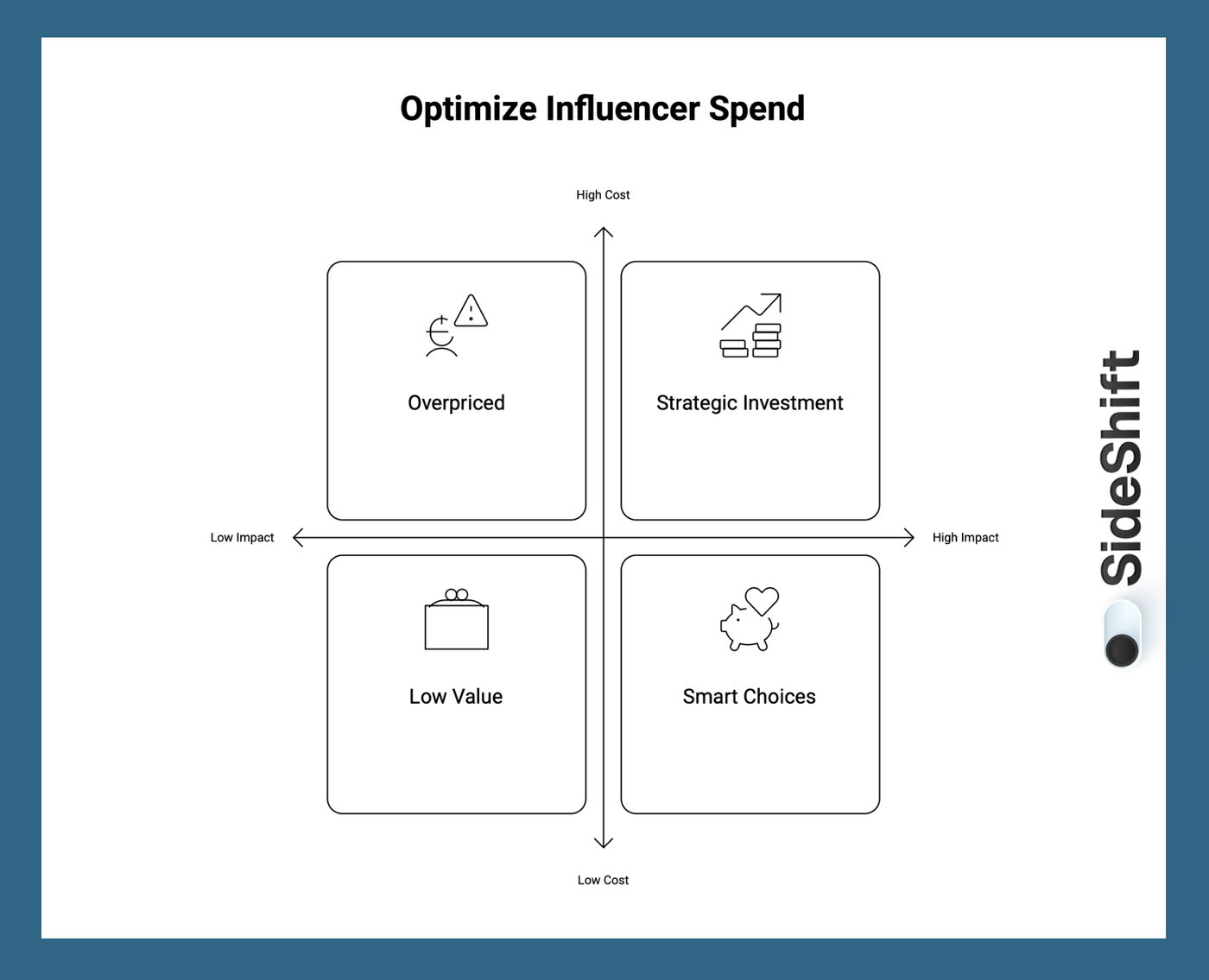
The key to affordable campaigns is blending UGC with influencer content, rather than relying solely on traditional influencers. High-volume UGC allows brands to test messaging, optimize hooks, and scale content faster, while micro and macro-influencers add credibility and reach where needed.
Platforms like SideShift make this approach seamless. Brands can:
- Hire hundreds of creators quickly
- Manage content, contracts, and payouts in one place
- Run hybrid campaigns combining UGC and influencers of any size
- Scale campaigns efficiently while keeping per-asset costs low
This model enables brands to get more content for every dollar and ensures campaigns are performance-driven from start to finish.
With SideShift, brands get more content for every dollar, maintain authenticity, and run performance-driven campaigns without the headaches of managing multiple platforms or contracts.
Want to put this into practice?
SideShift connects you with vetted UGC creators who actually deliver. Start your free trial and post your first job in under 10 minutes.
Start a free SideShift account today and connect with UGC creators and influencers of all sizes to scale your campaigns and maximize ROI.
FAQs
1. How much does an influencer campaign cost on average?
On average, brands pay between $500 - $5,000 per post for mid-tier influencers, but additional factors like production value, usage rights, and campaign length can drive costs higher. Small-scale or micro-influencer campaigns can start as low as $100 - $500 per post, while campaigns with macro or celebrity influencers can cost tens of thousands per post.
2. What is the average influencer rate per post?
Influencer rates vary widely:
- Nano influencers (1K - 10K followers): $50 - $150 per post
- Micro influencers (10K - 50K followers): $150 - $500 per post
- Mid-tier influencers (50K - 500K followers): $500 - $5,000 per post
- Macro & celebrity influencers (500K+ followers): $5,000 - $50,000+ per post
Rates also depend on content type (photo, video, story), platform, and usage rights.
3. Are micro-influencers more cost-effective?
Yes. Micro-influencers and UGC creators often deliver higher engagement rates per dollar compared to larger creators. They tend to have more authentic connections with their audiences, making them ideal for campaigns with smaller budgets or niche targeting.
4. Is influencer marketing more expensive than UGC?
Generally, yes. Influencer campaigns usually cost more because you’re paying for reach, brand alignment, and audience access. UGC (user-generated content) focuses on content creation rather than audience size, making it more affordable and scalable for paid ads and ongoing campaigns.
5. How do brands budget for influencer marketing?
Brands typically allocate 5 - 20% of their marketing budget to influencer marketing, depending on campaign goals. To budget effectively:
- Define campaign objectives (awareness vs conversions)
- Choose creator size strategically (micro vs macro)
- Factor in content production, licensing, and platform fees
- Include funds for paid amplification or boosting posts