
Traditional Marketing vs Influencer Marketing: Comparison Across 5 Aspects
A breakdown of how traditional and influencer marketing differ on cost, speed, and results so you can choose the right strategy based on your goals.
Table of Contents
If you want to get to Paris, booking a bicycle probably isn’t the best idea. And if you just want to go to the coffee shop down the street, taking a bus won’t make much sense either. The problem isn’t the vehicle. It’s the mismatch between the goal and the choice.
Marketing works the same way. Traditional marketing and influencer marketing are built for different jobs. One is designed for broad awareness and consistency. The other is built for trust, relevance, and influence inside specific communities. Neither is better nor worse on its own. They just solve different problems.
In this blog, we break down traditional marketing vs influencer marketing across different aspects, so you can decide which approach fits your goal. Or how to use both without forcing one to do the other’s job.
What is traditional marketing?
Traditional marketing refers to brand-led advertising that’s pushed out to a broad audience through established channels. This includes TV commercials, print ads, radio spots, billboards, sponsorships, and, more recently, large-scale digital display campaigns.
For example, here's an OOH (out of home) ad by Canva, the design tool:
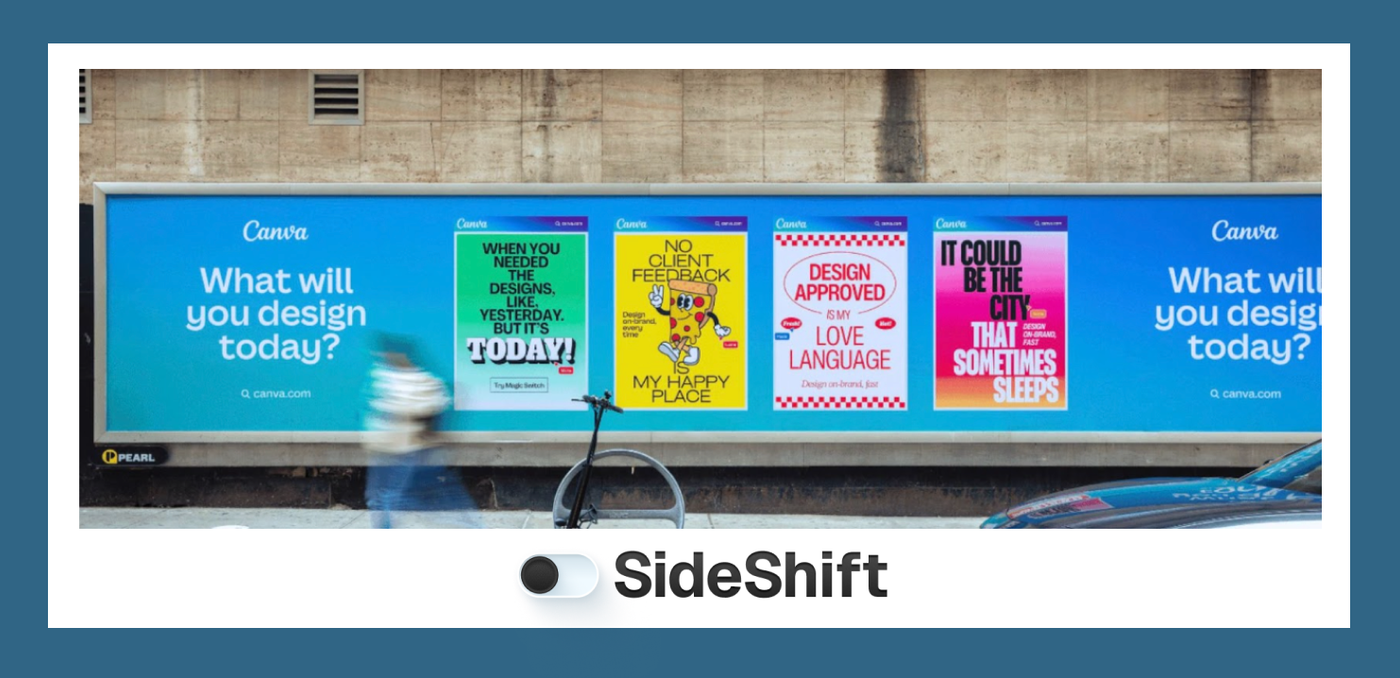
This type of marketing is built for reach and repetition. The goal is to put the same message in front of as many people as possible, often over a long period of time. That’s why it’s commonly used by large brands that want to stay top of mind or reinforce brand identity. You’ll often see it tied to big launches, seasonal campaigns, or moments where visibility matters more than immediate action.
What is influencer marketing?
Influencer marketing is a channel where brands partner with individuals who already have an audience and a voice people pay attention to. Instead of a brand speaking directly to everyone, the message is shared through an influencer who feels more like a person than an ad.
For example, this is an example of influencer marketing where someone with a social media following is promoting a brand:
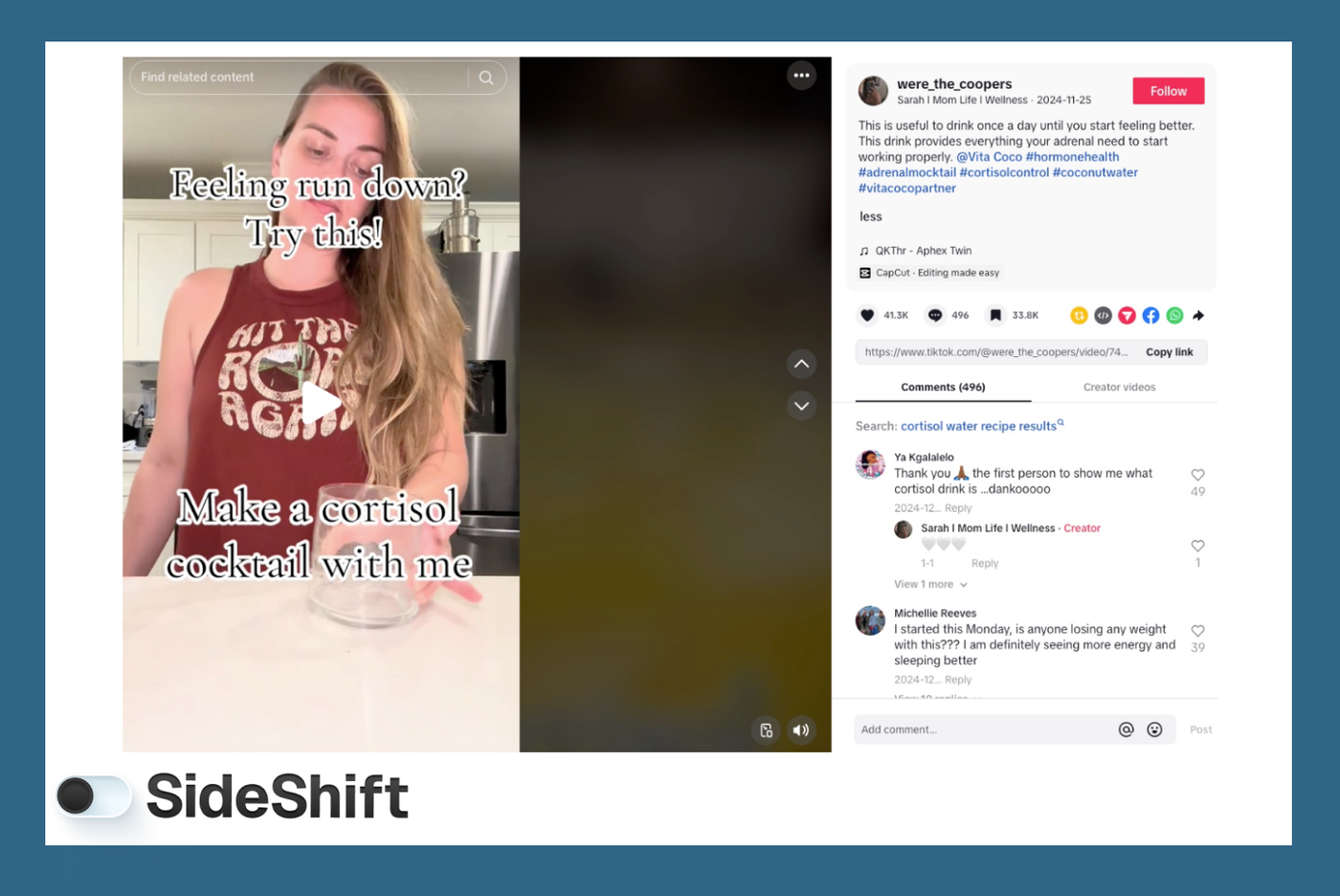
The content usually lives on platforms like Instagram, TikTok, YouTube, or blogs, and it blends into what people are already scrolling or watching.
Influencers tend to attract specific communities—fitness, skincare, tech, finance, travel—so brands can reach people who are already interested in the category. The content often feels more natural because influencers explain, demonstrate, or review products in their own way, rather than repeating a polished brand script.
Traditional marketing vs influencer marketing: how they differ in practice
At a high level, traditional marketing and influencer marketing are often framed as old vs new. In reality, the difference shows up in how teams plan, execute, and measure work. Looking at them side by side across a few practical dimensions makes the trade-offs clearer.
1. Primary goal: awareness vs influence
Traditional marketing is usually designed to broadcast a message. The goal is visibility, consistency, and recall. You want people to recognize the brand, remember the tagline, and associate it with a certain feeling or category. That’s why it works well for large launches, seasonal campaigns, or brands trying to stay top of mind.
Want to put this into practice?
SideShift connects you with vetted UGC creators who actually deliver. Start your free trial and post your first job in under 10 minutes.
Influencer marketing is designed to shape decisions, not just awareness. Instead of repeating one message at scale, it places the product inside a real-world context. An influencer explaining how they use something, why they chose it, or where it fits into their routine does more than announce a product—it nudges behavior.
You’ll often see this difference play out in creative:
- Traditional ads focus on clarity and polish.
- Influencer content focuses on relatability and experience.
Neither approach is wrong. They’re built for different outcomes.
2. Cost structure and risk
Traditional marketing usually requires committing a budget before you know what will work. Production, media buying, and agency costs are largely fixed upfront. If a concept underperforms, learning comes late, and iteration is expensive.
Influencer marketing spreads risk differently. Spend is tied to individual influencers and pieces of content, which makes it easier to test multiple directions at once. You can start small, learn quickly, and double down where results show up.
This also affects how teams think about failure. In traditional marketing, a campaign failing feels heavy. In influencer marketing, a few posts underperforming is expected—and useful.
That difference alone changes how often teams experiment.
3. Team and operational complexity
Traditional marketing relies on centralized control. Creative direction, approvals, messaging, and timelines are managed tightly. This often means larger teams, longer planning cycles, and more coordination across stakeholders.
Influencer marketing shifts some of that work outward. Influencers bring their own style, production setup, and understanding of what resonates with their audience. Internal teams spend less time crafting every detail and more time on:
- Influencer selection
- Briefing and alignment
- Reviewing content
- Measuring outcomes
That said, influencer programs introduce a different kind of complexity. Managing relationships, timelines, usage rights, and content approvals across many individuals can get messy without clear systems.
The work doesn’t disappear. It just changes shape.
4. Performance signals and feedback loops
Traditional marketing tends to rely on lagging indicators. Reach, impressions, brand lift studies, and recall surveys tell you what happened after the fact. These signals are useful for long-term brand health but slow for day-to-day optimization.
Influencer marketing offers faster feedback. Engagement, saves, comments, traffic, and conversions appear quickly and at the level of individual posts. Teams can see what messaging, formats, or influencers are driving action and adjust in near real time.
This makes influencer marketing especially useful when:
- You’re still figuring out positioning
- You want proof of demand
- You need learnings you can reuse in ads or other channels
The feedback loop is tighter, which changes how decisions get made.
5. Content lifespan and reuse
Traditional marketing is usually built around fixed campaigns. Assets are designed for a specific launch window or placement, and once that moment passes, the content often loses relevance. Reusing it outside that context can feel forced or dated.
Influencer marketing content tends to have a longer, more flexible life. A single influencer's post can be repurposed into ads, clipped into shorter videos, added to landing pages, or reused in emails—especially when usage rights are secured. Because the content is rooted in real usage rather than a campaign slogan, it often stays relevant longer.
Want to put this into practice?
SideShift connects you with vetted UGC creators who actually deliver. Start your free trial and post your first job in under 10 minutes.
For example, YETI uses influencer-generated content on its social media as well:
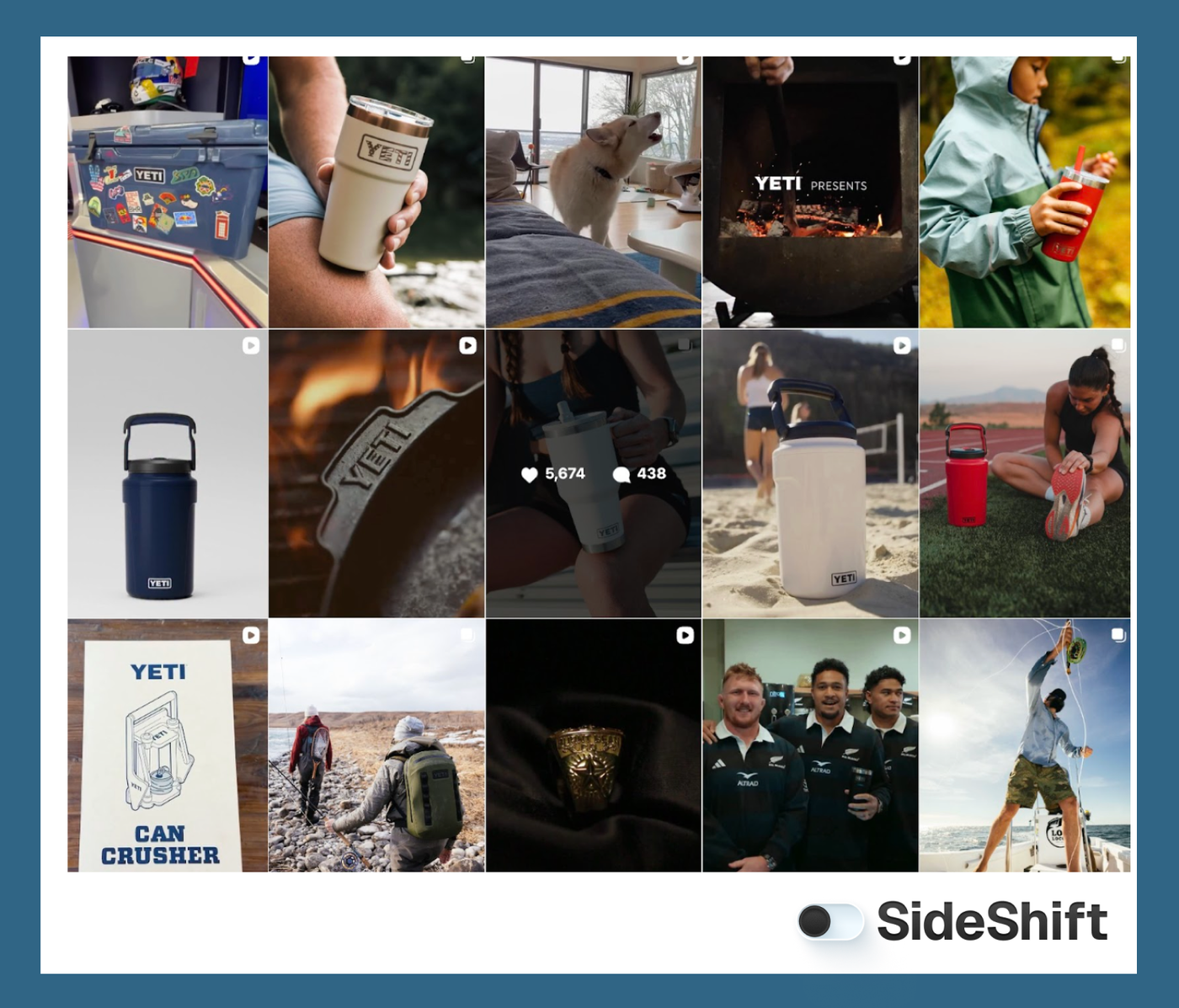
This difference matters for teams trying to build a content library rather than running one-off campaigns. When reuse and adaptability are priorities, influencer-led content usually delivers more value over time.
When you need influencer-style content without influencers
Sometimes the real need isn’t an influencer partnership. It’s content that looks, sounds, and feels like it came from a real influencer, without being tied to someone else’s audience or profile.
This usually happens when the content is meant to live on brand-owned channels: paid ads, email campaigns, landing pages, or product pages. In those cases, follower count matters less than whether the content feels authentic and usable.
That’s where UGC fits.
Platforms like SideShift help brands find creators who can produce influencer-style content without running influencer campaigns. Instead of paying for reach, brands focus on content they can reuse, test, and scale.
With SideShift, brands can:
- Find UGC creators on IG or TikTok who match their category, tone, and audience
- Run content-first campaigns built for ads, emails, and social
- Review creator portfolios before hiring, not after
- Test multiple hooks, formats, and creators without long-term commitments
- Track performance at the video and creator level to see what actually works
If you’re looking for creator-made content you can fully control and reuse, UGC is often the better fit.
Try SideShift for your brand and see how quickly you can find creators who already know how to make content your audience trusts.
FAQ
1.Is influencer marketing faster to launch than traditional marketing campaigns?
Yes. Influencer and UGC campaigns can be produced and activated in days, while traditional campaigns often require weeks or months for planning, production, and approval cycles. This speed allows brands to adapt quickly to trends or performance data.
2.Which approach offers more precise audience targeting?
Influencer marketing provides sharper targeting because creators come with built-in niche audiences. Traditional marketing usually relies on demographic-based targeting, which is broader and less behavior-specific.
3.Can influencer marketing outperform traditional marketing in direct-response campaigns?
Often, yes. Creator-driven content tends to generate higher click-through rates and stronger conversion metrics, especially on social platforms where viewers prefer authentic, short-form content over polished ads.
4.Does influencer marketing reduce creative fatigue compared to traditional ads?
It does. Traditional ads can become repetitive because they rely on a few core creatives. Influencer and UGC content allow brands to constantly refresh assets with new hooks, angles, and styles.