


CPM for Influencer Marketing: A Complete Guide
CPM in influencer marketing = (Campaign cost / Impressions) x 1,000. See platform benchmarks, how CPM differs by tier, and how to use it for budgeting.
Table of Contents
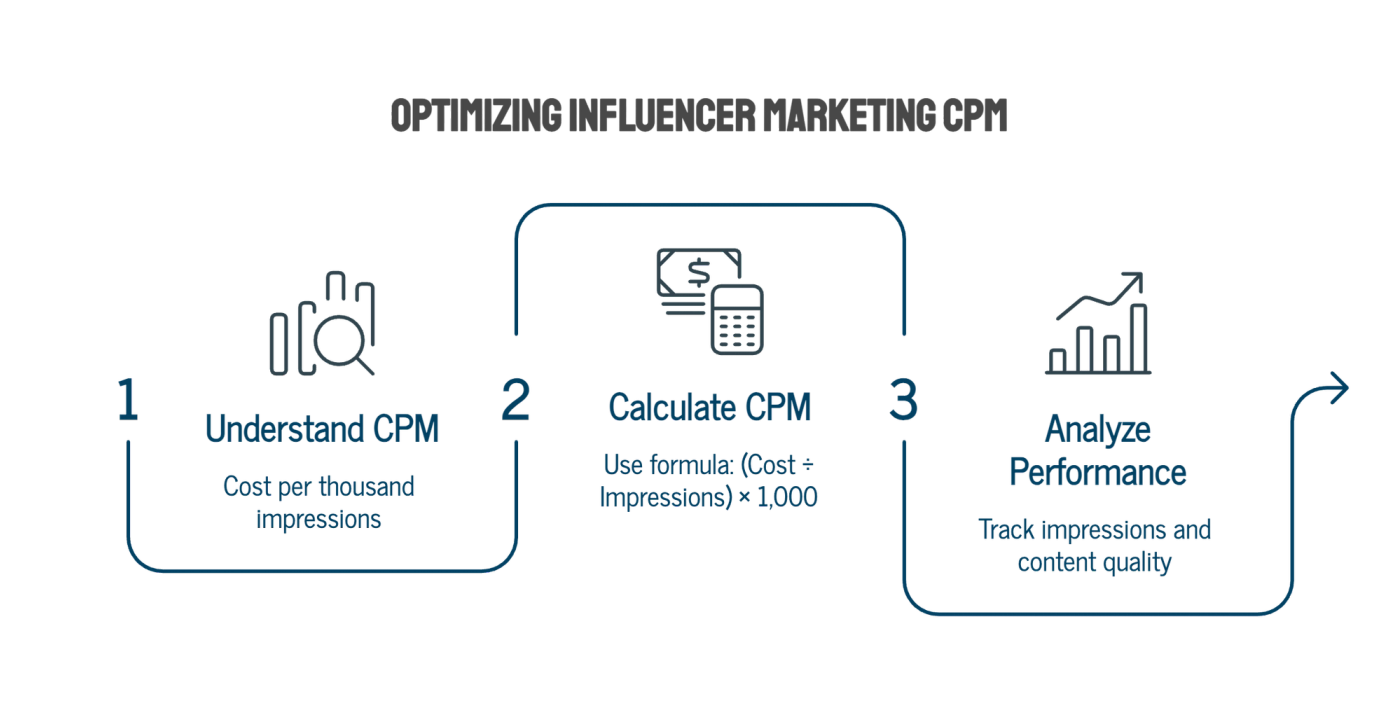
CPM, or cost per mille, is the cost of getting your brand in front of 1,000 people through a creator's content. It's calculated as (Campaign Cost ÷ Impressions) × 1,000, and it's one of the most direct ways to compare what you're paying for reach across different creators, platforms, and campaigns.
If you've ever tried to figure out whether $1,500 for an Instagram Reel is a fair price or a rip-off, CPM is the number that answers that question. We'll cover the formula, current benchmarks by platform and creator tier, what actually moves your CPM up or down, and how to use it without losing sight of the metrics that matter more than reach.
What Is CPM in Influencer Marketing?
CPM stands for cost per mille. "Mille" being Latin for thousand. In influencer marketing, it tells you how much you're paying for every 1,000 impressions a piece of sponsored content generates.
It's borrowed directly from traditional media buying, where CPM has been the standard way to price ad inventory for decades. The difference in influencer marketing is that you're paying a creator for content, not buying guaranteed placement from an ad network. Impressions are a byproduct of how well that content performs.
That distinction matters more than it sounds. A paid ad's impressions are guaranteed by the platform. A creator's impressions depend on the algorithm, the audience, and how good the content actually is. Two creators with identical follower counts can produce wildly different CPMs on the exact same budget.
The CPM Formula
The formula for calculating cost per mille (CPM) is:
CPM = (Campaign Cost ÷ Total Impressions) × 1,000
Imagine you pay a creator $2,000 to produce a TikTok video, and that video generates 250,000 impressions.
Your calculation would look like this:
CPM = ($2,000 ÷ 250,000) × 1,000
CPM = $8.00
In other words, you're paying $8 for every 1,000 impressions your campaign received. Whether that's a strong CPM depends on the platform, the creator's audience, campaign objectives, and the benchmarks you're comparing it against.
CPM Benchmarks by Platform
CPM varies significantly by platform, largely due to differences in content format, audience behavior, average watch time, and how each algorithm distributes content.
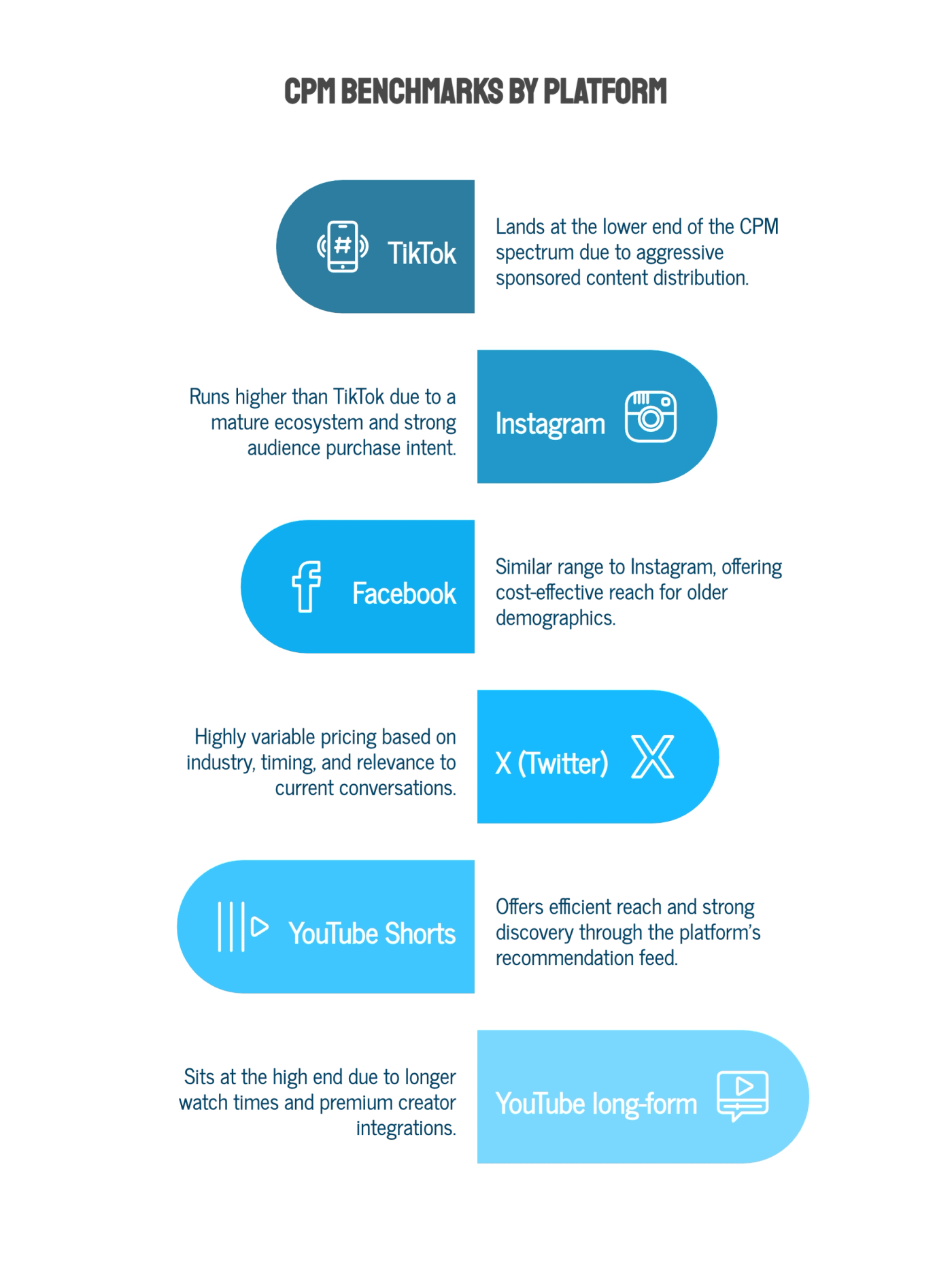
- TikTok tends to land at the lower end of the CPM spectrum across platforms, since its algorithm pushes sponsored content to non-followers more aggressively than Instagram or YouTube, which inflates impressions relative to spend.
- Instagram (Feed & Reels) typically runs a notch higher than TikTok. The platform's advertising ecosystem is more mature, and for many lifestyle and ecommerce brands, Instagram's audience tends to carry stronger purchase intent, which brands are willing to pay a premium to reach.
- Facebook generally lands in a similar range to Instagram, and remains a cost-effective option for broad reach, particularly among older demographics that are less concentrated on newer platforms.
- X (Twitter) is the most variable of the major platforms. Pricing leans heavily on industry and timing, news and technology campaigns riding a relevant conversation tend to command a premium over a typical evergreen post.
Want to put this into practice?
SideShift connects you with vetted UGC creators who actually deliver. Start your free trial and post your first job in under 10 minutes.
- YouTube Shorts behaves similarly to other short-form platforms, offering relatively efficient reach with strong discovery potential through the platform's recommendation feed.
- YouTube long-form sits at the high end of the spectrum, and by a wide margin in certain niches. Longer watch times, higher audience intent, and premium creator integrations all push the cost up, finance, software, and B2B content in particular can command a steep premium over the platform's already-elevated baseline.
There's no universal, agreed-upon CPM benchmark across the influencer marketing industry the way there is for programmatic display advertising. Different tools and platforms count impressions differently, and verified-view deals don't measure the same thing as flat-fee arrangements.
The more useful exercise is tracking your own CPM over time and across creators, rather than anchoring to an external "average" that may not reflect how your specific campaigns are measured.
How Creator Tier Affects CPM
Follower count doesn't move CPM in a straight line. In fact, smaller creators frequently post lower CPMs than their larger counterparts, because their content tends to over-perform relative to a modest fee.
- Nano-influencers (roughly 1,000-10,000 followers) tend to charge the least per post and post the highest engagement rates of any tier, since their audiences are small but highly attentive. Their CPM can be excellent when a post performs well, but the limited reach means the absolute impression volume stays low regardless.
- Micro-influencers (roughly 10,000-100,000 followers) sit in the tier where most brands find the strongest balance between cost efficiency and total reach. Fees scale up from the nano tier, but so does audience size, and engagement tends to hold up reasonably well at this range.
- Macro- and mega-influencers (100,000+ followers) command fees that scale into the tens or hundreds of thousands, but engagement rates typically decline as audience size grows. That tradeoff often pushes effective CPM higher even though the raw impression count is larger, you're paying significantly more for proportionally less audience attention per dollar.
This is why a high-volume program built across many micro-influencers at modest individual fees can frequently outperform a single large macro deal on both CPM and total engagement; you're buying reach in smaller, more efficient units instead of one large, less efficient deal.
What Else Affects Your CPM
Platform and tier set the range, but a few other factors shift where you land inside it:
- Niche: Finance, crypto, and B2B audiences carry premium CPMs because the value of reaching them is higher. Broad-appeal categories like entertainment or general lifestyle tend to sit at the lower end.
- Content format: Video generally commands a higher CPM than static images, and longer-form video commands more than short-form, simply because production effort and attention span both increase.
- Usage rights: If your contract includes the right to repurpose a creator's content as a paid ad or across multiple channels, expect the effective CPM to climb. You're paying for more than the original post.
- Audience geography: Creators with audiences concentrated in high-income markets like the U.S., U.K., or Australia typically command higher CPMs than creators reaching lower-spend regions, because the downstream value of an impression is higher.
Want to put this into practice?
SideShift connects you with vetted UGC creators who actually deliver. Start your free trial and post your first job in under 10 minutes.
CPM's Biggest Limitation
CPM tells you what you paid for attention. It tells you nothing about what that attention did.
A campaign can post an excellent CPM and still generate zero sales, because CPM has no concept of audience fit, content quality, or purchase intent. A $5 CPM on an audience that has no interest in your category is a worse outcome than a $15 CPM on an audience that converts.
That's the same trap that shows up with Earned Media Value (EMV). A clean-looking number on a slide that doesn't necessarily connect to revenue. CPM is useful for one specific question: is this a fair price for this much reach?
Using CPM for Budgeting Without Misusing It
CPM earns its place in a media plan when it's used for what it's actually good at:
- Comparing creators within the same tier and platform: If two micro-influencers on Instagram are quoting different rates for similar follower counts, CPM (calculated from past post performance, not just follower count) tells you which one is the better buy.
- Setting a pre-campaign benchmark: Knowing the typical CPM range for your platform and niche before you negotiate gives you a defensible number to use when pushing back, instead of guessing.
- Forecasting reach for a fixed budget: If you know your target CPM, you can estimate how many impressions a given budget should produce, which makes planning a multi-creator campaign far more predictable.
- Flagging underperformance early: A creator whose CPM comes in well above your benchmark after a campaign runs is worth a conversation before you renew, even if the relationship otherwise feels good.
What CPM shouldn't do is replace conversion-based metrics in your reporting. A campaign report that leads with CPM and nothing else is the same blind spot as a report that leads only with EMV. It answers "was this efficient" without ever answering "did this work."
Track CPM and Optimize Creator Campaigns with SideShift
CPM is a valuable benchmark for understanding how efficiently your creator campaigns generate reach, but it's only one metric. To understand what drives real business growth, you need to connect impressions with engagement, clicks, conversions, and revenue.
SideShift is an all-in-one influencer marketing platform built to help brands manage every stage of their creator campaigns, from discovering and recruiting creators to managing collaborations, tracking deliverables, and measuring performance. Instead of juggling spreadsheets, email threads, and reports from multiple social platforms, SideShift centralizes your entire workflow in one place.
With campaign analytics that surface CPM alongside engagement, clicks, conversions, and ROI, you can quickly compare creator performance, identify your highest-performing partnerships, optimize campaign budgets, and make data-driven decisions with confidence.
Whether you're running a single influencer campaign or scaling an always-on creator program, SideShift gives you the insights you need to maximize every marketing dollar.
FAQs
Want to put this into practice?
SideShift connects you with vetted UGC creators who actually deliver. Start your free trial and post your first job in under 10 minutes.
What's a good CPM for influencer marketing?
It depends on platform and niche, but most brands see $3-$15 as a reasonable range across Instagram, TikTok, and Facebook, with YouTube and finance/B2B niches running higher. A "good" CPM is really one that's in line with your platform's typical range and still produces results downstream.
How is CPM different from cost per engagement (CPE)?
CPM measures cost relative to impressions, while CPE measures cost relative to actions like likes, comments, or shares. CPM is better for awareness-focused campaigns; CPE tends to be a more useful comparison point for smaller creators where engagement quality matters more than raw reach.
Does a lower CPM always mean a better deal?
Not necessarily. A low CPM on an audience that doesn't match your target customer is a worse outcome than a higher CPM on an audience that converts. CPM should be weighed against audience fit and conversion data, not treated as a standalone score.
Why do flat-fee influencer deals make CPM harder to calculate?
Because the impressions aren't known until after the content goes live, you can't lock in a CPM at the time of booking the way you can with a verified-view or paid-media buy. You can only calculate the effective CPM retroactively, once the post has run its course.
Should CPM be the main metric in your influencer marketing reports?
No. CPM is useful context for media efficiency, but it should sit alongside engagement and conversion metrics, not replace them. A report built entirely around CPM can look healthy while hiding a campaign that drove no real business results.