


Micro vs. Macro Influencers: What Actually Fits Your Campaign
In the battle of micro vs. macro influencers, both have different benefits and trade-offs. Here's what to consider and which one to pick for your next campaign.
Table of Contents
In the micro vs. macro influencer debate, the instinct to chase the biggest follower count you can afford is understandable, but it's not necessarily the best choice. Instead of "how big of a creator can I get?" you should ask yourself "what does this campaign actually need to succeed?"
Sometimes that's the reach of a macro creator. More often, especially for brands with modest budgets, it's the trust and engagement of a micro influencer. In some instances, a hybrid strategy is what will bring the results you're looking for.
In this guide, we'll get straight to the comparison that matters most for budget decisions. You'll get a look at what separates micro and macro influencers, the benefits of each, and a decision framework you can actually use the next time you're choosing between them.
What Is the Difference Between Micro and Macro Influencers?
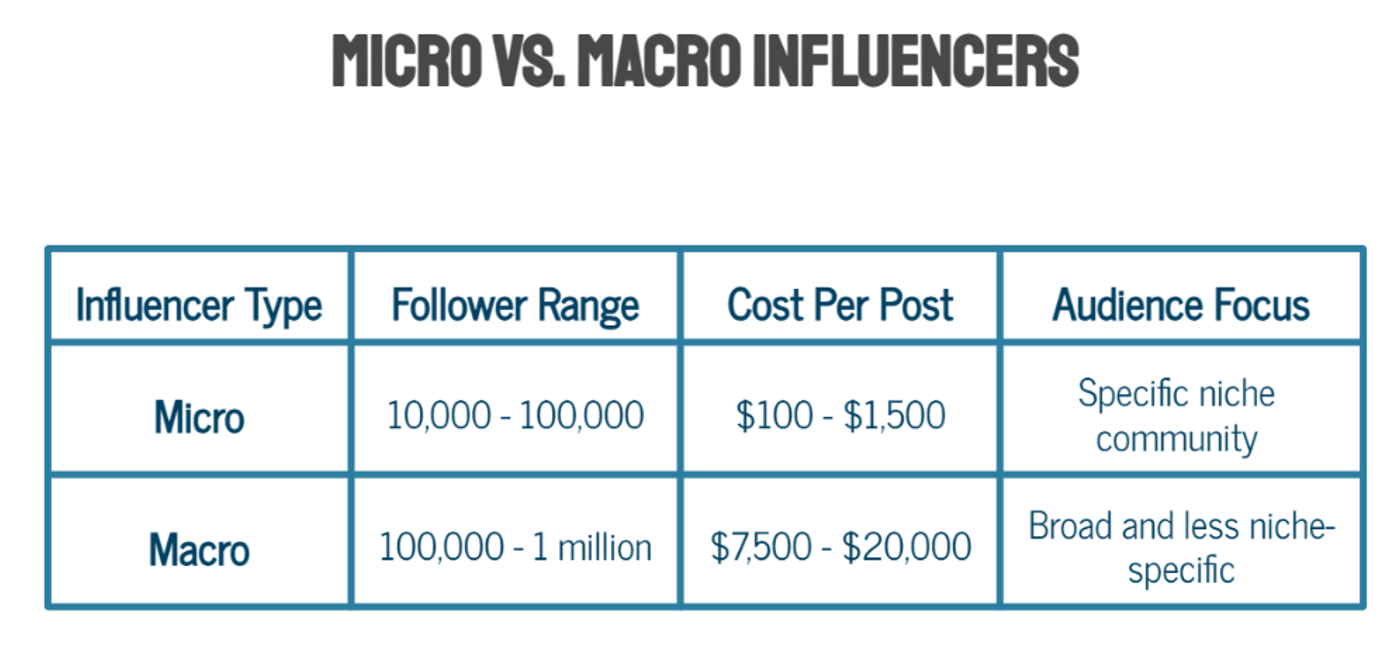
Micro influencers typically sit between 10,000 and 100,000 followers. Macro influencers sit between 100,000 and 1 million. The follower range is the easiest way to tell them apart, and it also tends to affect the pricing. Micro influencers roughly cost between $100 and $1,500 per post, while macro influencers can cost anywhere from $7,500 to $20,000 per post. (These ranges are estimates, not fixed rules, and actual rates can vary widely based on factors like platform, engagement, content type, audience, and creator demand.)
But those are not the differences that matter the most for a brand. The real distinction is in the relationship a creator has with their audience.
Micro influencers tend to operate inside a specific niche, cultivating a smaller audience that feels like a community. Macro influencers have scaled past that point: their content still performs, but the connection to any individual follower is thinner, and their audience is usually broader and less niche-specific. That trade-off, intimacy versus reach, is what this comparison comes down to.
What Are The Micro Influencer Benefits?
Micro influencers earn their spot in a campaign by being closer to their audience. That closeness shows up in the engagement numbers, the cost, and the way their content actually feels to the people watching it.
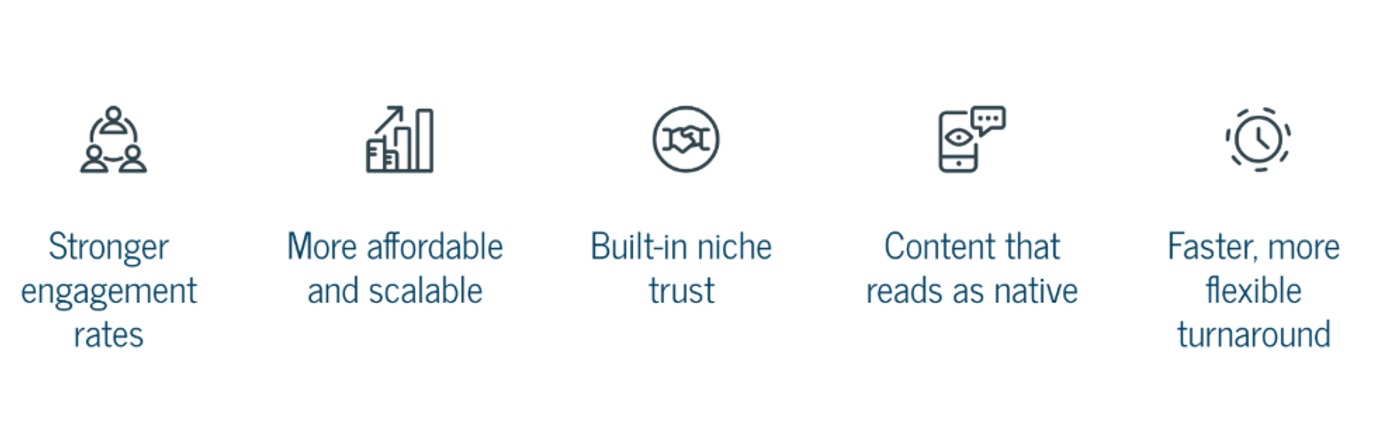
- Stronger engagement rates: Smaller, more tightly knit audiences comment, save, and share at a higher rate relative to their size. A micro creator's post often outperforms a macro creator's on engagement percentage alone, even with a fraction of the followers.
- More affordable and scalable: Micro creators often have lower fees compared to macro creators. That lower per-creator cost means you can run a wider roster, test messaging across several audiences at once, and diversify risk instead of betting a campaign on one account.
- Built-in niche trust: A micro creator's audience follows them because of a specific shared interest (a hobby, a profession, a lifestyle). A product recommendation lands as advice from someone in the know, not an ad.
- Content that reads as native: Micro creators typically shoot and edit content themselves, without a team polishing every frame. That rawness tends to perform better on platforms like TikTok and Instagram, where audiences are increasingly skeptical of anything that looks fake or too much like traditional advertising.
Want to put this into practice?
SideShift connects you with vetted UGC creators who actually deliver. Start your free trial and post your first job in under 10 minutes.
- Faster, more flexible turnaround: Without a large management team or a packed sponsorship calendar, micro creators are often easier to brief, schedule, and get content back from quickly, which matters for time-sensitive launches or trend-driven campaigns.
Taken together, these advantages make micro influencers a strong default for brands that need their budget to work harder, not just go further. The tier trades sheer visibility for a more genuine connection with a smaller group of people, which is often exactly the trade-off a growing brand needs.
What Are The Macro Influencer Benefits?
Macro influencers earn their spot in a campaign by offering something micro creators simply can't: reach. What that reach buys goes beyond raw follower counts; it also comes with polish, experience, and a shortcut to credibility.
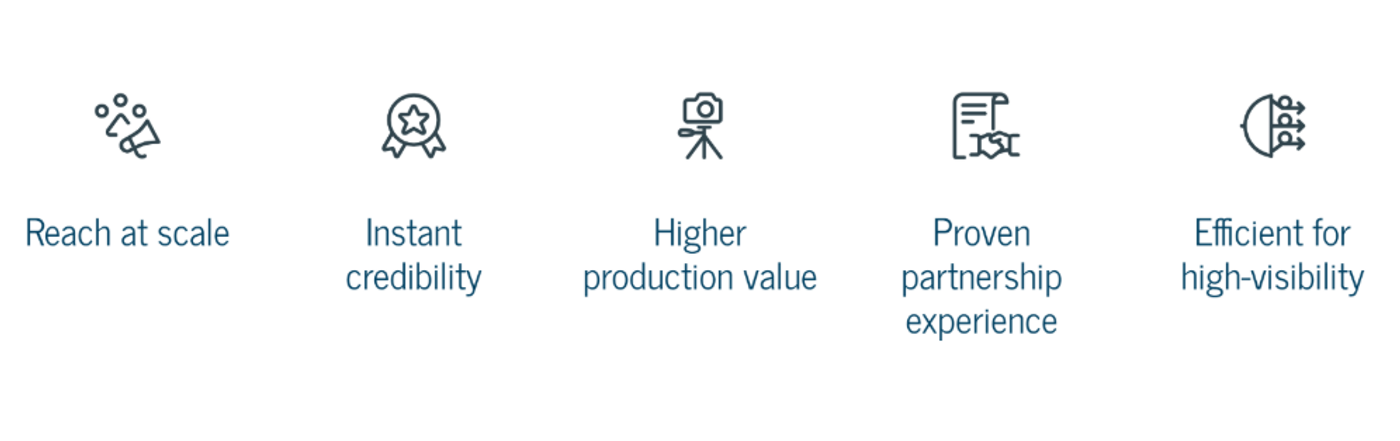
- Reach at scale: A single macro post can put your brand in front of hundreds of thousands or millions of people at once, which is difficult to replicate with any number of smaller creators in a short window.
- Instant credibility: Being associated with a well-known creator can lend your brand a sense of legitimacy and cultural relevance, especially useful for a launch moment where you want to make a splash.
- Higher production value: Macro influencers often work with editors, photographers, or full content teams, producing polished content.
- Proven partnership experience: Established creators at this tier have typically worked with dozens of brands before. They understand deliverables, usage rights, and disclosure requirements, which can mean fewer surprises during the collaboration.
- Efficient for a single high-visibility moment: When the goal is maximum exposure in a short window, one macro placement can be simpler to execute and manage than coordinating a large roster of smaller creators.
These strengths make macro influencers the better fit when a campaign is built around a single, high-stakes moment rather than an ongoing drip of content. The tier trades intimacy for reach, which is the right trade when visibility, not niche trust, is what the brand is looking for.
Micro vs. Macro Influencers: Which is Better for Your Campaign?
Benefits on both sides are real, which is exactly why "which is better" isn't a fair question. The better question is which one fits the specific situation your brand is in right now. Work through these five factors before you commit a budget to either tier.
1. What's the Actual Goal of This Campaign?
If the goal is broad awareness, getting as many eyes on your brand as possible, a macro influencer's reach can do the heavy lifting more efficiently.
If the goal is trust, consideration, or driving an actual purchase decision, micro influencers tend to convert better, since their recommendation often carries more personal weight with their audience.
Write the goal down in one sentence before you look at a single creator profile. It will filter out most of the wrong-tier options on its own.
2. What Does the Budget Buy at Each Tier?
Want to put this into practice?
SideShift connects you with vetted UGC creators who actually deliver. Start your free trial and post your first job in under 10 minutes.
A macro placement priced at $10,000 to $20,000 might buy you one video and one moment of reach. That same budget could fund 15 to 20 micro placements, each with its own engaged, niche audience, its own content style, and its own shot at resonating.
Neither allocation is automatically better, but most brands haven't actually compared the two side by side before defaulting to whichever tier feels more impressive.
3. How Niche Is Your Product or Audience?
A highly specific product, a piece of specialized gear, a supplement for a particular condition, or a tool for a specific profession usually performs better with micro creators whose audience already cares about that exact category.
A macro influencer's broader audience may include your buyer, but it also includes a lot of people who will never be your customer, which dilutes the value of that reach. The more specific your ideal customer, the more the math favors micro.
4. What Stage Is Your Brand At?
An early-stage or lesser-known brand often benefits more from micro creators, whose audiences are more open to discovering something new from a source they trust. A macro placement for a lesser-known brand can underperform because the audience has no context for why they should care.
A more established brand launching a major new product, on the other hand, can use a macro moment to reinforce credibility it's already built, since the audience isn't being asked to trust the brand and the message at the same time.
5. Do You Need Volume or a Singular Moment?
If the campaign calls for a steady stream of content across weeks or months, a roster of micro creators is easier to sustain and diversify than repeatedly paying for macro placements.
If the campaign is built around one specific event (a launch day, a limited drop, a major announcement), a macro placement can create a concentrated spike of visibility that a scattered roster of smaller creators may not be able to replicate on the same timeline.
Quick gut-check: if you found yourself nodding along to "trust," "niche," "budget-conscious," or "ongoing content" while reading through these, micro is likely your tier. If you were nodding at "reach," "credibility," "single big moment," or "established brand," a macro influencer could be the answer.
Can You Use Micro and Macro Influencers? Building a Hybrid Strategy
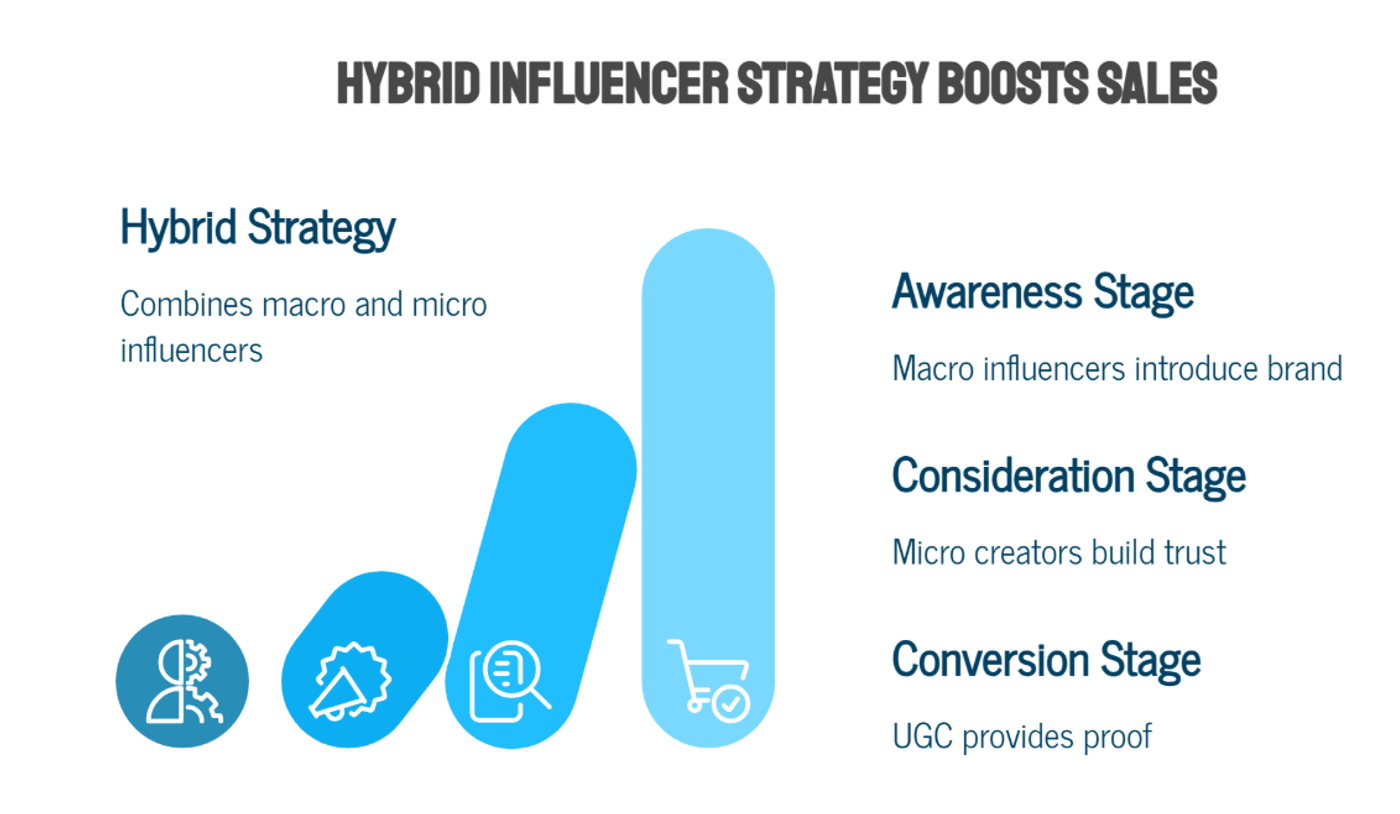
Some brands do benefit from working with influencers in different tiers. Each tier will serve a different stage of the funnel.
Macro influencers are well suited to the awareness stage, because their reach introduces your brand to a large audience quickly, creating the initial exposure. But awareness alone rarely closes a sale; the audience has seen your brand once, not been convinced by it. That's where micro creators take over. Their content is better positioned for the consideration and conversion stages, where a niche audience needs a more trusted, specific reason to actually buy.
This is also where UGC earns its place in the mix: UGC creators, paid to produce content rather than to lend their own following, can generate the demos, reviews, and testimonial-style videos that give a hesitant buyer the proof they need, often at a lower cost than another round of influencer placements. Layering UGC underneath micro-influencer content gives a brand a steady supply of conversion-focused content to run as ads or post organically, without leaning on reach it doesn't need at that stage.
Want to put this into practice?
SideShift connects you with vetted UGC creators who actually deliver. Start your free trial and post your first job in under 10 minutes.
For example, say a skincare brand is launching a new serum. In week one, it partners with two macro skincare influencers to introduce the product to a broad audience and generate initial buzz and credibility. Over the following few weeks, it shifts budget toward 15 to 20 micro creators in specific niches (sensitive skin, acne-prone skin, clean beauty) who create more detailed, trust-building content that speaks to their audience's specific concerns.
In the mix of micro influencers, there are a handful of UGC creators to produce straightforward demo and before-and-after videos, not for their own following but as creative the brand can run as paid ads and repost on its own channels to reinforce the message everywhere a potential customer might be looking.
The macro moment gets people to notice the serum. The micro and UGC layer underneath is what actually convinces them to buy it.
Find The Right Influencers For Your Brand with SideShift
Sometimes the fastest way to build awareness isn't one big name, it's dozens of smaller ones working at once.
Astra is a good example of what that can look like. The social self-growth app was struggling to create cultural relevance and grow installs, so SideShift built a roster of creators who could translate the product into relatable, emotionally resonant content. Friendship tests, compatibility skits, and a "what my dream meant" series generated more than 5 million organic views and helped convert viewers into paid users while lifting monthly revenue.
SideShift gives you access to a pool of 1M+ pre-vetted creators, with engagement data, past brand work, and audience insights available before you commit a budget. Contracts, payments, and performance tracking all run inside one platform. Post a brief and start reviewing applicants the same day.
FAQs
1. What is the difference between micro and macro influencers?
Micro influencers typically have 10,000 to 100,000 followers and higher engagement within a niche audience. Macro influencers typically have 100,000 to 1 million followers and broader reach, but generally lower engagement relative to their size.
2. Micro vs. macro influencers: which is better?
Neither is universally better. Micro influencers tend to win on engagement, trust, and cost efficiency, while macro influencers win on reach and brand credibility. The right choice depends on your campaign goal, budget, and how niche your audience is.
3. Are micro influencers more cost-effective than macro influencers?
Generally, yes. Micro influencers charge significantly less per post, and their higher relative engagement often means a brand gets more genuine interaction per dollar spent compared to a single macro placement.
Want to put this into practice?
SideShift connects you with vetted UGC creators who actually deliver. Start your free trial and post your first job in under 10 minutes.
4. When should a brand use macro influencers instead of micro?
Macro influencers make the most sense for broad awareness goals, major product launches, or moments where a brand wants a concentrated spike in visibility and already has enough recognition that an audience doesn't need much context to trust the recommendation.
5. Can a brand work with both micro and macro influencers in the same campaign?
Yes, and it's a common strategy for brands with the budget to support it. Macro placements create a visibility spike, while a roster of micro creators sustains engagement, niche trust, and content volume around that moment.