


Influencer Marketing and SEO: Tips To Combine Strategies
Learn how influencer marketing and SEO can work together to create long lasting visibility for your business through backlinks, branded search, and more.
Table of Contents
Influencer marketing and SEO can and should work together. A well-placed creator post can generate a backlink, a spike in branded search, social proof that AI answer engines pick up on, and content that ranks on its own.
Brands that understand this and are able to combine SEO and influencer marketing into a business strategy can see increases in sales, brand awareness, and authority.
Here you’ll learn how influencer content feeds SEO performance and how to build a strategy that treats the two as one system instead of opposites.
Understanding Influencer Marketing and Its Impact on SEO
Search engines don’t rank pages in a vacuum, they do it based on signals of trust, relevance, and demand. Some of those signals come from outside a brand's own website. Enter: influencer content.
Influencer content, when made by high-quality creators, with the right keywords used on title and captions, generates exactly the kind of external signal search engines are built to notice. This can improve your brand’s ranking on Google and potentially increase sales.
While the creator might gain from it only momentarily, from the partnership itself, the brand’s earning potential doesn’t have a time limit, as long as it's an ongoing, well-structured effort.
How Can Influencer Marketing and SEO Work Together?
This list gathers the main benefits of incorporating influencer marketing to a brand’s SEO strategy, from backlinks to AI engine citations.
Backlinks
Start with the most literal connection: creators link back to brands constantly and a lot of those links carry real SEO weight. Think of a creator reviewing a product on their YouTube channel and including affiliate or reference links in the description box. Or a creator's own website or blog (if they run one alongside their social media presence) might publish a full write-up with a contextual link to the brand's site.
What makes these links valuable isn't just that they exist, it's where they come from. A link from a creator's established blog or niche publication, one search engines already consider topically relevant, tends to carry more weight than a generic directory listing or low-effort guest post.
Search engines favor links that occur naturally, in context, from sources with some standing in the topic, and a creator writing about a product they actually used is about as natural as backlinks get. The value comes from the accumulation and diversity of a healthy link profile, spread across dozens of small, topically relevant sources, rather than from any single link doing all the work.
One nuance worth flagging: creator links should be marked rel="sponsored" when it’s a paid partnership. That doesn't erase the SEO value, because sponsored links still contribute to referral traffic, but brands shouldn't expect every creator sponsored link to pass full ranking authority the way an earned editorial link would.
Branded Search
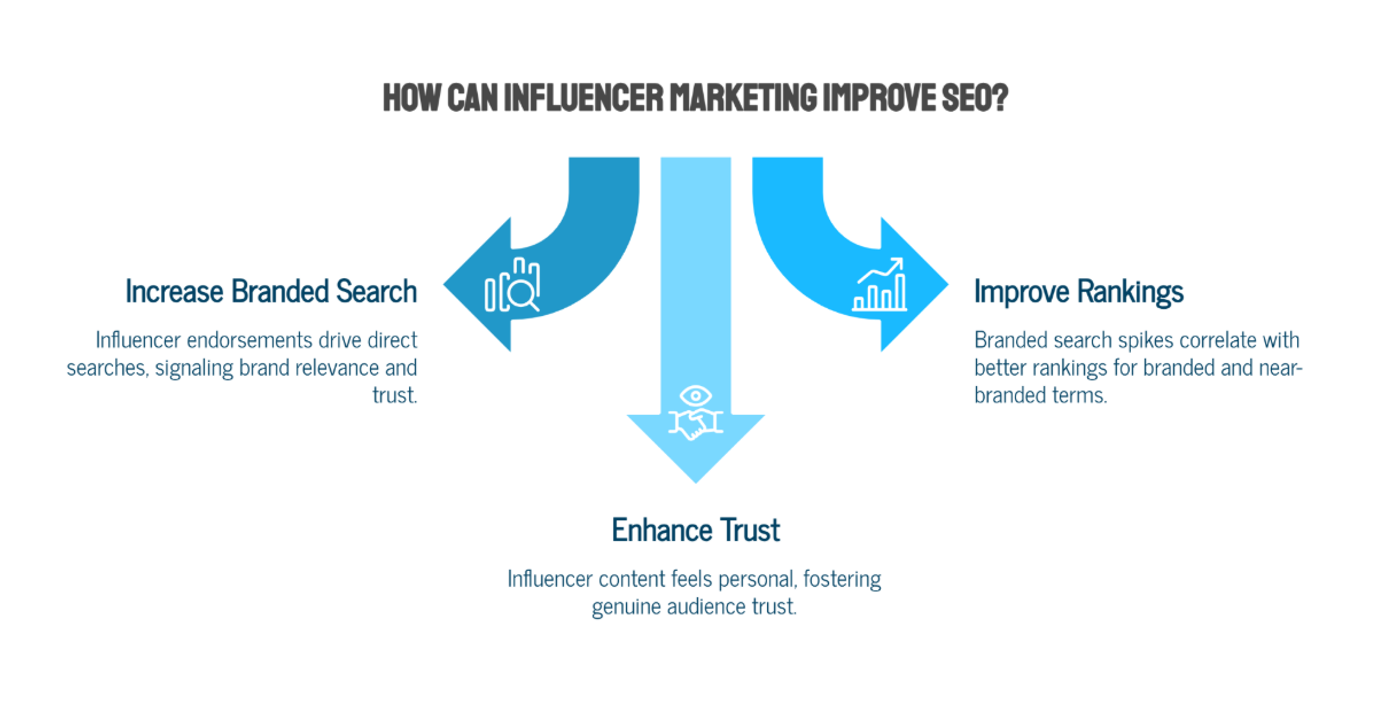
When a creator with real audience trust mentions a product, a meaningful share of that audience doesn't click the link in the caption. They open a search engine and type the product name directly, often alongside the brand name and a phrase like “is it worth it.”
Want to put this into practice?
SideShift connects you with vetted UGC creators who actually deliver. Start your free trial and post your first job in under 10 minutes.
That's branded search demand, and it's one of the behavioral signals search engines use to gauge whether a brand is genuinely relevant and trusted, independent of anything happening on the brand's own site.
This matters because branded search is difficult to fake and expensive to buy. Paid ads can put a brand in front of an audience, but they can't manufacture the follow-up behavior of someone actively searching for that brand by name afterward. Influencer content routinely does exactly that, especially when a creator's endorsement feels personal rather than scripted.
There's a compounding effect too. A spike in branded search after a creator campaign often correlates with improved rankings for the brand's own pages on branded and near-branded terms, like the brand's name plus “review,” “discount code,” or “vs [competitor].” Those are usually easier terms to win than competitive, unbranded head terms.
AI and Answer-Engine Citations
Influencer content can also feed AI Overviews, chatbots, and other answer engines that increasingly sit between a search query and a brand's website. These systems are built to synthesize an answer from multiple sources rather than simply ranking a list of links. And they tend to favor content that demonstrates real experience and consensus, for example, multiple independent sources saying similar things about a product, in their own words, based on actual use.
A creator's genuine review, a comparison video, a “does this actually work” post: these are exactly the kind of first-person, experience-based content that answer engines are trained to surface and cite.
This is a meaningful shift for brands that have historically thought about SEO purely in terms of ranking their own pages. The goal now isn't just to rank but to be part of the answer an AI assembles when someone asks about a product category.
A brand can't manufacture that kind of third-party consensus internally; it has to come from outside sources with some standing, and creators are one of the most scalable ways to build that presence.
Influencer Content That Ranks on Its Own
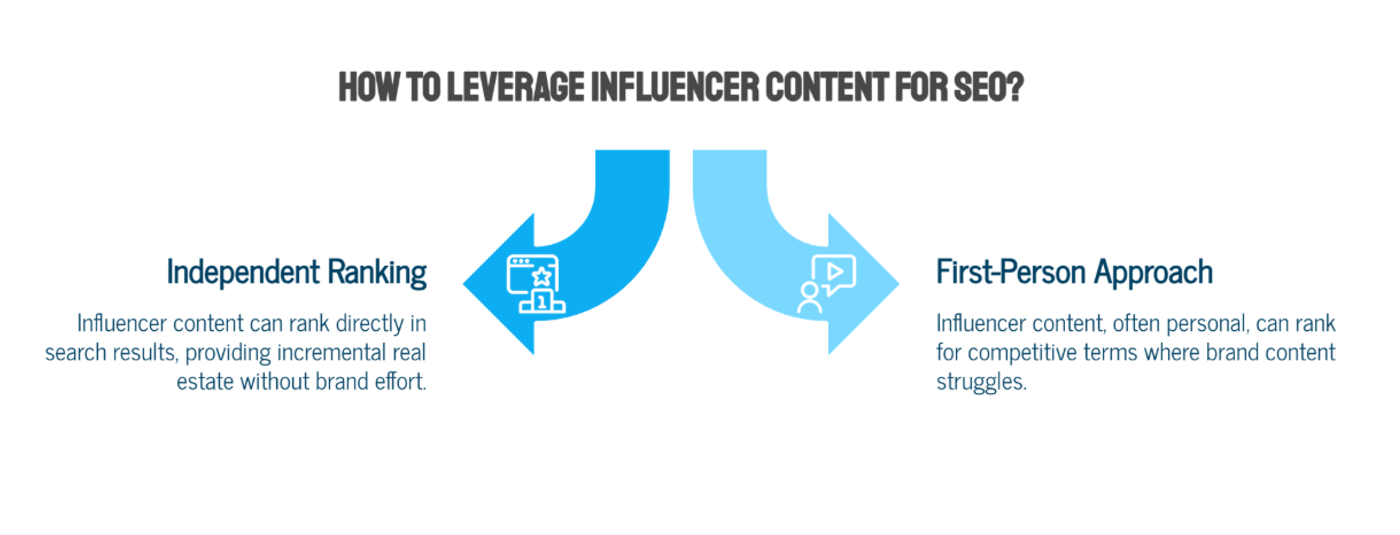
Some influencer content becomes an independent ranking asset in its own right. For example, a YouTube video optimized around a specific search term can rank directly in Google's video results, sometimes outranking the brand's own content for that exact query.
Even a well-optimized TikTok or Instagram post increasingly shows up in search results, as major search engines like Google lean harder into surfacing social content directly. This is a different kind of value than a backlink or a branded search bump. It's incremental real estate in the results that a brand doesn't have to build or rank for itself.
A brand fighting for a competitive head term might have almost no chance of ranking a second page for it. A creator's content sometimes can, simply by approaching the topic first-person instead of promotionally.
How to Improve SEO Ranking with Influencer Marketing
Merging influencer marketing and SEO takes a few deliberate shifts in how you strategize and measure results.
Want to put this into practice?
SideShift connects you with vetted UGC creators who actually deliver. Start your free trial and post your first job in under 10 minutes.
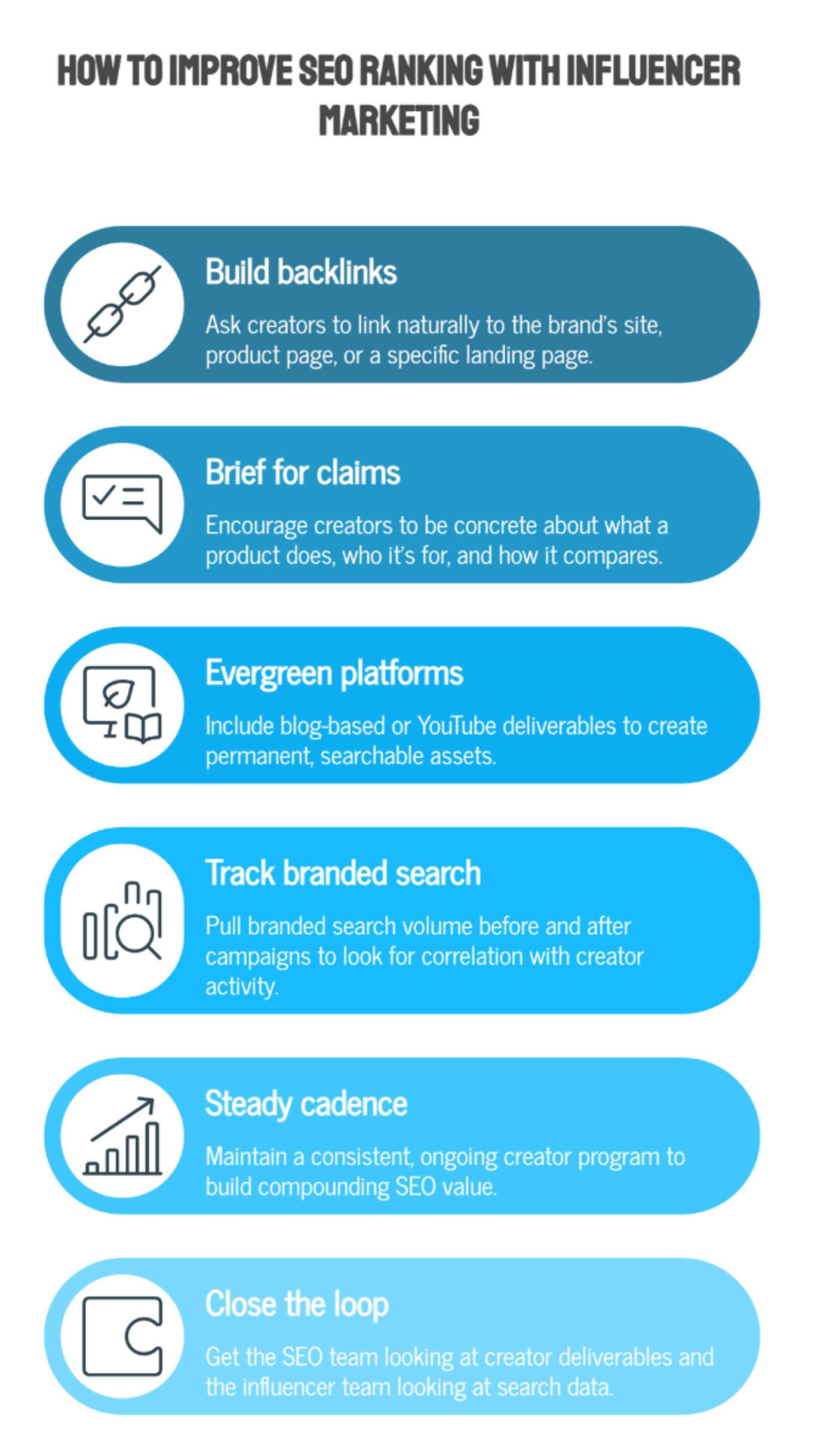
- Build backlinks into the brief. Ask creators to link naturally to the brand's site, product page, or a specific landing page relevant to the content, and be specific about where that link should point. A generic homepage link is far less useful than a link to the exact product or comparison page a customer would want to land on after reading the review.
- Brief for extractable claims. Since answer engines favor content with clear, specific statements, encourage creators to be concrete about what a product does, who it's for, and how it compares.
- Focus on platforms with evergreen value. A campaign built purely around Instagram Stories generates almost nothing indexable. A campaign that includes even one blog-based or YouTube deliverable per wave of creators creates a permanent, searchable asset that continues generating value long after the campaign ends.
- Track branded search lift alongside engagement. Pull branded search volume before and after major campaign waves, and look for correlation with creator activity. This is often the clearest way to demonstrate SEO impact from a campaign that never touched the brand's own website.
- Feed SEO with a steady cadence. A single large campaign creates a short-term bump in signals that fades. A consistent, ongoing creator program (a steady stream of new backlinks, new branded search mentions, and new independently-ranking content) builds compounding SEO value the same way consistent content publishing does on a brand's own blog.
- Close the loop between teams. The single reason this connection often goes unmanaged is organizational, not technical. Get the SEO team looking at creator deliverables, and get the influencer team looking at search data. The overlap only pays off once someone is actually watching both sides.
Scale Your Influencer Marketing Strategy with SideShift
None of this works without creators who actually deliver, whether that's an influencer with real search authority in their niche or a UGC creator with a track record of content that performs. Partner with the wrong fit and a campaign generates content with none of the downstream SEO value.
SideShift makes that kind of vetting fast instead of guesswork. Search a network of more than 800,000 creators, filter for established niche accounts, and match with partners in as little as 24 hours. Briefs, approvals, contracts, and payouts run from a single dashboard, so sourcing authority-rich creators doesn't have to slow a campaign down.
FAQs
1. What is influencer marketing in SEO?
In an SEO context, influencer marketing refers to using creator content as an off-page signal that builds a brand's search visibility, rather than just its social reach. That includes the backlinks creators generate, the branded search demand their content creates, the citations their reviews earn in AI answer engines, and any independently-ranking content that a creator publishes about the brand.
2. Is SEO dead or evolving in 2026?
SEO isn't dead, but the definition of “search” has broadened considerably. Traditional ranking in Google's blue links still matters, but a growing share of queries are now answered directly by AI Overviews that synthesize a response from multiple sources.
Want to put this into practice?
SideShift connects you with vetted UGC creators who actually deliver. Start your free trial and post your first job in under 10 minutes.
3. Do influencer links still help SEO if they're marked as sponsored?
Yes. Sponsored links, properly tagged with rel="sponsored", still contribute referral traffic, brand visibility, and diversity to a domain's overall link profile. The value comes from volume and variety across many creators rather than any single link passing full ranking authority.
4. How long does it take to see SEO results from an influencer campaign?
It varies, but branded search lift and referral traffic often show up within days of a campaign going live, while backlink authority and content rankings tend to build over weeks or months as search engines crawl, index, and evaluate the new content.
5. Which platforms give influencer content the most SEO value?
Platforms that index into search generally contribute the most: blogs, YouTube, and increasingly TikTok and Instagram, since major search engines have started surfacing social content directly in results. Stories and other ephemeral content contribute little on the SEO side compared to a deliverable that lives permanently and searchably somewhere.