


Influencer Mapping: How to Build Your Creator Landscape
Learn how influencer mapping helps you identify the right creators, structure outreach, and build a creator landscape that scales with your brand's growth.
Table of Contents
Influencer mapping is the process of identifying, researching, organizing, and prioritizing the creators who are most relevant to your brand. It helps you determine who is actually worth reaching out to, based on factors like audience fit, content quality, engagement, niche, brand alignment, and potential impact.
Without influencer mapping, outreach can quickly turn into a spreadsheet of hundreds of creator handles with no clear sense of which 10 actually matter. A strong influencer map turns a vague idea of "we should work with influencers" into a specific, ranked list of creators to approach, in what order, and why.
Most brands don't lose influencer campaigns to bad content. They lose them before the first message ever gets sent, because nobody took the time to figure out which creators were worth messaging in the first place. Influencer mapping is the step that comes before outreach, and skipping it is why so many partnerships underperform despite a reasonable budget and a decent product.
What Is Influencer Mapping, Exactly?
Influencer mapping is the practice of identifying the creators who hold real sway over your target audience and organizing them by relevance, reach, and fit. The goal is understanding who your buyers already trust, who competitors are working with, and where the gaps sit between the two, rather than just compiling a list of big follower counts.
A useful map doesn't just tell you who to contact. It tells you why. A creator with 40,000 followers who reviews products exactly like yours every week is often worth more than one with half a million followers who covers your category once a year. Mapping surfaces that distinction before you spend a single dollar on outreach.
Among marketers, 28.1% said they struggle to align creator content with brand strategy, and 27.3% said balancing brand requirements with creator authenticity is a persistent challenge. A good influencer map flags upfront which creators are likely to be easy to brief and which ones will need more back-and-forth to get right.
That ordering matters, largely because what makes influencer-generated content actually convert has more to do with fit than with follower count. A map built around reach alone will point you toward creators who look impressive on paper and convert almost nobody.
Why Does Mapping Your Creator Landscape Matter Before You Reach Out?
Skipping straight to outreach feels faster, and for the first campaign or two it might even work. The problem shows up on campaign three or four, when your team has burned through the obvious names and has no system for finding the next tier of good-fit creators.
This isn't a small-team problem, either: 43.9% of marketers say finding the right creators is their single biggest creator-marketing challenge, even as 77.7% report increasing their creator marketing budgets this year.
Money is flowing into creator marketing faster than the discovery process is keeping up. This matters even more for B2B brands, where longer sales cycles and pickier buyers leave less room for a mismatched partnership to just fade out quietly.
Want to put this into practice?
SideShift connects you with vetted UGC creators who actually deliver. Start your free trial and post your first job in under 10 minutes.
Mapping solves a few problems at once:
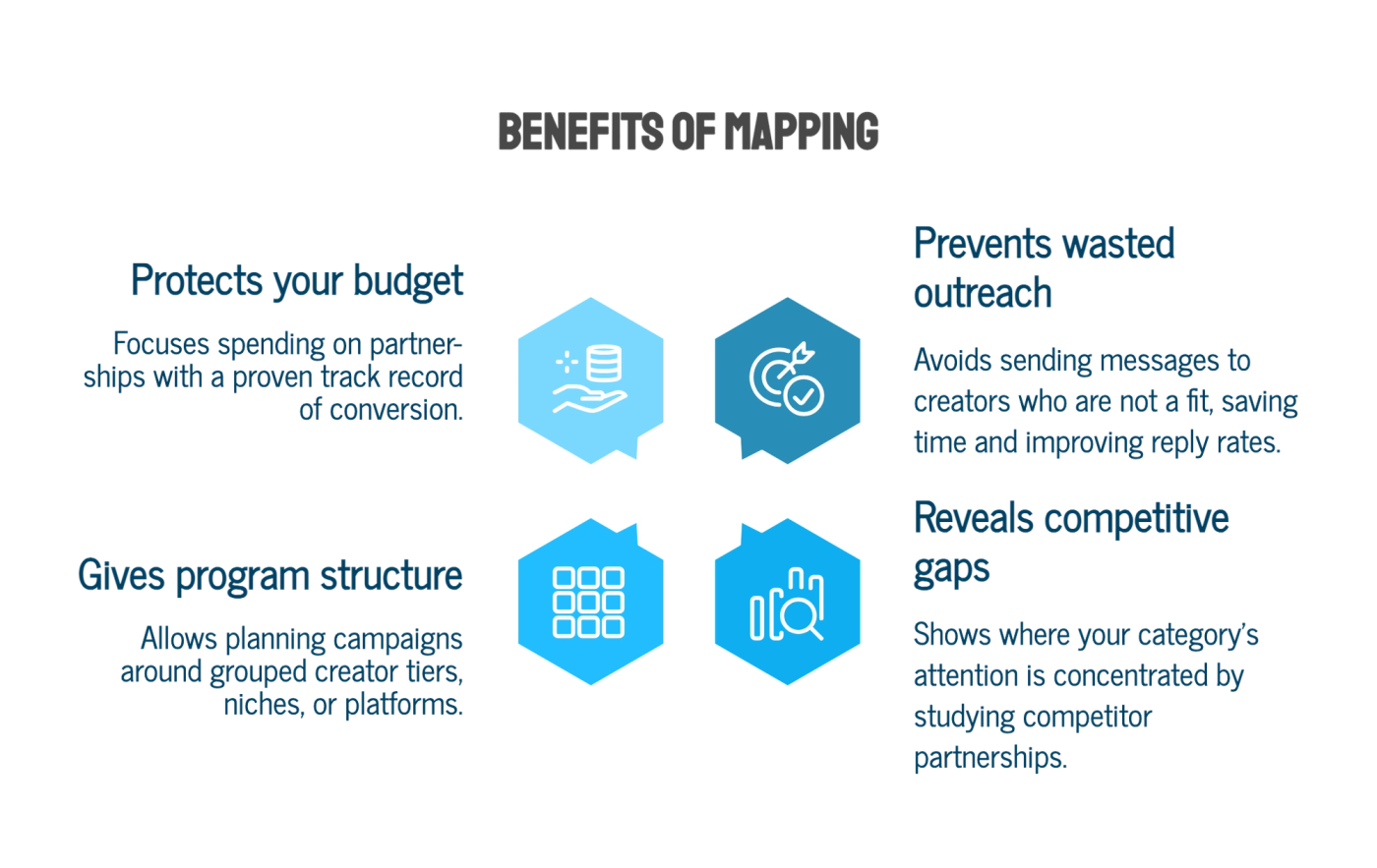
- It prevents wasted outreach. Every message you send to a creator who isn't a fit costs time, and building outreach around creators who are already a good match tends to get replies far faster than a generic pitch.
- It reveals your competitive gaps. Studying which creators your competitors already work with shows you where your category's attention is concentrated, and where it isn't.
- It gives your program structure. Once creators are grouped by tier, niche, or platform, you can plan campaigns around the map instead of reacting creator by creator.
- It protects your budget. Knowing which creators historically convert for brands like yours means you spend on partnerships with a track record, not just a following.
A brand that treats every creator as an equal unknown will always spend more to learn less than a brand that mapped the landscape first.
How Do You Actually Build an Influencer Map?
Building a map sounds abstract until you break it into a sequence you can run in an afternoon.
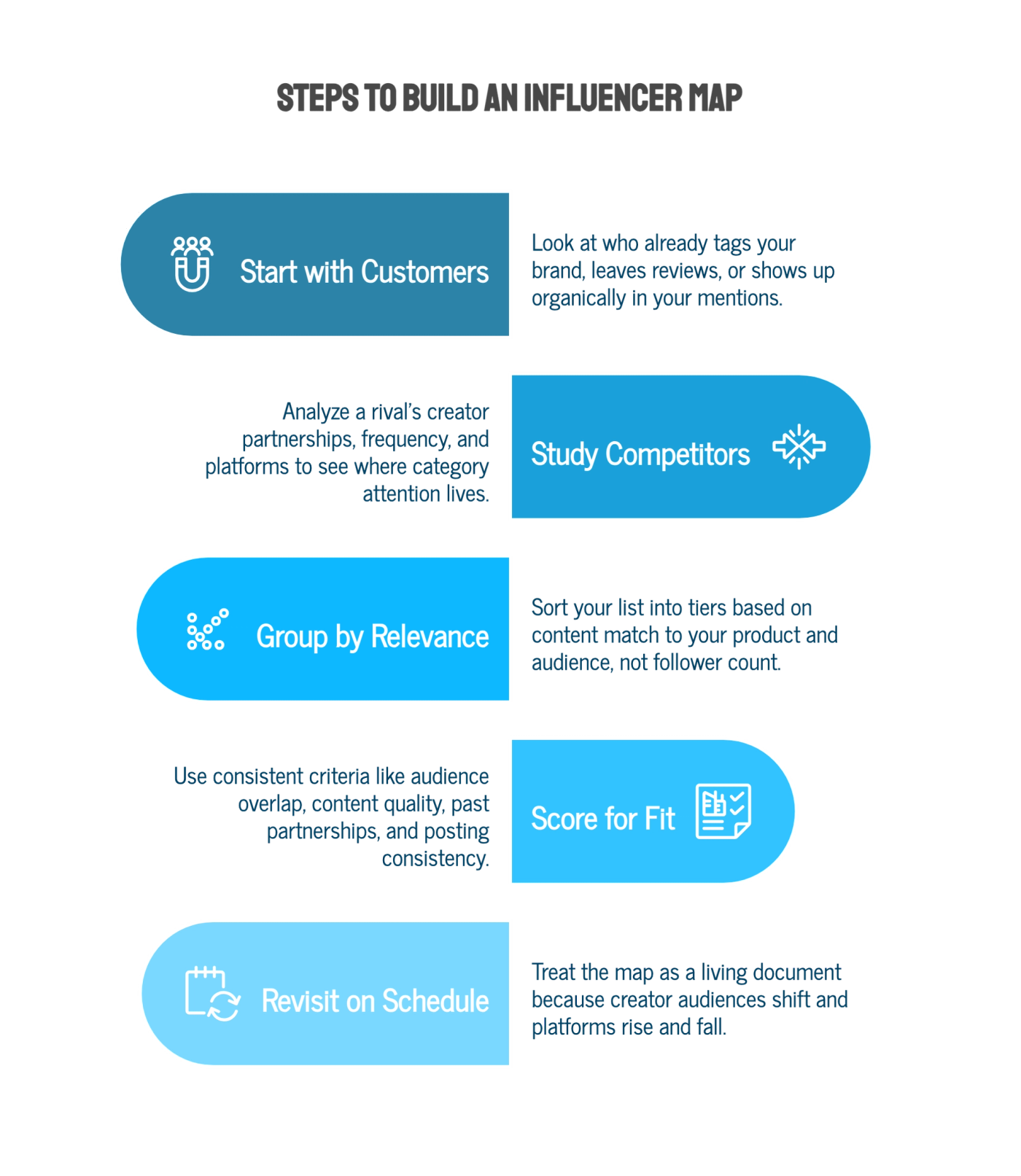
Start with Your Own Customers
Look at who already tags your brand, leaves reviews, or shows up organically in your mentions. These creators have already proven interest without being paid for it, which makes them some of the highest-converting names on any map.
Study Your Competitors' Rosters
A rival's creator partnerships, the frequency of those partnerships, and the platforms they favor tell you where category attention already lives. If three competitors are all working with the same five mid-tier beauty creators, that's a signal worth acting on rather than ignoring.
Group Creators by Relevance, Not Size
Sort your list into tiers based on how closely their content matches your product and audience, not just follower count. Finding micro-influencers will often outperform a broader account with a scattered one.
Score for Fit Using a Few Consistent Criteria
Audience overlap, content quality, past brand partnerships, and posting consistency are a reasonable starting set, and they're really just a more practical breakdown of the same relevance-and-audience-quality lens from above.
These are also the same levers involved in growing influencer engagement once a partnership is live, so scoring for them early tends to predict how a creator will perform later. Scoring every creator the same way is what turns a list into an actual map instead of a pile of names.
Revisit the Map on a Schedule
Creator audiences shift, platforms rise and fall, and a map built in January can be stale by summer. Treat it as a living document, not a one-time project.
Marketers who work through mapping this way generally end up with three tiers: a small group of proven partners worth a direct pitch, a mid group worth testing on smaller deliverables, and a long list worth monitoring but not yet approaching. Sorting creators this way is really the first step toward building long-term influencer partnerships instead of a fresh scramble before every campaign.
Common Influencer Mapping Mistakes to Avoid
A few patterns show up again and again in teams that struggle with this process.
Want to put this into practice?
SideShift connects you with vetted UGC creators who actually deliver. Start your free trial and post your first job in under 10 minutes.
The most common one is chasing reach over relevance. It's tempting to prioritize the creator with the biggest number, but a large, mismatched audience converts worse than a small, aligned one almost every time.
The second is treating the map as finished after the first pass. Creator landscapes move constantly, and a map that isn't updated becomes a liability rather than an asset.
The third is building the map manually in a spreadsheet with no way to score or filter at scale, which works for twenty creators and collapses at two hundred.
The teams that get this right build mapping into a repeatable process rather than a one-off research sprint before a single campaign, and they treat what happens after the first post the same way they treat the research that came before it. A map only pays off if managing influencer relationships gets the same attention as finding the creators in the first place.
Picsart is a good example of what a mapped, well-matched creator strategy can produce at scale. After struggling to get meaningful installs from paid ads alone, the photo and video editing app worked with SideShift on a creator-led campaign that generated 185 million views across 13,500 creator posts in six months, holding a top 10-25 spot on the App Store for five straight months. None of that came from guessing which creators to work with. It came from consistently matching the right ones.
How Does SideShift Turn Mapping Into Matching?
Manual mapping works, but it doesn't scale, and most in-house teams don't have the bandwidth to research thousands of creators by hand every quarter. That's the gap we built SideShift to close.
Post a brief on SideShift, and the platform puts it in front of a pool of more than one million creators, matched against your brand, your product, and your audience. Vetted creators apply directly, often the same day, and you approve every single one before a dollar moves. Instead of spending weeks building a spreadsheet of names you're not sure about, you get a shortlist of creators already filtered for fit, with the manual research compressed into minutes.
That's the same logic behind influencer mapping, just automated at a scale no team could match by hand. You still make the final call on every creator. SideShift just makes sure the shortlist in front of you is worth reviewing in the first place.
Build Your Creator Landscape With SideShift
Influencer mapping works, but doing it manually gets harder the bigger your program becomes. Researching creators, comparing audience fit, vetting content, tracking outreach, and constantly updating your shortlist can quickly turn into a full-time job. SideShift takes that work off your plate by turning creator discovery into a more scalable system.
The goal of influencer mapping is to find the right creators before you waste time and budget on the wrong ones. SideShift helps you get there faster, then gives you one place to manage the campaigns, content, relationships and payouts that come next.
Want to put this into practice?
SideShift connects you with vetted UGC creators who actually deliver. Start your free trial and post your first job in under 10 minutes.
FAQs
1. What's the difference between influencer mapping and influencer discovery?
Discovery is the act of finding individual creators, usually through search or platform tools. Mapping goes a step further by organizing those creators into a structured view based on relevance, tier, and fit, so you can see the landscape as a whole instead of one name at a time.
2. How often should a brand update its influencer map?
Most teams benefit from revisiting their map quarterly, or after any major shift in their product, audience, or competitive set. Creator audiences and platform trends change fast enough that a map from a year ago rarely still reflects who's worth approaching today.
3. Do I need special software to build an influencer map?
No. A spreadsheet works fine for a small list. The need for dedicated tooling usually shows up once you're trying to score and filter hundreds or thousands of creators, which is where a matching platform like SideShift saves the most time.
4. Should influencer mapping focus only on follower count?
No, and this is one of the most common mistakes brands make. Relevance to your brand, audience quality, and content quality are consistently rated as stronger predictors of a good partnership than raw follower count.
5. Can influencer mapping work for a brand with a small budget?
Yes. Mapping is arguably more important for smaller budgets, since there's less room to waste outreach on creators who aren't a fit. A well-built map lets a small team spend its limited budget on the partnerships most likely to convert.