


How to Run a Facebook Ad Campaign That Actually Converts With UGC
Create a Facebook ad campaign that converts with practical Ads Manager setup, UGC creative selection, and a hook-testing framework for finding winners faster.
Table of Contents
You followed the tutorial. You picked the sales objective, installed the pixel, set a reasonable budget, wrote decent copy, and launched. Two weeks and $1,000 later, Ads Manager shows you three purchases and a cost per acquisition (CPA) that would make you want to cry. So you assume the targeting was wrong, rebuild the audience, and get the same result.
Meta has spent years automating the levers media buyers used to obsess over, and its own Performance 5 framework now points advertisers toward creative variation as the biggest driver of results.
At SideShift, brands use our marketplace to source a high volume of content from thousands of vetted UGC creators, so they always have fresh creative to test. This guide covers how to create a Facebook ad campaign end to end, from the setup steps to the creative selection and hook testing that decide whether the campaign converts.
What Does Facebook Ad Campaign Setup Actually Involve?
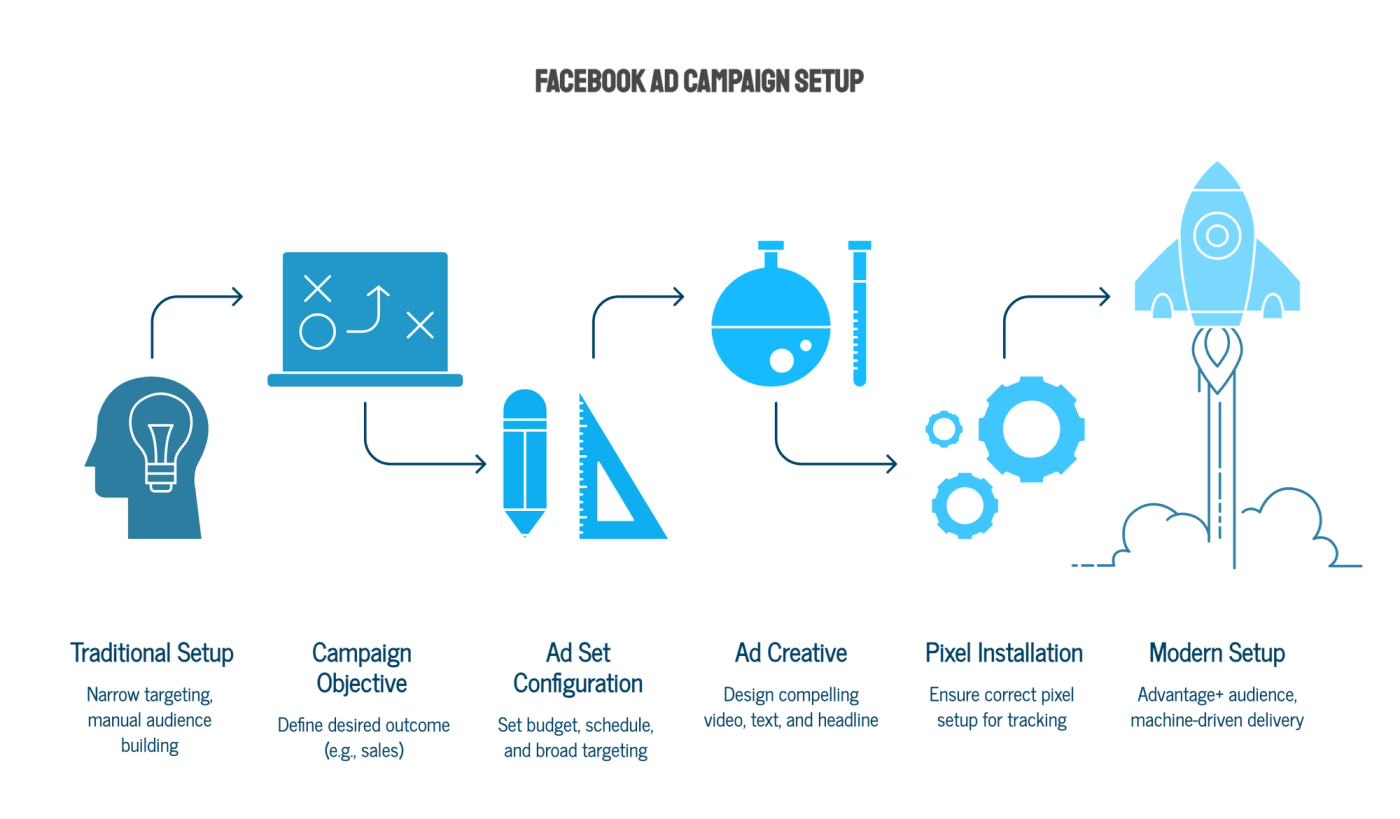
Every campaign in Meta Ads Manager has three layers, and understanding them takes about five minutes.
The campaign level holds your objective, meaning the outcome you want Meta's delivery system to chase. Sales, leads, traffic, and app installs are the common ones, and for most direct-response advertisers the answer is sales with a purchase conversion event. The ad set level holds your budget, schedule, audience, and placements. The ad level holds the creative itself: the video, the primary text, the headline, and the destination URL.
Any Facebook ads manager guide written before 2023 will tell you to spend serious time on audiences. That advice has aged poorly.
Facebook ad targeting has shifted toward Advantage+ audience, Meta's broad-by-default option that uses your pixel data and conversion history to find buyers on its own. Meta's own guidance recommends it for most advertisers, and it often outperforms narrow interest stacks for the majority of brands spending under six figures a month.
The honest summary of modern Facebook ad campaign setup: pick the sales objective, set a daily budget you can sustain for two weeks, go broad on targeting, install the pixel correctly, and move on. The machine handles delivery while you craft what people see.
Why Do UGC Facebook Ads Outperform Polished Brand Creative?
The never-ending feed of advertisements throughout our lives has trained people to skip anything that looks produced. Users scroll past studio lighting, licensed music, and logo animations on reflex, the same way they skip pre-roll on YouTube. UGC Facebook ads survive that reflex by looking like the content people opened the app to watch: a person, a phone camera, a direct-to-lens opinion about a real-world experience.
Trust has become just as important as cost and quality when consumers decide what to buy, with 88% saying it's important that they trust the brands they use. When it comes to getting accurate information about a brand, people are most likely to trust friends and family (84%) and customers like themselves (80%), while 58% say they trust influencers, according to the 2025 Edelman Trust Barometer Special Report.
Want to put this into practice?
SideShift connects you with vetted UGC creators who actually deliver. Start your free trial and post your first job in under 10 minutes.
A UGC ad borrows that trust structure. It reads as a recommendation from a peer first and an ad second, which changes how the first three seconds get processed.
There is also a mechanical advantage that gets less attention. Meta's delivery system rewards ads that earn engagement early, and native-feeling content earns watch time that polished ads rarely match. Better early engagement means cheaper distribution, which means your budget buys more impressions from the same audience. The creative choice compounds into a media cost advantage.
None of this means any rough phone video will convert. It means the ceiling for UGC is higher, if you select and test it properly.
How Do You Choose the Right UGC for Your Campaign?
Selection starts before the content exists, at the brief. The brands that get winning ads from creators tend to brief an angle rather than a script. An angle is the argument the ad makes: the skeptic who got converted, the problem you didn't know had a name, the comparison against the thing you currently use.
Our breakdown of UGC ad angles that convert covers the frameworks in depth, but the short version is that one strong angle filmed by three creators beats three vague briefs filmed by one creator every time.
Creator fit matters more than follower count, since your ad will run to strangers who have never seen the creator before. What you're really buying is credibility with a specific audience. A 43-year-old explaining a supplement routine will typically resonate more with a 43-year-old audience than a 22-year-old with better production skills.
If you're unsure which UGC format fits your industry, studying successful content in your niche can provide a useful starting point. Categories like fitness, food, travel, and fashion often rely on different creative structures, from software-style product walkthroughs and recipe demonstrations to skincare routines and travel vlogs.
Then hold every finished video to a feed-native standard before it goes anywhere near Ads Manager. Vertical 9:16, captions overlaying the visuals because most Facebook video is watched without sound, a hook in the first two seconds, and no branded intro card. If the first frame could open a TikTok, you're in good shape.
How Do You Test Hooks to Find Facebook Ads That Convert?
This is the section that separates how to run a successful Facebook ad campaign from how to run a Facebook ad campaign that merely spends money. The single highest-leverage variable in your creative is the hook, meaning the first one to three seconds. Most of your audience decides whether to keep watching before the fourth second, so two ads with identical bodies and different hooks can produce wildly different costs per purchase.
Create Multiple Openers
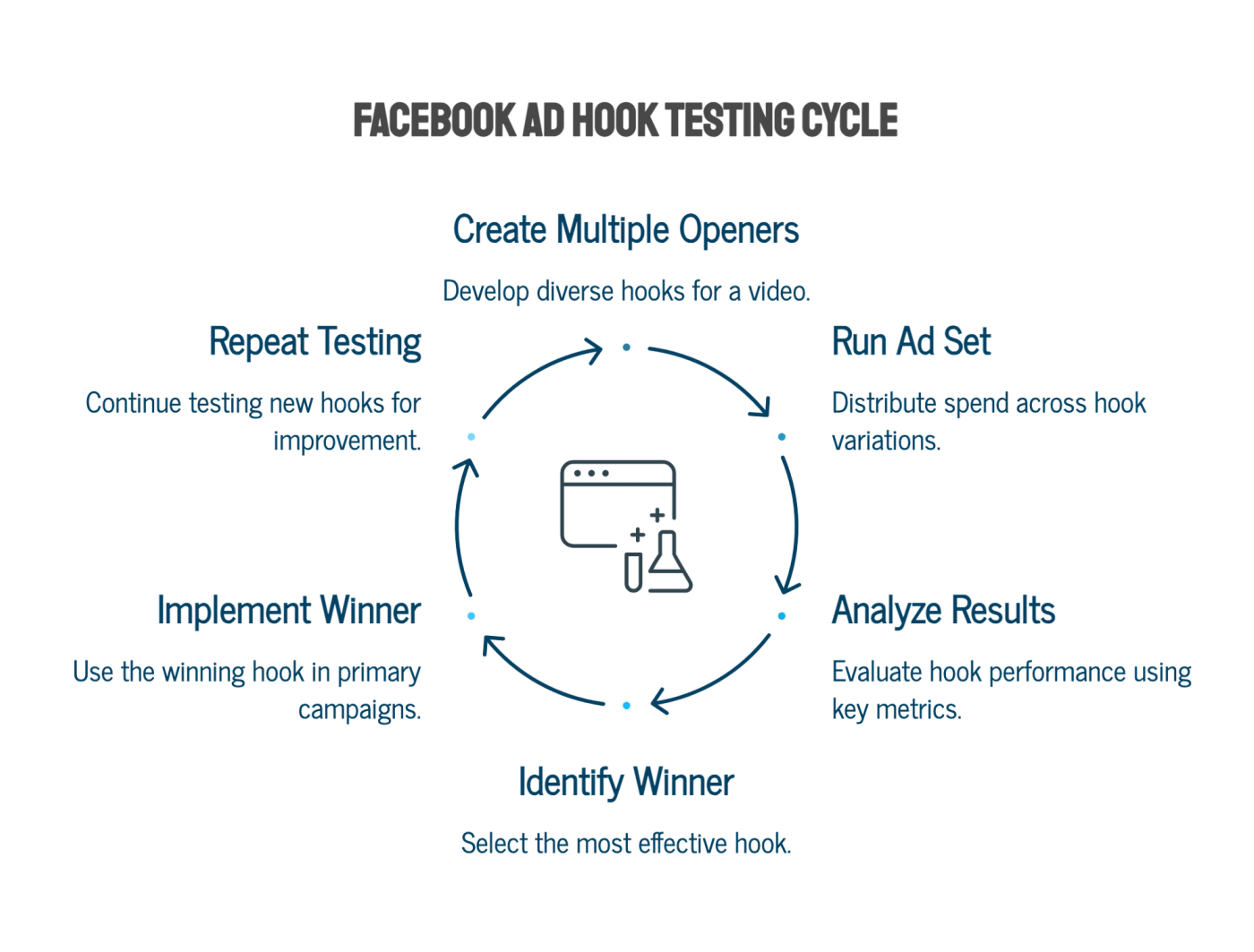
Take one strong UGC video body and have the creator film four or five alternate openers against it: a question, a bold claim, a pattern interrupt, a "watch this before you buy" caution. Load all versions into a single ad set with the same audience and let Meta distribute spend.
Want to put this into practice?
SideShift connects you with vetted UGC creators who actually deliver. Start your free trial and post your first job in under 10 minutes.
Give each variation enough budget to be judged fairly, which, for most brands, means letting the ad set spend three to five times your target CPA before drawing conclusions.
Read the Results in Order
Start with hook rate, calculated as three-second video plays divided by impressions. As a general benchmark, anything above about 30% suggests the opening is stopping people from scrolling.
Next, look at hold rate: the percentage of viewers still watching at 15 seconds. This tells you whether the rest of the video delivers on the promise of the hook.
Finally, check cost per purchase, because it's the metric that ultimately determines whether the creative is profitable.
Keep the Testing Loop Going
Once a clear winner emerges, pause the underperformers, move the winning creative into your primary campaign, and begin testing the next batch of hooks.
Creative fatigue happens over weeks, not quarters, so keep a close eye on ad frequency to see how often the same person is being shown a particular ad. Treat creative testing as an ongoing production system, not a one-time launch activity.
How Much Is a Facebook Ad Campaign?
You can run a meaningful test on $30 to $50 per day, but only if the budget is enough to generate a reasonable amount of conversion data. When campaigns are spread too thin, it becomes difficult to tell whether performance differences are real or simply the result of low volume. Rather than making changes every few days, let a campaign run for at least two weeks so Meta's delivery system has time to gather enough signals.
Creative is the second major expense, and with UGC it's often much easier to budget. Individual creator videos typically cost between $50 and $500+ depending on the creator's experience, content requirements, and usage rights. Our UGC creator pricing guide breaks down typical rates by deliverable.
Compare that with a traditional commercial shoot, where production, talent, editing, and post-production can quickly push a single concept into the five-figure range. For a similar investment, many brands can test multiple UGC concepts instead of relying on one polished campaign. That flexibility is valuable because most successful ad programs improve through iteration. Every additional hook, angle, creator, or call to action gives you another opportunity to find messaging that resonates with your audience.
Think of your creative budget as a testing budget rather than a production budget. Instead of investing everything in one ad, spread that investment across different concepts, creators, and messaging. Once the data identifies what works, you can allocate more budget behind those proven creatives and continue producing variations before performance begins to plateau.
Launch Facebook Ads That Convert with SideShift
Everything above depends on one input you cannot automate inside Ads Manager: a steady supply of creator content worth testing.
SideShift's creator marketplace connects you with vetted UGC creators across every major niche, so you can brief an angle, commission multiple hook variations, and have test-ready vertical video back in days instead of weeks. Brands on SideShift run the testing loop continuously because sourcing stopped being the bottleneck.
Want to put this into practice?
SideShift connects you with vetted UGC creators who actually deliver. Start your free trial and post your first job in under 10 minutes.
FAQs
- How long should you run a Facebook ad campaign before judging results?
Give it at least seven days and enough spend to exit the learning phase, which Meta defines as roughly 50 conversion events per ad set per week. Judging a campaign on 48 hours of data mostly measures luck.
- Do UGC ads need to be labeled as sponsored content?
When you run creator content as an ad from your own brand account with proper usage rights, standard ad disclosure applies automatically. If the ad runs from the creator's handle through a partnership ad, Meta requires the paid partnership label.
- What is a good hook rate for UGC Facebook ads?
Above 30% is solid and above 40% is strong for most direct-response accounts. If hook rate is high but conversions are weak, the problem usually lives in the offer or landing page rather than the creative.
- Can you run a Facebook ad campaign with a small budget?
Yes, if you concentrate it. One campaign, one ad set, broad targeting, and three to five UGC variations at $30 to $50 a day will teach you more than the same budget scattered across six audiences.
- How many UGC hook variations should you test at once?
Four or five per video body works well. Fewer than three give you a weak signal on what the audience responds to, and more than six split budgets so thin that no variation gets a fair read.