


Beauty Influencer Marketing in 2026: A Guide for Brands
Beauty influencer marketing drives real purchases. Learn why beauty influencers convert, creator types, campaign formats, and FTC compliance rules for 2026.
Table of Contents
The beauty influencer marketing industry was one of the first to thrive on social media. And it's still one of the first categories other industries look to for what's working now. Thousands of skincare routines, makeup tutorials, and “get ready with me” videos pop up in our feeds daily, and the creators behind them drive real purchase decisions.
Shade matching, skin type, ingredient sensitivities, and personal style all make a single product review far more useful than an ad with a supermodel. Influencer content helps customers see what they’re looking for on real faces and bodies.
Consumers also want to see visual proof that a product is what it claims to be: texture, pigment, application, and results on real skin before they commit. Once a creator they trust vouches for a product, that trust transfers from the creator to the product.
That’s why working with content creators is non-negotiable for brands in the beauty industry. Here’s a guide to get you started.
What Is a Beauty Influencer?
Beauty influencers are content creators or “social media personalities” who create content about makeup, skincare, and haircare. Their most common content formats are tutorials, product reviews, and PR and shopping hauls.
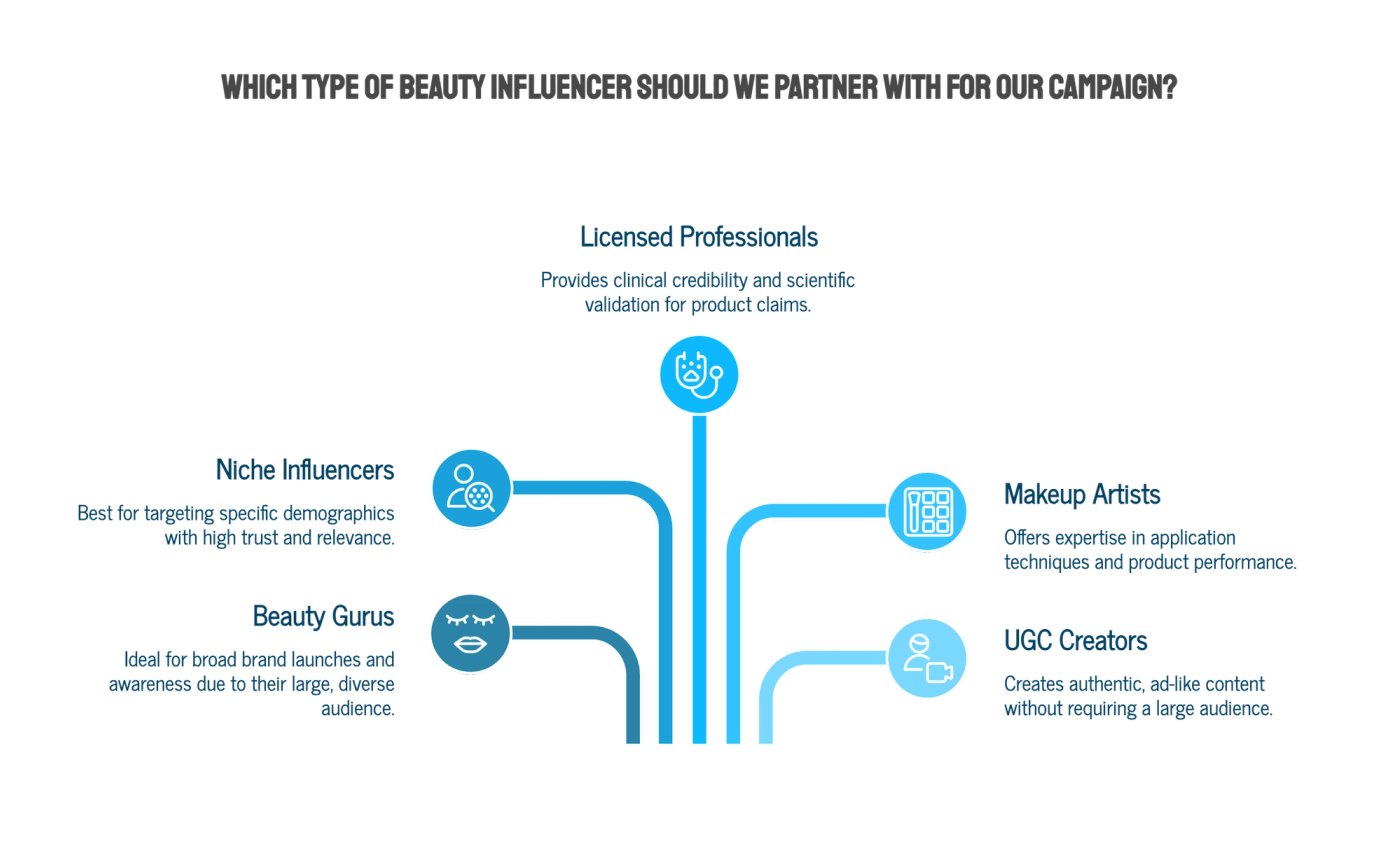
Typically, beauty influencers fall into:
- Beauty gurus: They cover makeup, hair, skincare, and product reviews across a broad range of brands. Their audience follows them for beauty content overall, recommendations, and new trends, which makes them strong for launches and awareness.
- Niche beauty influencers: They are creators built around a specific characteristic, condition, or lifestyle, such as acne-prone skin, textured hair, and clean beauty. They often have smaller audiences, but their trust and relevance are hard to replicate with a generalist.
- Licensed professionals: They can be dermatologists, estheticians, and cosmetologists who bring clinical credibility and scientific knowledge. This type of creator is well suited for campaigns where a specialist can help break down and validate a product claim.
- Makeup artists (MUAs): They are trusted for application technique, color theory, and product performance under real conditions like long wear or humidity. They are great for educational and detailed content.
Running in their own lane are the UGC creators. They’re not influencers in the traditional sense, but producers of native-feeling content brands can license and run as paid ads, without requiring the creator's own audience. Their power relies on their ability to create content that feels real and trustworthy and doesn’t look like it’s an ad, even if it’s being used as one.
How Brands Can Work with Beauty Influencers
Beauty content is very versatile and can be explored in different campaign formats. There’s no single right or wrong structure, and beauty brands often run multiple formats in parallel.
1. UGC Licensing
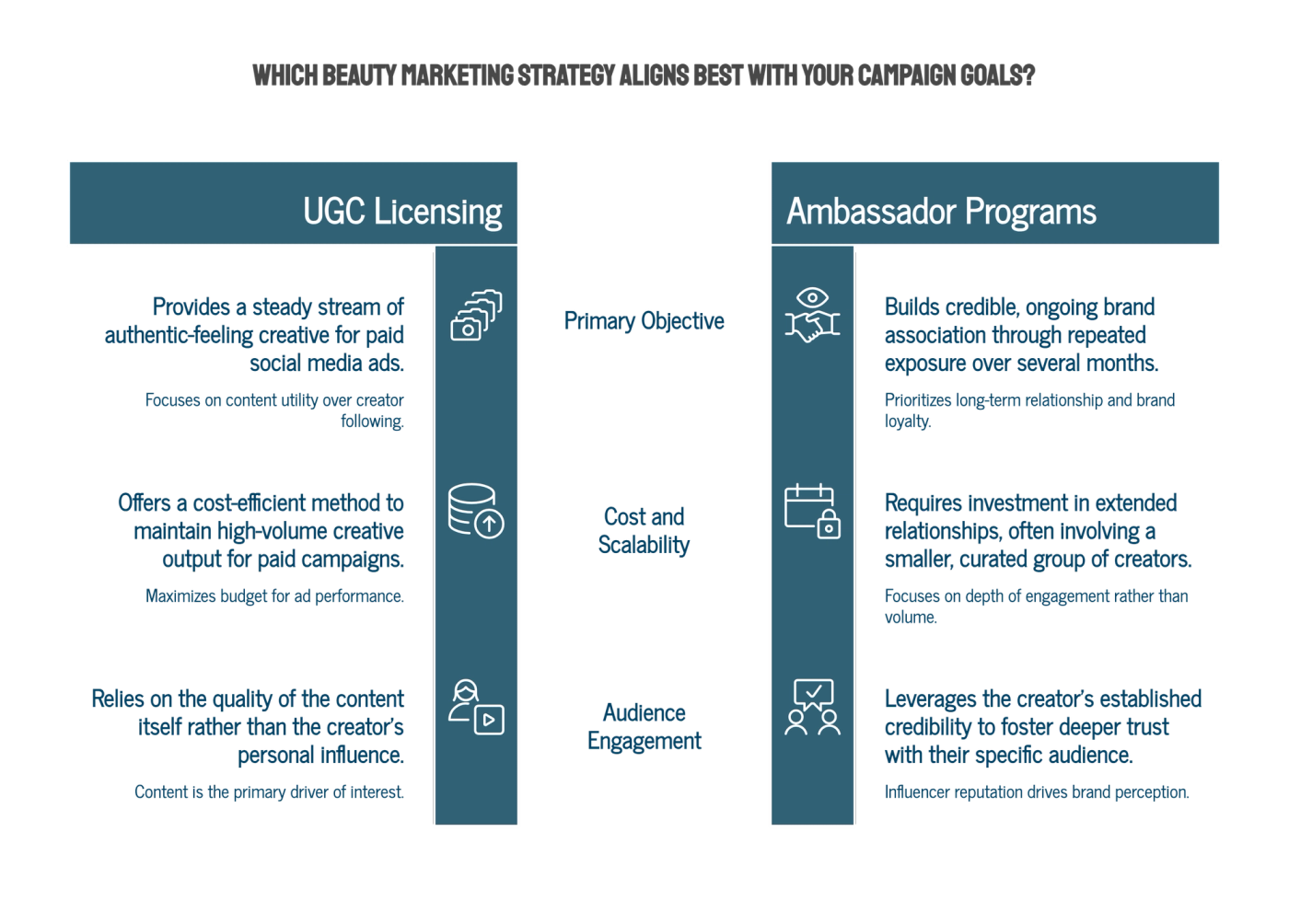
Brands commission UGC creators to produce content specifically for use in paid ads or product pages. This isn't influencer marketing in the traditional sense since the creator's own following isn't the point; the content itself is. It's often the most cost-efficient way to keep a steady stream of authentic-feeling creative moving through paid social.
Want to put this into practice?
SideShift connects you with vetted UGC creators who actually deliver. Start your free trial and post your first job in under 10 minutes.
For a deeper look at how UGC can support your next campaign, check out our guide to UGC for beauty brands, with practical tips on finding the right creators, building an effective strategy, and driving sales.
2. Paid Sponsored Content
The standard model: a creator is paid to post about a product, following a brief that covers key messaging, required disclosures, and content deliverables. Best for launches and campaigns tied to a specific moment. This content can come in multiple formats:
- Get ready with me (GRWM): The creator builds a routine or full look on camera, with the product worked in naturally alongside everything else they use. GRWM content performs well because it shows the product in context rather than isolated as an ad, making it especially effective for skincare and makeup brands looking to build familiarity.
- Makeup tutorials: A structured, step-by-step format focused on technique, whether that's a full-face look or a single skill like blending. Tutorials give brands longer, more detailed product exposure and tend to have a long shelf life since viewers return to them as reference content.
- Product demonstrations: The creator focuses entirely on the product itself: texture, application, wear test, or a side-by-side comparison against something the audience already knows. This format is direct and works well for performance marketing, since it gets to the product benefit quickly.
- Unboxings and first impressions: A creator's real-time reaction to trying a product for the first time. This leans into authenticity and curiosity, and it's a natural fit for new launches or when a brand wants to seed anticipation ahead of a bigger campaign.
- Routine and regimen content: Rather than a single product, the creator walks through their full skincare or makeup routine, positioning the brand's product as one part of an established habit. This is especially effective for skincare influencers, since it reinforces consistent use rather than a one-time purchase.
3. Affiliate and Commission Partnerships
In affiliate marketing and commission-based partnerships, creators earn a percentage of sales driven through a unique code or link, often layered on top of a smaller flat fee. This aligns creator incentives with actual conversions and can be part of a single campaign or an extended partnership with the creator.
4. Gifting and Seeding
This involves sending products to a large group of nano and micro creators in exchange for organic content, with no guarantee of a post. The approach is low cost and high volume, making it useful for generating social proof at scale, even when only a fraction of recipients post.
5. Ambassador Programs
Ambassador programs involve longer-term relationships where a smaller group of creators works with a brand repeatedly over months or a full product cycle. Ambassadors build a more credible, ongoing association with a brand than one-off posts.
How Do You Find the Right Beauty Influencers for Your Campaign?
With so many creators posting about the same categories, from drugstore dupes to derm-approved routines, sourcing the right partners takes more than a follower count filter.
Want to put this into practice?
SideShift connects you with vetted UGC creators who actually deliver. Start your free trial and post your first job in under 10 minutes.
- Start with the outcome, not the follower count. Decide whether the goal is awareness, conversion, or content supply before evaluating any creator. That answer determines whether you need reach, niche trust, or production volume.
- Vet engagement and audience quality. Comment quality, save and share rates, and audience demographics tell you more about whether a creator's followers will actually buy than total follower count does.
- Check content fit and past brand work. Review how a creator has represented other beauty brands. Someone whose content already looks and sounds like your brand will need less direction and produce better results.
- Use a marketplace to scale the search. Manually vetting hundreds of creators doesn't scale. Creator marketplaces like SideShift give brands direct access to a large pool of vetted creators, which can reduce months of outreach.
Getting this part right upfront saves time later. A creator who's a genuine fit for your brand needs less back-and-forth on briefs and revisions, and their audience is more likely to respond to the content as a real recommendation rather than a paid placement.
FTC Concerns in the Beauty Influencer Marketing Industry
Beauty is a category watched closely by the Federal Trade Commission (FTC) for two overlapping reasons: influencer disclosure rules and product claim accuracy.
Under the FTC's Endorsement Guides, any creator with a material connection to a brand must clearly disclose that relationship in a way an average viewer would notice. Burying a disclosure in a hashtag string or a caption's final line generally isn't considered adequate.
Influencers who lie about having used a product or their experience with it could be liable under the Commission’s Rule on the Use of Consumer Reviews and Testimonials. When it comes to skincare and treatment, scientific claims should be verifiable.
For brands, the practical takeaway is simple: build disclosure requirements and claim guardrails directly into influencer briefs, review creator drafts before they go live, and never ask a creator to make a claim your product documentation can't support.
Build Your Beauty Influencer Marketing Strategy with SideShift
Sourcing the right mix of creators, handling briefings, and keeping claims compliant across every post is a lot to manage manually once a program grows past a handful of partnerships.
SideShift makes these tasks easier. You get access to a pool of pre-vetted beauty creators who can apply to your campaigns directly through the platform. In the same dashboard, you can manage briefs, contracts, approvals, and payments.
On top of that, you get access to real-time performance data on views, engagement, and conversions, so scaling a roster doesn't mean scaling the manual work behind it or jumping from one dashboard to another.
FAQs
1. How much does it cost to work with beauty influencers?
It ranges from free products for nano creators to a few hundred dollars per post for micro creators, and into the tens of thousands (or six figures) for macro and celebrity campaigns. Most mid-market beauty brands see the best return blending nano and micro creators with occasional mid-tier or licensed-professional partnerships.
Want to put this into practice?
SideShift connects you with vetted UGC creators who actually deliver. Start your free trial and post your first job in under 10 minutes.
2. Which content formats work best for beauty content?
GRWM videos and routine content tend to perform best for building familiarity, since they show the product in context rather than isolated as an ad. Tutorials and product demonstrations work well for driving consideration, while unboxings and first impressions are strongest for new launches.
3. How can I measure the success of beauty influencer marketing campaigns?
Track engagement rate, saves, and shares alongside conversions from affiliate codes or trackable links, rather than relying on views alone. For awareness-focused campaigns, sentiment and comment quality are better indicators of impact than raw reach, and it's worth measuring performance by individual creators, not just campaign-wide averages, so underperformers can be swapped out.
4. What's the best platform for beauty influencer marketing in 2026?
Instagram and TikTok remain the primary platforms, with TikTok Shop increasingly used for direct conversion. YouTube still performs, specifically for long-format content.