


How to Test Ad Creative at Scale Without Burning Your Budget
A practical ad creative testing framework to help you find winning ads faster, cut wasted spend, and scale testing without blowing through your budget.
Table of Contents
Ad creative gets expensive when testing has no real structure. Teams test one idea at a time, let underperforming ads run too long, or launch new concepts without carrying what they learned into the next round. The result is more budget spent figuring out what works than scaling the creative that already does.
A strong ad creative testing process helps separate a weak concept from a weak execution, so you know what actually needs to change. Instead of treating every new ad like an isolated experiment, it gives your team a repeatable way to test ideas, identify useful signals, and decide what to iterate, scale, or cut.
This guide walks through a creative testing framework built for volume, so you can find promising concepts faster, make better use of your ad creative testing budget, and build each round of creative around what you learned from the last.
Why Does Most Ad Creative Testing Waste Budget?
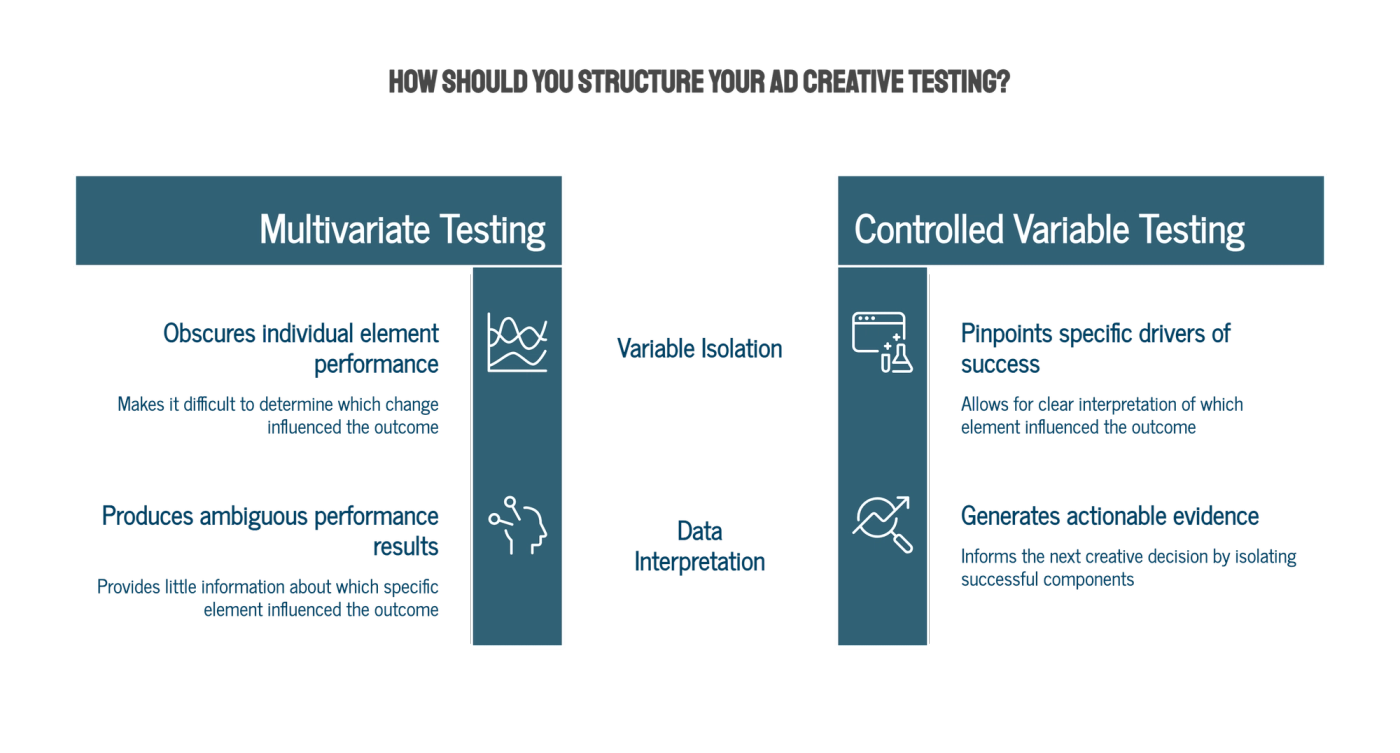
Creative testing is only useful when the results can be interpreted. If three ads differ in their visuals, hooks, copy, and calls to action, a difference in performance provides little information about which of those elements influenced the outcome. The stronger ad may reflect a better underlying concept, or its performance may be attributable to the creator, format, opening seconds, or offer.
Budget is most often wasted when the design of the test limits what can be learned from the result. Common examples include:
- Changing multiple variables at once, making it difficult to determine which change influenced performance
- Ending a test before enough data has accumulated to distinguish normal variation from a meaningful difference
- Increasing spend on a high-performing ad without evaluating whether its efficiency holds at a larger scale
- Discarding an underperforming concept without determining whether the concept itself failed or whether the hook, format, or execution was responsible
An underperforming ad does not necessarily represent wasted spend. Testing inherently includes unsuccessful variations, and those results can still provide useful evidence about what to pursue or avoid. Spend becomes less productive when a test produces a performance result without generating information that can inform the next creative decision.
How to Design Facebook Ad Creative Tests for Clearer Results
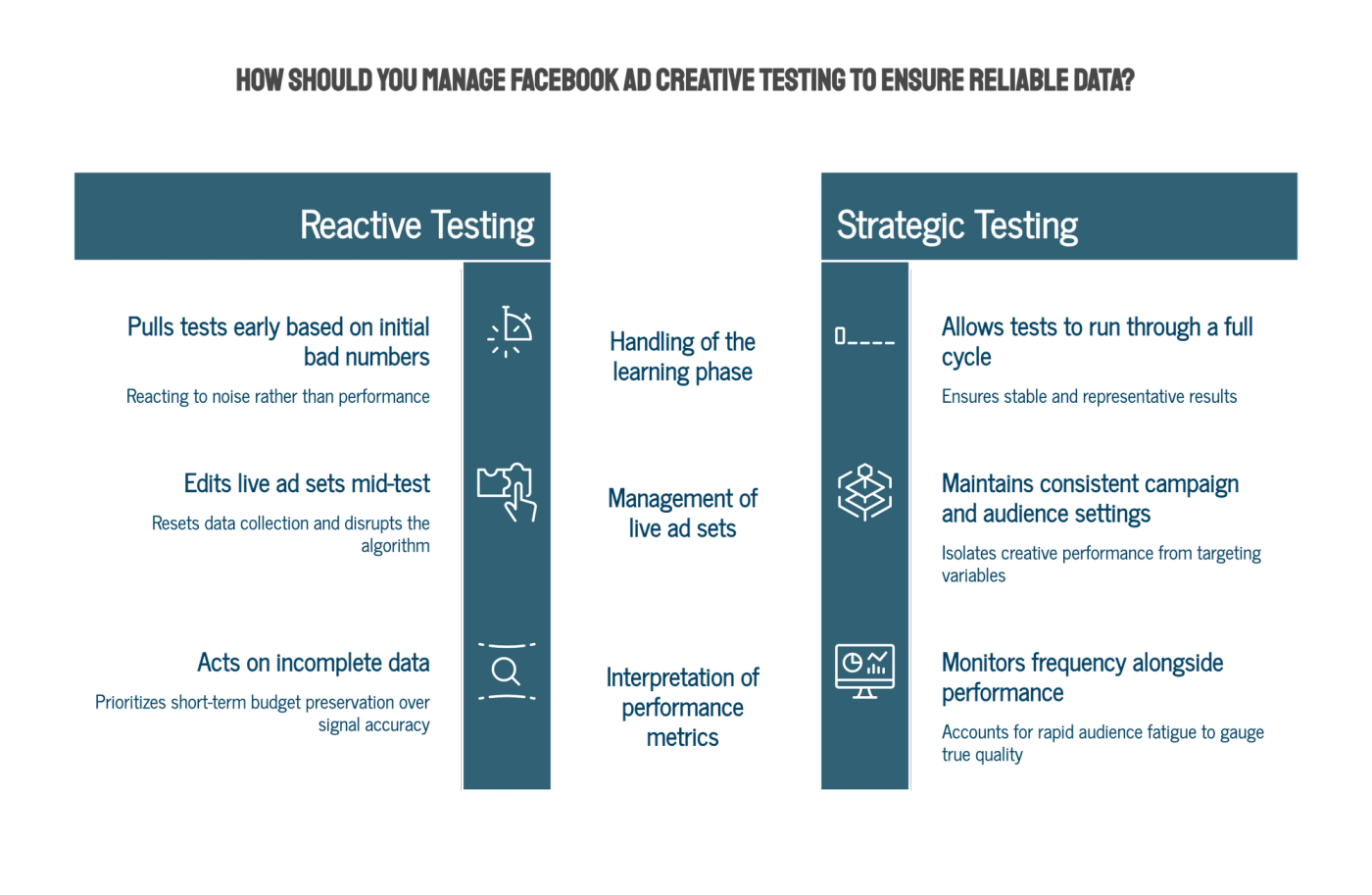
Facebook's algorithm needs volume to exit the learning phase and deliver stable, representative results. Pulling a test early, even if the early numbers look bad, usually means you're reacting to noise rather than performance.
A few practical guardrails for testing Facebook ad creative:
- Let each test run through a full learning phase before making a call, rather than judging performance after a day or two.
- Avoid editing a live ad set mid-test, since even small changes can restart the learning phase and reset the data you've already collected.
- Test creative concepts inside the same campaign structure and audience settings, so results reflect the creative itself and not a difference in targeting.
- Watch frequency alongside performance metrics, since a strong-looking ad can fatigue fast in a narrow audience and start to look worse than it actually is.
Want to put this into practice?
SideShift connects you with vetted UGC creators who actually deliver. Start your free trial and post your first job in under 10 minutes.
The instinct to react quickly is understandable, especially when budget is tight. But acting on incomplete data is often more expensive than waiting a few extra days for a real signal.
How to Set a Realistic Testing Budget
There's no universal number that works for every brand, but the principle holds across account sizes: Your ad creative testing budget should be sized to reach statistical relevance, not just to "try something."
A test that's underfunded doesn't save money. It just produces an answer you can't trust, which usually leads to either scaling a false winner or killing a concept that would have worked with a fair shot.
A reasonable starting approach is to treat the testing budget as a fixed percentage of total ad spend, separate from what's allocated to proven, scaling creative. As a program matures and more concepts have already been validated, that testing percentage typically shrinks, since less budget is needed to keep the pipeline of new ideas moving.
How to Determine When a Winning Ad Is Ready to Scale
Performance at a testing budget does not necessarily predict performance at a higher level of spend. As delivery expands, an ad may reach a broader audience, accumulate frequency more quickly, or begin competing in more expensive auctions. Scaling should therefore be treated as an additional stage of evaluation rather than an automatic next step for every high-performing ad.
A more controlled approach includes:
- Increasing budget incrementally and evaluating whether the metrics that established the ad as a strong performer remain within an acceptable range
- Limiting unnecessary changes to the campaign while spend is increasing, so changes in performance are easier to interpret
- Monitoring indicators of creative fatigue, including rising frequency, declining click-through rate, increasing acquisition costs, or deteriorating conversion rates
- Continuing to test new creative while existing ads are being scaled rather than waiting for their performance to decline before developing alternatives
An ad that performs well at one level of spend may not retain the same economics as delivery expands, which makes scaling another source of performance data rather than confirmation that the testing process is complete.
Structuring the Creative Iteration Process
Creative testing becomes less effective when the rate of testing exceeds the rate of creative production. A team may identify a strong concept, but if there are no new assets ready to test alongside or after it, the process becomes dependent on a small number of existing ads. This limits the team's ability to continue testing while high-performing creative is still active and leaves fewer alternatives available as performance begins to decline.
A consistent creative iteration process requires several activities to happen in parallel:
- A regular supply of new creative, produced according to a planned testing schedule rather than only when existing ads begin to decline
- A process for documenting findings from both high- and low-performing ads, including individual elements such as hooks, offers, creators, formats, and messaging
- Clear responsibility for interpreting results and determining which concepts or variables should be tested next
Want to put this into practice?
SideShift connects you with vetted UGC creators who actually deliver. Start your free trial and post your first job in under 10 minutes.
- A backlog of untested concepts and planned iterations that can move into production as testing capacity becomes available
For teams producing UGC at higher volumes, creator sourcing and campaign administration become part of this process as well. SideShift gives brands access to more than one million onboarded creators and allows creators to apply directly to campaign opportunities.
Astra offers a useful example of what this looks like at scale. The consumer app produced more than 400 TikToks over six weeks through SideShift, using daily feedback loops to refine formats and messaging based on performance. Rather than treating each piece of content as an independent test, the team iterated across concepts such as friendship tests, compatibility skits, and dream-related content.
The campaign ultimately generated more than 5 million organic views, with one video driving more than 25,000 downloads. Just as importantly for continued testing, the process produced a bank of UGC that Astra could subsequently use in paid advertising, while 10 creators continued producing evergreen content each week.
That infrastructure makes it easier to translate a testing insight into the next production brief without rebuilding the creator pipeline each time. If a particular concept performs well, the next round can preserve the underlying idea while testing different creators, hooks, or formats. If it underperforms, production can shift toward another hypothesis in the testing backlog.
The objective is to create continuity between testing and production. Results from one round should inform what enters the next, while new creative is already being developed rather than commissioned only after existing assets have exhausted their usefulness.
Creative Testing Best Practices
Over time, the quality of a creative ad testing program depends on how consistently its underlying principles are applied:
- Document every test, including the ones that failed, so the same weak concept doesn't get retested by accident six months later.
- Revisit "failed" concepts with a different hook or format before writing them off completely, since the underlying idea may not have been the actual problem.
- Set a testing cadence and stick to it, rather than testing in bursts whenever performance dips.
- Separate performance data by placement, since an ad that struggles on Reels can still perform well in feed.
- Keep testing even when current creative is performing well, since fatigue is a matter of when, not if.
Build a Faster Testing Engine with SideShift
A high-volume testing strategy requires a high-volume creative pipeline to support it. Testing more frequently means producing enough new concepts, hooks, creators, and executions to keep each round meaningfully different from the last. When production cannot keep pace, teams often end up making minor variations of the same assets rather than testing genuinely new creative hypotheses.
SideShift is built to make that volume easier to manage. Brands can access a network of more than one million creators, source UGC across multiple concepts and creator profiles, and manage briefs, approvals, communication, and creator payments within the same workflow. Instead of coordinating each piece of UGC as a separate production project, teams can build a broader pool of creative assets and continuously introduce new variables into their testing program.
Want to put this into practice?
SideShift connects you with vetted UGC creators who actually deliver. Start your free trial and post your first job in under 10 minutes.
For creative testing, that volume creates more opportunities to determine whether performance is tied to the concept itself or to factors such as the creator, hook, format, or execution. It also makes iteration easier: When a concept performs well, teams can develop additional versions around the same idea rather than waiting for another production cycle to begin.
Try SideShift for free today and build a higher-volume UGC testing pipeline.
FAQs
1. How many ad variations should I test at once without diluting my budget?
Most accounts get cleaner results testing three to five variations per round, with budget split evenly across them. Testing more than that usually spreads spend too thin to reach a reliable result on any single variant, especially for smaller accounts.
2. How long should I run a creative test before making a decision?
Let the test run through a full learning phase, which typically means allowing enough time and spend for the algorithm to stabilize delivery, generally several days to a week depending on budget and audience size.
3. What's a good starting budget for testing new ad creative?
There's no fixed number that works across every account, but testing budget should be enough to reach statistical relevance for the audience size you're targeting. A smaller, dedicated testing budget kept separate from the scaling budget tends to produce more trustworthy results than folding tests into general ad spend.
4. Should I test creative concepts or just small variations of the same ad?
Both, but at different stages. Early testing should focus on distinct concepts, different hooks, formats, or angles, to find out what resonates broadly. Once a concept shows promise, smaller variations within that concept help refine what's already working.
5. How do I know when a winning ad is ready to scale versus needs more testing?
A winning ad is ready to scale once it has held stable performance across a full learning phase and a reasonable spend threshold, not just a few strong days. If performance is inconsistent or the sample size is still small, it's worth confirming the result with another testing round before committing a scaling budget.